TL;DR:
- Failing to schedule water meter replacements or backflow device tests can result in costly fees, service shutoffs, and contamination liability in New Jersey. State and local regulations mandate annual testing, proper device installation, and meticulous recordkeeping to ensure compliance and protect community water safety. Proactive management and certification by qualified professionals are essential to avoiding violations and maintaining secure water supply systems.
Missing a single water meter appointment or letting a backflow test slip past its annual deadline can cost New Jersey property owners hundreds of dollars in fees, trigger service shutoffs, or expose them to contamination liability. Most owners don’t realize that New Jersey’s compliance rules go well beyond simply installing a device and forgetting about it. State regulations under the Safe Drinking Water Act, combined with municipality-specific ordinances, create a layered set of requirements with real deadlines and real consequences. This guide breaks down exactly what you need to know, device by device and step by step.
Table of Contents
- Why water meter and backflow device compliance matters in New Jersey
- The basics: Types of water meters and NJ-approved backflow devices
- How New Jersey’s compliance process works for water meters and backflow devices
- Local variations: Your responsibilities by municipality
- Best practices: Simplify compliance and avoid costly mistakes
- Our perspective: Why “bare minimum” compliance isn’t enough for NJ properties
- Need help with NJ water meter or backflow device compliance?
- Frequently asked questions
Key Takeaways
| Point | Details |
|---|---|
| NJ’s annual testing rule | All backflow devices must be tested on installation and every year, with reports sent to your local provider. |
| Device type matters | Only double check valve and reduced pressure zone assemblies qualify as approved devices in New Jersey. |
| Credentialed testing required | A certified tester—not just any plumber—is needed for required device testing and compliance. |
| Municipal rules add costs | Local ordinances may charge for missed water meter appointments and device replacements. |
| Best practice: Proactive management | Maintain clear records and a testing schedule to avoid fines and service interruptions. |
Why water meter and backflow device compliance matters in New Jersey
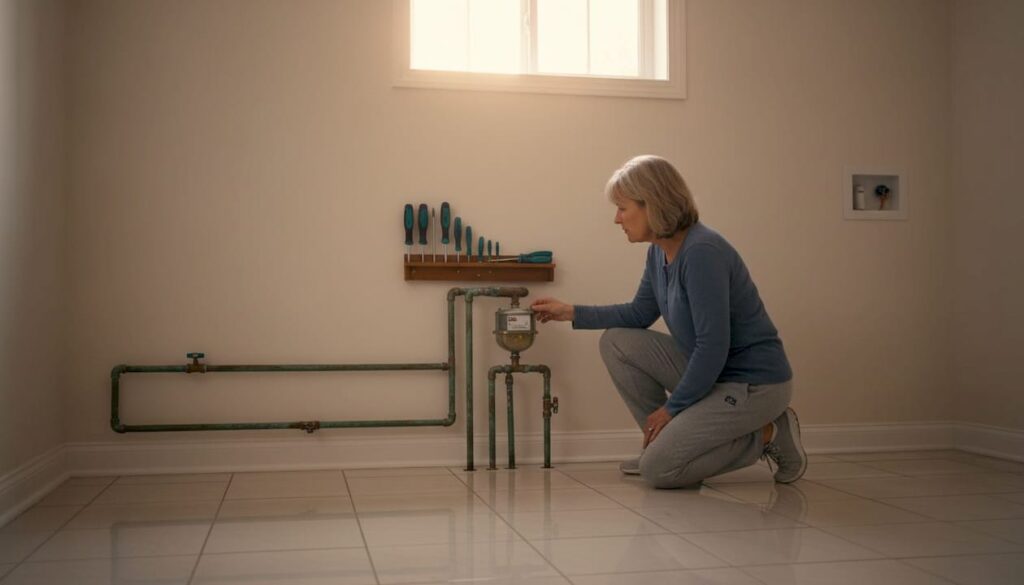
Water meters measure how much water flows into your property, and that number directly determines your bill. But meters are also regulated equipment. Municipalities schedule replacement cycles, and if you miss your window, you bear the cost. Backflow prevention devices serve a different but equally important purpose: they stop contaminated water from flowing backward into the public supply. New Jersey takes both seriously.
A cross-connection is any physical link between a potable water supply and any source of contamination. Think of an irrigation system connected to a well, or a boiler system tied into a drinking water line. Without a properly installed and tested backflow device, that connection is a pathway for bacteria, chemicals, or debris to enter the water supply that your neighbors and community use every day.
The NJDEP’s cross-connection control framework, established under the Safe Drinking Water Act, defines exactly which devices are approved and how they must be installed, tested, and maintained. This is not optional guidance. It carries the weight of law.
The stakes for non-compliance include:
- Fines imposed by your local water purveyor or municipality
- Costs for emergency or unscheduled meter work billed directly to you
- Discontinued water service until compliance is achieved
- Liability if a backflow event causes contamination
“Many property owners assume that once their backflow device is installed, they’re done. The reality is that New Jersey requires ongoing testing, reporting, and recordkeeping every single year.”
Now that you know what’s at stake, let’s clarify the categories and basic requirements of water meters and backflow devices in New Jersey.
The basics: Types of water meters and NJ-approved backflow devices
New Jersey water systems use several types of meters and two primary categories of backflow devices explained in state regulations. Knowing which device applies to your property is the first step toward staying compliant.
Device comparison table:
| Device type | Purpose | Typical application | NJ approval status |
|---|---|---|---|
| Displacement water meter | Measures residential water volume | Single-family homes | Standard municipal equipment |
| Turbine water meter | Measures high-volume flows | Commercial properties | Standard municipal equipment |
| Compound water meter | Handles variable flow ranges | Mixed-use properties | Standard municipal equipment |
| Double check valve assembly (DCVA) | Prevents backflow in low-to-medium hazard situations | Irrigation, fire lines | NJDEP approved |
| Reduced pressure zone assembly (RPZ) | Provides high-level backflow protection | High-hazard connections | NJDEP approved |
Per N.J.A.C. 7:10-10, a “backflow prevention device” is specifically defined as either a double check valve assembly or a reduced pressure zone assembly. Both must be designed, installed, and tested in accordance with state rules. An “approved physical connection” means the assembly meets those installation requirements in full.
The difference between a DCVA and an RPZ matters a great deal:
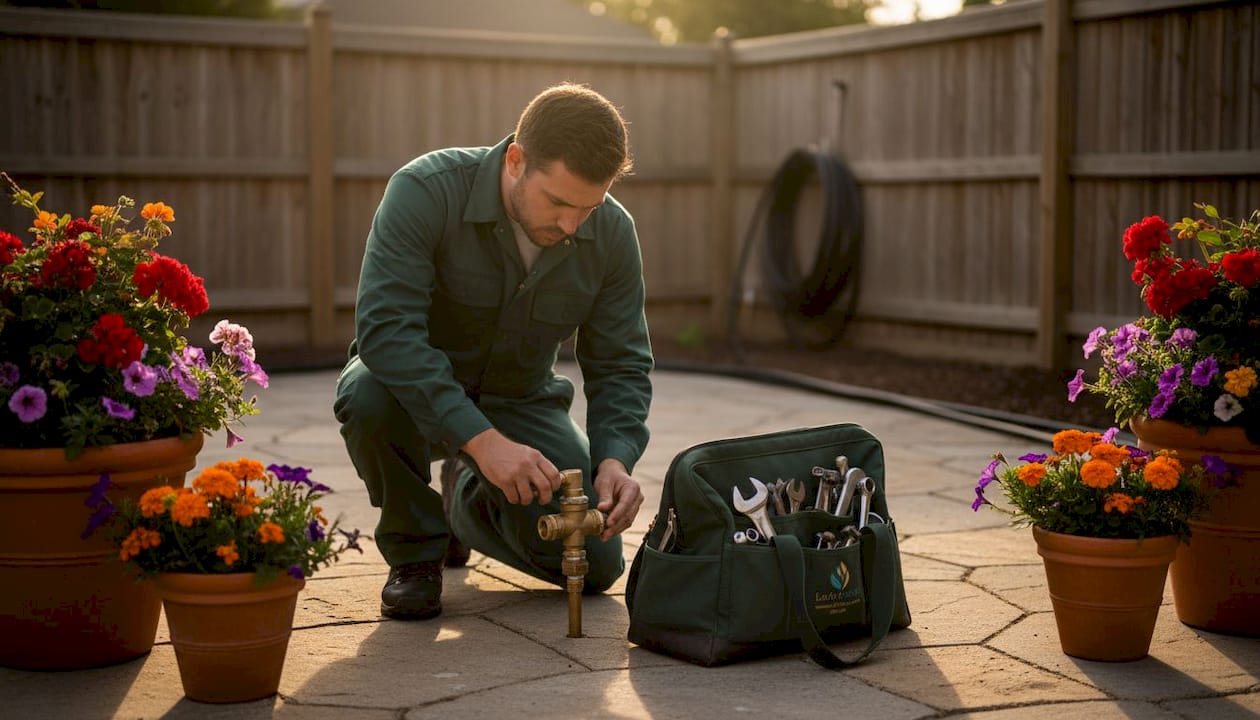
- A double check valve assembly uses two independent check valves to block reverse water flow. It’s appropriate for low-to-moderate hazard scenarios, such as a lawn irrigation system on municipal water.
- A reduced pressure zone assembly adds a pressure differential relief valve between the two check valves. If both checks fail, the relief valve opens and the water discharges harmlessly rather than flowing backward. This is required for high-hazard connections like chemical feed lines, pools, or certain boiler systems.
Understanding the difference is critical when comparing double check vs. RPZ assemblies for your site. Installing a DCVA where an RPZ is required is a compliance failure, even if the device is functioning perfectly.
Pro Tip: When you’re unsure which device applies to your property, ask your water purveyor or a certified backflow tester to assess your cross-connection hazard level before purchasing equipment. The wrong device type costs you money twice: once when you buy it and again when you replace it.
For homeowners specifically, residential backflow protection requirements depend on what’s connected to your water line, including in-ground sprinklers, pools, and supplemental water sources.
With a clear sense of the devices involved, let’s look at the compliance process for both water meters and backflow assemblies in practice.
How New Jersey’s compliance process works for water meters and backflow devices
Compliance in New Jersey involves multiple moving parts: installation, annual testing, credential verification, and documented reporting to the right authority. Getting any one of these wrong can result in a failed inspection or a violation notice.
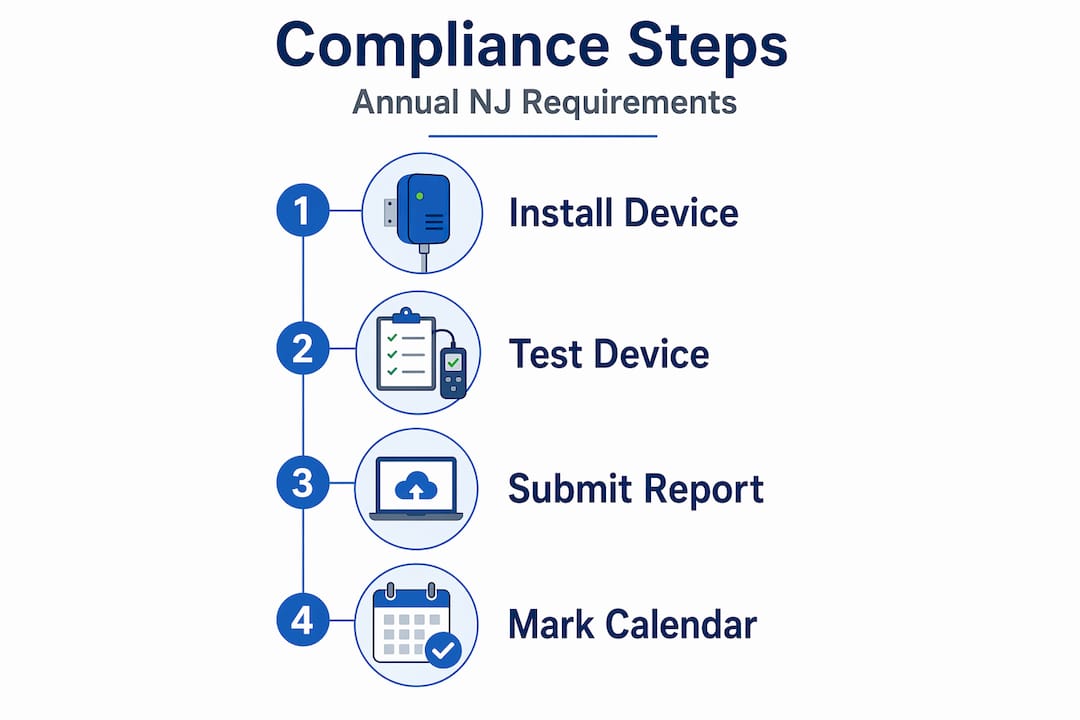
Step-by-step annual compliance checklist:
- Confirm your device inventory. List every backflow assembly on your property, including its type, location, installation date, and last test date.
- Verify tester credentials. Only a separately certified backflow tester, not just any licensed plumber, may legally conduct the annual operational test. A licensed plumber installing an assembly is not automatically qualified to test it unless they hold specific backflow testing certification.
- Schedule testing before your deadline. The NJ backflow certification process requires annual testing, and you need time to submit results.
- Conduct the test and document results. A certified tester uses calibrated gauge equipment to verify that each check valve and relief valve is operating within spec.
- Submit results to your water purveyor within 30 days. Backflow assemblies must be retested annually, and results go to the water utility, not just your files.
- Retain copies for your records. Your records serve as your legal evidence of compliance if a dispute or inspection arises.
- Schedule any required repairs immediately. If a device fails the test, it must be repaired or replaced and retested before it can be certified as compliant.
Meter-specific compliance comparison:
| Situation | Owner responsibility | Potential consequence |
|---|---|---|
| Municipal meter replacement program | Schedule access during program window | Charges for labor and equipment if missed |
| Missed meter appointment | May pay fees and reschedule | Risk of service discontinuation |
| Backflow device test overdue | Schedule certified tester, submit results | Fines, violation notices, liability |
| Unqualified tester used | Retest with credentialed professional | Test results invalid, compliance failure |
Understanding how often backflow testing is required removes the guesswork. Annual is the baseline. Some high-hazard connections may require more frequent checks under specific local ordinances.
Pro Tip: Build your backflow test deadlines into your property management calendar at least 60 days before the due date. That buffer gives you time to schedule a certified tester, get results, and submit paperwork to your water purveyor without scrambling at the last minute.
Compliance nuances often depend on the specific municipality and site. Let’s break down how responsibilities and requirements can vary across New Jersey.
Local variations: Your responsibilities by municipality
New Jersey state rules set the floor, but individual municipalities often raise the bar. Water meter replacement programs are a perfect example. Some towns fund and manage meter upgrades, but they require you to schedule an appointment to provide access. If you miss that window, you move from a free service to a billable one.
Key local-level factors to track:
- Whether your municipality has an active meter replacement program and what the scheduling deadline is
- Whether local ordinances specify flat fees for meter labor or equipment changes
- Whether your town uses a third-party contractor for meter work and how to contact them
- Whether backflow test reports go to the municipality directly, the water utility, or both
Local programs may require customers to schedule access for meter replacement. Failing to schedule within the program window can mean paying equipment and labor costs yourself, and in some cases, triggering a service discontinuation notice.
Some municipalities go further. NJ municipalities codify fees for meter replacement labor directly into their water system ordinances. That means the charges aren’t a surprise or a policy choice. They’re written law. You can’t negotiate them away after the fact.
“Always check both the state-level rules and your specific town’s water ordinances. State law tells you what devices are required and when they must be tested. Local ordinances tell you how meter access, fees, and service interruption are handled in your specific community.”
The practical takeaway: call your water utility or visit your municipality’s website before a replacement program notice lands in your mailbox. Getting ahead of the schedule means getting the service for free or at the lowest possible cost.
Now let’s pull together some essential best practices and troubleshooting advice to help you keep everything on track.
Best practices: Simplify compliance and avoid costly mistakes
Good compliance isn’t just about passing a test once a year. It’s about building a system that keeps you informed, organized, and ahead of every deadline. This matters even more when you manage multiple properties or a site with several backflow assemblies.
Your annual compliance workflow:
- Create a master inventory log for every backflow assembly on your property, including device type, model number, serial number, installation date, and location.
- Record each test date and result in your log the day testing happens, not later.
- Set calendar reminders 90 days, 60 days, and 30 days before each annual test deadline.
- File copies of all test reports digitally and in a physical folder sorted by device and year.
- When you receive a compliance letter or violation notice, respond in writing within the timeframe specified. Do not ignore it. A written response creates a paper trail.
- If you manage multiple sites, assign someone specifically responsible for each property’s compliance calendar. Shared accountability doesn’t always mean anyone acts.
Sites with multiple cross-connection points or different hazard-level assemblies need per-device scheduling. State rules apply to each installed assembly individually, not just to your property as a whole. If you have four backflow assemblies on site, that’s four separate annual test reports, four separate submission deadlines, and four separate records to maintain.
Pro Tip: When you receive a new compliance or violation letter, photograph it immediately and forward a copy to your property file before you respond. This timestamped record can protect you if there’s ever a dispute about when you received notice or how quickly you responded.
The complete owner’s backflow guide walks through each of these steps in detail and helps property managers build systems that scale across multiple units or addresses.
Our perspective: Why “bare minimum” compliance isn’t enough for NJ properties
The standard advice is simple: test annually, submit your paperwork, and you’re good. But after working with property owners across New Jersey, we’ve seen a pattern that this checkbox approach misses entirely.
Properties that treat compliance as a minimum requirement tend to get surprised. A device that passes one year might be showing wear that a thorough tester would flag. A meter running slow might be underbilling today but will create a dispute when it’s finally replaced. These are not catastrophic failures. They’re gradual drift. And gradual drift doesn’t show up until it becomes an emergency.
Proactive property managers treat annual testing as a diagnostic event, not just a certification event. They want to know if a check valve is getting sluggish. They want to know if their RPZ relief valve is cycling more than expected. These are early warning signs that the device is approaching the end of its useful life. Catching that early means planning a replacement on your schedule and your budget, not in response to a failed test notice from your water utility.
The cost argument for proactive compliance is straightforward. A device that fails a test must be repaired and retested. Emergency service calls cost more than scheduled ones. Water damage from an undetected backflow event can cost far more than years of testing fees. And if the backflow event involves contamination of a shared system, the liability exposure for a property owner is significant.
Working with credentialed professionals, rather than the lowest bidder who claims they can handle it, is where the real risk management happens. Certification matters. Equipment matters. And a tester who explains what they found, not just whether you passed, is worth every dollar. Resources on improving plumbing safety for NJ properties reinforce this point with practical detail.
Need help with NJ water meter or backflow device compliance?
Navigating state regulations, local ordinances, annual testing deadlines, and device-specific requirements is a lot to manage alongside everything else that comes with owning or managing property in New Jersey.
Our team handles the full compliance picture: testing, certification, report submission, and violation response support. Whether you’re looking to understand how to pass and submit backflow testing correctly the first time or you’ve already received a backflow letter and need to act fast, we’re ready to help. We also assist with diagnosing and fixing backflow issues before they become violations. Reach out to schedule a consultation with our certified team and take the guesswork out of compliance.
Frequently asked questions
How often must backflow assemblies be tested in New Jersey?
Backflow prevention assemblies must be tested at installation and retested every year, with results submitted to your water purveyor within 30 days of testing. This applies to all assemblies except air gaps.
Can any licensed plumber test or certify my NJ backflow device?
No. A licensed plumber is not automatically qualified to perform annual backflow operational tests unless they hold a separate backflow testing certification. These are two distinct credentials in New Jersey.
What happens if I miss a municipal water meter replacement appointment?
You may be charged for equipment and labor costs, and in some municipalities, missing the program window can lead to discontinued water service until the meter situation is resolved.
What are the approved backflow device types in New Jersey?
NJDEP defines approved devices as double check valve assemblies and reduced pressure zone assemblies, both of which must be installed and tested in compliance with N.J.A.C. 7:10-10.
Is recordkeeping required for backflow device testing?
Yes. You must submit test results to your water purveyor within 30 days and retain documentation to demonstrate annual compliance if your property is ever inspected or a violation is disputed.