TL;DR:
- Backflow is the unintended reversal of water flow, risking contamination of drinking water.
- Common sources include irrigation, fire suppression, boilers, and garden hoses in buildings.
- Regular testing and proper backflow prevention devices are essential for compliance and health safety.
One overlooked connection in your plumbing system can put your entire building’s water supply at risk. Most property owners assume clean water stays clean once it enters their pipes, but that assumption is wrong. Backflow is a primary cause of waterborne illness in the United States, responsible for a significant share of water distribution outbreaks. If you manage a residential, multifamily, or commercial property in New Jersey, understanding backflow hazards is not optional. This guide covers what backflow is, where it comes from, how to prevent it, and what New Jersey law requires you to do about it.
Table of Contents
- What is backflow and why is it a hazard?
- Common sources and consequences of backflow in New Jersey properties
- Backflow prevention devices: Options and selection
- New Jersey backflow prevention regulations and compliance steps
- Why backflow safety is a smart investment, not just a box to check
- Protect your property: Next steps for backflow compliance
- Frequently asked questions
Key Takeaways
| Point | Details |
|---|---|
| Backflow is preventable | With proper devices and testing, property owners can entirely prevent backflow contamination. |
| Compliance is mandatory | New Jersey law requires approved devices and annual testing, with penalties for missed deadlines. |
| Health is the top priority | Uncontrolled backflow risks not just property, but real public health consequences. |
| Choose the right device | Selecting the appropriate backflow prevention device depends on your system’s specific hazards and local code. |
What is backflow and why is it a hazard?
Most people picture water as flowing in one direction: from the municipal supply into their building and out through fixtures. Backflow breaks that assumption. Backflow is the unintended reversal of water flow in a plumbing system, caused by two distinct mechanisms: backsiphonage and backpressure.
Backsiphonage happens when a sudden drop in supply pressure creates a vacuum effect, literally pulling water backward through your pipes. Think of it like drinking through a straw and then releasing the suction. A water main break nearby, a burst hydrant, or heavy firefighting demand can all trigger this effect instantly.
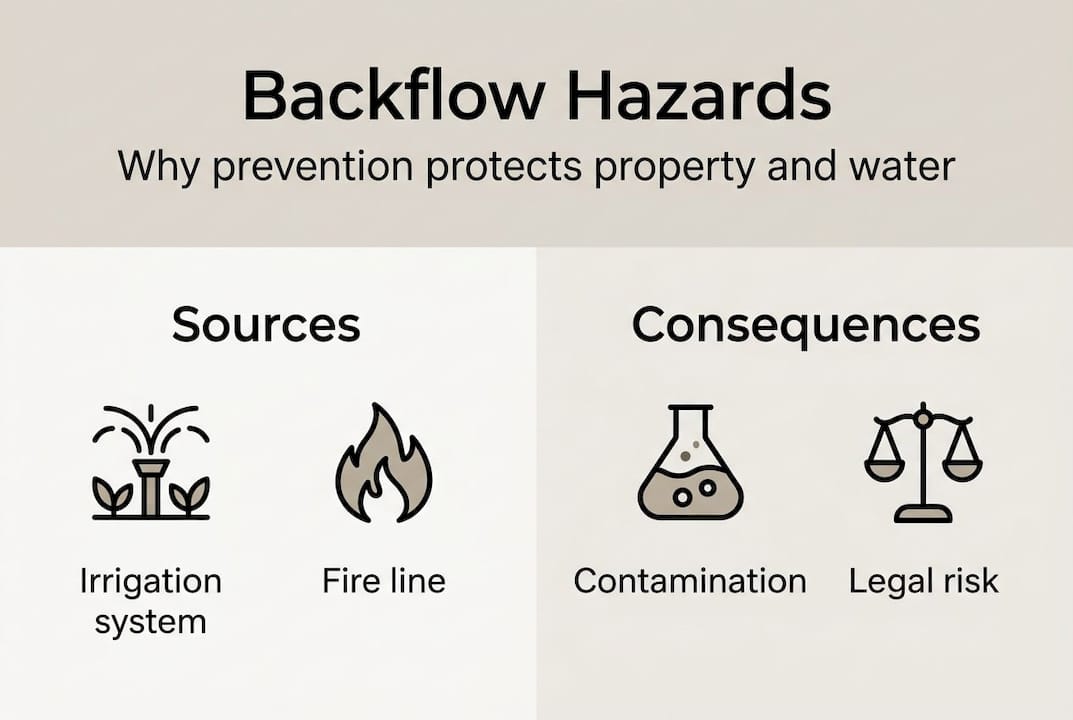
Backpressure is different. It occurs when the pressure on the downstream side of your system exceeds the incoming supply pressure. Boilers, pumps, and elevated storage tanks can all generate enough force to push water backward into the public main.
Here are the most common real-world scenarios that cause backflow events:
- A city crew shuts off a main for repairs, dropping supply pressure across your block
- Firefighters connect to a nearby hydrant and draw massive pressure from the system
- A boiler malfunction creates a pressure spike that reverses flow
- An irrigation system left submerged in a pond or fertilizer tank creates a direct contamination path
- Construction crews accidentally cross-connect potable and non-potable lines
“A cross-connection is any actual or potential link between the potable water supply and a source of contamination. Backflow is what happens when that link becomes active.”
The hazards are serious. When flow reverses, whatever is on the downstream side of that connection gets pulled or pushed into your clean water supply. That could be fertilizer, cleaning chemicals, boiler treatment compounds, or bacteria from a garden hose sitting in a puddle. Many property owners dismiss these risks as theoretical, but common backflow misconceptions like that one are exactly what lead to real contamination events.
Common sources and consequences of backflow in New Jersey properties
New Jersey properties face a specific combination of risk factors that make backflow a practical concern, not just a regulatory formality. Older building stock, dense urban water infrastructure, and the widespread use of irrigation, fire suppression, and commercial boiler systems all create cross-connection opportunities.
Here are the most frequent backflow sources found in New Jersey buildings:
- Irrigation systems connected directly to the potable supply without adequate protection
- Fire suppression systems that hold standing water treated with chemical additives
- Boilers and heating systems using water treated with corrosion inhibitors
- Commercial dishwashers and laundry equipment with direct supply connections
- Chemical dispensing equipment in restaurants, labs, or cleaning operations
| Source | Hazard level | Typical contaminant |
|---|---|---|
| Irrigation system | High | Fertilizers, pesticides, bacteria |
| Fire suppression | Medium to high | Chemical additives, stagnant water |
| Boiler system | High | Corrosion inhibitors, treatment chemicals |
| Commercial equipment | Variable | Cleaning agents, food waste |
| Garden hose | Low to medium | Soil, bacteria, lawn chemicals |
Backflow incidents often result from cross-connections and are major contributors to preventable water contamination events nationwide. The consequences for your property are not limited to health risks. A single confirmed backflow event can trigger municipal investigations, service interruptions, fines, and civil liability if tenants or employees are harmed.
Pro Tip: If your building has an irrigation system, a fire suppression line, or a boiler, you almost certainly have a cross-connection that requires a tested and approved backflow prevention device. Do not wait for a notice from your water utility to find out.
The financial exposure from a contamination event far exceeds the cost of prevention. Beyond remediation costs, you face potential lawsuits, lost rental income during building closures, and damage to your reputation as a property manager. Learning about preventing backflow contamination before an incident occurs is the only rational approach. Knowing the signs of backflow failure early can also help you act before a small issue becomes a major crisis.

Backflow prevention devices: Options and selection
Not every backflow risk requires the same solution. Device selection depends on the hazard class of the cross-connection, meaning whether contamination would pose a direct health threat or simply a non-health nuisance. Getting this wrong is a compliance failure, so understanding your options matters.
The four main backflow prevention device types are:
- Air gap: The simplest and most reliable method. A physical break between the water outlet and the receiving vessel. No mechanical parts to fail. Required for the highest-hazard situations.
- Reduced Pressure Zone (RPZ) assembly: The gold standard for high-hazard connections. Contains two independently operating check valves and a relief valve that opens if either check fails. Required by New Jersey code for chemical and health-hazard cross-connections.
- Double Check Valve Assembly (DCVA): Two check valves in series, appropriate for low-hazard connections. Commonly required for fire suppression systems in New Jersey.
- Pressure Vacuum Breaker (PVB) and Atmospheric Vacuum Breaker (AVB): Simpler devices suited for irrigation and low-risk applications where backpressure is not a concern.
Air gap, RPZ, DCVA, and PVB/AVB each offer different levels of protection matched to specific hazard levels. Choosing the wrong device for a high-hazard connection is not just a code violation. It is a gap in your actual protection.
| Device | Hazard class | Protects against backpressure | Annual test required |
|---|---|---|---|
| Air gap | High | Yes (physical) | No |
| RPZ assembly | High | Yes | Yes |
| DCVA | Low | Yes | Yes |
| PVB | Low to medium | No | Yes |
| AVB | Low | No | No |
Pro Tip: If you are unsure whether your cross-connection qualifies as high-hazard or low-hazard, always default to an RPZ. Installing a more protective device than required is never a compliance problem. Installing a less protective one is.
Understanding how preventers work in practice helps you have more informed conversations with your plumber and your water utility. It also helps you recognize when something is wrong before your annual test catches it.
New Jersey backflow prevention regulations and compliance steps
New Jersey has clear legal authority over backflow prevention, and the requirements apply to most commercial, multifamily, and public-supply-connected properties. Ignorance of the rules is not a defense.
The primary regulatory framework comes from N.J.A.C. 7:10 and UCC mandates, which require approved devices and annual testing for all assemblies connected to public water systems. The New Jersey Department of Environmental Protection enforces these rules through local water purveyors.
Here is the step-by-step compliance process every New Jersey property owner should follow:
- Identify all cross-connections on your property, including irrigation, fire suppression, boilers, and any equipment with a direct water supply tie
- Classify each hazard as high or low using your local water utility’s cross-connection survey or a certified tester
- Select and install the correct device based on hazard class and applicable code requirements
- Schedule initial testing immediately after installation by a New Jersey certified backflow tester
- Maintain annual testing records and submit them to your water utility on time
- Respond to notices promptly, as annual testing must be completed within 30 days of receiving a testing notice from your utility
Key stat: New Jersey law requires annual backflow assembly testing within 30 days of notice. Missing this deadline can result in service interruption and fines.
Non-compliance carries real penalties. Water utilities can terminate service, issue fines, and refer violations to the NJDEP. Property owners who fail to maintain approved devices also face civil liability if a backflow event harms a tenant or neighbor. Reviewing the full scope of backflow regulations for property owners gives you a clear picture of your obligations. You should also know how often testing is required for each type of assembly on your property.
Why backflow safety is a smart investment, not just a box to check
Here is the uncomfortable truth: most property owners treat annual backflow testing the way they treat renewing a car registration. It is a bureaucratic task, something to get done and forget. That mindset is exactly what creates risk.
A single backflow contamination event does not just affect one unit or one building. It can compromise a municipal supply zone, trigger public health investigations, and generate news coverage that follows your property’s address for years. Lax backflow control leads to real health crises and major costs, making proactive compliance the genuinely wise choice.
The property managers who understand this treat backflow testing as part of their asset protection strategy, not their compliance checklist. A building with documented, consistent backflow testing history is easier to insure, easier to sell, and easier to defend in court. It signals professional management to tenants, lenders, and inspectors alike.
Investing in regular backflow testing is not about satisfying a regulator. It is about protecting everything you have built around that property.
Protect your property: Next steps for backflow compliance
Understanding the risks is the first step. Acting on them is what actually protects your building, your tenants, and your investment. Working with a certified New Jersey backflow professional takes the guesswork out of device selection, installation, and annual testing requirements.
Our team at South Jersey Backflow specializes in helping property owners navigate compliance with confidence. From identifying backflow issue prevention strategies to scheduling your regular backflow testing, we handle the details so you do not have to. Explore our resource library for local regulations, device guides, and practical checklists, or contact us directly to schedule a certified inspection for your New Jersey property.
Frequently asked questions
What is the difference between backsiphonage and backpressure?
Backsiphonage is caused by negative pressure in the supply line drawing water backward, while backpressure occurs when downstream pressure exceeds supply pressure, pushing contaminants back into the system. Both can introduce hazardous materials into your potable water supply.
How often must backflow prevention devices be tested in New Jersey?
Backflow assemblies connected to public water supplies must be tested at least annually. Annual testing is required within 30 days of receiving a testing notice from your water utility under New Jersey law.
Who is responsible for backflow prevention in rental or multifamily buildings?
The property owner or designated manager is responsible for installing and maintaining approved devices and ensuring annual testing. This applies to multifamily residences with boilers, irrigation systems, and other cross-connection sources.
Can backflow really make water unsafe to drink?
Yes. Backflow incidents cause waterborne illness by introducing contaminants like chemicals or bacteria directly into the potable water supply, posing serious health risks to anyone who uses that water.
Pingback: RPZ Backflow Compliance and Protection for NJ Properties
Pingback: Backflow Preventers Explained: Protect Your NJ Water
Pingback: Backflow device installation guide for NJ property owners
Pingback: NJ residential backflow protection guide for homeowners