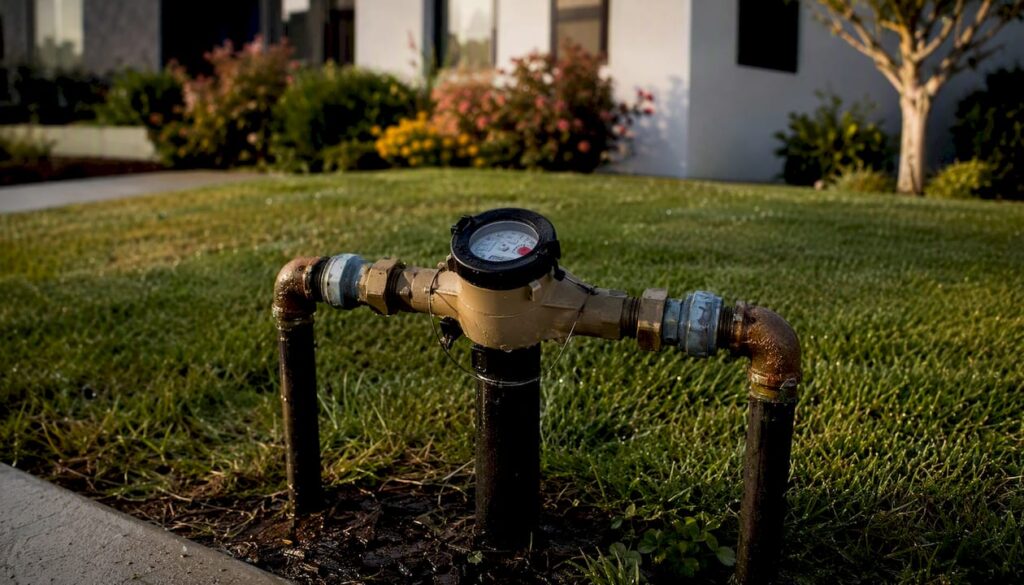
A water meter is the device on your property line or in your basement that measures every gallon of water flowing into your home, and it’s the single number your utility uses to bill you and the single tool that catches a hidden leak before it wrecks your foundation. The American Water Works Association treats metering as a core tool for fair billing and water conservation, and cities from Oklahoma City to towns across New Jersey rely on the same basic idea: measure what passes through the pipe, charge for exactly that.
Most residential meters look nothing like a high-tech gadget. They resemble a small odometer, sometimes with a digital readout tucked under a round metal or plastic lid near the curb, in a basement, or inside a crawlspace access panel. That unassuming little device is doing three jobs at once for you.
- Billing accuracy: You pay for the water you actually use, not an estimate.
- Leak detection: A meter that keeps spinning when every faucet in the house is off is telling you something is wrong.
- Usage tracking: Comparing readings month to month shows you patterns, like a sprinkler system running longer than it should.
Southjerseybackflow works constantly with meters in New Jersey, mostly at the point where they intersect with backflow prevention devices during testing, relocation, and compliance filings.
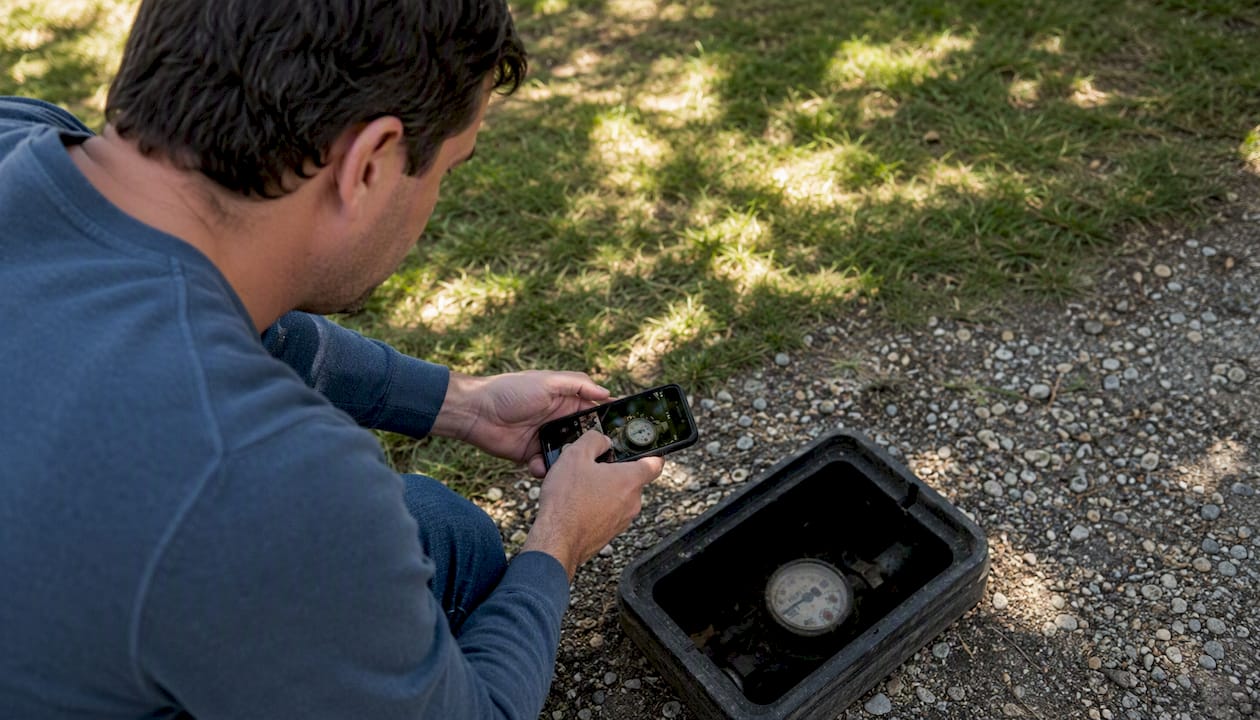
Pro Tip: Take a photo of your meter face the day you move in. It gives you a baseline reading and helps you spot tampering, damage, or a technician’s misread months later.
Key Takeaways
A water meter measures the volume of water passing through your service line, and reading it correctly is the fastest way to catch a leak before it turns into a costly repair.
| Point | Details |
|---|---|
| What a meter measures | Volume of water flow, used for billing, leak detection, and tracking household usage patterns. |
| Reading takes minutes | Locate the meter, note gallons vs. cubic feet, and record the digits with a timestamp. |
| Leak test is simple | Shut off all fixtures for 15 to 30 minutes and watch the low-flow indicator for movement. |
| High bills usually mean leaks | Hidden leaks, running fixtures, and failed appliances explain most unexpected spikes, not meter failure. |
| Access matters | Keep the meter pit or box clear since blocked access can lead to estimated billing. |
| Meter and backflow work often overlap | Southjerseybackflow coordinates meter relocation, testing, and direct filing with New Jersey water authorities. |
Table of Contents
- What Is a Water Meter and How Does It Actually Work?
- What Are the Different Types of Water Meters?
- How Do You Read a Water Meter?
- Why Are My Water Bills Suddenly Higher Than Normal?
- What Is a Smart Water Meter and How Is It Different?
- Who Owns Your Water Meter and How Long Does It Last?
- What Happens When a Meter Relocation Meets a Backflow Device?
- What Do Homeowners Usually Get Wrong About Their Meter?
- Need Help With Meter Access, Backflow Testing, or a Compliance Notice?
- Where to Learn More About Water Meters
- Frequently Asked Questions
- Sources
What Is a Water Meter and How Does It Actually Work?
Every water meter, regardless of brand or technology, does one job: it converts physical water flow into a volume number. The device sits inline with your service pipe, and according to the Water Metering Best Practices report from PNNL, the core anatomy is consistent across almost every type: a coupling connection to the pipe, a metering element that reacts to the moving water, and a register that totals the movement into a readable number.
The metering element is where the differences start. A positive-displacement meter uses a nutating disc, a small wobbling piece that rocks back and forth as a fixed volume of water passes through a chamber, and each wobble equals a known quantity. An impeller or turbine meter spins a rotor with the flow, counting rotations. Vortex shedding, electromagnetic, and ultrasonic meters skip moving parts entirely, reading flow through pressure changes, magnetic fields, or sound wave timing instead.
The register is the part you actually look at. Older mechanical registers work like a car odometer, with a series of dials driven by mechanical gears. Electronic registers convert the metering element’s motion or signal into digital pulses, display a number on a small screen, and, in newer systems, transmit that data wirelessly to the utility.
A few installation details affect how accurate that number is. Meters generally need a straight run of pipe before and after them, free of elbows or valves, because turbulence throws off the reading. Pressure drop matters too. Ultrasonic and electromagnetic meters cause almost none, which the PNNL research notes as a key advantage in facilities where consistent water pressure matters.
Oklahoma City’s utility offers a useful real-world data point here: it bills residential customers in 1,000-gallon increments using nutating disc meters, which is standard practice across much of the country and explains why your bill jumps in chunks rather than smooth fractions.
What Are the Different Types of Water Meters?
Not every property gets the same kind of meter, and the type installed usually tells you something about the building’s size and water demand. According to Linc Energy Systems, positive-displacement meters are the default for small residential and light commercial service, while larger or more specialized applications call for velocity, compound, electromagnetic, or ultrasonic designs.
Positive-displacement meters dominate single-family homes because they’re accurate at the low, inconsistent flow rates typical of a household, think a toilet refilling or a dishwasher cycling through. Their downside is moving parts that wear over time, especially with sediment or grit in the water.
Velocity meters, including turbine and multi-jet designs, handle higher and steadier flow rates. You’ll find turbine meters on larger commercial connections and multi-jet meters on some residential retrofits. They tend to lose accuracy at very low flows, which matters if a building has long stretches of minimal water use.
Compound meters combine a low-flow element with a high-flow element in one housing, switching between them automatically. For multi-unit residential buildings, this design is often the practical choice, since it stays reasonably accurate whether one tenant is running a faucet or the whole building hits peak demand at once.
Electromagnetic and ultrasonic meters have no moving parts, which means less wear, less maintenance, and consistent accuracy across a wide flow range. They cost more upfront but show up increasingly in commercial and industrial settings where reliability outweighs price.
Coriolis meters are the rare exception, used mostly in industrial and precision-measurement contexts rather than typical residential or commercial water service.
A quick way to identify what you have without cracking open the housing:
- Check the faceplate. Many meters print their type or manufacturer name directly on the register lid.
- Look for a small dial or “sweep hand.” A spinning low-flow indicator usually points to a positive-displacement or compound meter.
- Strap-on external sensors, rather than an inline device, usually mean an ultrasonic meter.
- A larger, heavier housing with two visible chambers suggests a compound meter, common in apartment buildings.
How Do You Read a Water Meter?
You read most residential meters the same way you’d read an odometer: the digits on the register show total gallons or cubic feet used since installation, and your bill is calculated from the difference between two readings. Some registers show a rolling digital total; older mechanical ones use a row of dial faces you read left to right.
Here’s the process from start to finish:
- Locate the meter. Check near the curb in a small in-ground box, in the basement near where the main line enters, or in a utility closet in newer construction.
- Note the unit of measurement. Most residential meters in the US read in gallons, but some municipal systems, and many commercial meters, read in cubic feet. One cubic foot equals about 7.48 gallons, so confusing the two can make your usage look wildly off.
- Read the digits in order, left to right, ignoring any red or decimal digits unless your utility tells you otherwise. Those often represent fractions of a gallon and aren’t part of the billed total.
- Record the date and time alongside the number so you can calculate usage over a specific period later.
- Run a leak test. Turn off every fixture and appliance that uses water, then watch the meter for 15 to 30 minutes. If the low-flow indicator (a small triangle, star, or spinning wheel) is moving, water is passing through somewhere it shouldn’t be.
Most utilities bill in 1,000-gallon blocks, rounding to the nearest whole unit, which is why two households using nearly identical amounts can occasionally see slightly different charges. The WaterWorld explainer on meter registers breaks down how both mechanical and electronic registers handle this totalizing function, whether the readout is a set of dials or a digital display feeding into a remote system.
Quick checklist before you call anyone:
- Confirm you’re reading the correct unit (gallons vs. cubic feet).
- Check that no one ran a hose, filled a pool, or used the washing machine during your test window.
- Note whether the low-flow indicator moved at all, even slightly.
- Write down the exact before-and-after numbers with timestamps.
Pro Tip: Run your leak test twice, ideally once at night when the house is quiet and once during the day. Ice makers, humidifiers, and irrigation controllers can trigger brief water draws that mimic a leak on a single test but disappear on a second check.
Why Are My Water Bills Suddenly Higher Than Normal?
A spike in your bill almost always traces back to one of five things: a hidden leak, a fixture left running, a failing appliance, meter wear, or a simple misread of the units. The trick is narrowing down which one you’re dealing with before you call anyone.

Start with the obvious. Walk the property and check for wet spots in the yard, damp drywall, or a running toilet, which is one of the most common silent water wasters in any home. A toilet flapper that doesn’t seal fully can leak hundreds of gallons a day without ever making a sound you’d notice.
If nothing visible turns up, re-run the leak test described above. A moving low-flow indicator with everything off points strongly toward an underground service line leak or a fixture failure inside a wall, neither of which you’ll spot by walking around.
Compare your current reading against your last two or three billing cycles. A gradual upward trend suggests a new habit, like more laundry loads, rather than a sudden mechanical failure. A sharp jump in a single period points to something that started recently: a burst pipe, a stuck valve, or a failed water heater.
Meter wear is a less common but real cause, especially in older positive-displacement meters where internal parts degrade or debris interferes with the moving disc. This typically shows up as gradual under-reporting rather than a spike, so it’s more often the explanation for a bill that seems too low for years followed by a “correction” adjustment.
When you’ve ruled out the obvious and still can’t explain the number, here’s the escalation path:
- Call your water utility if you suspect the meter itself is faulty. Most will send a technician to test accuracy on-site, sometimes at no charge for the first visit.
- Call a plumber if you’ve confirmed a leak but can’t locate or access it.
- Have this ready before you call: your meter’s serial number, your last three readings with dates, and photos of the meter face and surrounding area.
Pro Tip: Keep a simple log, even a note on your phone, with the date and reading every time you check the meter. When you do need to call the utility or a plumber, that log turns a vague complaint into documented evidence they can act on immediately. For homeowners chasing a leak they can’t pin down, a detailed guide on identifying hidden water leaks walks through non-invasive detection signs worth ruling out before you start opening walls.
What Is a Smart Water Meter and How Is It Different?
A smart water meter reports usage automatically, without anyone walking the property to check it, and that single shift changes how quickly you find out about a problem. Two acronyms cover this space: AMR (automatic meter reading) and AMI (advanced metering infrastructure).
AMR is the simpler version. A technician drives by with a receiver, or a fixed network picks up a radio signal from the meter, and the reading uploads without anyone opening the meter box. It’s a step up from manual reads but usually only happens on the utility’s normal billing cycle.
AMI goes further. It provides near-continuous, two-way data flow between the meter and the utility, often with hourly or even more frequent reads. That granularity is what makes real leak alerts possible instead of just faster billing.
For a homeowner, the practical benefits show up in a few places:
- Faster leak detection. Instead of finding out about a leak on next month’s bill, some AMI systems flag continuous flow within a day or two.
- Usage portals. Many utilities offer an online dashboard where you can track daily or hourly consumption instead of waiting for a paper bill.
- Fewer estimated bills. Manual meter reading sometimes gets skipped due to access issues; automated systems remove that gap.
- Better historical comparisons. Granular data makes it easier to spot a slow leak trend before it becomes a five-figure water bill.
The tradeoffs are worth asking your utility about directly. Some AMI rollouts come with modest rate increases to cover the infrastructure, and privacy-conscious homeowners sometimes have questions about how granular usage data is stored or shared. If your utility is switching to a smart meter, it’s reasonable to ask what data they collect, how long they retain it, and whether the leak-alert feature is opt-in.
Who Owns Your Water Meter and How Long Does It Last?
In most municipalities, the utility owns the meter itself, while you as the property owner own the service line running from the meter into your house. That division matters because it determines who pays for what when something goes wrong.
Your responsibility, in most jurisdictions, is keeping the meter accessible. A meter pit buried under mulch, blocked by a parked car, or overgrown with landscaping can lead to estimated billing or, in persistent cases, a service visit fee when a technician has to clear access just to take a reading.
Meters typically live in one of three places: an in-ground box near the curb or property line, mounted inside a basement or crawlspace wall where the main line enters, or, less commonly, in a dedicated utility closet in newer construction. Connections vary by type, flanged or threaded union fittings for most inline meters, and strap-on external sensors for many ultrasonic installations that don’t require cutting into the pipe at all.
A well-maintained mechanical meter typically lasts many years before accuracy drifts enough to warrant replacement, though the exact lifespan depends on water quality, sediment levels, and usage volume. Electronic and ultrasonic models, with fewer or no moving parts, generally hold up longer under similar conditions.
A few simple things you can do without calling anyone:
- Clear leaves, dirt, and debris from around an in-ground meter pit a few times a year.
- Keep the access lid visible and unobstructed, especially before winter.
- Do a visual check for moisture, corrosion, or a cracked housing when you’re near the meter anyway.
Signs that point toward needing a replacement rather than a repair include readings that consistently don’t match your own leak tests, visible physical damage to the housing, or a persistent clicking or humming noise that wasn’t there before. If you’re planning any project that involves moving the meter, our guide on water meter relocation and backflow covers what that process typically involves.
What Happens When a Meter Relocation Meets a Backflow Device?
Meter relocations come up more often than you’d expect, usually tied to a driveway expansion, a foundation repair, a safety concern with an exposed pit, or simply making the meter easier to access for readings. What a lot of homeowners don’t realize is how often that project intersects with backflow prevention requirements.
When a meter moves, the plumbing configuration around it often changes too, and that can trigger a fresh inspection requirement for any backflow preventer nearby. Utilities in New Jersey frequently require a new test report any time the assembly downstream of the meter is disturbed, even if the backflow device itself wasn’t physically touched.
A typical relocation project involves coordinating a permit with the local building department, scheduling the utility to disconnect and reconnect service, and, if a backflow assembly sits close to the affected line, arranging a retest so the paperwork stays current. Skipping that last step is one of the more common reasons a property fails a routine compliance check months later.
Here’s what to expect on the checklist side:
- A permit from the municipality before any relocation work begins.
- Direct coordination with the water utility for service interruption scheduling.
- A backflow test report, filed with the water authority, if the relocation affects an existing enclosure or assembly.
Pro Tip: Schedule the backflow retest for the same week as the relocation, not weeks later. Utilities that see a gap between the plumbing change and the new test report are more likely to flag the property for a compliance review.
What Do Homeowners Usually Get Wrong About Their Meter?
Jordan has spent enough time in New Jersey basements and meter pits to notice a pattern: most homeowner confusion isn’t about the meter itself, it’s about what the numbers mean and who’s responsible for what.
The most common mistake is assuming a high bill means the meter is broken. In the vast majority of cases, the meter is doing exactly what it’s supposed to do, and the real culprit is a running toilet, an irrigation controller stuck on, or a slow leak in a wall nobody’s seen yet. Meters are mechanically simple and remarkably reliable; they rarely fail in a way that inflates a reading.
The second mistake is not knowing where the meter actually is. A surprising number of property owners have never located their own meter pit, which becomes a real problem when a technician shows up for a scheduled visit and half the appointment gets eaten by digging through landscaping to find it.
If you’re preparing for any kind of service visit, whether it’s a utility technician or a backflow test, clear a path to the meter and any nearby assembly ahead of time. Pull your last two or three water bills so you have actual numbers to reference instead of a vague sense that “it seems high.” And if you’ve noticed anything unusual, a fixture that sounds different, a damp patch near the foundation, mention it specifically rather than waiting to be asked.
One more thing worth knowing: when a professional tests a backflow preventer or inspects meter-adjacent plumbing, the paperwork doesn’t stop at a handshake. A proper test report gets filed directly with the water authority, which is the piece that actually keeps a property compliant. Verbal confirmation that “everything looks fine” means nothing to a municipal inspector without that filed report behind it.
Need Help With Meter Access, Backflow Testing, or a Compliance Notice?
If your meter sits next to an aging backflow preventer, or a relocation project just complicated your compliance status, Southjerseybackflow handles exactly that intersection across New Jersey, backflow testing and certification, meter access coordination during relocations, and direct filing of test reports with your water authority so you’re not the one chasing down paperwork.

A typical service visit starts with an on-site check of the backflow assembly and any nearby meter or plumbing changes, followed by documentation of the results and, where required, direct submission to the municipality. If a technician finds a repair need instead of a clean pass, that gets flagged on the spot rather than buried in a report you have to interpret yourself. For property managers juggling multiple addresses, consolidated billing keeps multi-property compliance from turning into a paperwork mess.
If you’ve already received a compliance notice from your water authority, or you just want your test scheduled before that letter ever shows up, start with our backflow testing and certification guide to see how the process works and book your test.
Where to Learn More About Water Meters
For homeowners who want to dig deeper into meter mechanics, billing, or compliance, a handful of sources stand out as genuinely useful rather than generic filler.
- The PNNL water metering best practices report is the strongest technical source for understanding metering components and accuracy considerations.
- Oklahoma City’s water utility page offers a clear, real-world example of how a municipal system bills and reads residential meters.
- The Wikipedia entry on water metering gives a solid overview of the practice and its role in public water systems.
- Linc Energy Systems’ breakdown of meter types is the most practical resource for comparing positive-displacement, velocity, compound, and electromagnetic meters.
- The AWWA policy statement on metering and accountability explains the industry’s standards-level view on why metering matters for conservation.
- WaterWorld’s explainer on meter registers is the best short read for understanding mechanical vs. electronic register differences.
For DIY reading steps and leak tests, lean on your own utility’s how-to page first, most publish one, since local billing rules and unit conventions can vary. For the mechanics and industry standards behind the number on your bill, the PNNL and AWWA sources above carry the most weight.
Frequently Asked Questions
What is a water meter in the simplest terms?
A water meter is a device installed on your water line that measures the volume of water flowing through it, giving your utility a number to bill you on and giving you a way to spot leaks or unusual usage.
Do I own my water meter or does the utility?
In most cases, the utility owns the meter itself, while you own the service line connecting it to your house. Check with your local water authority for the specific rule in your area.
How do I read my water meter if it shows cubic feet instead of gallons?
Multiply the cubic feet reading by roughly 7.48 to convert to gallons. Your bill should specify which unit it’s using, so check that first to avoid comparing the wrong numbers.
What does it mean if my meter’s low-flow indicator keeps spinning?
It usually means water is flowing somewhere in your system even with every fixture off, which points to a leak. Rerun the test to confirm, then check visible plumbing before calling a professional.
How often do smart water meters send readings to the utility?
It depends on the system. AMR setups typically upload on the standard billing cycle, while AMI systems can report hourly or more frequently, which is what enables faster leak alerts.
When should I call a plumber instead of my water utility?
Call the utility if you suspect the meter itself is inaccurate or damaged. Call a plumber if you’ve confirmed a leak through testing but can’t locate or access the source yourself.
Sources
- Water Metering Best Practices | PNNL
- Your water meter | Oklahoma City
- Water metering – Wikipedia
- Common water meter types and water measurement devices | Linc Energy Systems
- What is a water register? | WaterWorld
Pingback: Containment vs Isolation: What Owners Must Know About Meter Devices