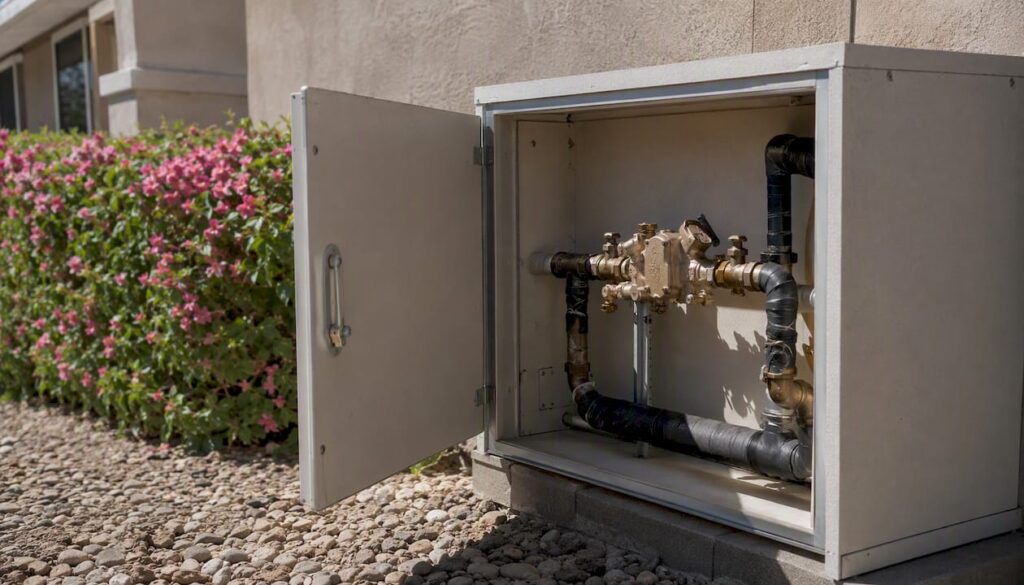
Backflow enclosure costs in New Jersey typically vary widely depending on device size, material, insulation, and whether installation is included. A basic steel cage for a 1" residential device starts at several hundred dollars product-only. A fully insulated, heated aluminum enclosure for a commercial multi-connection assembly can cost several thousand dollars before labor. For most residential and light-commercial jobs, the installed total often ranges from moderate to several thousand dollars once you add labor, delivery, and any permit fees.
Price snapshot: Basic cage (product only): moderate cost | Mid-range insulated enclosure: mid-tier cost | Heavy-duty heated commercial model: high cost | Typical installed residential job: moderate installed cost
The fastest way to get a firm number is to request a free sizing quote from a local New Jersey installer. Southjerseybackflow offers remote and on-site sizing with written quotes typically turned around within 48 hours for custom work.
- Entry-level steel cage (1" device, product only): starting from a few hundred dollars
- Mid-range insulated enclosure (1.5"–2" device): mid-range pricing
- Heavy-duty insulated/heated commercial enclosure: several thousand dollars
- Full installed job (residential, including labor and permit): modest installed cost
- Full installed job (commercial multi-connection): higher-end installed cost
Key Takeaways
Backflow enclosure cost in NJ ranges from roughly $300 for a basic cage to $9,000+ for a fully installed heated commercial enclosure, with most residential jobs landing between $800 and $1,500 installed.
| Point | Details |
|---|---|
| Core price range | Basic cage starts at $300–$600; typical residential installed job runs $800–$1,500. |
| Biggest cost drivers | Device size, insulation level, and heater add-ons move the price more than any other factor. |
| NJ permit risk | Annual Physical Connection Permit fees and enforcement penalties of $500–$5,000 per device make compliant enclosures a financial priority. |
| Measure before ordering | Record height, width, depth, pipe protrusion, and clearance needs before requesting any quote to avoid costly change orders. |
| Southjerseybackflow | Offers free sizing, written quotes within 48 hours, on-site installation, and direct test-report filing across New Jersey. |
Table of Contents
- How much does a backflow enclosure cost in NJ?
- What actually changes the final price?
- How to measure your backflow device before ordering
- What NJ compliance rules mean for your budget
- What does the full installation process look like?
- Which materials hold up best in New Jersey conditions?
- How Southjerseybackflow helps NJ property owners get it right
- An installer’s honest take on where budgets go wrong
- Get a fast, accurate quote from Southjerseybackflow
- Sources
How much does a backflow enclosure cost in NJ?
Price bands split cleanly into four tiers once you separate product-only cost from installed cost.
Band 1: Basic steel cage, product only (starting at a few hundred dollars)
These are open-frame or mesh cages designed for above-grade residential preventers. They protect against casual tampering and meet minimum code in many municipalities, but offer no freeze protection. Retail suppliers list commercial-grade cages across a range of sizes, with per-unit pricing varying by configuration.
Band 2: Mid-range insulated enclosure (moderate product cost)
Insulated fiberglass or aluminum enclosures with foam-core panels. Suitable for 1"–2" devices in most New Jersey residential and light-commercial settings. These handle typical NJ winters without a heater if the device is in a sheltered location.
Band 3: Heavy-duty insulated/heated commercial enclosure (high product cost)
Large aluminum enclosures with built-in heaters, high-R insulation, and lift-off or hinged access panels. Vendor product pages show that models like the 600D-AL aluminum enclosure reach four-figure list prices even before installation, with heated versions adding several hundred dollars to the base price.
Band 4: Custom prefab solutions (premium pricing)
Custom-fabricated enclosures for non-standard device assemblies, multi-connection commercial systems, or coastal installations requiring marine-grade finishes. Lead times are longer and quotes are job-specific.
According to a U.S. installation cost guide, residential installs commonly fall in the $300–$1,000 range while commercial installs can reach several thousand dollars, which aligns with what New Jersey property owners typically encounter.
Three real-world installed cost scenarios
- 1" residential RPZ preventer, suburban NJ: Basic insulated enclosure, half-day labor, no permit required. Total installed: approximately $800–$1,200.
- 2" irrigation system preventer, commercial property: Mid-range insulated enclosure, full-day labor, permit filing. Total installed: approximately $1,500–$2,800.
- Commercial multi-connection assembly (3"+ device), industrial site: Heavy-duty heated enclosure, custom sizing, two-day install, permit and inspection. Total installed: approximately $4,500–$9,000+.
What actually changes the final price?
Most cost surprises come from a handful of decisions buyers make (or don’t make) early in the process. Here is what moves the number:
- Device size: A 1" residential preventer needs a much smaller enclosure than a 3" commercial assembly. Larger enclosures cost more in materials, shipping weight, and labor time. Cost impact: high.
- Material: Galvanized steel is cheapest. Aluminum costs more upfront but resists corrosion better, which matters near the coast. Fiberglass sits in between. Cost impact: medium.
- Insulation level: Foam-core panels add $200–$600 over an uninsulated cage. Higher R-value panels cost more but reduce freeze risk significantly in New Jersey winters. Cost impact: medium.
- Heater: An integrated electric heater adds $300–$800 to the enclosure price, plus wiring labor if an outlet isn’t nearby. Cost impact: high.
- Locks and security hardware: Tamper-resistant locks and hasps add $50–$150 but are worth it in high-traffic commercial locations. Cost impact: low.
- Lift-off vs. hinged access panels: Lift-off panels cost slightly more to fabricate but make annual testing and repairs faster. Over the life of the enclosure, that time savings often justifies the upcharge. Cost impact: low to medium.
- Custom sizing: Stock enclosures are cheaper and ship faster. Any deviation from standard dimensions triggers custom fabrication fees and longer lead times. Cost impact: high.
- Delivery and site access: Ground-floor installs with clear access are straightforward. Tight mechanical rooms, stairs, or fenced utility areas add labor hours. Cost impact: medium.
Pro Tip: If you manage multiple properties or have more than one backflow device at a single site, batch the enclosure work into one job. Combining two or three enclosure installs with a scheduled annual test visit cuts per-device travel and mobilization costs noticeably.
How to measure your backflow device before ordering
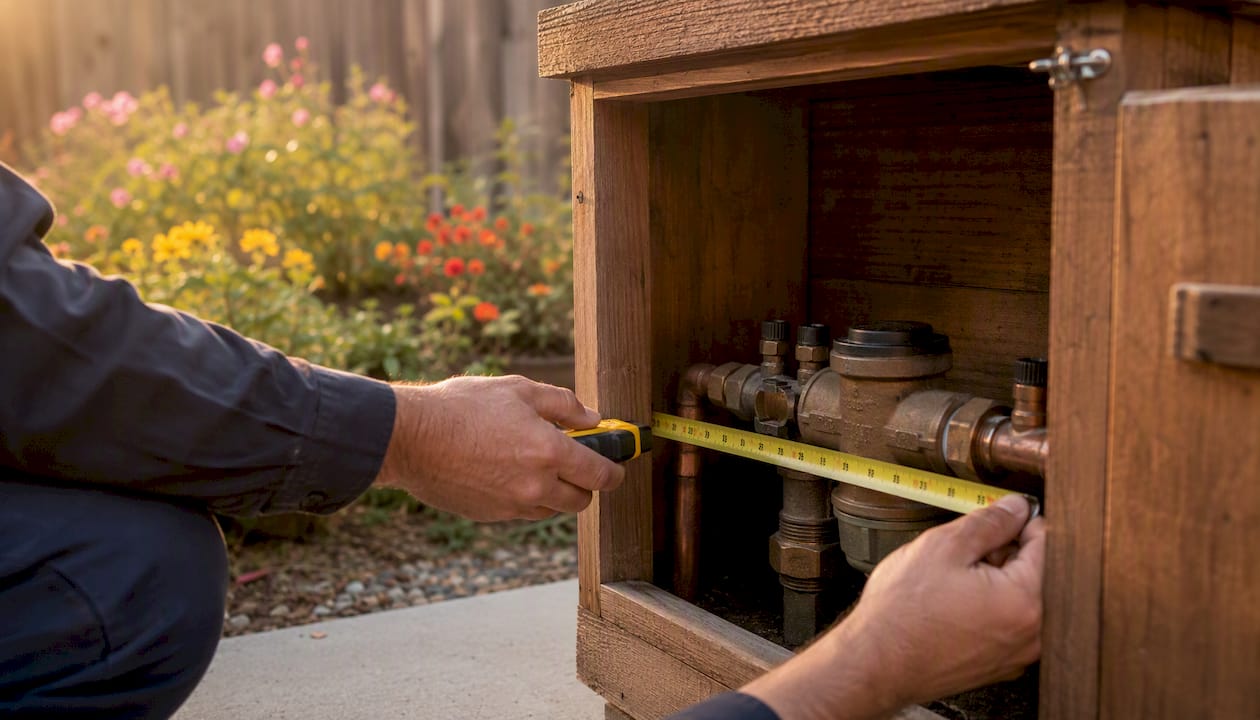
Getting the measurement right before you call for a quote saves at least one site visit and prevents the most common change-order: an enclosure that arrives and doesn’t fit.
Measure and record all of the following:
- Overall height of the device assembly from the floor or mounting surface to the highest point (usually the relief valve)
- Overall width at the widest point, including any side-mounted test cocks
- Overall depth from the inlet pipe face to the outlet pipe face
- Pipe protrusion on both the inlet and outlet sides (how far the pipe extends beyond the device body)
- Inlet/outlet orientation (horizontal, vertical, or offset) and pipe diameter
- Clearance above the device needed for testing (most manufacturers require at least 12" above the relief valve)
- Swing space for repair access (hinged covers need room to open fully)
- Location constraints: nearby walls, fences, stairs, or electrical panels that limit enclosure footprint
Once you have those numbers, you can map your device to a standard enclosure band. The table below shows common device sizes and their typical enclosure fit:
| Device pipe size | Typical device assembly dimensions | Recommended enclosure band |
|---|---|---|
| 3/4"–1" | Up to 18"H × 12"W × 10"D | Basic cage or small insulated |
| 1.5"–2" | Up to 28"H × 18"W × 16"D | Mid-range insulated |
| 3" | Up to 36"H × 24"W × 22"D | Heavy-duty insulated/heated |
| 4"+ | Custom assembly dimensions | Custom prefab only |
A good installer will confirm these measurements on-site before fabrication. For the NJ installation process, clearance for annual testing is non-negotiable: the enclosure must allow a certified tester to connect gauges and operate all test cocks without removing the entire unit.
What NJ compliance rules mean for your budget
New Jersey’s backflow rules carry real financial teeth, and ignoring them costs more than the enclosure itself.
Under N.J.A.C. 7:10-10, many commercial and industrial facilities that connect to a public water supply must hold a Physical Connection Permit issued by NJDEP. That permit requires an approved backflow prevention assembly to be installed and maintained. The same source reports that device replacement costs commonly range from around $1,000 to more than $30,000 for commercial systems, and that enforcement penalties can run roughly $500–$5,000 per device for facilities that fall out of compliance.
Budget line to add: An annual Physical Connection Permit fee (commonly cited at $150) plus potential enforcement penalties of $500–$5,000 per device make a properly enclosed and maintained assembly a straightforward financial decision, not just a regulatory formality.
The permit picture matters for enclosures specifically because an exposed or improperly protected device can fail inspection, triggering a notice of violation. Some legacy installations are only grandfathered if a permit issued before November 18, 1996, has been continuously maintained. If that chain breaks, the facility may need a full device replacement to obtain a new permit, which is where costs escalate well beyond the enclosure price.
Many New Jersey municipalities also require annual backflow testing, particularly for commercial and irrigation systems. The enclosure must allow a certified tester to perform that test without removing or damaging the housing. Check the 2026 NJ compliance roadmap for updated checklist items before ordering enclosure work, and confirm your specific permit requirements with your local water supplier or NJDEP directly.
What does the full installation process look like?
From the first phone call to the final inspection sign-off, a typical New Jersey enclosure job moves through five stages.
- Site measurement and quote (Day 1–3): Remote sizing via photos and dimensions, or an on-site visit. Written quote typically within 48 hours for standard stock enclosures; up to 5 business days for custom fabrication quotes.
- Fabrication or order fulfillment (Days 3–15): Stock enclosures ship within 3–7 business days. Custom-fabricated units take 2–4 weeks depending on complexity and material availability.
- Delivery and staging (Day of install): Enclosure delivered to site. Installer confirms fit against device dimensions before any work begins.
- On-site installation (Half day to 2 days): Enclosure set, anchored, and sealed. Electrical connection for heated models if applicable. Access panels tested for clearance.
- Inspection and report filing (Within 1–5 business days post-install): Certified tester performs a post-install backflow test. Test reports are submitted directly to the water authority. Permit documentation filed if required.
Which materials hold up best in New Jersey conditions?
New Jersey throws three specific challenges at backflow enclosures: hard winters with freeze risk, coastal salt air in shore counties, and urban vandalism pressure in commercial zones. Material choice matters more here than in milder climates.
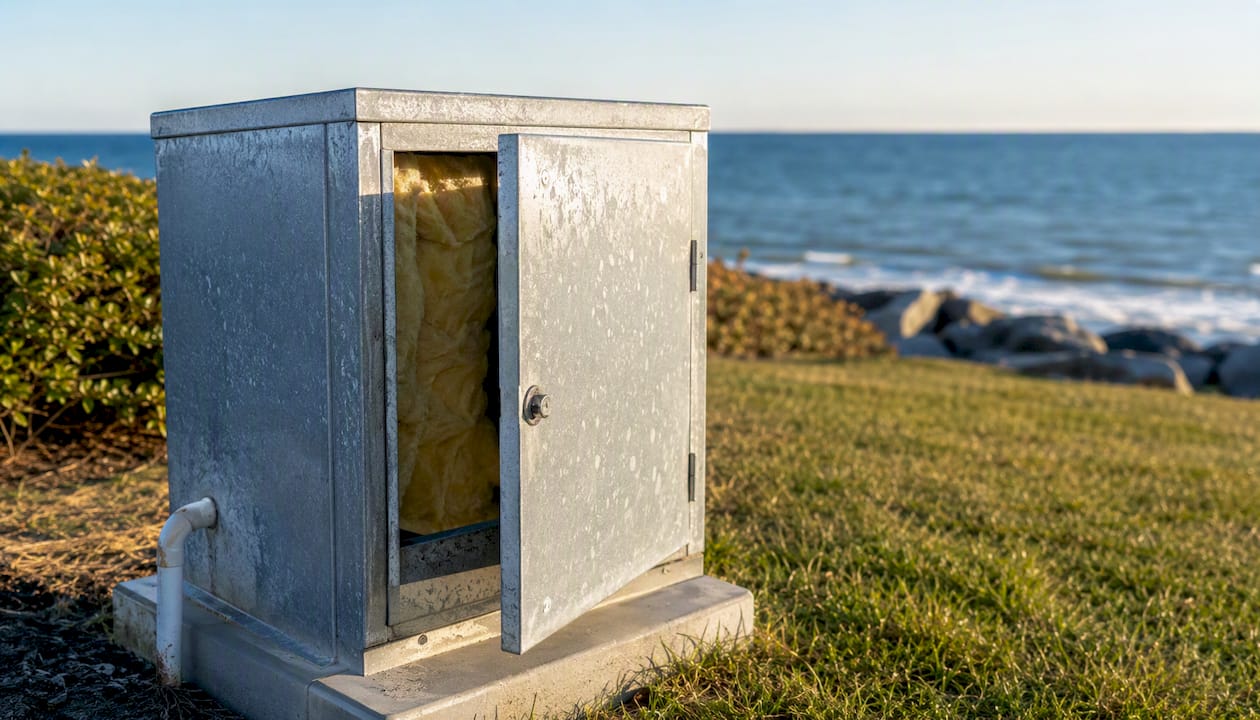
| Material | Weight | Corrosion resistance | Thermal performance | Typical cost band |
|---|---|---|---|---|
| Galvanized steel | Heavy | Moderate | Low (no insulation) | Low |
| Powder-coated steel | Heavy | Good | Low to medium | Low to medium |
| Aluminum (standard) | Light | Excellent | Medium (with insulation) | Medium to high |
| Aluminum (heated) | Light | Excellent | High | High |
| Fiberglass | Medium | Excellent | Medium to high | Medium |
Heated vs. insulated vs. unheated:
- Unheated steel cage: Lowest cost, zero freeze protection. Acceptable only for indoor or climate-controlled locations.
- Insulated enclosure (no heater): Good for most NJ residential and suburban commercial sites. Handles typical winter lows if the device is in a sheltered spot. Costs $200–$600 more than a bare cage.
- Insulated + heated enclosure: Best choice for exposed locations, irrigation systems that stay pressurized through winter, and coastal installations. Higher upfront cost, but avoids freeze damage that can run $1,000–$5,000 in emergency repairs.
Use-case recommendations:
- Residential RPZ in a sheltered side yard: mid-range insulated aluminum or fiberglass
- Irrigation system preventer, exposed location: insulated + heated aluminum
- Commercial multi-connection, urban site: heavy-duty heated aluminum with security locks
- Shore county installation: aluminum or fiberglass with marine-grade coating; avoid galvanized steel
Vendor product pages confirm that adding heaters, higher R-value insulation, and coastal-grade finishes materially increases list price. Balancing that upfront cost against avoided freeze damage and emergency service calls is the right frame for the decision.
How Southjerseybackflow helps NJ property owners get it right
Southjerseybackflow handles the full enclosure process from first measurement to final compliance filing, which is the part most property managers underestimate when they try to source an enclosure independently.
The service sequence works like this:
- Free sizing consultation: Submit device photos and dimensions remotely, or schedule an on-site visit. Most standard jobs get a written quote within 48 hours.
- Enclosure selection and fabrication coordination: Southjerseybackflow matches your device to the right product band and handles ordering or custom fabrication.
- On-site installation: Local NJ crews handle delivery, anchoring, sealing, and heater wiring where needed. No coordinating separate trades.
- Post-install testing and certification: A certified tester performs the required backflow test immediately after installation.
- Direct report filing: Test results are submitted directly to your water authority. You get documentation for your permit file without chasing paperwork.
Local coverage spans New Jersey, with service available across residential, commercial, and multi-unit properties. Emergency service is available for freeze damage or post-inspection failures. For property managers running multiple sites, consolidated billing and batch scheduling reduce per-device cost across the portfolio.
The compliance filing step is where independent buyers most often get stuck: they install an enclosure, skip the post-install test, and receive a violation notice months later. Having the installer and the certified tester be the same local team eliminates that gap.
An installer’s honest take on where budgets go wrong
The single most expensive mistake property managers make is ordering an enclosure before measuring the device. A cage that arrives 2" too short for the relief valve clearance goes back, the job gets delayed three weeks, and the property sits exposed through the delay. Measure first, order second.
The second most common budget-buster is treating the enclosure as the whole project. Permit fees, inspection costs, and the post-install test are line items that surprise buyers who only priced the hardware. Budget for them from the start.
A few tactics that consistently reduce total cost:
- Choose a stock enclosure size over custom whenever the device dimensions allow it. Stock ships in days; custom takes weeks and costs more.
- Schedule enclosure installation during the same site visit as annual testing. You pay one mobilization fee instead of two.
- Plan the install in spring or fall, outside the freeze season. Emergency installs in January cost more and carry longer lead times.
- If you have three or more devices across a property or portfolio, batch them. Per-device labor drops when the crew is already on-site.
Pro Tip: Ask your installer for a lift-off access panel rather than a hinged door if your device is in a tight space. Lift-off panels cost slightly more but make annual testing faster, which reduces your long-term service labor bill.
The real long-term cost for commercial sites is rarely the enclosure itself. Unplanned device replacement after a freeze event, emergency shutdown costs, and permit-driven upgrades for non-compliant installations add up far faster than the price difference between a basic cage and a properly insulated enclosure.
Get a fast, accurate quote from Southjerseybackflow
Southjerseybackflow gives New Jersey property owners a faster path to a compliant, properly sized enclosure than sourcing hardware independently and coordinating separate trades. Free remote sizing means you can submit device photos and dimensions today and receive a written quote within 48 hours for standard jobs. Custom fabrication quotes follow within 5 business days.
Every job includes post-install testing and direct filing of test reports with your water authority, so your permit file is complete when the crew leaves. No chasing paperwork, no separate inspection scheduling.
Schedule your free sizing consultation or contact Southjerseybackflow to get a written quote for your New Jersey property. Service covers residential, commercial, and multi-unit sites across the state, including Ocean County and surrounding areas.
Sources
- Does My Facility Need a Physical Connection Permit in NJ?
- Backflow Preventer Installation Cost Guide | Pacific Backflow San Diego
Pingback: Backflow Replacement Cost: What to Budget in 2026