
The most effective cross-connection control tools for U.S. properties are the Reduced Pressure Principle (RP/RPZ) assembly, the Double Check Valve Assembly (DCVA), the Pressure Vacuum Breaker (PVB/SVB), and hose-bib vacuum breakers, backed by the USC Foundation for Cross-Connection Control and Hydraulic Research (FCCCHR) approved assemblies list, a state/locally certified backflow assembly tester, and a cloud-based backflow management platform for scheduling and compliance filing.
For a typical commercial or multi-unit property, prioritize these steps immediately:
- Inspect every backflow device on the property and confirm the model number appears on the USC/FCCCHR approved assemblies list.
- Verify your tester holds current state or local certification before any field test is scheduled.
- Confirm annual test reports are filed with your local water authority on time, not just completed.
- Install RP/RPZ assemblies at high-hazard connections (chemical feed, boilers, fire mains) and DCVAs at moderate-hazard points (irrigation, HVAC makeup water).
- Add hose-bib vacuum breakers on every outdoor hose connection and utility sink.
- Consider a cloud backflow management platform if you manage more than a handful of devices across multiple buildings.
The regulatory trust signal that matters most: USC-approved assembly + annual test by a certified tester + documented report filed with the water authority.
Table of Contents
- What is a cross-connection, and why does backflow matter?
- Which backflow prevention assemblies actually protect your property?
- How does USC/FCCCHR approval work, and how do you verify it?
- Where are backflow devices typically installed, and what do municipalities require?
- Testing, maintenance, and what it actually costs
- How do you choose the right assembly for your property?
- What do cloud backflow management platforms actually do?
- Why USC approval, certified testing, and training are the foundation
- Key Takeaways
- What most facility managers get wrong about backflow compliance
- Southjerseybackflow handles NJ compliance from test to filing
- Authoritative sources and where to find local rules
What is a cross-connection, and why does backflow matter?
A cross-connection is any physical link between a potable water supply and a source of contamination. Backflow is what happens when water flows in the wrong direction through that link, pulling contaminants into the drinking water system. Two mechanisms drive it: backpressure, where a downstream system operates at higher pressure than the supply line, and backsiphonage, where a sudden pressure drop in the supply line creates a siphon effect that pulls water backward.
The hazards are not hypothetical. A garden hose submerged in a bucket of fertilizer, a fire sprinkler system connected to a non-potable water source, a boiler with chemical additives tied into the domestic water line, a chemical injection point on a commercial cooling tower — any of these can push or pull contaminated water back into the municipal supply if no protective assembly is in place.
The stakes go beyond water quality. A backflow incident can trigger a municipal boil-water notice, expose a property owner to liability for contaminating the public supply, and result in fines or service shutoff from the water authority. In New Jersey, local water purveyors are required to enforce cross-connection control programs, and non-compliance is not treated as a paperwork issue.
For facility managers, the practical takeaway is straightforward: every connection between potable water and any other system is a potential cross-connection until a properly rated and approved assembly says otherwise.
Which backflow prevention assemblies actually protect your property?
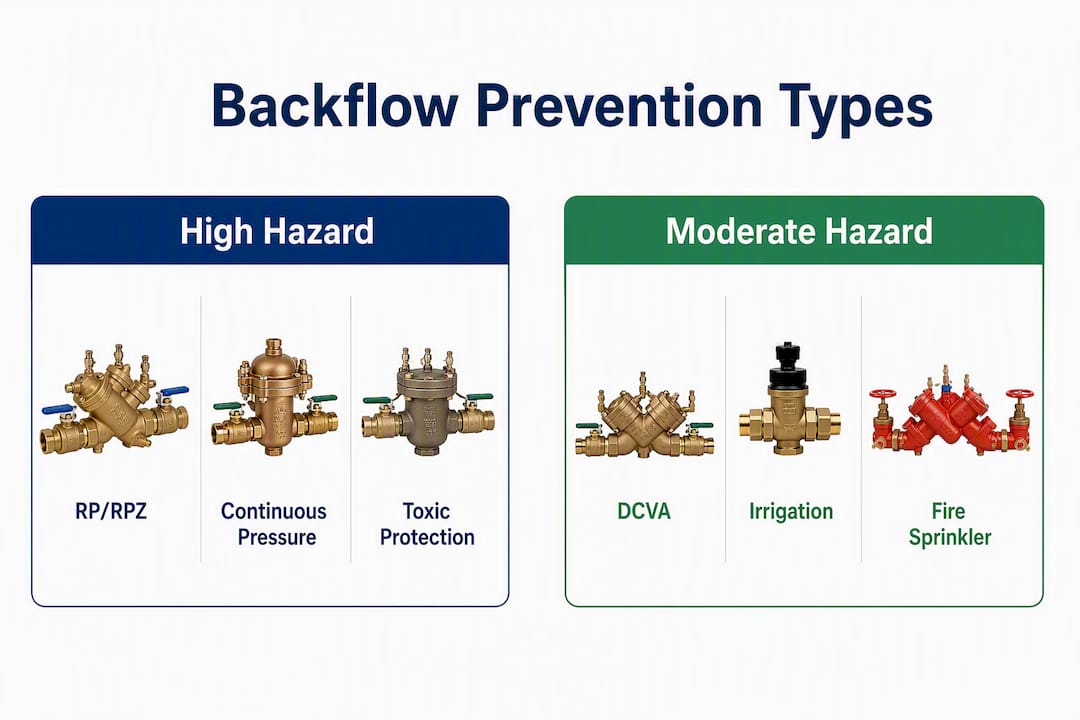
The four assembly types below cover the vast majority of installations on commercial and multi-unit residential properties. Choosing the right one depends on hazard level and location, not brand preference.
Reduced Pressure Principle (RP/RPZ) assembly
The RP assembly is the highest-rated mechanical protection available for continuous-pressure applications. It uses two independently operating check valves separated by a reduced-pressure zone, with a differential pressure relief valve that opens to atmosphere if either check valve fails. That relief valve discharge is the tell: if you see water dripping from the relief port, the assembly is doing its job under stress, but it also needs immediate inspection.
Best for: high-hazard connections where contamination would be toxic or seriously harmful, including boilers with chemical additives, chemical feed systems, fire sprinkler mains connected to non-potable sources, and commercial cooling towers. RP assemblies require annual field testing and must be installed above grade in an accessible, freeze-protected location.
One practical upgrade worth knowing: connected flood control systems like Zurn’s FCIS add 24/7 relief-valve discharge notifications and automatic shutoff to a standard mechanical RP, which is particularly valuable in basement mechanical rooms where an undetected discharge can cause serious water damage before anyone notices.
Double Check Valve Assembly (DCVA)
The DCVA uses two independently operating spring-loaded check valves in series. It provides solid protection against backpressure and backsiphonage but has no relief valve, so it cannot protect against high-hazard contamination. That distinction matters: a DCVA is appropriate for moderate-hazard applications, not anywhere a chemical or biological contaminant could enter the supply.
Typical locations: irrigation systems, HVAC makeup water lines, fire sprinkler systems supplied entirely by potable water, and commercial dishwasher connections. DCVAs are testable and require annual field testing. They are generally more compact than RP assemblies and can be installed in pits or vaults where above-grade placement is not feasible, though local codes vary on this.
Pressure Vacuum Breaker (PVB) and Spill-Resistant Vacuum Breaker (SVB)
The PVB is a non-continuous-pressure device: it must be installed at least 12 inches above the highest downstream outlet and cannot be subjected to backpressure. It protects against backsiphonage only. The SVB is a variation designed to reduce incidental spillage during operation, making it more suitable for indoor installations.
PVBs are the standard choice for residential and light commercial irrigation systems. They are testable, relatively inexpensive, and straightforward to maintain. The critical installation rule is elevation: a PVB installed below the highest sprinkler head provides no protection at all.
Hose-bib vacuum breakers and atmospheric vacuum breakers
These are the simplest devices in the backflow prevention toolkit. A hose-bib vacuum breaker (HBVB) threads directly onto an outdoor spigot or utility sink faucet and prevents backsiphonage when a hose is submerged. Atmospheric vacuum breakers (AVBs) serve a similar function in low-hazard irrigation and fixture applications.
Neither device is testable in the field the way RP or DCVA assemblies are, and neither provides protection against backpressure. For residential backflow protection, hose-bib vacuum breakers are the minimum standard on every outdoor hose connection. They cost a few dollars and take minutes to install, yet they are routinely missing on older properties.
Pro tip from the field: USC field-testing instructional videos cover RP, DC, PVB, and SVB test procedures in detail and are designed to be used alongside the Tenth Edition Manual. If you are evaluating a tester’s competence, ask whether they follow USC test procedures — a qualified tester will know exactly what you mean.
Pro Tip: Never mix up hazard levels when selecting an assembly. Installing a DCVA where an RP is required is a code violation and leaves your property genuinely unprotected. When in doubt, ask your water authority for the required protection level in writing before purchasing any device.
How does USC/FCCCHR approval work, and how do you verify it?
The USC FCCCHR List of Approved Backflow Prevention Assemblies is the U.S. field standard for approved devices. Most state and local water authorities require that any installed backflow prevention assembly appear on this list. Approvals are not permanent: assemblies undergo independent laboratory and field evaluations, and each approval is valid for a three-year period subject to renewal. An assembly that was approved when it was installed may no longer be listed if the manufacturer did not renew, which matters at inspection time.
Practitioners treat the USC List as the field’s approved parts list. Installing any assembly or shutoff valve not on the list can invalidate the approval and cause a municipal rejection of the installation.
Here is how to verify an assembly before purchasing or accepting an installation:
- Go to the USC List — at fccchr.usc.edu/list.html. The list is available in three formats: a web app, a downloadable Excel file, and a PDF.
The three-year approval cycle is not a technicality. It reflects ongoing independent evaluation of whether a device continues to meet performance standards. When you procure a new assembly, verify the current listing — not a catalog page or a distributor’s claim.
Where are backflow devices typically installed, and what do municipalities require?
Backflow prevention devices show up in more places on a typical commercial property than most facility managers expect. Common installation locations include:
- Irrigation system service entrances (PVB or DCVA depending on hazard level and local code)
- Fire sprinkler mains (RP or DCVA depending on whether the system uses additives or non-potable water)
- Boilers and chillers with chemical treatment (RP required)
- Chemical feed and injection points (RP required)
- HVAC makeup water lines (DCVA typically)
- Mechanical room hose stations (hose-bib vacuum breakers at minimum)
- Service entrances for multi-unit buildings (RP or DCVA at the meter, depending on the water authority’s hazard classification)
Before any installation, confirm these requirements with your local water authority:
- Whether the specific assembly model is on the local authority’s accepted list (most reference the USC List, but some jurisdictions maintain their own)
- Permit requirements for new installations or replacements
- Whether installation must be performed by a licensed plumber or a certified backflow assembly tester
- Enclosure and access requirements, particularly for outdoor or below-grade installations
Fire sprinkler compliance carries its own set of requirements in New Jersey. If your property has a sprinkler main, review the NJ fire sprinkler backflow requirements before scheduling any work, since the required assembly type and test frequency can differ from standard domestic service.
Pro Tip: RP assemblies installed outdoors in New Jersey must be protected from freezing. A properly rated heated enclosure is not optional — an RP that freezes and cracks will fail a test and may discharge water into the enclosure or the building. Budget for the enclosure when you budget for the assembly.
Testing, maintenance, and what it actually costs
Most backflow prevention assemblies require annual field testing by a state or locally certified backflow assembly tester, with results filed with the water authority. That is the baseline requirement across virtually every New Jersey municipality. Missing a test cycle is not just a compliance gap — it can trigger a notice of violation and, in some cases, water service interruption.
Here is how a standard annual test and compliance cycle works:
- Pre-test inspection. The tester visually inspects the assembly for physical damage, corrosion, unauthorized modifications, and correct orientation. They confirm the model is on the USC approved list and that shutoff valves are operational.
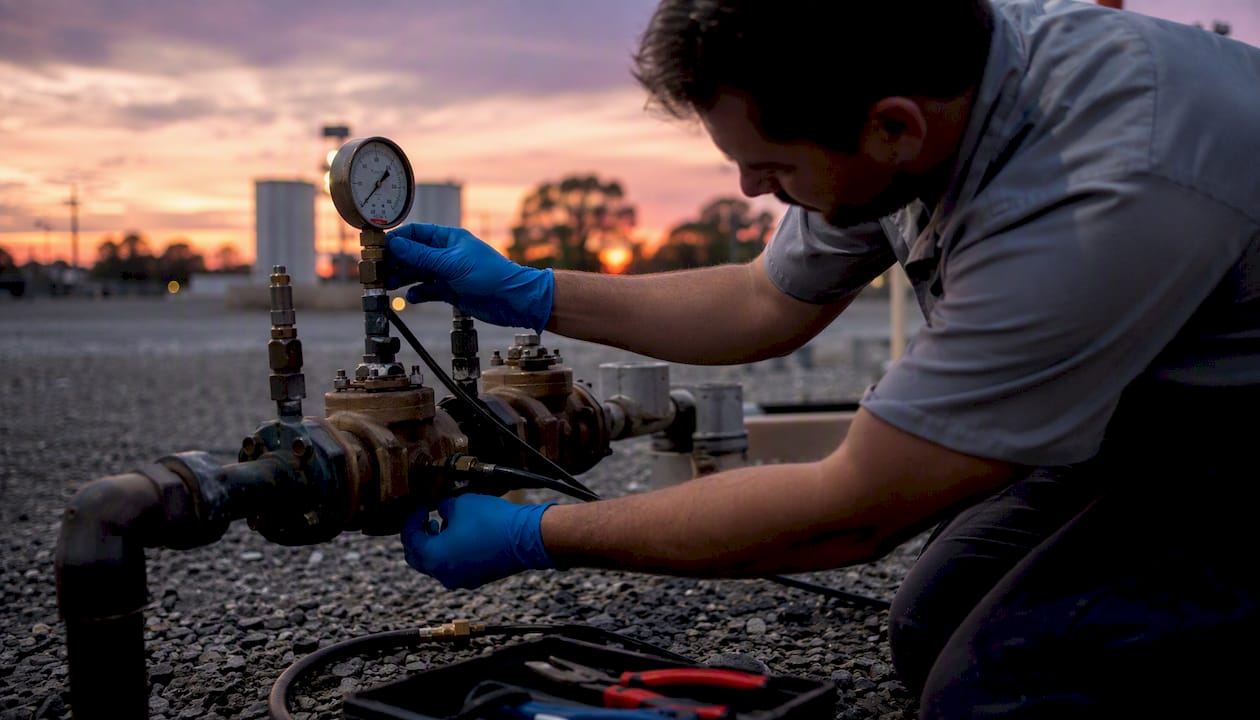
- Field test sequence. Using calibrated backflow test equipment, the tester measures differential pressure across check valves and the relief valve (for RP assemblies), following USC-standardized procedures for the specific assembly type.
- Pass/fail determination. If the assembly passes, the tester records results and prepares the test report. If it fails, the tester documents the failure mode and the assembly must be repaired or replaced before it can be returned to service.
- Repair or replacement. Common repairs include replacing worn check valve seats, springs, or diaphragms. A rebuild is often cost-effective for RP assemblies; replacement makes more sense for older or heavily corroded units.
- Report filing. The completed test report is filed with the local water authority, either directly by the tester or through a backflow management platform. In New Jersey, the report filing process varies by municipality, so confirm the required format and submission method with your water authority.
When verifying a tester’s credentials, confirm:
- Current state or local certification (not just a training certificate)
- Calibration records for their test gauge
- Familiarity with your specific assembly types and local filing requirements
Beyond annual testing, backflow assemblies need periodic maintenance:
- Clean strainers and inlet screens annually or more frequently in systems with sediment.
- Replace internal components (seats, springs, O-rings) on a schedule based on the manufacturer’s guidance and the tester’s findings, not just when a test fails.
- Inspect relief valve ports on RP assemblies for debris or mineral buildup that could prevent proper discharge.
- Rebuild vs. replace: For RP assemblies, a rebuild with OEM parts is often the right call if the body is in good condition. For assemblies more than 15–20 years old with repeated failures, replacement is usually more cost-effective.
Cost ranges vary by assembly type, location, and condition. Testing alone for a single assembly typically runs in the range of $50–$150 depending on the assembly type and local market. Repairs and rebuilds vary widely based on parts and labor. For multi-property portfolios, consolidated billing and scheduling through a service provider can reduce per-unit costs meaningfully.
How do you choose the right assembly for your property?
The selection decision comes down to a few concrete questions, not a brand comparison.
Hazard level first. Ask your water authority how they classify the hazard at each connection point. High-hazard connections require an RP assembly. Moderate-hazard connections may accept a DCVA. Low-hazard, non-continuous-pressure applications may qualify for a PVB or vacuum breaker. Never self-classify a high-hazard connection as moderate to save money on the assembly.
Flow capacity and pressure requirements. An assembly that is undersized for the system’s flow demand will create pressure loss problems. Size the assembly to the service line, not the minimum that fits the pipe.
Location constraints. RP assemblies must be installed above grade and accessible for testing. If your only available space is a below-grade vault, a DCVA may be the code-compliant option, but confirm with your water authority.
Compatibility with existing shutoff valves. The USC List covers shutoff valves as well as assemblies. Replacing an assembly without checking shutoff valve compatibility is a common procurement mistake.
Local code requirements. New Jersey municipalities follow state plumbing code, but individual water authorities can impose stricter requirements. Always confirm the required assembly type in writing before purchasing.
The questions to ask any installer before signing a contract: Is the assembly model currently on the USC approved list? Are you a certified backflow assembly tester in New Jersey? Will you file the test report directly with the water authority? What is your process if the assembly fails the initial test? An installer who cannot answer all four questions clearly is not the right choice.
Red flags to watch for: non-USC-listed models offered at a discount, installers who cannot produce current tester certification, and service providers who hand you the test report and leave the filing to you without confirming the format your water authority requires.
What do cloud backflow management platforms actually do?
Software does not replace field services, but it does eliminate the administrative failures that cause compliance problems: missed test reminders, expired tester credentials, test reports filed in the wrong format, and no audit trail when a water authority asks for records.
The features that matter most for a facility manager running a multi-property portfolio:
- Automated test scheduling and reminders tied to each device’s test due date
- Tester credential verification built into the workflow so an expired certification cannot be used to submit a report
- Offline field data entry so technicians can record results in basements and mechanical rooms without a signal
- Automated report generation in formats that match state and local filing requirements
- Analytics and dashboards showing pass/fail rates, overdue tests, and repair history across the portfolio
BSI Online (Backflow.com) is one example of a cloud-based platform that centralizes test data, verifies tester credentials, automates notices, and handles filings for water purveyors. Platforms like this can transition a program within 60–90 days.
Software reduces administrative burden but is not a substitute for field services. The value comes from integrating the platform with certified testing, repairs, and filing workflows — not from treating it as a standalone compliance solution.
On cost: some comprehensive platforms and service bundles start around $350 per month for full program management. For smaller portfolios, a simpler scheduling and record-keeping tool may be sufficient. The right level of investment depends on the number of devices, the number of properties, and how much administrative time the current process consumes.
When evaluating any platform, require three specific capabilities: offline field data capture, automatic tester credential verification, and report-export formats that match your state and local reporting fields. Those three features are what prevent transcription errors and late filings.
Why USC approval, certified testing, and training are the foundation
The USC FCCCHR approval program is not just a procurement checklist item. It represents independent laboratory and field evaluation of whether a device actually performs as claimed under real operating conditions. The USC Manual of Cross-Connection Control, Tenth Edition, is the authoritative reference for field test procedures, device selection criteria, and program design. Certified testers are trained against these standards, and their test procedures are designed to catch the failure modes the manual documents.
The practical implication: a program built on USC-approved assemblies, tested annually by certified technicians following USC procedures, with results filed with the water authority, is defensible. A program built on non-listed assemblies, tested by uncertified personnel, with incomplete records, is not.
The minimum defensible program for any commercial or multi-unit property includes:
- USC-approved assemblies at every required connection point
- Annual field testing by a state or locally certified backflow assembly tester
- Documented test reports filed with the water authority in the required format and timeframe
- Staff education on what cross-connections are and how to report suspected problems
- A record-keeping system (paper or cloud) that can produce a complete compliance history on request
Education and professional training are as important as the device itself. Correct installation, regular field testing by qualified technicians, and adherence to updated manuals drive program success — device selection alone is not enough.
Key Takeaways
The most defensible cross-connection control program pairs USC-approved assemblies with annual certified testing, documented report filing, and a record-keeping system that can withstand a water authority audit.
| Point | Details |
|---|---|
| Assembly selection by hazard | Use RP/RPZ for high-hazard connections, DCVA for moderate-hazard, PVB/SVB and hose-bib vacuum breakers for low-hazard and non-continuous-pressure applications. |
| USC approval verification | Confirm every assembly model is on the current USC/FCCCHR approved list before purchase; approvals are valid for a three-year period and require renewal. |
| Annual testing and filing | Schedule annual field tests with a state or locally certified tester and file results with your water authority in the required format and timeframe. |
| Cloud platforms for portfolios | Platforms starting around $350/month automate scheduling, credential verification, and report filing for multi-property portfolios. |
| Southjerseybackflow for NJ compliance | Southjerseybackflow handles testing, rebuilding, emergency service, and direct report filing with New Jersey water authorities across multiple counties. |
What most facility managers get wrong about backflow compliance
The conventional wisdom treats backflow compliance as a once-a-year checkbox: schedule the test, get the report, file it, done. That framing is what causes the failures that actually cost money.
The relief valve on an RP assembly in a basement mechanical room can discharge for weeks before anyone notices, if no one is looking for it. By the time the water damage shows up, the repair bill is far larger than any testing fee. Connected monitoring systems address exactly this gap, and they are still underused in most commercial portfolios.
The other thing facility managers consistently underestimate is the credential gap. Not every person who shows up with a test gauge is a currently certified backflow assembly tester. Certification lapses, and some technicians continue working after their credentials expire. A test performed by an uncertified tester is not a valid test in the eyes of your water authority, regardless of whether the assembly passed. Verifying credentials before the appointment, not after, is the move.
There is also a procurement trap worth naming: non-USC-listed assemblies are sometimes offered at a meaningful discount, and the pitch is that they “meet the same standards.” They may or may not. What they definitely do not have is independent third-party verification of that claim. A water authority inspector who sees a non-listed assembly will not accept the installer’s assurance as a substitute for the USC listing.
The program that actually holds up is not complicated. USC-approved assembly, certified tester, filed report, documented records. The tools exist. The standards are clear. The gap is almost always execution.
Southjerseybackflow handles NJ compliance from test to filing
Skipping the administrative complexity of backflow compliance is exactly what Southjerseybackflow delivers for property owners and facility managers across New Jersey. Rather than coordinating a tester, tracking filing deadlines, and confirming your water authority received the report, you hand that off to a team that does it daily.
Southjerseybackflow provides backflow preventer testing, certification, repair, rebuilding, and enclosure installation for residential, commercial, and multi-unit properties. Test reports are filed directly with the water authority, so you are not left wondering whether the paperwork landed. Emergency service is available when an assembly fails outside a scheduled visit. Service covers Ocean, Mercer, Salem, Gloucester, Cumberland, Middlesex, Hunterdon, and Atlantic counties, among others.
When you book, have the assembly model number, installation location, and last test date ready. If you received a compliance notice from your water authority, the NJ backflow compliance guide walks through exactly what the test, submission, and filing process looks like. For properties in Ocean County or Mercer County, schedule service directly through the county page to confirm availability.
Authoritative sources and where to find local rules
When you need to verify an assembly, look up local requirements, or confirm filing procedures, go directly to primary sources:
- USC Foundation for Cross-Connection Control and Hydraulic Research: Approved Assemblies List — the primary U.S. source for approved assembly verification, available in Excel, PDF, and web app formats.
- USC FCCCHR Training Tools — the Tenth Edition Manual, field-testing videos, model ordinances, and slide decks for certified testers and program administrators.
Pingback: 30–60 Day Setup: Consolidated Backflow Billing for Property Managers