
TL;DR:
- Annual inspections verify an asset’s safety, compliance, and serviceability to prevent costly failures. Proper documentation and timely filing with authorities are as important as the physical checks, especially for regulated assets like aircraft and backflow preventers. Regular inspections support safety, regulatory compliance, and long-term financial planning.
An annual inspection verifies an asset’s safety, regulatory compliance, and serviceability so you can manage risk and plan repairs before small problems become expensive ones. Whether you own a Cessna, a rental property, a commercial sprinkler system, or a backflow preventer in New Jersey, the yearly inspection is the single most reliable mechanism for catching what daily use hides.
Quick takeaways:
- Annual inspections are legally required for most general aviation aircraft under FAR Part 43 and Part 91, and for backflow preventers and fire protection systems under local water authority and NFPA guidance.
- Missing an inspection or failing to file the resulting report can trigger denied insurance claims, municipal citations, or grounded assets regardless of actual equipment condition.
- The inspection report and logbook entry are as legally significant as the physical checks themselves.
- For NJ property owners, timely backflow test filing with local water authorities is a compliance step, not optional paperwork.
- Start now: locate your most recent inspection report, confirm its filing status, and schedule the next one before the calendar window closes.
Table of Contents
- What does an annual inspection actually cover?
- Why annual inspections matter: safety, compliance, and money
- What happens during an annual inspection?
- Who is qualified to perform an annual inspection?
- How often should you schedule inspections?
- Records, certificates, and filing: what to keep and why
- Typical costs and how to budget
- What inspectors commonly find, and what happens if you skip the inspection
- A pre-inspection checklist for owners
- How inspections support risk management and asset lifecycle planning
- Key Takeaways
- Why the paperwork is the inspection
- Southjerseybackflow handles NJ backflow testing and filing for you
- Authoritative sources and further reading
What does an annual inspection actually cover?
An annual inspection is a structured, documented evaluation of an asset’s condition, safety, and compliance status, conducted at least once every 12 months by a qualified professional. The word “annual” is precise: for aircraft, the FAA measures it by calendar month, not flight hours. For backflow preventers in New Jersey, local water authorities set the filing deadline. For homes and commercial properties, the cadence is a best-practice standard enforced through insurance requirements and municipal codes.
What the inspection covers depends entirely on the asset:
- Homes and rental properties: A licensed home inspector reviews structural components, roofing, HVAC, plumbing, and electrical systems. Per InterNACHI guidance, an annual maintenance inspection for current owners is distinct from a buyer’s inspection. Its purpose is monitoring system condition over time and prioritizing repairs before they escalate.
- Backflow preventers: — Certified testers check valve function, pressure differentials, and seal integrity. In New Jersey, the test report must be filed directly with the local water authority.
- Heavy equipment: Manufacturers and OSHA standards set inspection intervals for cranes, aerial lifts, and similar machinery. OSHA aerial lift guidance requires pre-use and periodic inspections to confirm safe operation.
When “annual” is a legal mandate versus a best-practice recommendation depends on the asset and jurisdiction. For aircraft and backflow devices in NJ, it is a hard legal requirement with enforcement teeth. For homes, skipping it is legal but financially risky.
Why annual inspections matter: safety, compliance, and money
The primary purpose of any inspection is to identify safety discrepancies, confirm legal compliance, and verify that an asset remains in serviceable condition. Those three roles are not interchangeable. Each one addresses a different kind of risk.

Safety is the most obvious. A corroded brake line, a failed backflow check valve, or a cracked aircraft spar are not visible during normal operation. Inspections find them before they cause harm.
Regulatory compliance is where most owners underestimate the stakes. For commercial and multi-unit properties, missing documented inspection reports during audits or after system failures can result in denied insurance claims or regulatory fines regardless of actual equipment condition. The equipment may be perfectly functional. Without the paperwork, you cannot prove it.
Financial impact is the third driver. Inspections catch early-stage defects that cost far less to fix than the emergencies they prevent. Plumbing leaks found during a routine home inspection cost a few hundred dollars to repair. The same leak discovered after it has damaged flooring, framing, and drywall costs several times more. The same logic applies to aircraft, where deferred maintenance compounds quickly.
Top benefits of keeping inspections current:
- Reduced emergency repair costs through early detection
- Defensible documentation for insurance audits and claims
- Maintained asset resale or appraisal value
- Regulatory standing with municipal authorities and the FAA
- A longitudinal condition record that supports phased budget planning
What happens during an annual inspection?
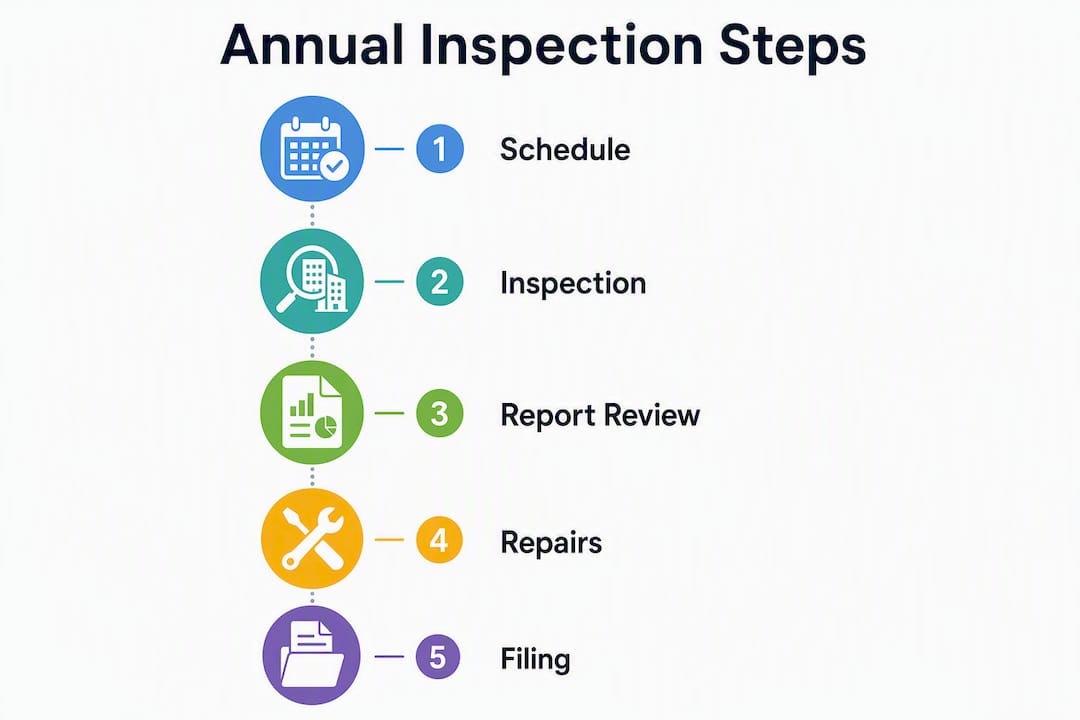
Most inspections follow a consistent sequence, even when the asset type differs. Here is the typical flow:
- Intake and records review. The inspector collects previous inspection reports, maintenance logs, and any known-issue notes from the owner. For aircraft, this means reviewing logbooks and verifying compliance with Airworthiness Directives. Aviation maintenance professionals consistently stress that documentation review is as critical as the physical checks. Missing paperwork can ground an aircraft even when every mechanical item passes.
- Visual inspection. The inspector walks the asset, checking for obvious damage, corrosion, leaks, and wear. For homes, this covers the exterior envelope, roof, and visible mechanical systems. For backflow devices, it includes the valve body, test cocks, and shutoff handles.
- Access and disassembly where required. Aircraft inspections typically require cowling removal and access panel work to reach hidden components. Backflow testing requires isolating the device and connecting differential pressure gauges. This phase is diagnostic, not corrective. Repairs come later.
- Functional testing. The inspector runs the system under controlled conditions. For backflow preventers, this means a differential pressure test across each check valve. For sprinkler systems, it means flow tests and alarm verification. For vehicles, it means brake performance and emissions checks.
- Findings categorization. Results fall into: pass/serviceable, discrepancies requiring immediate repair, recommended maintenance items, and conditional or grounding actions for safety-critical systems.
- Report and sign-off. The inspector documents findings in a written report. For aircraft, the IA endorses the logbook. For backflow devices in NJ, the certified tester files the test report with the local water authority.
Pro Tip: When you receive the inspection report, read the findings section before the summary. Inspectors sometimes list a “recommended” item that is actually safety-critical but phrased conservatively. If anything is flagged as requiring repair before next operation, treat it as mandatory, not optional.
Who is qualified to perform an annual inspection?
Credentials vary by asset, and hiring the wrong inspector can invalidate the entire inspection legally.
- Aircraft: An A&P mechanic with Inspection Authorization (IA). The IA sign-off in the aircraft logbook within the preceding 12 calendar months is required for airworthiness. No IA endorsement means the aircraft is not legally airworthy, period.
- Homes: A certified home inspector, ideally holding an InterNACHI credential or equivalent state license. InterNACHI’s standards of practice are widely recognized by insurers and real estate attorneys.
- Vehicles: A state-licensed inspection station. In New Jersey, the Motor Vehicle Commission designates authorized inspection facilities.
- Fire sprinkler systems: An NFPA-qualified fire protection inspector or a licensed fire suppression contractor. Credentials should align with NFPA 25 requirements.
- Backflow preventers: A certified backflow tester holding a valid state or local certification, plus a plumbing license where required. In New Jersey, testers must be certified and their reports must be filed directly with the local water authority.
Before hiring any inspector, ask:
- What license or certification do you hold, and is it current?
- Do you carry errors-and-omissions and general liability insurance?
- Can you provide a sample report so I know what I’m getting?
- For backflow and fire systems: do you file the report directly with the relevant authority, or do I have to do that myself?
Walk away from any inspector who cannot produce a written report, cannot verify credentials on request, or has no proof of insurance. An unverifiable inspection is worse than no inspection in a regulatory or insurance dispute.
How often should you schedule inspections?
“Annual” is the baseline, but several asset types require additional periodic checks layered on top.
- Backflow preventers: — Annually, per most NJ municipal water authority requirements. Some high-hazard commercial connections require more frequent testing.
- Commercial vehicles: The FMCSA requires annual inspections for commercial motor vehicles under 49 CFR Part 396.
Practical scheduling tips: set a calendar reminder 60 days before each inspection deadline, not 7. Align inspections with seasonal downtime when possible (aircraft in late fall, irrigation backflow devices before spring startup). For multi-device commercial properties, coordinate all inspections in a single visit to reduce per-visit overhead and disruption.
Records, certificates, and filing: what to keep and why
Documentation is where many owners lose compliance status even when the physical inspection went fine. Here is what each asset type requires:
- Aircraft: Logbook entries signed by the IA, including the date, aircraft total time, and a statement of airworthiness. Airworthiness Directive compliance records must also be current and accessible.
- Backflow preventers (NJ): A completed test report filed with the local water authority. Missing or delayed filing after a failed test can result in municipal enforcement actions and complications with insurance. The filing, not just the test, is the compliance event.
- Fire sprinkler systems: Annual inspection reports per NFPA 25, retained on-site and available for fire marshal review. Five-year test reports require separate documentation.
- Homes: Inspection reports, contractor invoices for any repairs, and warranty documents for replaced systems. These support insurance claims and protect you in a future sale.
Store digital copies in a named folder structure (asset name, inspection type, year) and keep physical copies in a binder at the property. Retention periods vary, but keeping records for at least five years covers most insurance and regulatory lookback windows.
Pro Tip: For NJ backflow devices, confirm with your tester that the report has been filed with the water authority before you consider the inspection closed. A test completed but not filed is a compliance gap. Southjerseybackflow files reports directly with local authorities as part of the service.
For broader recordkeeping practices, professional home watch documentation guidance offers a useful framework for organizing inspection records across multiple properties.
Typical costs and how to budget
Inspection costs vary by asset complexity, required disassembly, regional labor rates, and whether the work is scheduled or emergency. General ranges to plan around:
- Home inspection: Typically $300–$600 for a standard single-family home, more for larger properties.
- Aircraft annual: Ranges widely based on aircraft type and condition, from roughly $1,000 for a simple single-engine piston to several thousand dollars for complex or turbine aircraft. Parts and repairs are billed separately.
- Backflow preventer test: Generally $75–$200 per device for a scheduled test in NJ, with repair costs added if the device fails.
- Fire sprinkler annual: Varies by system size; commercial systems typically run several hundred dollars per visit.
A practical budgeting checklist:
- Inspection fee (get a written quote before scheduling)
- Repair contingency: budget 20–30% of the inspection fee as a baseline for minor findings; more for older assets
- Permit and filing fees where applicable
- Seasonal surge pricing: inspections booked at peak times (spring for backflow, pre-winter for HVAC) often cost more
Pro Tip: Always get a written repair estimate before authorizing any corrective work found during the inspection. The inspection and the repair are separate transactions. A reputable inspector will not pressure you to approve repairs on the spot.
For multi-property managers, consolidated inspection contracts reduce per-visit costs and simplify scheduling. Ask vendors about volume pricing when you manage more than three or four properties.
What inspectors commonly find, and what happens if you skip the inspection
Common findings across asset types:
- Homes: Roof wear, plumbing leaks, HVAC filter neglect, electrical panel issues, and moisture intrusion in crawlspaces
- Aircraft: Corrosion on control cables, worn brake pads, oil leaks, cracked exhaust components, and logbook noncompliance
- Backflow devices: Failed check valves, seized relief valves, corroded test cocks, and pressure differentials outside acceptable ranges
- Fire sprinkler systems: Closed or obstructed control valves, corroded heads, and inadequate water pressure at test points
- Vehicles: Worn brake components, tire tread below minimums, inoperative lights, and emissions failures
Each finding maps to a consequence. A failed backflow check valve requires repair before the device can be certified. A closed sprinkler valve is an immediate life-safety issue. A logbook gap grounds an aircraft. Deferred findings do not disappear; they compound.
Skipping the inspection entirely is worse. Without a current inspection record, you lose insurance coverage for related claims, face regulatory citations, and lose the condition history that lets you plan repairs. Repeated annual inspections build a year-over-year record that turns surprise failures into predictable maintenance events. That longitudinal view is where the real financial value accumulates.
A pre-inspection checklist for owners
Arriving prepared cuts inspection time and often reduces fees. Before the inspector shows up:
- Gather your last two inspection reports and any repair invoices since the previous inspection
- Clear physical access to all devices, panels, and systems being inspected
- Compile maintenance receipts for any work done since the last inspection
- For aircraft: have logbooks open to the last annual entry
- For backflow devices: locate the device, confirm shutoff valve accessibility, and note any recent pressure issues or water quality complaints
- Note any symptoms you have observed: unusual sounds, pressure drops, warning lights, or visible damage
- Confirm site safety: clear pathways, adequate lighting, and any necessary permits for access
Questions to have ready for the inspector: What is the expected turnaround for the report? Will you file directly with the relevant authority? If repairs are needed, what is the estimated timeline and cost range? Does any finding affect the asset’s operational status immediately?
Pro Tip: For properties with multiple backflow devices, schedule all of them in a single visit. The per-device cost drops, the filing happens in one batch, and you have one compliance date to track instead of several.
Use Southjerseybackflow’s water system safety checklist to prepare NJ backflow devices before the tester arrives.
How inspections support risk management and asset lifecycle planning
The regulatory framework behind annual inspections is not arbitrary. Each standard exists because the failure mode it addresses has caused documented harm.

FAR Part 43 and Part 91 require that most general aviation aircraft undergo a complete annual inspection within the previous 12 calendar months. The IA must endorse the aircraft logbook; without that entry, the aircraft is not legally airworthy regardless of its physical condition. AOPA’s guidance reinforces that logbook endorsement is as important as the physical checks for airworthiness and legal operation.
For fire protection systems, NFPA 25 governs inspection, testing, and maintenance of water-based fire protection systems. Annual inspections address visible components and system readiness. Five-year inspections examine internal piping and hydraulic performance. These two inspection types serve different roles and neither substitutes for the other in a compliant maintenance program.
In New Jersey, backflow preventer testing and filing requirements are enforced at the municipal level, with NJDEP oversight of cross-connection control programs. Complying with NJ backflow inspection requirements means not just testing the device but filing the report with the local water authority on time. A test completed but not filed is treated as noncompliant.
| Asset Type | Governing Standard / Agency | Typical Filed Document |
|---|---|---|
| General aviation aircraft | FAA (FAR Part 43/91) | Logbook entry with IA endorsement |
| Backflow preventer (NJ) | Local water authority / NJDEP | Certified test report filed with municipality |
| Fire sprinkler system | NFPA 25 / local fire marshal | Annual inspection report; separate 5-year test report |
| Commercial motor vehicle | FMCSA (49 CFR Part 396) | Annual inspection report retained with vehicle |
| Residential home | State licensing boards / insurers | Inspection report retained by owner |
The highest value from annual inspections comes from building a longitudinal condition history. Year-over-year comparison lets owners plan phased repairs and budget rather than react to catastrophic failures. That record also functions as evidence in insurance disputes and regulatory audits, where the burden of proof falls on the owner.
For NJ property owners, understanding backflow inspection requirements and keeping filed test reports current is the most direct way to stay ahead of municipal enforcement.
Key Takeaways
Annual inspections protect safety, preserve regulatory standing, and reduce lifetime ownership costs when owners treat them as a planning tool rather than a compliance chore.
| Point | Details |
|---|---|
| Safety and compliance are both required | Inspections verify physical condition AND generate the documentation that proves compliance to regulators and insurers. |
| Filing matters as much as testing | For NJ backflow devices and fire systems, an unfiled or late report creates a compliance gap even when the device passes. |
| Credentials determine legal validity | Only an IA-endorsed logbook makes an aircraft airworthy; only a certified tester’s report satisfies NJ backflow requirements. |
| Inspections reduce long-term costs | Early defect detection through routine checks costs far less than emergency repairs or insurance claim denials. |
| Southjerseybackflow for NJ backflow | Southjerseybackflow tests, certifies, repairs, and files reports directly with NJ water authorities for residential and commercial properties. |
Why the paperwork is the inspection
Most owners focus on whether the asset passed or failed. The more experienced view is that the report and its filing status are the inspection. A backflow device that passed but whose report was never filed with the municipality is, from a compliance standpoint, an uninspected device. An aircraft whose logbook lacks an IA endorsement is unairworthy on paper regardless of its mechanical condition.
This distinction matters because enforcement and insurance decisions are made on documentation, not on the actual state of the equipment. A fire marshal, an insurance adjuster, or an FAA inspector will ask for the record first. If the record does not exist or is incomplete, the physical condition of the asset becomes secondary to the paperwork gap.
The practical implication: treat filing and recordkeeping as part of the inspection itself, not as administrative follow-up. When you hire an inspector or tester, confirm upfront that report submission to the relevant authority is included in the service. If it is not, either negotiate it in or handle it yourself the same day the report is issued. Waiting creates risk.
Southjerseybackflow handles NJ backflow testing and filing for you
Property managers and owners across New Jersey who need annual backflow testing done right the first time use Southjerseybackflow. The service covers testing, certification, repair, and direct filing of test reports with local water authorities, so you never have to track down a municipality’s submission portal or wonder whether your compliance window is still open.
Southjerseybackflow works with residential homeowners, landlords, and commercial property managers across New Jersey, including Ocean County, Mercer County, Gloucester County, and surrounding areas. If you received a backflow compliance letter from your municipality, that is the clearest signal to act now. Schedule your annual backflow test, get the device certified, and let Southjerseybackflow file the report directly with your water authority. Contact Southjerseybackflow to book a test or get a quote for your property.
Authoritative sources and further reading
- AOPA — Aircraft Inspections and Logbook Requirements: Practical guidance for aircraft owners on what annual inspections involve and why logbook endorsements carry legal weight.
- InterNACHI — Annual Home Maintenance Checkup: Standards and rationale for annual home maintenance inspections, including how they differ from buyer’s inspections and how they support long-term asset management.
- Southjerseybackflow — Backflow Testing in New Jersey: NJ-specific guidance on backflow testing, report submission, and staying compliant with local water authority requirements.