
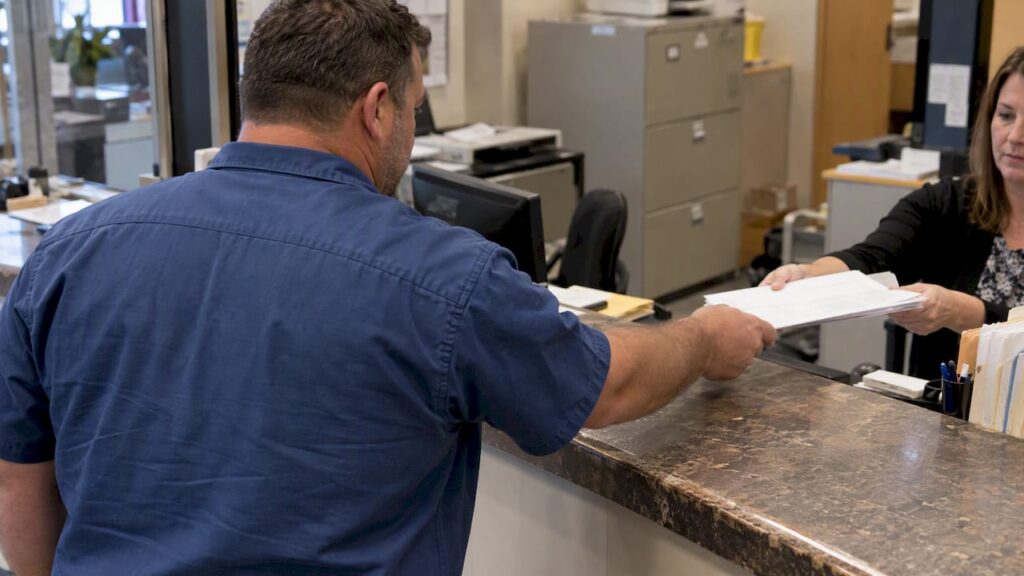
Yes, replacing a backflow preventer in New Jersey takes a permit. The state’s Division of Codes and Standards says a plumbing permit is required for backflow preventer replacements under the Uniform Construction Code (UCC). The permit is pulled through your local construction office, not the state. The new device must then be tested by a certified tester before final inspection. A separate state permit from the Department of Environmental Protection (NJDEP) applies only to certain commercial and industrial connections.
This guide walks through who needs what, in what order, and where owners and property managers most often go wrong.
TL;DR
- Every backflow preventer replacement needs a plumbing permit from your municipality’s construction office under the UCC. Fire service lines are filed under the Fire Protection Subcode instead.
- The new device must be field tested by a certified tester before final inspection. Testable devices are then retested annually, with a few exceptions for one- and two-family homes.
- The NJDEP Physical Connection Permit is a separate, state-level permit. It generally does not apply to private residences, but it often applies to commercial and industrial sites.
- The owner stays responsible for the paperwork, even when a contractor does the work. Ask who files what before you sign.
- Fees and extra rules vary by town, so call your local code office before you schedule.
Table of Contents
- Why a replacement needs a permit at all
- Two permit systems, and which one is yours
- Step by step: replacing a backflow preventer in New Jersey
- Who is allowed to test the new device
- What the test actually covers
- Annual testing after the replacement
- Residential, commercial and multi-unit: what changes
- Costs to expect
- Our perspective: replace only when you have to, and file it right
- How we can help
- Common mistakes to avoid
- FAQ
- Sources
Why a replacement needs a permit at all
A backflow preventer protects the public water supply. It keeps water from your irrigation system, boiler, fire sprinklers or process equipment from flowing backward into the municipal main. Because a failed device is a public health risk, New Jersey treats a swap as plumbing work, not a like-for-like part change.
The rule comes from the Uniform Construction Code. DCA Bulletin 99-2 references N.J.A.C. 5:23-2.23(l) and the Plumbing Subcode and says devices that fail their tests must be repaired or replaced to restore compliance. A replacement is also not a quick fix you can skip paperwork on. The permit creates the record that an inspector checked the installation and a qualified person tested it.
A rebuild is different from a replacement in practice. Swapping internal parts such as seats, springs and discs is a repair that restores a device to working order. Replacing the entire assembly is the permitted installation. If you are unsure which one your device needs, the tester’s failed-test report will usually point to the answer. Ask the tester to say so in writing, because your code office may ask.

Two permit systems, and which one is yours
This is where most confusion starts. New Jersey runs two separate systems that both touch backflow devices.
| Plumbing or fire subcode permit | NJDEP Physical Connection Permit | |
|---|---|---|
| Who issues it | Your municipal construction office | NJDEP, Bureau of Safe Drinking Water |
| Governs | Physical installation, inspection, testing before final | The cross-connection control program itself |
| Applies to | Every backflow preventer replacement | Commercial and industrial facilities with certain connections to public potable water |
| Private homes | Yes, if you replace a device | Generally no |
NJDEP’s own guidance explains that Physical Connection Permits cover connections between public potable water systems and unapproved water sources, such as auxiliary intakes. Under N.J.A.C. 7:10-10.1, the subchapter sets permit, design and testing requirements for facilities with physical connections to public community water systems. Private residences are exempt from that subchapter, though local plumbing code still applies.
The practical takeaway: a homeowner replacing an irrigation backflow device deals with the town. A restaurant, factory, school or multi-building commercial property may deal with both the town and NJDEP. If you manage commercial properties, find out early which of your buildings hold a Physical Connection Permit.
Step by step: replacing a backflow preventer in New Jersey
1. Confirm what you have
Find the device and read the manufacturer tag: make, model, size, serial number. Note whether it serves irrigation, domestic water, a boiler feed or a fire line. The service type decides which permit section you file under. Also check whether the device has test cocks, which is what makes it testable. A nontestable device is often charged differently by towns.
2. Get the failed test or the reason for replacement
Most replacements start with a failed annual test, a damaged or frozen device, or a code upgrade. Keep the tester’s report. Your water authority or code official may want it, and it documents why the work was necessary.
3. Choose the right subcode
The DCA bulletin explains that a Fire Protection Subcode section applies to dedicated fire services, while a Plumbing Subcode section is used for combination fire and domestic services. It adds that some municipalities require joint plan review by plumbing and fire subcode officials for combination services. If your building has a combined line, ask the office up front so you do not file twice.
4. File the permit with your local construction office
Applications go to the local enforcing agency, usually the construction code office in your township or borough. Expect to provide the property address, owner details, the contractor’s license information, the device type and size, and the scope of work. Many offices now take applications through an online portal, but some still want paper. Your contractor can usually file on your behalf, but confirm who is doing it.
5. Pay the fee
Fees are set by each municipality’s ordinance. As one example, Moorestown’s construction permit fee schedule lists $50 for a testable backflow preventer in a one- or two-family use group and $115 for testable devices in other uses. Your town’s number will differ, and schedules get updated, so check the current one before budgeting.
6. Install, then test
The new device must be installed to code, with proper clearance, drainage for relief-valve discharge types, and access for testing. Then a certified tester performs the initial field test. The DCA bulletin says testers must show qualifications and hold certification from an agency recognized by the state.

7. Final inspection and records
The plumbing or fire subcode official inspects and signs off. Keep the permit, the final inspection record, and the passed test report together, ideally in one folder per device. If your site is under a Physical Connection Permit, make sure the removal of the old device and installation of the new one are recorded with NJDEP too. NJDEP’s answer-links guidance points to its online permitting system for this, and skipping the update can cause trouble at the next renewal.
Who is allowed to test the new device
Not every plumber can sign a backflow test. NJDEP maintains a page of certifying agencies approved to certify backflow device testers under N.J.A.C. 7:10-10.8. A valid certificate from one of those agencies is what qualifies a person to test.
Before you hire, ask for the tester’s current certificate number and issuing agency, and confirm it against the agency’s list. Also ask whether the same company handles the permit filing, the repair parts and the report submission. One company doing all of it avoids the finger-pointing that happens when an installer says the tester will file and the tester says the installer will.
The municipal inspector will not do this for you. According to the same DCA guidance, the inspector’s role is to verify that you used a qualified person, not to perform the test. You, as the owner, remain responsible for making sure the testing and documentation get done.
What the test actually covers
For the initial test, N.J.A.C. 7:10-10.6 sets out inspection and testing procedures for physical connection installations, beginning with a test for tightness under pressure. Your tester will work through the procedure for your specific device type: double check, reduced pressure zone, pressure vacuum breaker and so on.
Fire systems add one more item. The state’s Construction Code Communicator notes that forward flow testing, often required by NFPA 25, needs a physical means to perform the test downstream of the valve. If the plans for a new fire-line device do not include that provision, you can end up with a device that works but fails on paperwork. Raise it before the installer orders parts.
Annual testing after the replacement
Once the new device is in, the testing clock starts. Cherry Hill Township notes that testable backflow preventers are required to be field tested when installed and then retested on a recurring schedule under N.J.A.C. 5:23-2.23(l)4. Check your own township’s page for how it handles reminders and report submission.
One-and two-family homes have a carve-out. The DCA bulletin says testable backflow preventers for one- and two-family dwellings are not required to be tested annually, but they still need the permit if replaced. Some towns and water utilities add their own rules, and an irrigation system tied to a utility program may be tested regardless. Confirm with your local code office rather than assuming.
Residential, commercial and multi-unit: what changes
Single-family homes. The device is usually on an irrigation line or a private fire sprinkler system. Expect a plumbing permit, a modest town fee, an initial test and a final inspection. NJDEP’s Physical Connection Permit generally does not apply.
Commercial properties. More devices, higher stakes, and a better chance that NJDEP rules apply. Maintain an inventory of every device with its location, size, service and last test date. Missed annual tests are a common reason for water shutoff notices.
Multi-unit and managed portfolios. Property managers carry the same obligations building by building. A tracking sheet with permit numbers, test dates and the responsible vendor per property saves hours. Consolidated billing and a single point of contact make this easier to run.
Costs to expect
Three cost lines add up: the municipal permit fee, the device and installation, and the test. Our published ranges at South Jersey Backflow are:
| Service | Published price |
|---|---|
| Residential installation | 300-800 USD one-off |
| Annual residential certification test | 150-250 USD one-off |
| Commercial device testing | 200-450 USD one-off per device |
| Rebuild kit service (residential) | 125-250 USD one-off |
| Protective enclosure installation | 200-500 USD one-off |
Municipal permit fees are separate and set by your town. Final cost depends on device size, access and site conditions, so the ranges above are a starting point. You can see how we describe them on our backflow installing, testing and rebuilding costs page.
Our perspective: replace only when you have to, and file it right
We test and repair devices across New Jersey, and most failed tests we see do not require a full replacement. A fouled check, a worn seat or a cracked spring is often a rebuild, which is quicker and cheaper. That is why we stock OEM parts and aim to finish repairs and rebuilds in the same visit when the device allows it.
When replacement is the right call, the permit is where owners lose time. The device gets installed, nobody pulls the permit, and the problem surfaces months later at a sale, an inspection or an annual renewal. Retroactive permitting is more awkward than getting it right at the start. Our advice is simple: get the failed-test report, ask your code office which subcode applies, and make sure the same party who installs is also clear on who files and who tests.
For property managers, the bigger risk is not any one permit but losing track across buildings. Keep one record per device and one calendar for all of them.
— Jordan
How we can help
If your device failed or you suspect it will, we handle testing, certification, repair, rebuilds and installation for residential, commercial and multi-unit properties in New Jersey, including emergency calls and filing test reports with the water authority. Start with our backflow preventer testing and certification service, or see our custom enclosures if freezing or tampering damaged your device. Questions on price? Our FAQ lists the ranges.
Common mistakes to avoid
- Assuming the plumber files it. Confirm in writing who pulls the permit.
- Mixing up the two systems. A town permit does not replace an NJDEP Physical Connection Permit where one applies, and the reverse is also true.
- Forgetting the NJDEP registry update. If your site is covered, record the removal and the new installation online.
- Using an uncertified tester. The test does not count if the certification is not from an approved agency.
- Skipping forward flow provisions on fire lines. Check this at the design stage.
- Not keeping the paperwork. Permit, inspection sign-off and passed test report should live together.
FAQ
Do I need a permit to replace a backflow preventer in NJ?
Yes. DCA Bulletin 99-2 states that a plumbing permit is required for backflow preventer replacements. You file with your local construction office, and the work is inspected before sign-off.
Does a homeowner need an NJDEP Physical Connection Permit?
Generally no. NJDEP’s guidance exempts private residences under N.J.A.C. 7:10-10.1(e), and the permit is aimed at commercial and industrial facilities. Local plumbing code still applies, so you will still need the town permit for a replacement.
Is backflow testing required every year in New Jersey?
For most testable devices, yes. The state rules call for testing at installation and annually. The DCA bulletin does exempt testable devices in one- and two-family dwellings from annual testing, though some towns or utilities add requirements, so check locally.
Who can test a backflow preventer in NJ?
A tester holding a valid certificate from an agency approved by NJDEP. The department publishes the list of approved certifying agencies, and you can ask any tester for their certificate number and verify it.
Can a repair or rebuild avoid the replacement permit?
Sometimes. If the device only needs new internal parts, it is a repair rather than a replacement, but a full replacement always needs the permit. Ask your code office how it treats rebuilds, since local practice can differ.
Sources
- NJ DCA Bulletin 99-2: Testing of Backflow Preventers
- NJDEP: Physical Connection Permit regulatory guidance
- NJDEP: Certified Backflow Prevention Device Testers
- NJDEP: 2025 answer links for Physical Connection Permit questions
- N.J.A.C. 7:10-10.1, Purpose and scope
- N.J.A.C. 7:10-10.6, Inspection and testing requirements
- NJ DCA Construction Code Communicator, Summer 2025
- Cherry Hill Township: Backflow Preventers
- Moorestown Township: Municipal Construction Permit Fee Schedule