
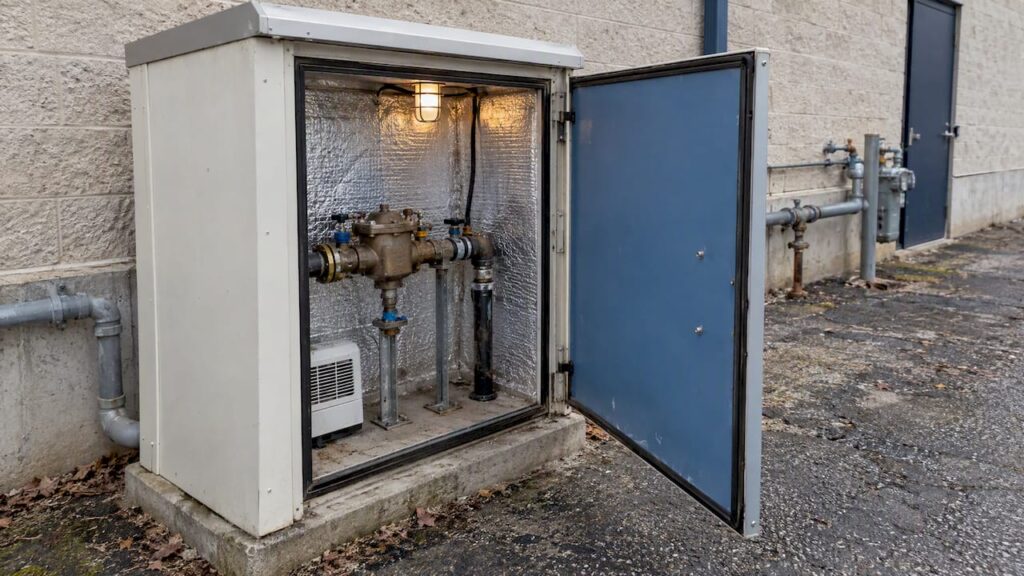
In New Jersey, an outdoor backflow preventer must sit in a heated, insulated enclosure (a “hot box”), never in a pit or vault. It must go on your side of the water meter, as close to the meter as reasonably practicable. A licensed plumber must install it under a plumbing permit, and a certified tester must test it on the schedule that applies to your property. This guide walks through each requirement, the points owners and property managers most often get wrong, and what to confirm before you buy or build an enclosure.
TL;DR
- Outdoor devices need a heated, insulated enclosure. Pits and vaults are prohibited under N.J.A.C. 7:10-10.4.
- Placement: customer’s side of the meter, close to it, ahead of any other connection, horizontal unless the device is certified for vertical use, and 12 to 60 inches above the floor or platform.
- A New Jersey licensed plumber must install the device under a plumbing subcode permit. DIY installation is not allowed.
- The enclosure does not replace testing. Your certificate of compliance is what inspectors ask for.
Table of Contents
- What New Jersey actually requires of the enclosure
- Why pits and vaults are off the table
- Choosing the right enclosure type
- Placement: where to put the device
- Permits and who can install
- Testing: the enclosure does not replace the certificate
- What it costs in South Jersey
- Our perspective: plan the enclosure around the test
- When we can help
- FAQ
- Sources
What New Jersey actually requires of the enclosure
The state does not publish a single page titled “enclosure requirements.” The rules sit inside the installation standards for the backflow device itself, in the Safe Drinking Water Act rules at N.J.A.C. 7:10-10. The NJDEP physical connection checklist summarizes them, and the full text is in the N.J.A.C. 7:10 rule document.
The points that shape any enclosure:
- Outdoors means heated and insulated. When a device is installed outside, it must be housed in a heated, insulated hot box to prevent freezing.
- No pits or vaults. Installation in a pit or vault is strictly prohibited. Burying the device is not an option, however tempting for appearance or space.
- Horizontal position. Devices go in horizontally unless they are specifically ASSE certified for vertical use.
- Height. The checklist calls for the device to be at least 12 inches above the floor and no higher than 60 inches above the floor or a permanent platform. That range also decides how tall an enclosure must be and whether it needs a base.
- Location. The device goes on the customer’s side of the meter, as close as reasonably practicable, and ahead of any other connection.
The state rules say “heated, insulated.” They do not name a brand or size. Your water purveyor, the utility that serves your address, can add its own preferences, so ask before you order anything.
Why pits and vaults are off the table
A below-grade box is a common request. It hides the device, protects it from lawn equipment and keeps it from freezing. New Jersey still bans it. A device in a pit can flood. The enclosure you want sits above grade, is insulated and has a heat source.
If the existing device sits in a pit or vault, it is a candidate for relocation, not a repair. Expect a plumbing permit for the move (see below).

Choosing the right enclosure type
The enclosure category matters more than the brand. Here is how to think about the options.
| Enclosure type | Best for | Watch out for |
|---|---|---|
| Insulated, heated hot box | Outdoor domestic, irrigation and fire lines in New Jersey winters | Needs a reliable power supply and a heat source sized for the space |
| Insulated cover only, no heat | Mild, short-term protection | Does not match the state’s “heated, insulated” language for outdoor devices, so confirm with your purveyor first |
| Indoor mechanical room or utility room | Devices placed inside the building near the meter | Still needs the height range, clearance for testing, and floor drainage for relief discharge |
| Pit or vault | Nothing | Prohibited |
Three practical features separate a good enclosure from a problem:
- Test access. A tester has to reach the test cocks and shutoff valves. If the enclosure forces a tester to remove half the housing, expect longer visits and more cost every year.
- Drainage. A reduced pressure zone assembly can discharge water when it relieves. The enclosure needs a drain path so it does not flood or freeze in place.
- Power and heat. A heated box depends on electricity. Put the heater setpoint and the enclosure’s rating in writing with your installer. A property-focused article on heater setpoints and NEMA ratings for outdoor equipment shows why specifying those details up front avoids winter failures, even though it is about package kiosks rather than plumbing.
Placement: where to put the device
People also ask where backflow preventers should go. In New Jersey the answer follows the regulation:
- On your side of the meter, so the utility’s equipment stays untouched.
- As close to the meter as is reasonably practicable.
- Before any other tee, branch or connection, so nothing is left unprotected upstream.
“Reasonably practicable” is where owners and utilities negotiate. Utilities often have configuration preferences and the authority to require them. A filing before the state Board of Public Utilities shows how seriously utilities treat their cross-connection control practices. Ask your purveyor for its cross-connection control requirements before the design is final, because its approval is part of the permit process.
A simple placement checklist
- Is the location on the customer side of the meter, and ahead of every branch?
- Is the device horizontal, or certified for vertical use?
- Is the device between 12 and 60 inches above the floor or platform?
- Is there room around it for a tester to work and for relief water to drain?
- Is the power supply for the heater protected and accessible?
Permits and who can install
A plumbing subcode permit is required to install a backflow prevention device in New Jersey, for new installations and for replacements. State law requires the work to be done by a New Jersey licensed plumber. So yes, a licensed plumber can install a backflow preventer, and in most cases must. Homeowner DIY installs are not permitted.
If the device serves a combined domestic and fire system, plumbing and fire subcode officials review the plans jointly. Allow time for that.
Fire lines have another wrinkle. According to a DCA formal technical opinion, a line that serves only the fire system is governed by the water purveyor, often with fire officials. A line serving both domestic and fire needs falls under the Plumbing Subcode. Property managers should confirm which they have before scheduling work. Designs for fire systems should also leave a means for forward flow testing downstream of backflow valves, which affects where the enclosure and its piping can go.

Testing: the enclosure does not replace the certificate
An enclosure keeps a device alive. It does not make it compliant. Compliance comes from testing.
Per DCA Bulletin 99-2:
- Testable devices that isolate cross-connections, such as lawn irrigation, fire protection and industrial process lines, are tested annually.
- Testable devices in one- and two-family dwellings are not required to be tested annually under the current DCA guidance. Your purveyor may still ask for testing, so check.
- The tester must hold a certification from an NJDEP-recognized agency. NJDEP keeps a list of approved certifying agencies.
- The certificate must identify the device type, location, test date and results, and carry the tester’s signature and credentials. A certificate of compliance is valid for one year.
Code officials generally do not test the device. They check that you had it tested by a qualified third party, and may witness the test or ask for the paperwork. A missing or expired certificate is the usual reason for a violation at inspection.
Fire inspection is not a backflow test
Property managers often assume a fire sprinkler inspection covers backflow. It may not. Bulletin 99-2 says fire officials accept a certificate of compliance from a certified backflow tester to satisfy the NFPA 25 requirement, so a forward flow test belongs in the report. Unless the report says the backflow-specific test was done, do not assume it was.
What it costs in South Jersey
Published ranges from our FAQ and pricing pages:
| Service | Published price |
|---|---|
| Protective enclosure installation | $200 to $500, one-off |
| Residential installation | $300 to $800, one-off |
| Annual residential certification test | $150 to $250, one-off |
| Commercial device testing | $200 to $450 per device, one-off |
| Rebuild kit service (residential) | $125 to $250, one-off |
Final pricing depends on the device, the site and the work needed. Our installation, testing and rebuilding cost page explains what moves the number.
Our perspective: plan the enclosure around the test
Most enclosure problems we see are not about the box. They come from decisions made before the box. A device set too low, a heater on an outlet nobody can find, a housing that blocks the test cocks: each one turns a routine annual test into a callout.
Our advice is to design for the tester. Leave room, keep the device in the allowed height range, confirm the drain path and write down the heat source. Then ask your purveyor what it wants before anyone digs or buys. For property managers with several sites, we suggest listing each device, its line type (domestic, fire or combined) and its certificate date in one place, so no site slips past its due date.
We are family-owned, licensed and insured, and we stock OEM parts so most repairs and rebuilds can be done in the same visit. We also file test reports directly with water authorities, which removes one more piece of paperwork from your desk.
— Jordan
When we can help
If your device sits in a pit, freezes every winter or has no enclosure, we can look at it, tell you what the rules mean for your site and quote the work. See our custom backflow preventer enclosures for installations across New Jersey, or our testing and certification service if your certificate is due. You can also start from our home page.
FAQ
Does New Jersey require a heated enclosure for every backflow preventer?
The rule applies to devices installed outdoors, which must be housed in a heated, insulated hot box to prevent freezing. A device installed inside a heated building follows the same placement rules but does not need a hot box. Confirm details with your water purveyor.
Can I put my backflow preventer in a pit or vault?
No. N.J.A.C. 7:10-10.4 prohibits pit and vault installations. If your device is in one, plan to have it relocated above grade by a licensed plumber under a permit.
Do all homes have a backflow preventer?
No. Many homes have them because of an irrigation system, a fire sprinkler line or another cross-connection. Under DCA guidance, testable devices in one- and two-family dwellings are not required to be tested annually, though your utility may set its own rules.
Can a licensed plumber install a backflow preventer?
Yes, and New Jersey requires it. The installer must be a licensed New Jersey plumber and the work needs a plumbing subcode permit. Testing is done separately by a certified tester.
Sources
- NJDEP physical connection permit application and checklist
- N.J.A.C. 7:10 Safe Drinking Water Act rules
- NJ DCA Bulletin 99-2, Testing of Backflow Preventers
- NJ DCA Construction Code Communicator, Summer 2025
- NJ DCA Formal Technical Opinion 7
- NJ Department of Agriculture and DCA permit fact sheet
- NJDEP certified backflow prevention device testers
- NJ Board of Public Utilities filing, December 15, 2016
Pingback: Veterinary Clinic Backflow Requirements in New Jersey