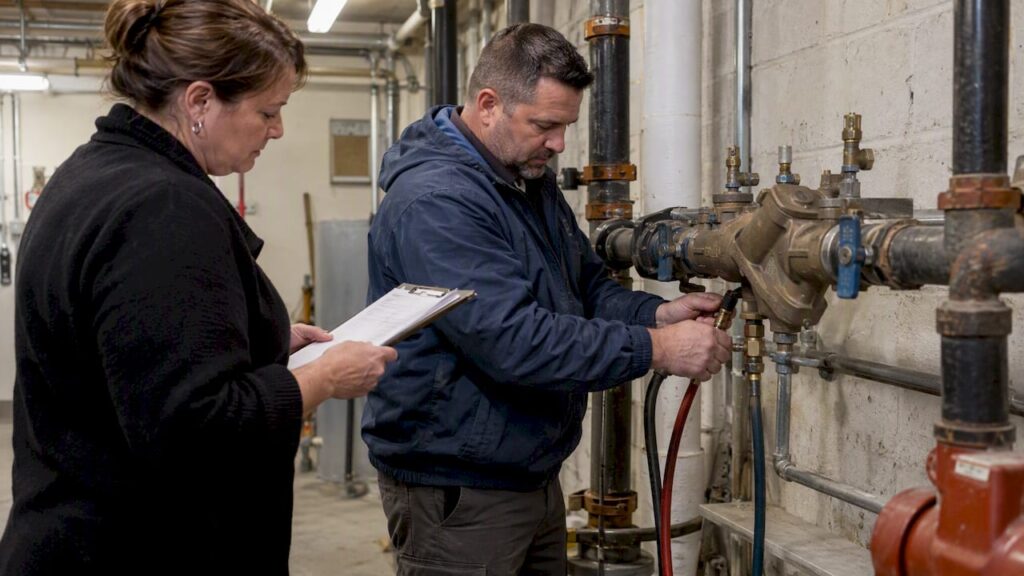
If you own or manage a commercial, industrial, or multi-unit residential property in Atlantic City, you likely need an annual backflow test filed with the Atlantic City Municipal Utilities Authority (ACMUA) and tracked under New Jersey Department of Environmental Protection (NJDEP) permit rules. The single next step is simple: hire a certified backflow tester and confirm where your report needs to land, ACMUA, NJDEP, or both.
TL;DR:
- A Physical Connection Permit can add quarterly NJDEP data entries to annual ACMUA reports; confirm whether both filings apply and verify device identifiers before submission.
- One and two family homes are generally exempt unless irrigation, fire sprinkler lines, or local rules trigger coverage; certified testers must perform required tests.
- Choose the assembly by hazard level, then check its model, shutoff pairing, and orientation against the USC Foundation’s approved list before installation.
- Before test day, provide the latest certificate and clear valve access; schedule outside the coldest stretch because coastal enclosures can freeze or suffer damage.
- After a failed test, notify ACMUA or NJDEP as applicable; larger replacement work may require a permit before repairs and recertification proceed.
Table of Contents
- Which properties must comply and who can perform tests
- Testing frequency, permits, and where to file your report
- Common backflow device types and when they’re required
- How testing works and how to prepare for test day
- If a device fails: repairs, rebuilds, and recertification timelines
- Practical compliance checklist for Atlantic City property managers
- Local Atlantic City rules layered on top of state requirements
- What non-compliance can cost you
- A local view: what actually causes compliance gaps in Atlantic City
- How South Jersey Backflow keeps your properties compliant
- FAQ
- Sources
Which properties must comply and who can perform tests
Backflow rules in Atlantic City follow the pattern used across most of New Jersey. Commercial, industrial, and multi-unit residential buildings generally need a testable backflow preventer and an annual test. One- and two-family homes are usually exempt unless a connection type (like an irrigation system or a fire sprinkler line) triggers a local requirement.
Testing itself has to be done by a certified tester, never by the property owner or a general handyman. Municipal inspectors play a different role: they check that a valid certificate exists or witness the test, rather than performing it themselves.
- Commercial, industrial, and multi-unit residential properties typically require annual testing.
- One- and two-family homes are generally exempt unless a local ordinance or special connection applies.
- Only a certified backflow tester can legally perform and sign off on the test.
If you’re unsure whether your property is covered, a letter from ACMUA or a municipal notice is usually the clearest signal. Property managers who’ve received a backflow letter in New Jersey should treat it as a compliance deadline, not a suggestion.
Testing frequency, permits, and where to file your report
Most testable backflow assemblies in New Jersey need a certified test once a year under the state plumbing subcode. Properties operating under an NJDEP Physical Connection Permit face an added layer: some permits require quarterly data entries tied to the device, not just an annual certificate.
- Schedule your annual test before your certificate expires, not after.
- If your property holds a Physical Connection Permit, check whether quarterly reporting applies and confirm the entry schedule with your tester.
- Submit completed reports to ACMUA for Atlantic City properties, and to NJDEP’s permitting system when a Physical Connection Permit is in place.
- Double-check device identifiers and submission formats before filing. Incomplete or inconsistent entries are the most common reason automated permit renewals stall and require manual processing.
Timely, accurate certified submissions matter beyond avoiding late fees. NJDEP’s permitting system favors consistent data from certified testers, and clean annual filings tend to keep renewals automated rather than kicked into manual review.
Common backflow device types and when they’re required
The device installed at your property depends on the hazard level of the connection. Reduced-pressure (RP) assemblies are standard for high-hazard applications like chemical feed lines and boiler returns, where a backflow event could introduce contaminants directly into the potable supply. Double-check assemblies cover lower-hazard connections, and pressure vacuum breakers (PVB) are common on irrigation systems and certain point-of-use setups.
- RP assemblies: required for high-hazard connections, including many fire suppression systems and chemical feed points.
- Double-check assemblies: typical for lower-hazard commercial connections and multi-tenant buildings.
- PVB assemblies: common for irrigation systems and some point-of-use installations.
Whichever assembly you’re replacing, the model and shutoff-valve pairing should be checked against the Foundation for Cross-Connection Control and Hydraulic Research’s approved assemblies list, which the USC Foundation maintains and updates with orientation, spare-parts, and lead-content requirements. Installing a non-approved part or the wrong orientation can invalidate the approval and force a redo.
How testing works and how to prepare for test day
A certified tester checks each assembly against pass or fail criteria defined by industry standards, confirming tight shutoff and proper pressure differentials across the check valves. The field testing and maintenance procedures referenced by testers across New Jersey come from CSA B64.10 and B64.10.1, which cover selection, installation, and field testing protocols for backflow preventers, including test cock requirements updated in the 2023 edition.
To keep the visit short, have these ready:
- Your most recent test report or certificate.
- Clear, unobstructed access to the valve and any enclosure.
- A site contact who can unlock gates, mechanical rooms, or crawl spaces.
Seasonal timing matters too. Enclosures left exposed over winter are a frequent cause of frozen or damaged assemblies in coastal Atlantic City properties, so schedule testing before or well after the coldest stretch when possible.
Pro Tip: Label your backflow assembly’s location on a site map ahead of the tester’s visit. It shaves real time off multi-building properties.
If a device fails: repairs, rebuilds, and recertification timelines
A failed test doesn’t mean a shutdown, but it does start a clock. Here’s the typical sequence:
- Notify your property’s compliance contact (and ACMUA or NJDEP, depending on your permit status) that the device failed.
- Determine whether the issue needs a simple rebuild kit or a full rebuild. Minor repairs usually don’t require a separate permit, but larger replacement work can be treated as construction and may need a permit before recertification.
- Schedule the repair and a follow-up test as soon as parts are available. Rebuilds and repairs performed same-visit, when stock parts are on hand, shorten the gap between failure and a clean certificate considerably.
High-hazard connections like chemical feed lines or boiler returns tend to have less tolerance for delay, so budgeting for expedited replacement parts on those systems is worth building into your maintenance plan.
Practical compliance checklist for Atlantic City property managers
Staying ahead of backflow compliance comes down to a short set of habits repeated every year.
- Set a 60 to 90 day reminder ahead of your certificate’s expiration date.
- Confirm your tester’s certification before the appointment, not after.
- Keep copies of every test report for the retention period your water authority recommends.
- Check your Physical Connection Permit status and confirm whether quarterly data entry applies.
| Task | Frequency | Who to contact |
|---|---|---|
| Backflow device test | Annual | Certified backflow tester |
| Physical Connection Permit data entry | Quarterly (where required) | NJDEP permitting system |
| Test report submission | Annual, per certificate cycle | ACMUA |
| Permit renewal check | Annual | NJDEP |
If your property is part of a larger portfolio, consolidating multiple sites under one testing schedule cuts down on missed deadlines and mismatched paperwork.
Local Atlantic City rules layered on top of state requirements
NJDEP sets the statewide floor for backflow prevention, but Atlantic City adds its own layer through ACMUA’s role as the local water authority. ACMUA is the contact point property owners and managers deal with directly for submitting annual test reports and resolving compliance questions specific to the city’s water system, separate from whatever NJDEP permit obligations a property might also carry.
In practice, this means two tracks can run at once. A property without a Physical Connection Permit may only need to satisfy ACMUA’s annual reporting expectations. A property with a permit, common for larger commercial or industrial sites, has to satisfy both ACMUA’s local filing and NJDEP’s permit renewal and potential quarterly entries. Municipal plumbing inspectors in Atlantic City typically confirm compliance by reviewing submitted certificates or witnessing the test rather than performing it, which keeps the actual testing work with certified professionals.

The practical takeaway for property managers is to never assume a single filing covers everything. Confirm directly with ACMUA whether your property’s submission satisfies local requirements, and separately confirm with NJDEP whether a permit ties your device to additional reporting. Local installers and testers who already know ACMUA’s expected submission format and required attachments tend to avoid the rejected-filing problems that catch out-of-area contractors off guard.
What non-compliance can cost you
Skipping a required backflow test or letting a Physical Connection Permit lapse creates real exposure, both financial and operational. Municipal and state oversight bodies can issue fines for properties operating without a current, valid test certificate, and in some cases water service itself can be restricted until compliance is restored. For properties with NJDEP permits, a lapsed or incomplete submission can also trigger manual review and delay the automated renewal that timely, accurate filings normally receive.
Beyond the direct fines, non-compliance creates downstream risk. Insurance carriers and lenders increasingly ask for current backflow certification as part of property due diligence, and a gap in records can complicate refinancing, sales, or claims after a water-related incident. For multi-unit or commercial properties, the administrative cost of catching up on missed filings, tracked permits, and overdue inspections usually outweighs the cost of staying current in the first place.
The safest posture is treating your annual test and any quarterly permit entries as fixed calendar items, not optional maintenance. A missed deadline rarely causes an immediate shutdown, but it does start building the kind of paper trail that regulators and inspectors notice during the next review cycle.

A local view: what actually causes compliance gaps in Atlantic City
Most compliance gaps we see in Atlantic City trace back to two things: enclosures left exposed through winter storms near the boardwalk, and multi-site managers juggling mismatched test dates across properties. Consolidating test schedules under one certified tester closes both gaps faster than chasing each building separately.
— Jordan
How South Jersey Backflow keeps your properties compliant
We handle the parts of backflow compliance that eat up a property manager’s time: certified testing, filing reports directly with ACMUA and NJDEP, same-day repairs and rebuilds using OEM parts we stock, and custom enclosures built for New Jersey’s weather. Because we are licensed across the state, we can move fast when a device fails instead of leaving your property in a compliance gap while parts get ordered.
- Certified testing and certification with direct report filing to close your compliance loop.
- Same-day rebuilds and repairs when a device fails a test.
- Custom enclosures to protect assemblies through coastal winters.
If you manage multiple units, our local Atlantic City backflow service page lays out how we coordinate testing across a portfolio on one schedule. For a broader look at tenant and landlord compliance responsibilities tied to property upkeep, RentrIQ’s New Jersey landlord-tenant guide is a useful companion resource. When you’re ready, schedule your test or request a quote and we’ll take the paperwork off your plate.
FAQ
Is backflow testing required in NJ?
Yes, testable backflow preventers in New Jersey generally require an annual test performed by a certified tester, with results reported to the relevant water authority or NJDEP permit system. Coverage depends on property type and connection hazard level, so commercial, industrial, and multi-unit buildings are typically included while single-family homes are often exempt.
What is the NJ plumbing code requirement for backflow preventers?
New Jersey’s plumbing subcode requires testable backflow assemblies at qualifying connections to be tested annually by a certified tester, following field testing and maintenance protocols set out in CSA B64.10.1. Device selection and installation follow CSA B64.10, and approved models must appear on recognized assembly lists.
Is backflow testing required in South Carolina?
Backflow testing requirements vary by state and are set by each state’s own plumbing code and local water authorities, so South Carolina’s rules differ from New Jersey’s and fall outside the scope of NJDEP or ACMUA oversight. Property owners in South Carolina should check with their state plumbing authority or local water utility for the applicable requirement.
Where are backflow preventers required?
Backflow preventers are required at connection points with elevated contamination risk, including fire suppression systems, irrigation lines, chemical feed systems, boiler returns, and most commercial or multi-unit service connections. The specific assembly type, RP, double-check, or PVB, depends on the hazard level of that connection as referenced in the USC Foundation’s approved assemblies list.
Sources
- Foundation for Cross-Connection Control and Hydraulic Research — List of Approved Backflow Prevention Assemblies
- CSA B64.10/CSA B64.10.1 standards (2023 edition)