
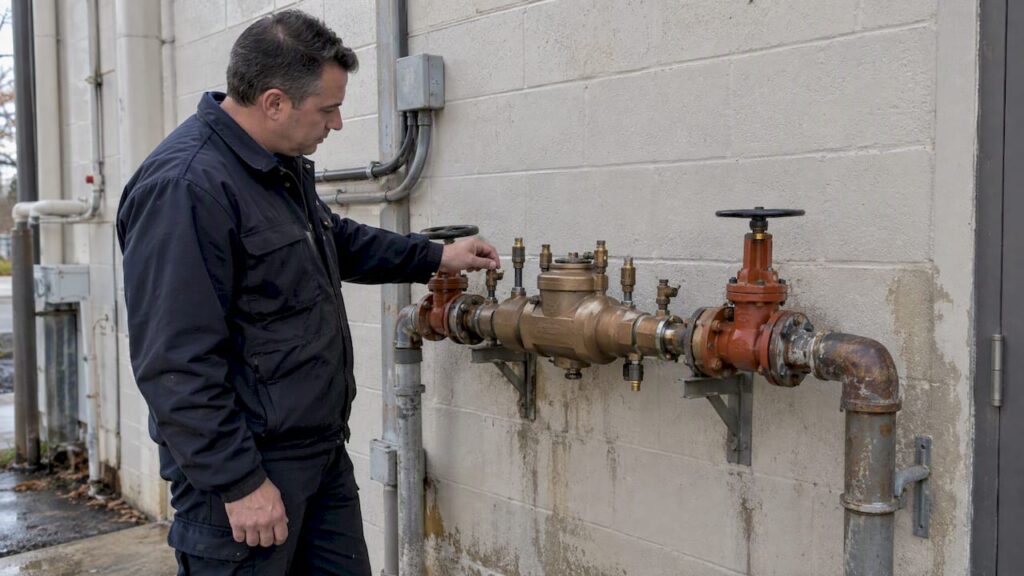
Testable backflow devices are assemblies with test cocks and isolation valves that let a certified tester verify the internal checks still work; non-testable devices have no such ports and are built for low-hazard, end-of-line use only. If your connection poses any real contamination risk, you almost certainly need a testable assembly and an annual test. Start by checking your device for test cocks, or call a certified tester to confirm what you have.
TL;DR:
- Low hazard, end of line uses may allow atmospheric vacuum breakers or dual checks; chemical or medical risks call for an RPZ or air gap.
- Fire sprinkler lines and moderate hazard commercial connections commonly use DCVAs, while irrigation may require a PVB installed above the highest downstream outlet.
- Most jurisdictions require testing every year and after installation, repair, or relocation; failed devices need repair or rebuilding followed by another test and report filing.
- Keep assemblies accessible, observe PVB height rules, and file every test report with the water authority; an unfiled passing test still leaves property noncompliant.
Table of Contents
- What makes a backflow device “testable”
- Common testable devices: RPZ, DCVA, and PVB
- Common non-testable devices and where they’re allowed
- How utilities decide which device you need
- How to tell what device you already have
- What annual testing involves and when to schedule it
- Common mistakes and compliance pitfalls to avoid
- How a certified local tester handles the testing, repair, and filing process
- Why routine testing beats reactive fixes
- Get your device tested, repaired, or certified
- FAQ
- Sources
- Authoritative documents and guidance
What makes a backflow device “testable”
A testable assembly has three features a non-testable device lacks. First, test cocks (small valved ports) let a technician attach a differential pressure gauge and measure how the internal checks are performing. Second, shutoff or isolation valves on the inlet and outlet let the tester take the assembly offline without shutting down the whole building’s water. Third, the internal mechanical parts, springs, check disks, and on reduced-pressure devices, a relief valve, are built to be inspected and adjusted rather than simply replaced.
These features exist because mechanical parts wear, and a device protecting a high-hazard connection needs proof it still functions, not just an assumption. The EPA Cross-Connection Control Manual frames’ device selection around exactly this idea: verifiability matters most where the degree of hazard is highest.
- Test cocks allow gauge attachment for differential pressure readings.
- Isolation valves let the assembly be shut down for testing without disrupting water service.
- Internal checks and relief valves are serviceable parts meant for periodic verification, not one-time installation.
Reduced-pressure devices add a relief valve between two check valves, a design the EPA manual notes provides a tertiary layer of protection, which is part of why these assemblies are specified where contaminant backflow would do the most harm.
Common testable devices: RPZ, DCVA, and PVB
Three assemblies cover most testable installations you’ll encounter.
- Reduced pressure zone (RPZ/RPD) assemblies use two independently acting check valves with a relief valve venting between them. If either check fails, the relief valve opens and discharges water rather than letting contamination flow backward. These are the standard choice for high-hazard connections: chemical injection systems, boilers, and certain irrigation setups with fertilizer or pesticide lines.
- Double check valve assemblies (DCVA) use two independent check valves with no relief function. They’re common on fire sprinkler lines and moderate-hazard commercial connections, but they offer less protection than an RPZ and aren’t approved where backflow could introduce a genuine health hazard.
- Pressure vacuum breakers (PVB) are spring-loaded and rated for continuous pressure, which makes them testable, unlike their atmospheric cousins. They’re typically used on irrigation systems and must be installed at a minimum height above the highest downstream outlet, a rule detailed in municipal backflow guidance.
Common non-testable devices and where they’re allowed
Non-testable devices are simpler, cheaper, and intentionally limited in scope. Atmospheric vacuum breakers (AVBs) rely on an air inlet valve that opens when pressure drops, but they cannot be used under continuous pressure and can’t have a shutoff valve anywhere downstream, a constraint that local water authority documents spell out explicitly. Dual check valves and the integrated preventers built into hose-bib fixtures fall into the same category: they stop backflow under normal conditions but have no test cocks, so nobody can verify their internal condition without disassembling them.
- AVBs must sit above the highest outlet and never have a downstream shutoff.
- Dual checks and hose-bib devices suit low-hazard residential uses, like a garden hose or a simple irrigation line.
- None of these devices satisfy a requirement for periodic, verifiable testing.
Non-testable hardware is acceptable precisely because the applications are low-hazard and end-of-line. Once a connection introduces a real contaminant risk, a non-testable device no longer meets the bar.
How utilities decide which device you need
Water authorities don’t pick devices arbitrarily. The EPA’s guidance ties the decision mainly to degree of hazard: a lawn irrigation system with no chemical injection is a lower risk than a commercial boiler loop or a lab sink, and the required device scales with that risk. Piping size, the connection’s location (at the service line versus at the end of a fixture), and the possibility of chemical or biological contaminants all factor into the call.
- Low-hazard, end-of-line connections often allow AVBs or dual checks.
- High-hazard connections, chemical feed, medical, industrial, almost always require an RPZ or an air gap.
- Fire lines and irrigation systems frequently fall in a middle zone requiring a DCVA or PVB.
Utilities generally lean on standards from AWWA, ASSE product standards, and EPA guidance when writing local cross-connection ordinances, so the device your water authority requires is rarely a local invention.
Pro Tip: If your water authority sends a letter specifying a device type, treat that as the minimum requirement, not a suggestion, since it reflects the hazard rating they’ve already assigned to your connection.
How to tell what device you already have
Before calling anyone, a short inspection tells you most of what a tester will need.
- Look for small valved ports (test cocks) near the device body; their presence means it’s testable.
- Check for shutoff valves on both the inlet and outlet side of the assembly.
- Find the manufacturer’s tag or model number stamped or affixed to the device, and note the exact location (basement, yard box, mechanical room).
- If it’s an irrigation device, measure its height above the highest downstream outlet, since vacuum breakers have strict placement rules covered in our installation guide for NJ property owners.
- Photograph the device and any paperwork or notices from the water authority before you contact a tester.
What annual testing involves and when to schedule it
A standard test follows a consistent sequence, and knowing it helps you understand what you’re paying for.
- The tester isolates the assembly using its shutoff valves.
- A differential pressure gauge connects to the test cocks.
- The tester measures pressure differentials across each check, and on an RPZ, confirms the relief valve opens at the correct point.
- Results get recorded and typically filed with the local water authority.
Testing is required annually in most jurisdictions, but also after any installation, repair, or relocation, since disturbing an assembly can shift its internal setpoints. The EPA’s archived testing procedures describe this isolate-gauge-measure-record workflow as the standard across most assemblies. A failed test usually leads to one of two outcomes: an on-site repair if the issue is minor, or a full rebuild if internal parts are worn beyond adjustment, both of which require re-testing and re-filing before the device is considered compliant again. Our page on the importance of regular backflow testing covers what happens if testing lapses.
Common mistakes and compliance pitfalls to avoid
Most compliance problems trace back to a handful of recurring errors.
- Installing a dual check or AVB where the hazard level actually calls for an RPZ.
- Burying an assembly, enclosing it without access, or installing a vacuum breaker below the required height above its outlet.
- Skipping the test after a repair, replacement, or relocation, even though the assembly’s setpoints may have shifted.
- Completing a test but never filing the results with the water authority, which leaves the property technically non-compliant despite the work being done.
Reviewing a plumbing inspection checklist alongside your backflow schedule can help catch these issues before an authority notice does.
How a certified local tester handles the testing, repair, and filing process
Once you know what device you have, the practical next step is testing and documentation. A certified tester isolates the assembly, measures it against ASSE standards, and files the report with your water authority directly. We handle testing and certification, on-site rebuilds when a device fails, and enclosure installation for exposed assemblies, all billed per service visit.

Why routine testing beats reactive fixes
Facility managers who treat backflow testing as a calendar item, not a reaction to a violation letter, avoid almost all the pitfalls above. Build the annual test into your existing maintenance cycle, photograph each device at every visit, and keep a simple file of past results. A certified tester handling the technical verification and the filing removes the guesswork, but the recordkeeping habit is what actually keeps a property compliant year over year.
— Jordan
Get your device tested, repaired, or certified
We test, certify, rebuild, and install backflow assemblies, with same-day service available and compliance reports filed directly with your water authority. Before you call, have your device’s photo, location, and any authority notice on hand so we can give you an accurate quote; current prices are on the pricing page.

- Annual testing and certification for residential and commercial devices.
- On-site rebuilds and repairs using OEM parts when a device fails inspection.
- Custom enclosure installation for exposed or at-risk assemblies.
Check pricing or book a backflow preventer test and certification visit today.
FAQ
What are two types of backflow?
Backflow happens either through backpressure, where downstream pressure exceeds supply pressure and pushes water backward, or backsiphonage, where a drop in supply pressure pulls contaminants into the clean water line. Both scenarios are what backflow preventers, testable or not, are designed to stop.
What are the four types of backflow preventers?
The four most common assemblies are reduced pressure zone (RPZ) devices, double check valve assemblies (DCVA), pressure vacuum breakers (PVB), and atmospheric vacuum breakers (AVB). The first three are field-testable; AVBs are not.
What is the most effective type of backflow preventer?
Reduced pressure zone assemblies offer the strongest protection because they combine two independent checks with a relief valve that discharges water if either check fails, a tertiary safeguard described in the EPA’s cross-connection manual. That design is why RPZs are typically required for high-hazard connections like chemical feed systems or boilers.
What is the main difference between an RPZ and a double check valve?
An RPZ has a relief valve between its two checks that opens and discharges water if either check fails, giving it a built-in failure warning. A double check valve assembly has two checks but no relief valve, so it offers less protection and is limited to moderate-hazard uses like fire lines.
Sources
- EPA Cross-Connection Control Manual
- Common testable backflow devices (municipal guidance)
- AWWA policy: cross-connection control
Authoritative documents and guidance
For readers who want the original source material behind these standards, the EPA Cross-Connection Control Manual and the EPA’s cross-connection fact sheets cover device types and testing rules in detail. AWWA’s policy statement explains the industry position utilities often draw on when setting local requirements.