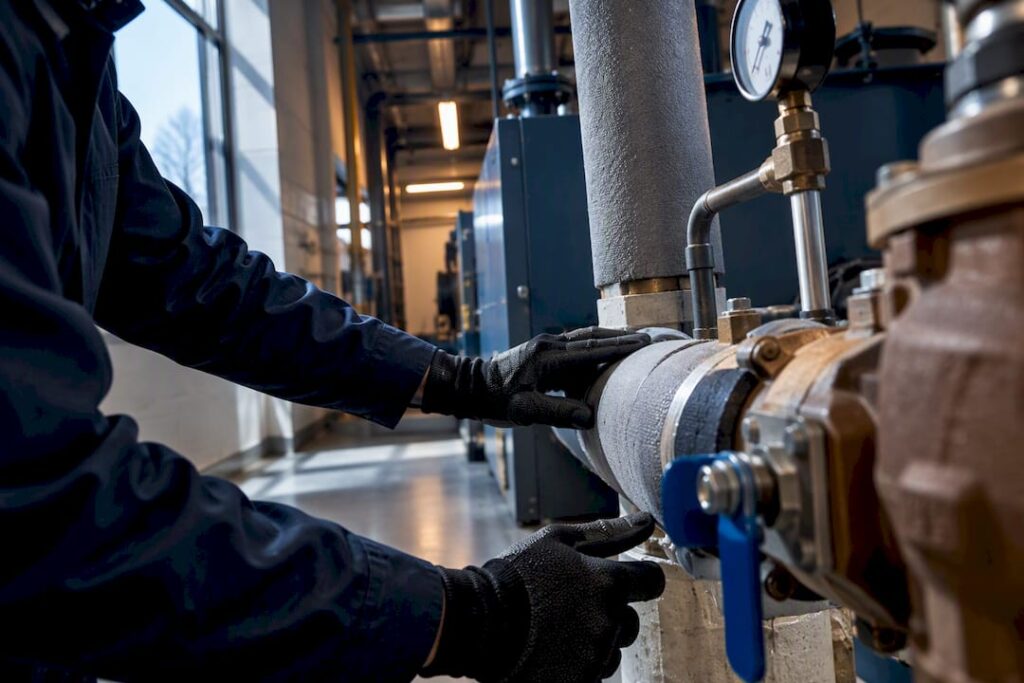
If your boiler installation includes a testable backflow preventer, New Jersey law requires it be tested and certified, typically once a year, with quarterly testing for facilities holding a DEP physical connection permit. Owners should confirm the device is field-testable, hire a certified tester, and submit the resulting Certificate of Compliance to the municipal plumbing subcode official. If a device fails, repairs or replacement must happen before recertification, and a permit may be required first.
TL;DR:
- Most properties should schedule annual backflow preventer testing, but facilities with a DEP physical connection permit may require quarterly testing.
- Only testers certified by an agency recognized by the NJDEP can legally perform the tests, and their certification must be verified beforehand.
- Replacement devices must be installed according to placement and accessibility rules, with repairs requiring recertification before use.
- Property owners must submit a Certificate of Compliance after testing and keep detailed records of test results, permits, and service invoices.
- Private residences are generally exempt from DEP testing, but any connection to higher-risk sources mandates approved backflow assemblies and proper documentation.
Table of Contents
- Which New Jersey laws and agencies set backflow rules for boilers
- Testing frequency and who can legally perform the tests in NJ
- Approved device types and boiler-specific installation notes
- Permitting, placement, and municipal coordination for replacements
- If a device fails: repair, replacement, timelines, and re-testing
- Owner checklist: schedule, documents, and recordkeeping to stay compliant
- Where to find certified testers and how to file test results in New Jersey
- Practitioner perspective: common mistakes and fixes
- South Jersey Backflow services: testing, repairs, and filing
- Sources
- FAQ
Which New Jersey laws and agencies set backflow rules for boilers
Three separate frameworks touch a boiler’s backflow preventer, and mixing them up is the fastest way to miss a deadline. The New Jersey Department of Environmental Protection governs physical connections under N.J.A.C. 7:10-10, setting device standards and permit rules for facilities tied to public water systems. The Plumbing Subcode, N.J.A.C. 5:23, works through the Department of Community Affairs and puts the testing and certification duty on the property owner, with the municipal plumbing subcode official issuing the Certificate of Compliance. The Boiler, Pressure Vessel, and Refrigeration Law, enforced under N.J.A.C. 12:90, covers mechanical safety inspections of the boiler itself and has nothing to do with backflow. DEP’s physical connection rules generally exempt private one- and two-family residences, which is why most single-family homeowners never see a DEP permit even though their commercial neighbors do.
Testing frequency and who can legally perform the tests in NJ
Annual testing is the default for any field-testable backflow preventer, a standard set out in DCA Bulletin B-99-2, which also exempts one- and two-family dwellings from the annual requirement in most cases. Facilities operating under a DEP physical connection permit, or those with recognized cross-connection hazards, may face quarterly testing instead. Only testers certified by an agency recognized by the NJDEP Bureau of Safe Drinking Water may legally perform the test. Municipal inspectors review paperwork; they do not run the test themselves.
A compliant test report typically includes:
- The device make, model, and serial number matched to its location.
- Static and differential pressure readings for each check valve or relief valve.
- The tester’s certification number and the agency that issued it.
- The pass or fail result and, for a fail, the corrective action taken.
Approved device types and boiler-specific installation notes
New Jersey’s approved assemblies fall into two main categories under N.J.A.C. 7:10-10: the double check valve assembly (DCVA) and the reduced pressure zone assembly (RPZ), with detector versions of each required on fire protection lines. An RPZ is generally required where the boiler system connects to a non-potable source or presents a higher contamination risk, since its design vents to atmosphere under failure rather than allowing backpressure into the main. For a boiler’s makeup water line, a simple check valve can satisfy a low-hazard connection, but any line drawing from a source DEP or the local subcode official flags as higher risk needs a full testable assembly, not just a check valve. Installation rules keep things practical: the device sits near the water meter or point of entry, at an accessible elevation with clear test cocks, protected from freezing and flooding, and never installed in a pit. Property owners handling elevation or freeze protection often use a protective enclosure to meet those placement rules without relocating the device.

Permitting, placement, and municipal coordination for replacements
A Physical Connection Permit under N.J.A.C. 7:10-10 is triggered when a facility connects to an unapproved water supply or falls into a category DEP treats as a cross-connection hazard. Replacing a failed device, even a routine swap, generally requires a construction permit from the municipality before work starts. When a boiler and fire suppression line share a combined domestic and fire service, replacement often needs joint review from both the plumbing subcode office and the fire subcode official, which adds time to the schedule. Municipal fees vary by town, and the Certificate of Compliance issued after a passing test is valid for one year under the model reminder forms municipal officials use, so owners should track the expiration date rather than wait for a notice.
If a device fails: repair, replacement, timelines, and re-testing
A failed test puts the legal obligation squarely on the owner: repair or replace the device and obtain any required construction permit before the replacement goes in. Devices protecting fire protection services carry an added restriction, since a replacement can never reduce the fire system’s effectiveness, which sometimes narrows the approved options for that connection. Once repairs are complete, the device needs a fresh test and a new Certificate of Compliance filed with the municipal plumbing subcode official. Skipping this step can bring municipal enforcement action, and a related guide on backflow inspection compliance walks through what that notice process typically looks like.
Owner checklist: schedule, documents, and recordkeeping to stay compliant
A simple annual routine keeps most properties out of trouble:
- Identify every backflow preventer on the property and confirm which are field-testable.
- Check whether the property holds a DEP physical connection permit that shifts testing to quarterly.
- Schedule a tester certified by an NJDEP-recognized agency.
- Confirm the tester’s certification before the visit, not after.
- Collect the signed test report with readings and results.
- Submit the Certificate of Compliance to the municipal plumbing subcode official.
- File the report, permit, and receipts together and keep them for future inspections.
Pro Tip: Set two calendar reminders, one thirty days before the Certificate of Compliance expires and one at renewal, so a missed test never turns into a lapsed certificate.
Recordkeeping matters as much as the test itself. Keep signed test certificates, any construction permits tied to replacements, service invoices, and a running log of test dates in one folder so a municipal request never catches you searching.
Where to find certified testers and how to file test results in New Jersey
Start with the list of certifying agencies NJDEP recognizes and confirm any tester’s certification number against that list before booking. From there:
- Ask the tester for their certification number and issuing agency in writing.
- Submit the completed Certificate of Compliance to your municipal plumbing subcode office.
- Check whether your facility’s DEP permit requires filing through DEP’s online system rather than, or in addition to, the municipal filing.
- Expect the property owner, not the municipality, to cover testing fees.
A breakdown of who’s qualified to test covers the documentation municipalities usually expect alongside the report itself.
Practitioner perspective: common mistakes and fixes
The most common mix-up we see is an owner assuming a passing boiler safety inspection covers backflow compliance. It does not: BB&PVC inspections and backflow certification run on separate tracks with separate paperwork. The second is hiring a tester without checking their certification against the NJDEP list, which can void the report. The third is missing a permit trigger on a device replacement and getting flagged during a routine municipal review. A tester who also files the Certificate of Compliance on your behalf tends to prevent the repeat notices that come from paperwork falling through the cracks.
— Jordan
South Jersey Backflow services: testing, repairs, and filing
Coordinating certified testing, permit filing, and repairs across multiple properties eats up time most managers don’t have. South Jersey Backflow handles the full cycle for New Jersey properties:
- Annual and quarterly backflow preventer testing and certification.
- Rebuilds and repairs for devices that fail inspection, often same-visit.
- Certificate of Compliance filing directly with municipal officials.
- Protective enclosure installation for elevation and freeze-protection compliance.
The company stocks parts for same-day rebuilds and manages the filing so a failed test doesn’t turn into a missed deadline. Start with backflow preventer testing and certification to get your property’s schedule in order.
Sources
Bookmark the NJDEP physical connection permit page, DCA Bulletin B-99-2, the N.J.A.C. 7:10 rule text, and the BB&PVC compliance page to confirm current local requirements before scheduling work.
FAQ
Is backflow testing required in NJ?
Yes, field-testable backflow preventers in New Jersey must be tested and certified, typically once a year under DCA Bulletin B-99-2. One- and two-family dwellings are generally exempt from the annual requirement, while facilities with a DEP physical connection permit may need quarterly testing instead.
Do all boilers need a backflow preventer?
Not every boiler connection requires a testable backflow preventer. A low-hazard makeup water line can sometimes rely on a simple check valve, but any connection to a non-potable or higher-risk source needs an approved assembly under N.J.A.C. 7:10-10.
Is a backflow preventer required by code?
Yes, New Jersey code requires approved backflow assemblies, either a double check valve assembly or a reduced pressure zone assembly, wherever DEP’s physical connection rules or the Plumbing Subcode identify a cross-connection risk. Private residential connections are often exempt from the DEP permit rules that trigger this requirement.
Is backflow testing required every year?
Annual testing is the standard cadence for most field-testable devices under DCA guidance, though one- and two-family homes are generally exempt. Facilities under a DEP physical connection permit may be required to test quarterly instead, so the permit conditions determine the actual schedule.