
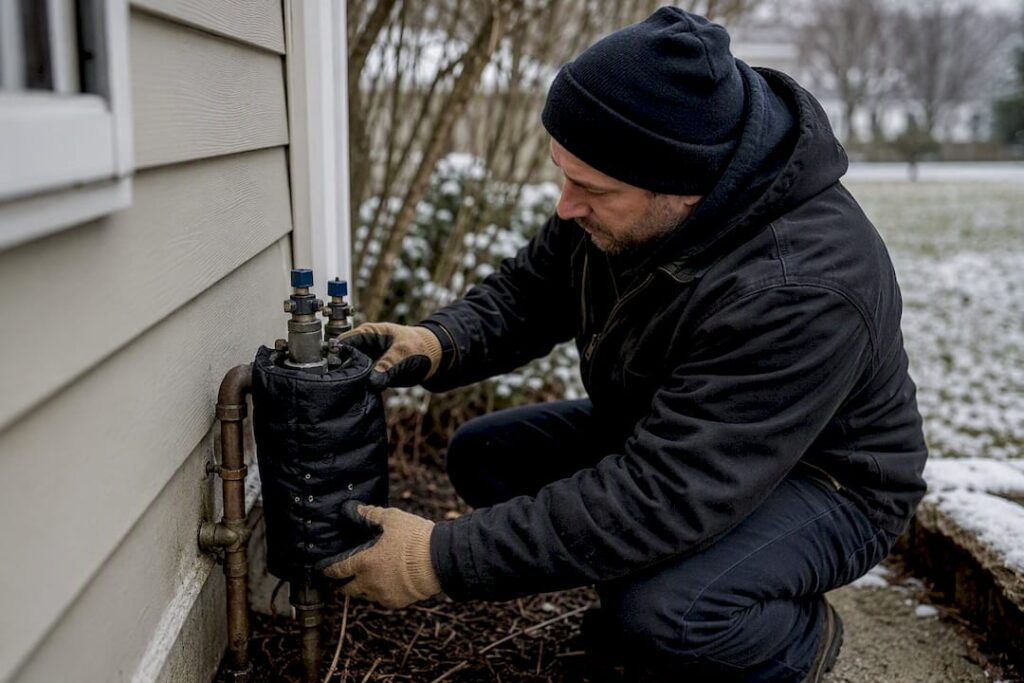
Shut off the supply, open the test cocks, and drain any exposed backflow preventer before the temperature drops below freezing. That is the immediate move. For a permanent fix, install an ASSE 1060 heated enclosure around any device that has to stay outdoors year round.
- Shut the supply valve to the backflow assembly.
- Open both test cocks and let the body drain fully.
- Have compressed air ready to purge irrigation lines if the device feeds a sprinkler system.
- Budget for an ASSE 1060 heated enclosure if the unit can’t be relocated indoors.
- Add a thermostatic relief valve or a freeze sensor as backup, not as a replacement.
Key Takeaways
Permanent ASSE 1060 heated enclosures prevent freeze damage more reliably than seasonal winterization alone, which remains necessary for any device that stays exposed outdoors.
| Point | Details |
|---|---|
| Act before the freeze | Shut the supply, open test cocks, and drain the assembly ahead of the first hard freeze. |
| Know your device type | PVBs and AVBs freeze fastest due to exposed components with no drain path. |
| Go permanent when possible | An ASSE 1060 enclosure holds internal temperature near 40°F and removes the annual winterization risk. |
| Use retrofits as backup | Thermostatic relief valves and Wi‑Fi freeze sensors add protection but don’t replace draining the system. |
| Test after every freeze | Hidden damage can pass a visual check but fail certified testing, so book an inspection promptly. |
| Southjerseybackflow handles both paths | Southjerseybackflow installs enclosures and performs certified post-freeze testing and repair across New Jersey. |
Table of Contents
- Which Backflow Preventer Types Freeze the Fastest?
- How Do You Winterize a Backflow Preventer Before Winter?
- What Makes an ASSE 1060 Enclosure the Better Long-Term Fix?
- Can Freeze Sensors and Relief Valves Replace Winterization?
- Do Foam Covers and Insulated Bags Actually Work?
- What Should You Check After a Hard Freeze?
- What Southjerseybackflow Sees on Freeze-Damage Calls
- Why Budgeting for Enclosures Beats Repeating Repairs
- Get Your Backflow System Ready for Winter
- Frequently Asked Questions
- Sources
Which Backflow Preventer Types Freeze the Fastest?
Pressure vacuum breakers (PVBs) fail first in cold weather because their air inlet valve and spring mechanism sit exposed at the top of the device, right where trapped water freezes and cracks the housing. Double check (DC) assemblies hold water in two check valves with almost no drainage path, so a hard freeze can split the seats even before you see ice on the outside. Reduced pressure zone (RPZ) assemblies are the most freeze-resistant of the bunch on paper, but their relief valve discharges water constantly under certain conditions, and that steady discharge can ice over and jam the mechanism. Atmospheric vacuum breakers (AVBs) are simpler and cheaper, yet the same trapped-water problem applies whenever they sit above grade with no shutoff below.
- PVBs: exposed air inlet and spring, high freeze risk if left uncovered.
- DC assemblies: water trapped between check valves, no natural drain path.
- RPZ assemblies: relief valve discharge can freeze and stick.
- AVBs: vulnerable whenever installed above grade without a drainable shutoff.
Placement matters as much as device type. A backflow preventer mounted in a below-grade vault behaves differently than one bolted to an exterior wall in open air, and a unit with tight clearance for testing often gets skipped during a rushed winterization pass simply because it’s hard to reach.
How Do You Winterize a Backflow Preventer Before Winter?
Winterizing an exposed assembly is a short, mechanical job, but skipping a step is what causes the split housings and cracked check valves that show up every spring, as explained in the process of pipe maintenance for homeowners.
- Shut off the main supply valve feeding the backflow assembly.
- Open both test cocks to relieve pressure and let residual water drain out.
- If local practice calls for it, position the isolation valves at roughly 45 degrees so no water pools inside the body.
- For irrigation systems tied to the device, use a high-volume air compressor to blow out the lines, working from the point closest to the backflow preventer outward.
- For units in below-grade vaults, prioritize draining the connected piping fully, since standing water in a buried line does just as much damage as a frozen device.
- Recheck that every drain point is actually open before you walk away. Water that looks drained sometimes isn’t.
This sequence mirrors the standard winterization steps most manufacturers and municipal water departments recommend.
Pro Tip: Never remove or bypass a backflow preventer to “solve” the freeze problem. Most local codes require continuous backflow protection on irrigation and fire lines, and disabling the device to dodge winter maintenance can trigger a compliance violation on top of the freeze risk.
What Makes an ASSE 1060 Enclosure the Better Long-Term Fix?
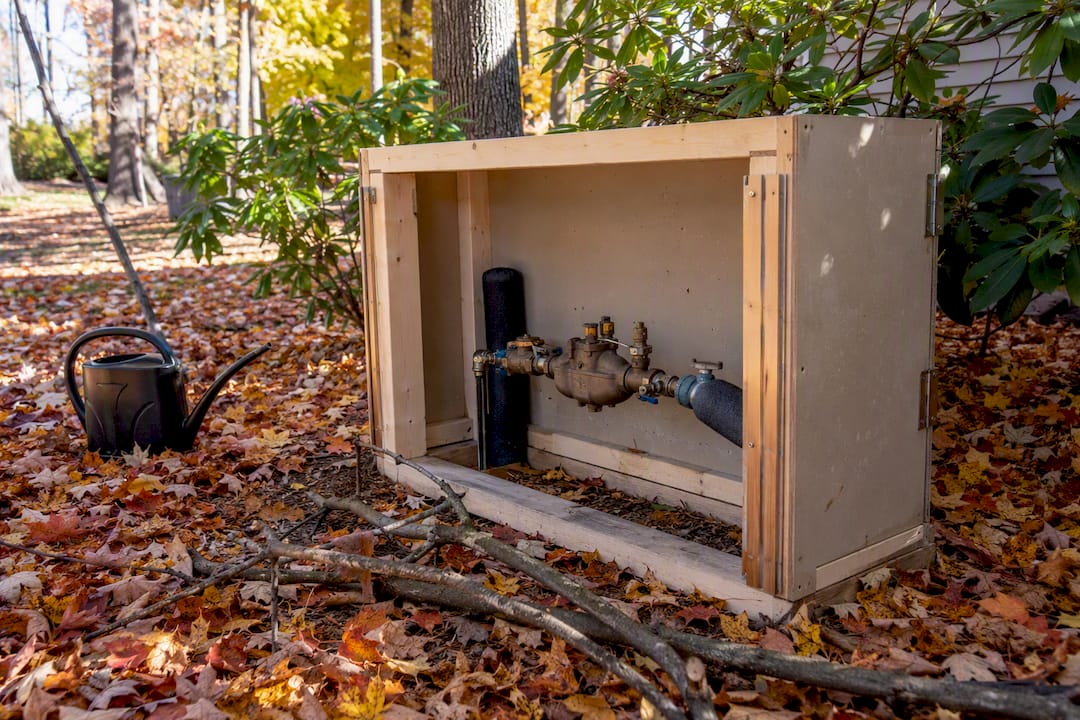
An ASSE 1060 Class I heated enclosure maintains an internal temperature above freezing even during extreme cold, protecting device components year-round without seasonal intervention. That single feature is why ASSE 1060-rated enclosures have become the default recommendation for any backflow preventer that has to stay outdoors permanently.
- Heater options include slab heaters, wall-mounted units, and self-regulating heat cable, chosen based on climate and enclosure size.
- A proper drain path handles relief valve discharge so water doesn’t pool and refreeze inside the housing.
- Lockable access panels keep the device secure while still leaving clearance for annual certified testing.
The upfront cost of an enclosure is real, and property managers weighing several devices across a portfolio feel that number right away. But weigh it against the hidden costs of a backflow failure: emergency repair calls, water damage to adjacent structures, and the compliance exposure of a device that fails certification mid-winter. One deep freeze in a climate that “never gets that cold” can undo years of savings from skipping the enclosure.
Can Freeze Sensors and Relief Valves Replace Winterization?
They help, but they don’t replace draining the system. Thermostatic relief valves typically open around 35°F and close around 40°F, releasing a small amount of water to prevent the internal components from freezing solid. That valve has to be installed vertically downward with a clear drain path, otherwise the discharge itself can ice over and jam the mechanism it’s supposed to protect.
Freeze sensors work differently. A Wi‑Fi-connected freeze detection kit monitors temperature at the device and sends a real-time alert to a phone or a building management system the moment conditions turn dangerous, giving staff a window to react before damage occurs.
- Thermostatic valves: passive, mechanical, require drainage and correct orientation.
- Freeze sensors: active alerts, integrate with BMS/IMS, no mechanical intervention on their own.
Neither one covers a multi-day deep freeze the way full winterization or a heated enclosure does. Both discharge water or send alerts. Neither drains the system for you.
Do Foam Covers and Insulated Bags Actually Work?
Foam insulation and insulated pouches buy time between maintenance windows, and they’re worth using, as long as you use them correctly. Wrap the supply and outlet piping fully, leaving the relief valve opening and any drain ports uncovered so discharge water has somewhere to go.
- Foam pipe insulation and insulated bags: good for short cold snaps, not multi-week deep freezes.
- Burlap wrapped with roofing felt: a low-cost traditional method still recommended by municipal water departments.
- Decorative rock covers: fine for mild climates, but check that they don’t trap moisture against the housing.
The most common mistake is sealing the relief valve shut along with everything else, which turns a minor freeze event into a pressure problem. A close second is wrapping only the visible parts and leaving a connector or elbow exposed where it bends out of sight.
What Should You Check After a Hard Freeze?
Look for split housings, bulging fittings, water that discharges continuously instead of intermittently, a drop in downstream pressure, or an unusual hissing or gurgling sound at the device. Any of those signs means damage has already happened.
- Visible cracks or bulges in the check valve body or relief valve housing.
- Continuous discharge from the relief valve instead of the normal occasional release.
- Reduced water pressure at fixtures served by the line.
Even when nothing looks wrong, freeze damage can be invisible from the outside. A double check assembly can lose its ability to stop backflow while still passing water normally, which is exactly why a certified test after a hard freeze isn’t optional. A minor repair can often restore the device, but a cracked body or a check valve that fails testing twice usually means it’s time to rebuild or replace rather than patch again. Southjerseybackflow’s maintenance and preventive care guidance walks through what a post-freeze inspection typically covers.
What Southjerseybackflow Sees on Freeze-Damage Calls
The calls follow a pattern: a PVB with a cracked spring housing after one cold weekend, or a DC assembly that tested fine visually but failed certification because a check valve seat froze and warped. Both usually trace back to a property that skipped winterization or relied on a decorative cover alone.
- Properties with a documented history of freeze calls are the ones we push hardest toward an ASSE 1060 enclosure, not another season of manual draining.
- Buildings in sheltered or south-facing locations with a mild freeze history often do fine with seasonal winterization plus a thermostatic relief valve as backup.
- Multi-unit and commercial clients tend to standardize on enclosures across a portfolio once one property has a bad freeze season.
Why Budgeting for Enclosures Beats Repeating Repairs
The real cost of a frozen backflow preventer isn’t the part. It’s the cross-connection risk while the device is down and the regulatory exposure if a water authority flags a lapsed test. Property managers who treat freeze protection as a line item instead of an emergency repair spend less over three winters, not one. Schedule enclosure installation in the fall, not after the first cold front.
Get Your Backflow System Ready for Winter
Southjerseybackflow tests, repairs, rebuilds, and installs enclosures for backflow preventers across New Jersey, and files the certification paperwork directly with your water authority so you’re not chasing forms after a freeze. Where a national manufacturer sells you a product and leaves installation and code compliance to you, Southjerseybackflow handles the enclosure install and the certified test in one visit, backed by field experience with exactly the freeze failures covered above.

If your property has had a freeze scare before, or you’re scheduling protection ahead of this winter, start with a backflow compliance check to see where your device stands, then book a test or enclosure installation before the next cold front moves in.
Frequently Asked Questions
What is the fastest way to protect a backflow preventer from freezing tonight?
Shut off the supply valve and open both test cocks to drain the device completely. If temperatures are dropping fast and you have no time for a permanent fix, wrap the body loosely with foam insulation or an insulated pouch, leaving the relief valve opening uncovered.
Does homeowners insurance cover frozen backflow preventer damage?
Coverage varies by policy and insurer, and many policies exclude damage from foreseeable neglect, such as skipping known winterization steps. Check your specific policy language, since this is not a fixed rule across all providers.
How cold does it need to get before a backflow preventer freezes?
Damage risk starts as soon as water inside the device drops to 32°F and stays there long enough to form ice, though wind exposure and how long the cold lasts both affect the actual timeline for a given device.
Can I install a heated enclosure myself?
Some enclosures are sold for property owner installation, but proper heater sizing, drainage for the relief valve, and clearance for annual testing all affect whether the unit performs as designed. Southjerseybackflow’s backflow preventer services cover enclosure installation as part of a certified visit.
Sources
For product specs and enclosure standards, see ASSE 1060 enclosure guidance and Watts freeze detection systems.
- Thermomegatech thermostatic valve product page
- Freeze Detection Backflow System
- Winterizing your backflow device to prevent freeze damage
Pingback: Property Managers: Night Before Backflow Freeze Checklist & Tech Tips