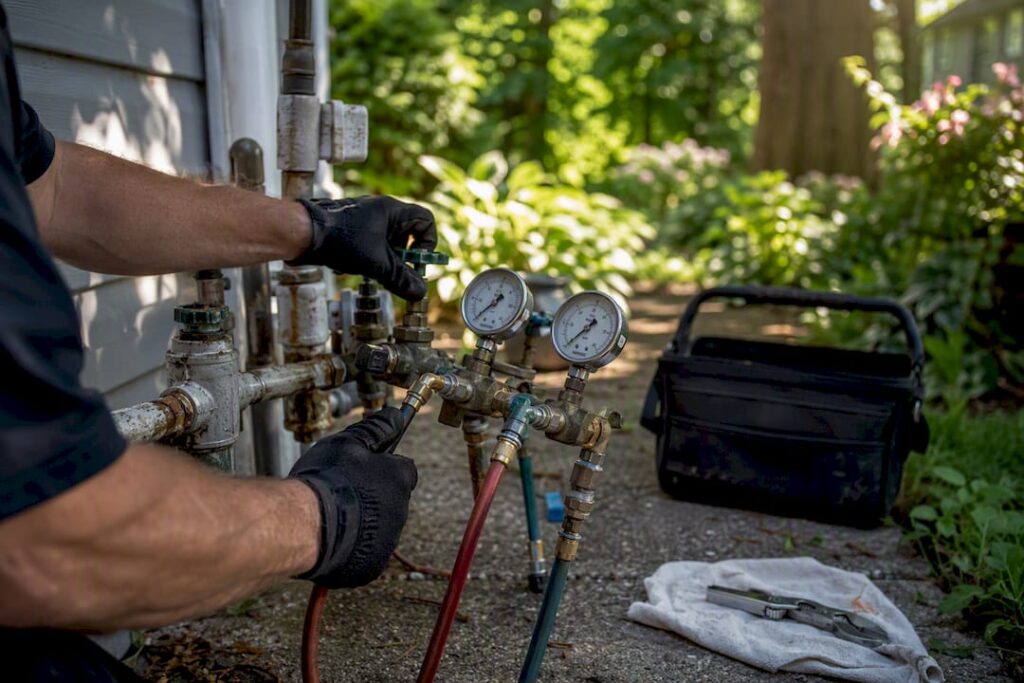
Every backflow device you own needs three things on a fixed schedule: a visual inspection, a certified functional test, and a filed report with your water authority. Miss any one of those three, and you’re carrying legal and financial risk you probably don’t know about. Here’s what to do this week, not eventually.
Start with what you have. Walk your property, or send someone who knows what a reduced pressure zone assembly looks like, and confirm the device count, model, location, and last test date against your records. If you can’t find that information, you have your first task.
- Locate and photograph every backflow device on the property
- Confirm the device ID, model number, and installed location match your records
- Check the date of the last certified test (most NJ water authorities require annual testing)
- Inspect for visible corrosion, leaks, or damaged relief valve discharge
- Verify enclosure or insulation is intact heading into cold weather
- Flag any device that failed its last test for immediate repair
- Confirm your tester is properly licensed and files directly with your local water authority
The NJDEP backflow prevention FAQ outlines certification and filing requirements you’re legally bound to follow. A common asset-management benchmark, mean time between failures (MTBF), can help you decide which devices need tighter inspection intervals. South Jersey Backflow handles the testing, filing, and repair side of this list for property owners across the region who’d rather not chase down paperwork themselves.
Key Takeaways
A working backflow maintenance program combines an accurate device inventory, criticality-based scheduling, certified testing, and documented records filed on time with your water authority.
| Point | Details |
|---|---|
| Build a full inventory | List every device by asset ID, location, model, and age before setting any schedule. |
| Rank by criticality | Give high-consequence devices (fire lines, medical connections) shorter inspection intervals than standard irrigation lines. |
| Use three trigger types | Schedule time-based annual tests, condition-based retests, and event-based checks after any repair or nearby construction. |
| Document everything | Record test dates, technician certification, pass/fail results, and filing confirmation for every device. |
| Winterize by mid-November | Insulate exposed piping and seal enclosures before the first hard freeze to avoid cracked check valves. |
| Work with a certified local provider | Southjerseybackflow handles testing, repair, rebuilds, enclosure winterization, and direct filing with NJ water authorities. |
Table of Contents
- What Goes Into a Backflow Device Inventory for NJ Properties?
- Which Backflow Devices Should You Prioritize First?
- What Should Each Device’s Inspection Checklist Include?
- How Often Should You Test and Inspect Backflow Devices?
- Who Should Handle Testing, Filing, and Repair Approval?
- Why Documentation Is the Backbone of Compliance
- How Do You Know if Your Maintenance Program Is Working?
- How Do You Actually File a Backflow Test Report in New Jersey?
- What NJ Regulations Govern Backflow Device Maintenance?
- Do NJ Backflow Testers Need Special Certification?
- What Happens if You Don’t Comply With NJ Backflow Rules?
- What Tools and Equipment Support Backflow Device Maintenance?
- What Causes Backflow Devices to Fail in New Jersey?
- How Should You Winterize Backflow Devices in New Jersey?
- Why This Checklist Matters More Than It Looks
- How South Jersey Backflow Handles Every Item on This Checklist
- Frequently Asked Questions
- Sources
What Goes Into a Backflow Device Inventory for NJ Properties?
You can’t maintain what you haven’t counted. A proper inventory lists every backflow prevention assembly on the property with four data points: unique asset ID, physical location, make and model, and installation age. Skip any one of these and your maintenance program has a blind spot.
Commercial and multi-unit properties in New Jersey often have more devices than the property manager realizes. A strip mall might have a master meter assembly, separate assemblies for each irrigation line, and dedicated units for fire suppression systems. Each one falls under separate testing obligations, and each one needs its own line in your records.
Assign a permanent asset ID to each device, something as simple as a building code plus a sequential number, and stencil or tag it on-site. That ID becomes the anchor for every test report, repair invoice, and inspection note going forward. Without it, you’re matching paperwork to devices by memory, which fails the moment staff turnover happens.
Age matters more than most owners assume. A device installed before 2010 is statistically more likely to need rebuilding rather than simple repair, and knowing installation age lets you budget for replacement before a failure forces an emergency call. A seven-step program framework recommended by facilities management guides starts with exactly this step: inventory before anything else, because criticality ranking, scheduling, and documentation all depend on having accurate baseline data.
Southjerseybackflow’s step-by-step guide to locating and testing backflow preventers walks through where devices typically hide on older NJ properties, including basements, mechanical rooms, and irrigation vaults that get overlooked during renovations.
Which Backflow Devices Should You Prioritize First?
Not every backflow assembly carries equal risk if it fails. A device protecting a fire suppression line or a commercial kitchen’s connection to the potable water supply demands faster attention than a decorative irrigation line assembly, even though both need annual testing.
Rank devices using consequence of failure, not just device type. Ask what happens if this specific assembly fails: does contaminated water reach a public supply line, does a fire system go offline, does a tenant lose water service entirely? A high-consequence answer means the device gets a shorter inspection interval and faster repair turnaround when something goes wrong.
Preventive maintenance experts consistently flag applying one uniform schedule to every asset as the most common program failure. A backflow device serving a hospital wing and one serving a landscaping spigot should never sit on the same maintenance calendar.
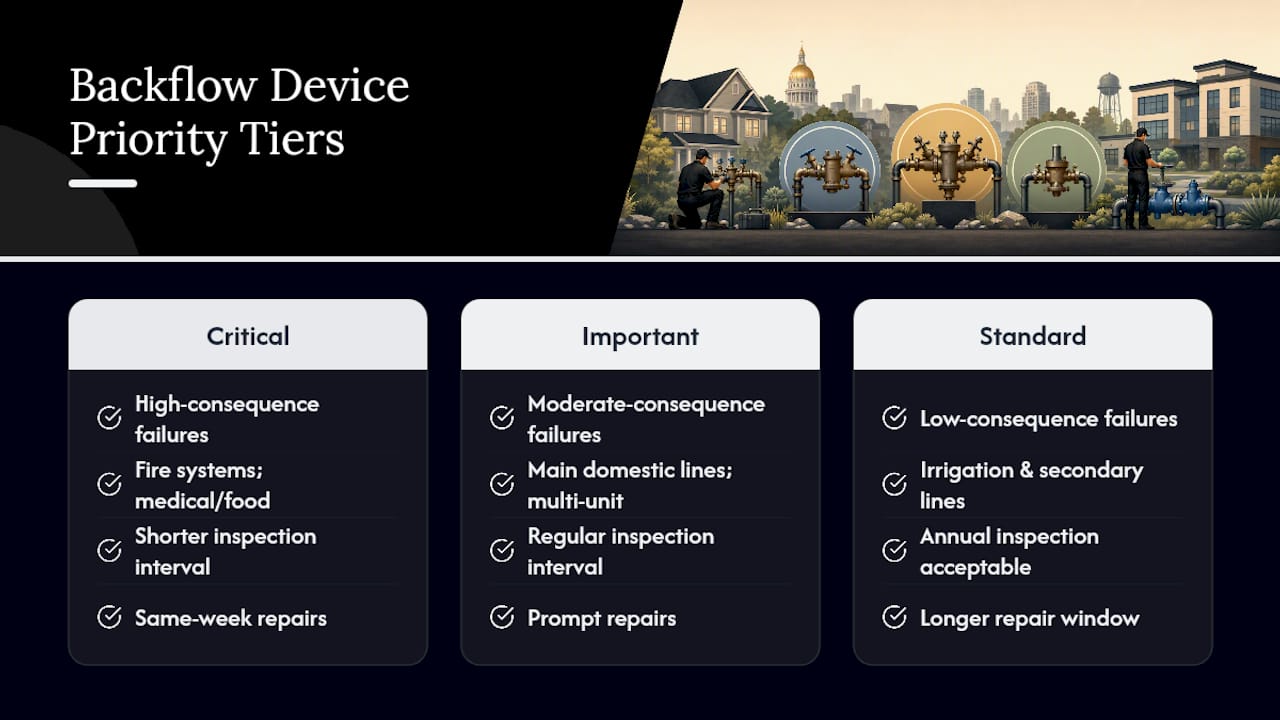
Build a simple three-tier system: critical (health and life safety exposure, fire systems, medical or food-service connections), important (main domestic water lines, multi-unit residential connections), and standard (irrigation, non-essential secondary lines). Critical devices get inspected more frequently and repaired same-week when flagged. Standard devices can tolerate a slightly longer window without meaningful added risk.
This ranking also drives your budget conversation. Property managers juggling a dozen properties can justify spending more on rebuild versus repair decisions for critical-tier devices while stretching standard-tier equipment closer to its useful life. Southjerseybackflow’s commercial backflow compliance guide breaks down criticality tiers specific to multi-tenant and mixed-use properties.
What Should Each Device’s Inspection Checklist Include?
A generic “check the backflow device” line item on a work order tells a technician nothing useful. Every device needs its own task list with explicit pass or fail criteria, or you end up with inconsistent inspections depending on who shows up that day.
For a reduced pressure zone (RPZ) assembly, the checklist should specify: verify both check valves hold pressure differential, confirm the relief valve discharges properly under test conditions, check for any continuous discharge at rest (a clear fail sign), and inspect shutoff valves for full open and close function. For a double check valve assembly, the criteria shift slightly since there’s no relief valve, but the two check valves still need individual pressure differential tests.
Pro Tip: Print the manufacturer’s exact test procedure and pass/fail thresholds for each device model and keep it clipped to the device’s enclosure. Technicians move faster and make fewer judgment calls when the standard is sitting right in front of them.
Beyond the internal mechanism, every checklist needs an enclosure and environmental section: is the enclosure or pit free of debris and standing water, is insulation intact, does the access panel seal properly, and is there any sign of freeze damage from the prior winter. New Jersey’s seasonal swings make this section as important as the mechanical test itself.
A comprehensive PM checklist framework built for facilities recommends documenting pass/fail against a written standard rather than a technician’s subjective call, which is exactly what NJ water authorities expect to see on a filed test report.
How Often Should You Test and Inspect Backflow Devices?
Most New Jersey water authorities require annual certified testing at minimum, but “annual” is a floor, not a ceiling, and treating it as the only trigger is where programs quietly break down.
Three trigger types should drive your schedule. Time-based triggers cover the standard annual test cycle every device needs regardless of condition. Condition-based triggers fire when a visual inspection turns up corrosion, a leak, or discharge at rest, which should push a device to immediate retest rather than waiting for its annual date. Event-based triggers cover anything that physically disturbs the water line, meaning any repair, replacement, new installation, or even nearby construction work that could have jarred a fitting.
Scheduling frameworks built for asset-heavy operations recommend tagging every device with its trigger type up front, so a missed annual date, a failed visual check, and a post-repair retest all route through different alert paths instead of getting lumped into one generic reminder.
For critical-tier devices identified in your ranking, consider a semiannual visual check even though the certified functional test stays annual. It costs little in labor and catches enclosure damage or freeze exposure before it becomes a failed test months later. Standard-tier irrigation devices can generally run on the annual cycle alone unless local code says otherwise.
Southjerseybackflow’s commercial maintenance workflow guide lays out a sample scheduling calendar property managers can adapt directly for multi-device sites.
Who Should Handle Testing, Filing, and Repair Approval?
A backflow program falls apart fastest when nobody owns each specific task. Testing, filing, and repair approval are three distinct jobs, and they usually belong to three different people, even on a small property.
Testing must be performed by a New Jersey certified backflow tester. This isn’t optional and it isn’t something a general maintenance technician can do without the credential, no matter how mechanically capable they are. Filing the test report with the local water authority is often handled by the tester directly, but on properties managed by a third party, the property manager needs to confirm that filing actually happened rather than assuming it did.
Repair approval is where budget authority matters. Decide in advance who signs off on repair costs above a certain threshold so a failed test doesn’t sit in limbo for weeks while paperwork routes through an approval chain. For portfolio owners managing several NJ properties, a single point of contact for repair sign-off keeps response time consistent across sites.
Write these three roles down by name, not by title, and post the assignment somewhere the property team can reference it. When a device fails a test on a Friday afternoon, you don’t want to be figuring out who has repair authority for the first time.
Why Documentation Is the Backbone of Compliance
An inspection that isn’t documented might as well not have happened, at least as far as a water authority auditor or an insurance adjuster is concerned. Every test, every repair, and every inspection needs a written record tied to that device’s asset ID.
Your documentation should capture the date, technician name and certification number, specific pass/fail results per component, any parts replaced, and the date the report was filed with the water authority. Standardized documentation practices recommend tracking these records against KPIs like completion rate and time-to-repair, which gives you an early warning system rather than a filing cabinet of paperwork nobody reviews.
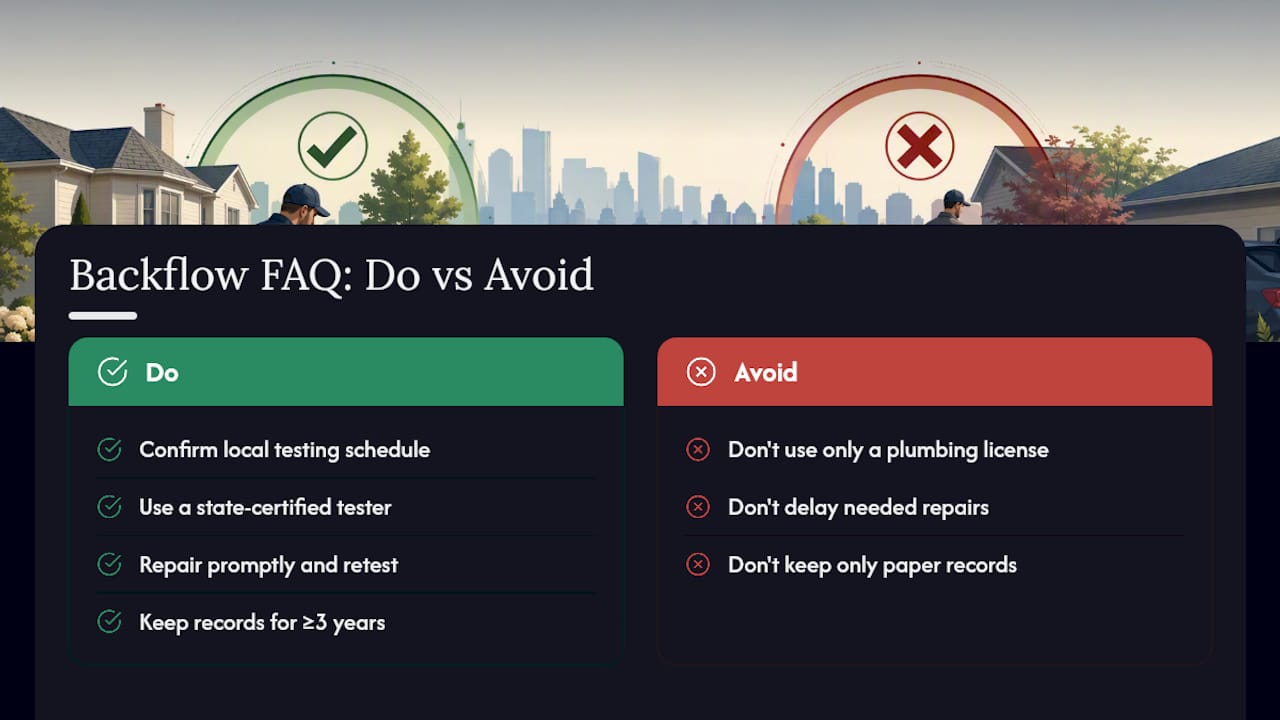
Keep records for a minimum of three years, though many NJ water authorities and insurance policies effectively expect longer retention since backflow incidents can trigger liability claims well after the fact. Digital storage beats paper here, if only because a water authority requesting five years of records on short notice is a real scenario, not a hypothetical one.
Southjerseybackflow’s recordkeeping compliance guide covers exactly which fields NJ authorities expect to see and how long different property types need to retain them.
How Do You Know if Your Maintenance Program Is Working?
A checklist you set up once and never revisit isn’t a program, it’s a document. The difference between the two is whether you’re tracking outcomes and adjusting based on what the numbers tell you.
Track two figures over time: completion rate (percentage of scheduled tests actually performed on time) and failure history (which specific devices fail repeatedly). A device that fails its test two years running isn’t a maintenance problem anymore, it’s a replacement decision you’re delaying. Program reviews built around MTBF and failure history let you shift a chronically failing device to a shorter inspection interval or flag it for rebuild before it becomes an emergency.
Review your program at least annually, ideally right after your busiest testing season, while the friction points are still fresh. Did technicians consistently miss the same enclosure issue? Did filing deadlines slip because nobody owned that task clearly? Adjust the checklist and the assignment sheet based on what actually happened, not what the original plan assumed would happen.
Portfolio owners managing multiple properties benefit most from this step, since patterns that look like one-off problems on a single site often turn out to be systemic once you’re comparing data across ten or twenty properties.
How Do You Actually File a Backflow Test Report in New Jersey?
Testing the device is only half the job. The certified tester needs to submit results to the water purveyor that supplies the property, and the format and deadline vary by municipality.
Here’s the practical sequence: the tester performs the functional test and records results on the standard test form, the tester (or the property owner, depending on local practice) submits that form to the water authority within the required window, usually within a set number of days after testing, and the water authority confirms receipt or flags any deficiency that needs a retest. If the device fails, repairs need to happen and a retest needs filing before the authority considers the property compliant again.
Some NJ municipalities accept electronic filing, others still require a mailed or hand-delivered form. Confirm your specific water authority’s process before your test date rather than after, since a tester who assumes electronic filing works everywhere can cause an accidental compliance lapse.
If your property just received a notice from a water authority about an overdue or missing test, that’s not a situation to sit on. Guidance for owners who’ve received a backflow compliance letter walks through the response timeline most NJ authorities expect.
What NJ Regulations Govern Backflow Device Maintenance?
New Jersey backflow prevention rules flow from state cross-connection control requirements enforced at the local water authority level, meaning your specific obligations depend partly on which municipality supplies your water. The NJDEP backflow prevention FAQ is the authoritative starting point for understanding certification standards, testing frequency expectations, and how local water purveyors enforce compliance.
The general framework requires annual testing for most assembly types, mandatory use of a certified tester, and filing of results with the local purveyor. But local water authorities can and do layer additional requirements on top of the state baseline, including shorter testing intervals for certain device types or additional documentation for commercial properties.
This is where property owners get tripped up. Assuming your obligations match a neighboring town’s requirements, because you read about them online or heard it from another property manager, is a real risk. Contact your specific water purveyor directly, or work with a tester who already knows that municipality’s exact process, rather than assuming a one-size-fits-all state rule covers everything.
Southjerseybackflow’s backflow statute overview breaks down which statutory sections apply to different property types across the state.
Do NJ Backflow Testers Need Special Certification?
Yes, and this is not a gray area. New Jersey requires anyone performing certified backflow assembly tests to hold a valid state-recognized tester certification. A general plumber’s license does not substitute for this credential, no matter how much plumbing experience someone has.
Certification requires completing an approved training course covering test procedures for each assembly type (RPZ, double check, pressure vacuum breaker) and passing a hands-on proficiency exam. Certified testers also need calibrated test gauges, and many water authorities require proof of gauge calibration within a set window before they’ll accept a filed report.
Property owners bear some responsibility here too. Hiring an uncertified individual to test your devices, even if they get the mechanics right, means the test doesn’t count in the eyes of your water authority. You’d be paying for a test result that can’t legally be filed, which puts you right back at square one on your compliance deadline.
Always ask for a tester’s current certification number before booking work, and confirm it’s active rather than expired. Southjerseybackflow’s NJDEP-compliant testing and certification service handles both the certified test and the direct filing, which removes the guesswork of confirming a tester’s credentials yourself.
What Happens if You Don’t Comply With NJ Backflow Rules?
Non-compliance carries real financial and legal exposure, and it compounds the longer it goes unaddressed. Water authorities can issue formal notices for missed or overdue tests, and repeated non-response typically escalates to water service restriction or termination, which for a commercial or multi-unit property means an operational shutdown, not just a fine.
Insurance exposure is the less obvious risk. If a backflow incident causes contamination and your device wasn’t tested on schedule, your liability coverage may not respond the way you’d expect, since maintaining code-required safety equipment is often a condition buried in commercial policy language. A lapsed backflow test turns what should be a routine compliance item into a coverage dispute after the fact.
Property sales and refinancing can also stall over unresolved backflow compliance notices, since buyers and lenders increasingly check for open code violations before closing. What looks like a minor paperwork gap in year one can turn into a real transaction delay in year three.
The fix costs far less than the consequence: a scheduled annual test and a filed report, every year, on time.
What Tools and Equipment Support Backflow Device Maintenance?
Backflow maintenance isn’t equipment-heavy compared to other building systems, but the few tools involved need to be right or your test results won’t hold up to scrutiny.
A calibrated differential pressure gauge kit is the core tool for any certified tester, and calibration needs to be current, typically annually, or a water authority can reject the filed report outright. Beyond the test kit, enclosure maintenance calls for basic weatherproofing supplies: pipe insulation sleeves, heat tape for exposed lines in unheated spaces, and enclosure seal kits to keep moisture and pests out between inspections.
For property managers tracking multiple devices across several sites, a computerized maintenance management system (CMMS) does more than store paperwork. It auto-generates work orders based on the trigger types and intervals discussed earlier, which closes the gap between having a schedule on paper and actually executing it. Programs that automate scheduling consistently outperform manually tracked calendars, since a human remembering to check a spreadsheet is a weaker system than software that pushes a reminder automatically.
Smaller portfolios can get by with a shared calendar and a consistent naming convention tied to each device’s asset ID, as long as someone owns checking it weekly. The tool matters less than whether anyone actually uses it.
What Causes Backflow Devices to Fail in New Jersey?
New Jersey’s climate creates specific failure patterns that don’t show up the same way in warmer states, and knowing them helps you inspect for the right things at the right time of year.
Freeze and thaw cycles are the single biggest seasonal threat. Water trapped in an unheated enclosure or exposed pipe run expands when it freezes, cracking check valve seats and housing components that then fail their next test even though the device looked fine going into winter. Coastal properties face a second threat: salt air corrosion accelerates wear on metal components faster than inland sites, which is why shore-area devices often need closer visual inspection between certified tests.
Seasonal usage swings cause a subtler failure mode. Irrigation-line backflow devices that sit dormant all winter and then get switched on in spring often reveal a check valve that seized during months of inactivity, something a fall inspection wouldn’t have caught. Sediment buildup from municipal water main work is another factor specific to older NJ infrastructure, where check valves can get fouled by debris kicked loose during nearby repairs.
Age compounds all of these. A device past 15 years old is more likely to show cumulative wear that turns a routine test into a failed one, particularly on rubber seals and springs inside check valve assemblies.
How Should You Winterize Backflow Devices in New Jersey?
Winterization is where a lot of NJ preventive maintenance programs quietly fall short, mostly because it gets treated as an afterthought instead of a scheduled task with its own checklist.
Before the first hard freeze, typically by mid-November for most of the state, insulate any exposed piping leading to and from the device with foam sleeves rated for outdoor use. Enclosures and pits need their seals checked for gaps that let cold air in, and any heat tape protecting exposed lines should get tested before it’s actually needed rather than during the first cold snap.
NJ-focused seasonal maintenance guidance recommends treating fall backflow winterization with the same urgency as heating system prep, since both failures share a common cause: cold exposure to a system that wasn’t insulated properly. For above-ground devices in colder inland counties, some property owners drain non-essential irrigation-line assemblies entirely for winter rather than insulating them in place, which eliminates freeze risk on a device that isn’t needed until spring anyway.
Coordinate this with your broader property winterization schedule. A commercial roof maintenance checklist covering gutter and drainage checks pairs naturally with backflow winterization, since water intrusion around a mechanical enclosure often starts as a roof or drainage issue before it becomes a frozen pipe problem.
Why This Checklist Matters More Than It Looks
A checklist like this prevents the two outcomes property owners fear most: a failed inspection that shuts off water service, and a fine that shows up months after the problem started. New Jersey’s freeze-thaw cycles and coastal salt-air exposure wear down check valves faster than owners expect, and seasonal irrigation shutdowns hide seized components until spring testing exposes them. Testers need active state certification, and using one who files directly with your water authority removes a step most owners forget to confirm themselves.
Pro Tip: Insulate exposed piping and check enclosure seals before mid-November. A freeze crack found in March costs a lot more than insulation found in October.
How South Jersey Backflow Handles Every Item on This Checklist
Reading this checklist is one thing. Executing it across a portfolio of properties, on schedule, with proper filing, is a different job entirely, and it’s the job Southjerseybackflow was built to do.
On-site testing and certification covers the annual functional test every device needs, performed by certified technicians using calibrated equipment. When a test fails, repair and rebuild services address the issue directly rather than sending you searching for a separate contractor, which matters most when a critical-tier device goes down and every day of delay adds risk. Enclosure installation and winterization work protects devices against the freeze damage and enclosure failures common across New Jersey winters, and direct filing with your local water authority closes the loop so you’re not the one tracking down submission deadlines.
For property managers juggling multiple sites, consolidated billing keeps testing costs organized across a portfolio instead of scattered across separate invoices. Southjerseybackflow serves properties across Ocean, Mercer, Gloucester, and Cumberland counties, among others across South Jersey.
If your next test date is approaching, or you’ve received a compliance notice you haven’t addressed yet, request a quote or schedule a test before it becomes an emergency call instead of a routine one.
Frequently Asked Questions
How often does New Jersey require backflow device testing?
Most NJ water authorities require certified testing on a regular schedule, often annually, though your specific municipality may require more frequent checks depending on device type and property classification. Confirm the exact requirement with your local water purveyor.
Who can legally test a backflow device in New Jersey?
Only a state-certified backflow tester with an active certification and calibrated test equipment can perform a test that a water authority will accept. A standard plumbing license alone doesn’t qualify someone for this work.
What happens if my backflow device fails its annual test?
Repairs need to happen promptly, followed by a retest and a new filed report before the water authority considers the property compliant again. Delaying repair on a failed device extends your compliance gap and increases the risk of service restriction.
How long should I keep backflow test and repair records?
Keep records for at least three years, though longer retention protects you better against insurance disputes or delayed water authority audits. Digital storage tied to each device’s asset ID makes retrieval far easier than paper files.
Does winterization really affect backflow test results?
Yes. Freeze damage from an uninsulated enclosure or exposed pipe run is one of the most common causes of a failed spring test in New Jersey, making fall winterization a direct compliance safeguard, not just a maintenance nicety.
This article is general information, not a substitute for advice from a qualified lawyer. Consult a qualified legal professional about your own circumstances before acting on anything here.