TL;DR:
- Property owners in New Jersey must conduct annual backflow tests with certified testers, repair failed devices within 30 days, and file reports with water authorities and administrative offices to stay compliant. Proper site preparation, certified testing, and timely reporting prevent violations and protect the public water supply. Southjerseybackflow offers comprehensive services, including testing, filing, repairs, and emergency response, ensuring adherence to the state’s strict backflow prevention regulations.
New Jersey property owners and managers: your backflow-prevention compliance checklist comes down to three moves. Schedule an annual test with a certified backflow tester. If the device fails, repair and retest within 30 days. File the completed test report with your local water authority and the administrative authority. That sequence, done correctly every year, keeps you compliant with the New Jersey Department of Environmental Protection (NJDEP) and your local water utility.
Before you call a tester, have this information ready:
- Device make, model, serial number, and permit number
- Your Certificate of Compliance (if previously issued) and its expiration date
- Access instructions for the device location and any enclosure keys
- Contact information for your local water authority (example: New Jersey American Water)
If you received a backflow compliance letter from your municipality, that notice is your deadline. Act on it immediately.
Table of Contents
- Who must perform the test, and what credentials should you verify?
- How should you prepare your building before the tester arrives?
- What happens during the test, and how do you read the report?
- How do you file test reports in New Jersey, and what records should you keep?
- What violations and red flags do inspectors look for?
- What should you do in a backflow emergency?
- Key Takeaways
- Why this checklist matters more than most property owners realize
- Southjerseybackflow handles testing, filing, and repairs for NJ properties
- Useful sources and NJ contacts
Who must perform the test, and what credentials should you verify?
Under N.J.A.C. 7:10-10.6, only a certified backflow prevention device tester may perform official tests. That certification must be issued by an approved certifying agency. Hiring an uncertified plumber, even a licensed one, produces a test report the water authority will reject.
Before the tester arrives, request:
- Their backflow tester certificate number and the name of the certifying agency
- Proof of current insurance
- Confirmation they are familiar with NJ test form requirements
At job completion, collect:
- Signed test certificate with the tester’s certification number
- Itemized written estimate for any repairs (if the device failed)
- Proof of filing or submission receipt showing the report was sent to the water authority
Pro Tip: Ask the tester to provide before-and-after photos of the device, especially if repairs are performed. These photos serve as documentation if a compliance dispute arises later.
Southjerseybackflow employs certified testers who carry valid NJ credentials and handle backflow prevention methods for both DCVA and RPZ installations across residential, commercial, and multi-unit properties.
How should you prepare your building before the tester arrives?
A poorly prepared site is the most common reason tests get delayed or rescheduled. Run through this list the day before:
- Clear physical access to the backflow device and remove any stored materials blocking it
- Unlock all enclosures and have spare keys available
- Locate and label the upstream and downstream shutoff valves
- Confirm interior shutoffs are accessible and functional
- Shut off irrigation systems if the device serves an irrigation line
- In cold weather, verify the enclosure heater is working and drainage is clear
For multi-tenant buildings or properties with devices in mechanical rooms, notify affected tenants at least 48 hours in advance. Coordinate with building staff to prevent accidental valve operation during the test. If the device is in a shared mechanical room, confirm the room will be unlocked and that no other contractors are scheduled at the same time.
Pro Tip: Devices installed per N.J.A.C. 7:10-10.3 require full-port ball-type shutoff valves and test cocks. If yours are missing or seized, flag that before the tester arrives — it will affect the test outcome.
What happens during the test, and how do you read the report?
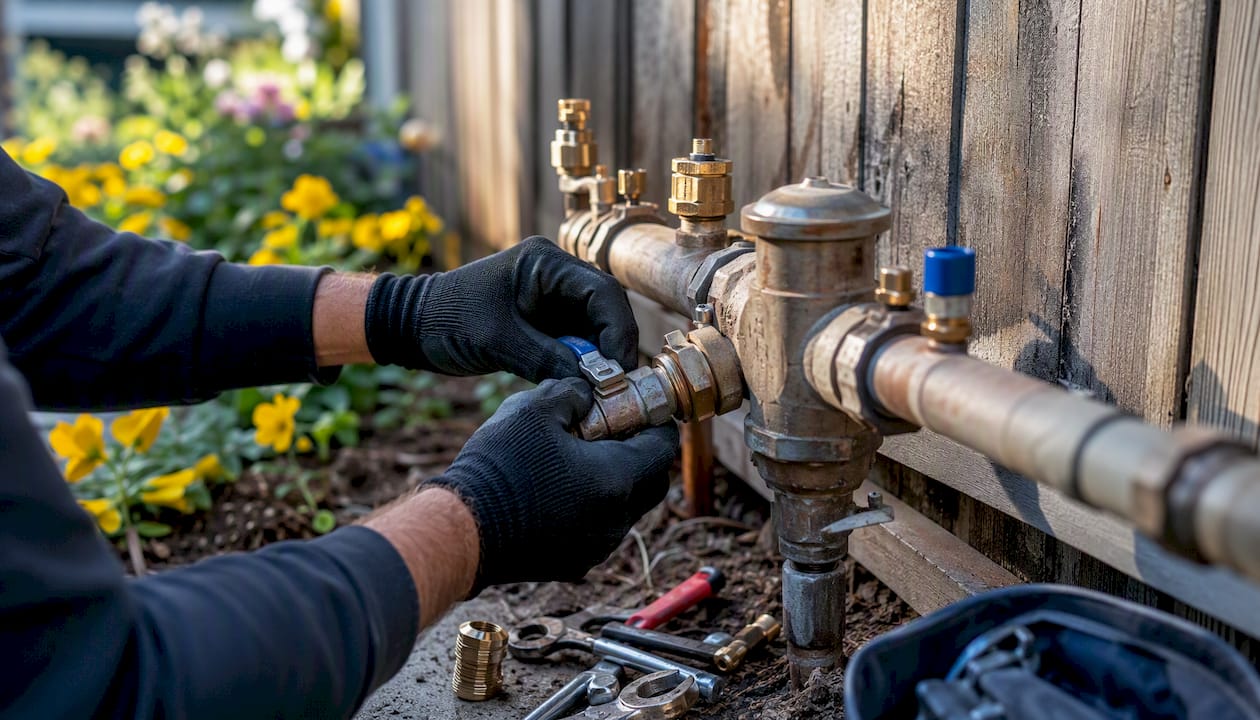
The tester connects differential pressure gauges to the test cocks and checks each check valve and the relief valve (for RPZ assemblies) against minimum performance thresholds. Here is what those readings mean:
| Device Type | Component Tested | Minimum Passing Reading |
|---|---|---|
| DCVA | First check valve | 1 psi differential |
| DCVA | Second check valve | 1 psi differential |
| RPZ | First check valve | 5 psi differential |
| RPZ | Second check valve | 1 psi differential |
| RPZ | Relief valve | Opens correctly when first check drops below 2 psi |
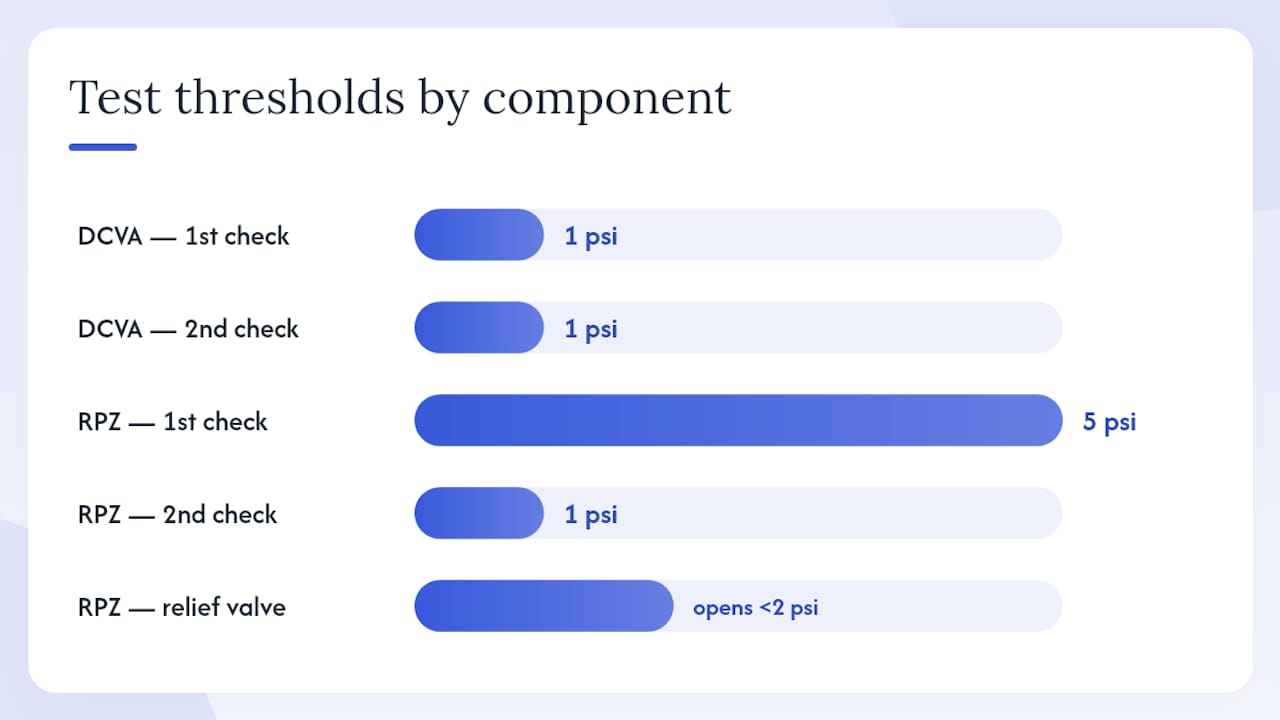
These thresholds come from NJDEP rule definitions for minimum differential pressures and relief valve behavior under the NJ Safe Drinking Water Act.
A valid test certificate must include: device make, model, and serial number; tester name and certification number; test date; all measured readings; pass/fail result; and the facility’s permit or filing number. Any missing field is grounds for rejection by the water authority.
How do you file test reports in New Jersey, and what records should you keep?
Filing is where many property owners fall short. The test report must go to both the administrative authority (typically your municipal Construction Code Enforcement office) and the supplier of water. Under N.J.A.C. 7:10-10.6(b), certain Quarterly Physical Connection Test and Maintenance Reports must be mailed within five days of completion.
Follow this sequence:
- Confirm the completed test form includes all required fields (device info, tester credentials, readings, pass/fail).
- Obtain the tester’s signature and certifying agency name on the form.
- Submit to your local water authority (example: New Jersey American Water) and the municipal administrative authority.
- Request a submission receipt or confirmation of filing.
- File your copy in your compliance folder.
For records, keep: signed test certificates, repair invoices, construction permits, correspondence with the water authority, and filing receipts. Municipal offices and NJDEP may request records going back several years during an audit. A practical minimum is five years, though your municipality may specify longer. The step-by-step inspection reporting process for NJ properties covers this filing sequence in detail.
What violations and red flags do inspectors look for?
The most common compliance failures are straightforward to avoid once you know what inspectors check:
- Unsigned or incomplete test forms submitted to the water authority
- Tests performed by uncertified individuals
- Missing annual tests (no test on record for the current compliance period)
- Device inaccessible at time of inspection (locked enclosure, blocked access)
- Missing test cocks or seized shutoff valves
Red flags that typically lead to mandatory repairs or replacement:
- Visible corrosion on the device body or fittings
- Water discharging from the RPZ relief port (a sign the first check valve has failed)
- Wrong device type installed for the hazard level (RPZ required where unapproved water sources exceed drinking-water contaminant levels, per N.J.A.C. 7:10-10.3)
- No Certificate of Compliance on file
The single most preventable violation is a missed annual test. Certificates of Compliance expire, and the municipal Construction Code Enforcement office tracks renewal deadlines. A lapsed certificate can trigger fines and a stop-use notice before you realize the deadline passed.
Keep a compliance folder with your most recent test certificate, any repair records, and your current Certificate of Compliance. Review it every October so you have time to schedule before year-end.
What should you do in a backflow emergency?
If you see water discharging from a relief port, smell contamination, or have reason to believe backflow has entered the potable supply, treat it as an emergency.
- Isolate the affected system by closing the upstream shutoff valve if it is safe to do so.
- Notify tenants and building occupants immediately.
- Contact your water supplier (example: New Jersey American Water) to report a potential contamination event.
- Call a certified emergency backflow technician.
- Document everything: time-stamped photos, written notes of observations, and records of every call made.
When you call for emergency service, have ready:
- Device make, model, and serial number
- Location of the device and access instructions
- Description of what you observed (discharge, odor, pressure loss)
- Your facility permit number
Southjerseybackflow provides emergency backflow service and can document the response for submission to the water authority.
Key Takeaways
Annual backflow testing, timely repairs, and dual filing with the water authority and administrative authority are the three non-negotiable pillars of NJ backflow-prevention compliance.
| Point | Details |
|---|---|
| Annual test required | Certificates of Compliance expire; test annually and retest before renewal. |
| 30-day repair window | A failed pressure test triggers a mandatory repair and retest within 30 days under N.J.A.C. 7:10-10.6. |
| Dual filing required | Submit test reports to both the supplier of water and the administrative authority within the required window. |
| Collect proof at completion | Keep the signed test certificate, itemized repair invoice, and filing receipt in a dedicated compliance folder. |
| Southjerseybackflow | Handles testing, certification filing, repairs, and emergency response for NJ properties, including direct report submission to water authorities. |
Why this checklist matters more than most property owners realize
Most property owners treat backflow testing as a box to check. Pay the fee, get the certificate, file it away. That mindset is exactly why violations pile up. The real risk is not the fine. It is that a failed or missing device creates a direct pathway for contaminated water to enter the public supply. Tenants, neighboring properties, and the broader distribution system are all downstream of that failure.
What I find underappreciated is the dual-submission requirement. Many owners file with the water utility and assume they are done. The administrative authority, usually the municipal Construction Code Enforcement office, is a separate recipient with its own deadline. Missing that second submission means you are technically non-compliant even with a passing test on record.
The other thing worth saying plainly: the 30-day repair window is not a suggestion. NJDEP enforcement has real teeth, and water authorities do follow up on failed tests. A property manager who schedules the test, gets a fail, and then delays repairs while getting multiple bids is already running out of time by week two.
The checklist in this article is not complicated. The compliance gap is almost never about not knowing the steps. It is about not having a system to track certificate expiration dates, coordinate site access, and confirm filing receipts. Build that system once, and annual compliance becomes routine.
Southjerseybackflow handles testing, filing, and repairs for NJ properties
Compliance paperwork and tight repair windows are where most property owners lose time. Southjerseybackflow covers the full process: certified on-site testing, direct filing of test reports with your local water authority and administrative authority, repair and rebuild services, enclosure work, and emergency response. Property managers with multiple units get consolidated billing so every device across your portfolio is tracked in one place.
When you call, have your device make, model, serial number, and permit number ready. Southjerseybackflow handles the rest, including confirming whether your municipality requires a witnessed test and submitting the completed report on your behalf. For a full walkthrough of what passing, submitting, and staying compliant looks like in New Jersey, visit the backflow testing compliance guide. To book service or get a quote, contact Southjerseybackflow directly at southjerseybackflow.com.
Useful sources and NJ contacts
- Model Annual Testing of Backflow Preventers Reminder Office of Construction Code Enforcement
- N.J. Admin. Code § 7:10-10.6 – Inspection and testing requirements and procedures for physical connection installations | State Regulations | US Law | LII / Legal Information Institute
- N.J. Admin. Code § 7:10-10.3 – Approved physical connection installation requirements | State Regulations | US Law | LII / Legal Information Institute
- NJ SDWA Rule Text June 1 2020 Courtesy Copy
- REGULATORY GUIDANCE: PHYSICAL CONNECTION PERMIT FOR APPROVED PHYSICAL CONNECTION INSTALLATION
| Contact | Purpose |
|---|---|
| Your municipal Construction Code Enforcement office | Certificate of Compliance issuance, witnessed test coordination, violation notices |
| Local water utility (e.g., New Jersey American Water) | Test report submission, contamination reporting, advance notice for witnessed tests |
| NJDEP Division of Water Supply and Geoscience | Physical connection permits, regulatory guidance, enforcement questions |
| Southjerseybackflow | Certified testing, repairs, filing support, and emergency service across New Jersey |
For next steps: contact your local water utility to confirm their submission requirements, check your Certificate of Compliance expiration date, and schedule your annual test with a certified tester before the deadline.