
TL;DR:
- New Jersey enforces the NSPC with state-specific amendments to regulate plumbing systems and ensure public health safety. Backflow prevention requirements mandate specific devices based on hazard levels, with annual testing and accurate recordkeeping critical for compliance. Local municipalities oversee permits and inspections but must adhere to state technical standards, emphasizing ongoing maintenance and clear communication to prevent violations.
Plumbing codes are the mandatory technical standards that govern how plumbing systems are designed, installed, and maintained to protect public health and ensure building safety. In New Jersey, these regulations fall under the National Standard Plumbing Code (NSPC), adopted through the state’s Uniform Construction Code (UCC) with New Jersey-specific amendments. For property owners and managers, understanding plumbing codes explained in plain terms is not optional. Backflow prevention sits at the center of NJ compliance requirements, and failing to meet those standards carries real financial and legal consequences.
What plumbing codes actually regulate in New Jersey
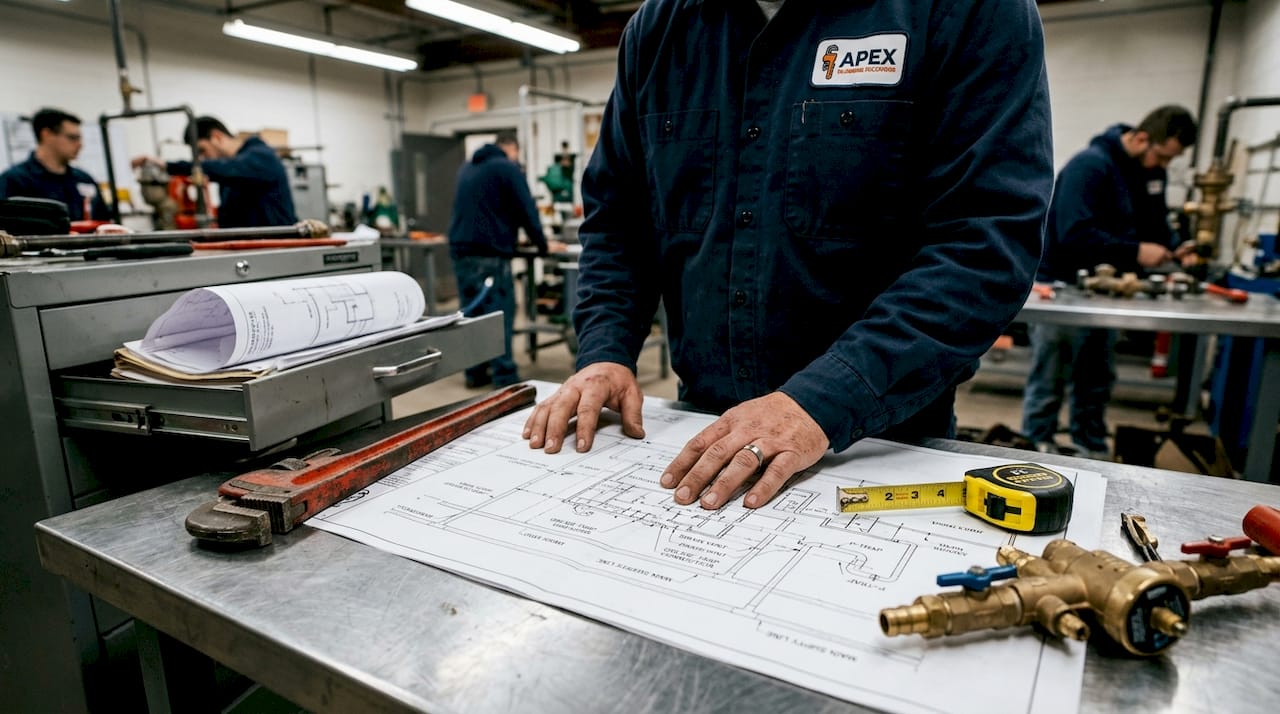
New Jersey’s plumbing code requirements cover three major system categories, each with distinct rules and inspection checkpoints. Knowing which system you are dealing with tells you exactly which code sections apply to your property.
| System | Primary function | Code focus |
|---|---|---|
| Potable water supply | Delivers clean drinking water | Backflow prevention, pipe materials, pressure |
| Drain-waste-vent (DWV) | Removes wastewater and gases | Trap seals, pipe slope, venting requirements |
| Stormwater drainage | Manages roof and surface runoff | Separate systems, discharge points, sizing |
The NSPC governs all three systems and updates on a three-year cycle, meaning the rules you followed in 2023 may not fully reflect what inspectors check in 2026. That gap catches property managers off guard more often than any single technical violation.
For the potable water system, the code mandates backflow preventers at every cross-connection point where contamination could enter the drinking supply. The DWV system requires trap seals on every fixture drain and specific pipe slopes, typically one-quarter inch per foot, to prevent standing waste. Stormwater drainage must remain completely separate from sanitary systems under NJ amendments, a distinction that differs from some other states.
Pro Tip: Review your property’s as-built plumbing drawings against the current NSPC edition before scheduling any inspection. Discrepancies between installed systems and current code requirements are the leading cause of failed rough-in inspections in New Jersey.
NJ-specific amendments add requirements beyond the base NSPC text. These amendments address local water quality conditions, soil types, and municipal water system configurations that the national code does not account for. Treating the NSPC as a complete picture without reading the NJ amendments is a common and costly mistake.
How NJ plumbing codes address backflow prevention
Backflow is the reversal of water flow in a plumbing system, pulling potentially contaminated water from a non-potable source back into the clean drinking supply. The health risks are direct: irrigation system chemicals, boiler additives, and industrial process fluids have all entered municipal water supplies through unprotected cross-connections.
Backflow prevention is a primary public health focus of New Jersey plumbing codes, requiring certified devices and regular inspections to prevent contamination. The NSPC mandates specific device types based on the degree of hazard at each cross-connection point:
- Air gaps are the highest level of protection and are required where the risk of contamination is severe, such as connections to chemical feed systems.
- Reduced pressure zone (RPZ) assemblies are required for high-hazard connections including irrigation systems, fire suppression lines, and boiler feeds.
- Double check valve assemblies apply to low-hazard connections where the contaminant would not cause illness but could affect water quality.
- Pressure vacuum breakers are commonly used on hose bibs and irrigation systems with lower hazard classifications.
Device selection is not discretionary. The code assigns hazard levels to specific connection types, and installing a lower-grade device where an RPZ is required is a direct code violation. Certification by accredited organizations like NSF is standard for backflow devices, though final acceptance depends on the local Authority Having Jurisdiction (AHJ) rather than a single national mandate.
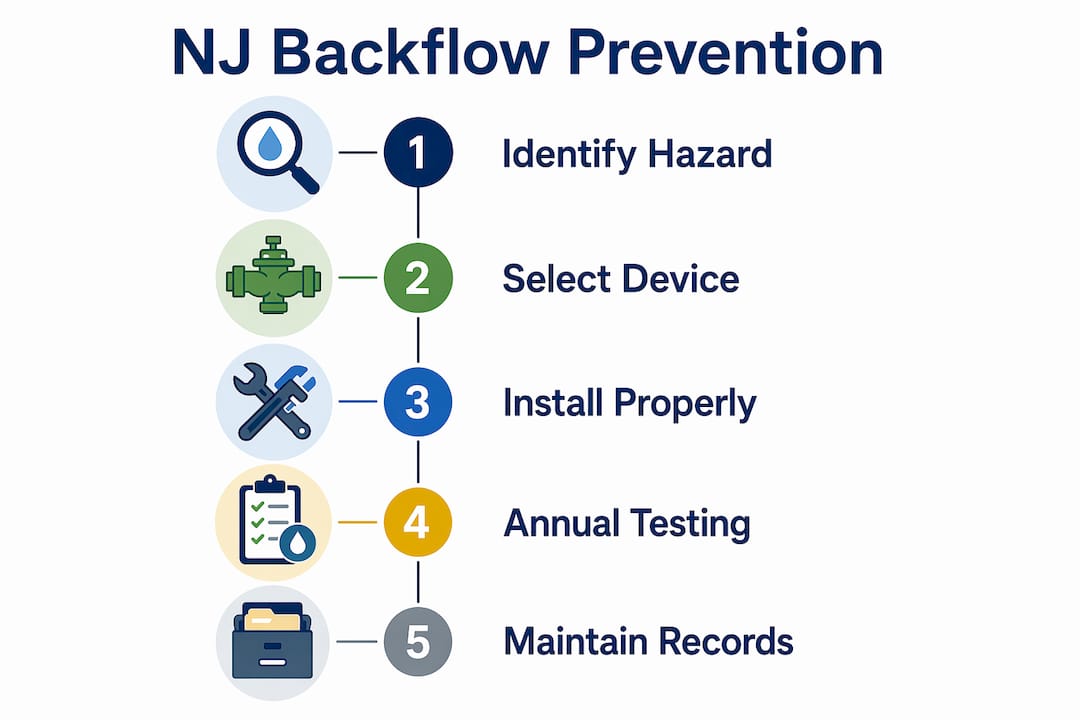
Annual testing is required for most mechanical backflow prevention assemblies in New Jersey. A certified tester must verify that the device operates within pressure tolerances and submit results to the local water authority. Many property owners receive a compliance letter from their municipality when testing is overdue. If you have received one of those notices, the backflow compliance letter guide from Southjerseybackflow walks through exactly what to do next.
Pro Tip: Keep a log of every backflow test result, device serial number, and tester certification number on file. Inspectors in New Jersey can request records going back several years, and missing documentation is treated the same as missing compliance.
How NJ plumbing code adoption and enforcement actually work
Understanding who writes the rules and who enforces them prevents a lot of confusion when you are dealing with permits and inspections. The structure in New Jersey is straightforward once you see it clearly.
- The state sets the technical standard. New Jersey adopts the NSPC by statute under the Uniform Construction Code, with state-specific amendments that carry the same legal weight as the base code.
- Local municipalities handle permits and inspections. Your town’s construction office issues plumbing permits, schedules inspections, and employs the licensed inspectors who sign off on your work.
- Local authorities cannot override state technical provisions. A municipal inspector applies state codes regarding permits and inspections but cannot change the technical requirements. If the NSPC requires an RPZ assembly, no local variance can substitute a lesser device.
- The NSPC updates every three years. The 2024 NSPC update is expected to be adopted in spring 2026, meaning NJ properties will need to track new amendments that increase code complexity for certain system types.
- The permit inspection sequence is fixed. The plumbing permit process includes rough-in, top-out, and final inspections, each verifying specific compliance points before the next phase can proceed.
The practical implication for property managers is that you need to track both the state adoption calendar and your local municipality’s enforcement practices. Two towns in the same county can have different permit timelines and inspection scheduling norms, even though they apply identical technical standards. Building a working relationship with your local construction office is not just good practice. It is the most reliable way to avoid permit delays on time-sensitive projects.
The International Plumbing Code (IPC) is a separate model code used in many other states. New Jersey does not adopt the IPC. Contractors who work across state lines sometimes bring IPC assumptions into NJ projects, which creates compliance problems. Always confirm that any contractor you hire is current on NSPC requirements and NJ amendments specifically.
What common backflow violations look like and how to prevent them
Common NJ plumbing code violations involve backflow devices, improper pipe materials, venting issues, and incorrect pipe slopes, all of which lead to inspection failures and fines. Failed inspections cause rework, fines, and project delays that compound quickly on commercial and multi-unit properties.
The violations inspectors flag most often in New Jersey fall into predictable categories:
- Wrong device for the hazard level. Installing a double check valve where an RPZ is required is the single most common backflow violation. The code is explicit about hazard classifications, and inspectors know them cold.
- Expired or missing test records. Mechanical backflow assemblies require annual certified testing. Properties without current test records on file fail compliance reviews immediately.
- Improper device location. Backflow preventers must be installed at accessible locations above the flood rim of the lowest fixture they protect. Devices buried in crawl spaces or installed below grade fail on location alone.
- Incorrect pipe materials. NJ amendments specify approved materials for different system types. Using non-listed pipe in a potable water application is a code violation regardless of how well the installation is executed.
- Venting deficiencies. Missing or undersized vents cause trap seal loss, which creates sewer gas entry points and fails DWV inspections.
| Violation type | Typical consequence | Prevention step |
|---|---|---|
| Wrong backflow device | Immediate inspection failure, device replacement required | Verify hazard classification before purchase |
| Missing test records | Compliance hold, potential fines | Schedule annual testing, retain all records |
| Improper device location | Rework required before approval | Confirm accessible above-grade installation |
| Non-approved pipe materials | Full section replacement required | Check NJ-approved materials list before installation |
The NJ backflow compliance roadmap from Southjerseybackflow covers the 2026 code cycle in detail, including which device types are under increased scrutiny this inspection season. Proactive maintenance, specifically annual testing and a documented inspection schedule, eliminates the majority of these violations before they become enforcement issues.
Key takeaways
New Jersey plumbing compliance depends on understanding the NSPC, meeting backflow prevention requirements, and maintaining accurate test records year over year.
| Point | Details |
|---|---|
| NJ uses the NSPC, not the IPC | New Jersey adopts the National Standard Plumbing Code with state amendments under the UCC. |
| Backflow prevention is code-mandated | Device type is assigned by hazard level; substituting a lesser device is a direct violation. |
| Local enforcement, state technical rules | Municipalities issue permits and inspect, but cannot alter state technical requirements. |
| Annual testing is required | Mechanical backflow assemblies must be tested yearly by a certified tester and results submitted. |
| Code updates every three years | The 2024 NSPC edition is expected in spring 2026; NJ amendments add further complexity. |
What I have learned working with NJ backflow compliance
After years of working with property owners across New Jersey, the pattern I see most often is not ignorance of the codes. It is the assumption that compliance is a one-time event rather than an ongoing obligation. A property that passed inspection in 2022 is not automatically compliant in 2026. Codes update, devices age, and annual testing requirements do not pause because you are busy.
The second thing I have observed is that property managers who build a direct relationship with their local AHJ consistently have fewer problems. Inspectors are not adversaries. They are applying the same NSPC provisions you can read yourself. When you show up to a permit meeting with documentation, device specs, and a clear installation plan, the process moves faster and the outcomes are better.
The trend worth watching right now is the increased scrutiny on RPZ assemblies at irrigation and fire suppression connections. Municipal water authorities across New Jersey are tightening enforcement on annual test submission deadlines, and the consequences for late or missing submissions are escalating. If your property has an irrigation system or a fire line, those devices should be at the top of your maintenance calendar, not an afterthought.
Staying current with NJ plumbing safety improvements is not complicated. It requires a documented schedule, a certified tester you trust, and the discipline to treat compliance as a recurring operational task rather than a reactive one.
— Jordan
How Southjerseybackflow helps NJ property owners stay compliant
Southjerseybackflow provides backflow testing, certification, and device inspection services specifically for New Jersey property owners and managers. The team understands NSPC requirements and NJ-specific amendments, which means you get accurate compliance guidance rather than generic advice. Whether you need annual testing for an existing assembly, help responding to a municipal compliance notice, or a full backflow testing and certification review for your property, Southjerseybackflow handles the documentation, submission, and follow-up. For a complete overview of what the testing process involves and how to stay compliant through the 2026 code cycle, the NJ backflow testing guide is the right starting point.
FAQ
What plumbing code does New Jersey use?
New Jersey enforces the National Standard Plumbing Code (NSPC) with state-specific amendments under the Uniform Construction Code (UCC). The NSPC governs water supply, DWV, and stormwater drainage systems statewide.
How often do backflow preventers need to be tested in NJ?
Most mechanical backflow prevention assemblies in New Jersey require annual testing by a certified tester. Results must be submitted to the local water authority to maintain compliance.
Can a local NJ municipality change the plumbing code requirements?
Local municipalities issue permits and conduct inspections but cannot override the state’s technical plumbing provisions. The NSPC requirements apply uniformly across all New Jersey towns.
What happens if a backflow device fails inspection?
A failed backflow inspection typically results in a compliance hold, required device repair or replacement, and potential fines. Missing test records carry the same consequence as a failed device test.
What is the difference between an RPZ and a double check valve?
A reduced pressure zone (RPZ) assembly is required for high-hazard cross-connections such as irrigation and boiler feeds. A double check valve applies to lower-hazard connections where contamination risk is present but would not cause illness.
Pingback: The Role of EPA in Backflow Prevention for NJ Owners
Pingback: Backflow vs. Cross Connection: What NJ Owners Must Know
Pingback: Backflow Preventer Pipe Size Guide for NJ Properties