
What are the top smartwaterbackflow.com alternatives?
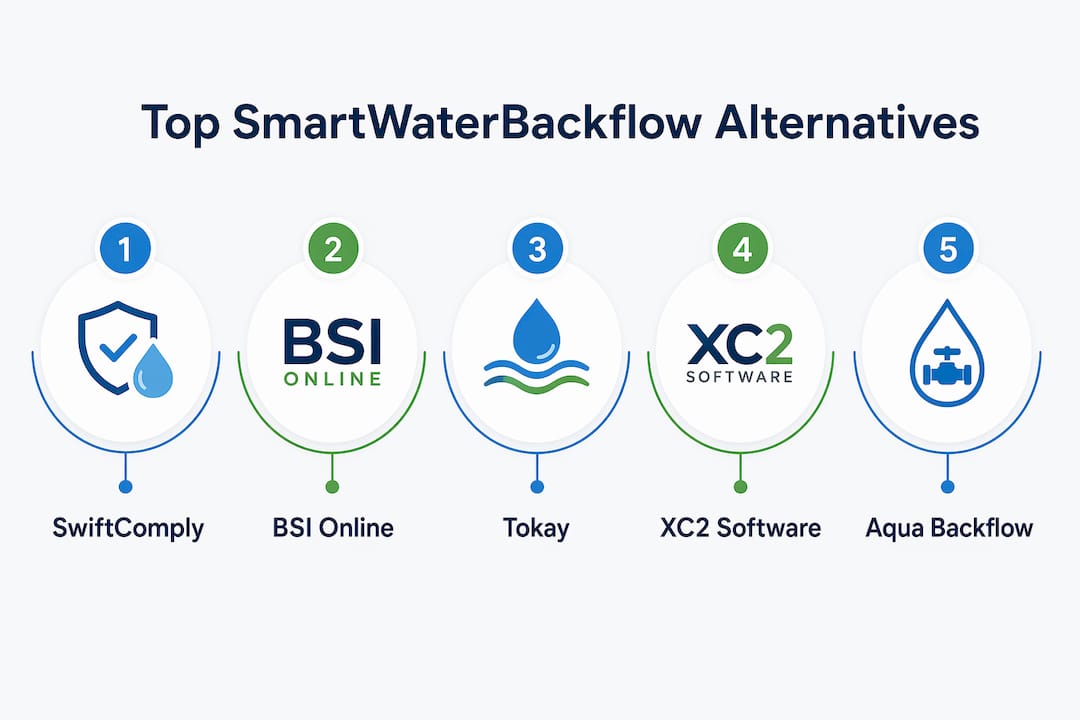
If you’re looking to move beyond smartwaterbackflow.com, the strongest alternatives in 2026 are SwiftComply Backflow, BSI Online, Tokay, XC2 Software, and Aqua Backflow (TrackMyBackflow.com). Each targets a different slice of the compliance management problem, from full-service administration to lightweight database tracking. The table below maps the field so you can build a shortlist fast.
| Software | Key Features | Compliance Support | Automation | Ease of Use | Best For |
|---|---|---|---|---|---|
| SwiftComply Backflow | Scheduling, reporting, compliance dashboards | Strong | High | High | Compliance-focused property managers |
| XC2 Software | Tester credential mgmt, ordinance tracking | Strong | Moderate | Moderate | Tester database and municipal tracking |
| SEMS Technologies | Intuitive UI, integration options | Moderate | Moderate | High | Users wanting simple interfaces |
| Tokay | Cloud automation, ordinance review | Strong | High | High | Full administrative program support |
| Aqua Backflow (TrackMyBackflow.com) | Automated notices, scheduling | Strong | High | High | Automated notification management |
| iWorQ | Permit mgmt, municipal device tracking | Moderate | Moderate | Moderate | Municipal compliance coordination |
| BSI Online | Full-service, in-house staff, cloud platform | Very Strong | High | High | Managers needing hands-on administration |
| BAT Database | Tester cert tracking, compliance deadlines | Moderate | Low | Moderate | Database-driven documentation |
| BPMS Software | Workflow automation, reporting | Moderate | High | Moderate | Workflow-centric compliance |
| Safe Water Commission | Safety standards, documentation mgmt | Strong | Moderate | Moderate | Regulatory documentation precision |
| Aqua Backflow | Backflow tracking and compliance | Moderate | Moderate | Moderate | General backflow tracking |
A few quick takeaways before diving deeper. BSI Online and Tokay are the only platforms that qualify as genuinely full-service: they handle ordinance review, tester credential checks, and customer notifications without pushing those tasks back onto your staff. SwiftComply and Aqua Backflow (TrackMyBackflow.com) lead on automation for scheduling and notices. XC2 Software is the go-to when tester license verification is the primary pain point. BAT Database suits managers who need a clean, database-driven record of certifications and deadlines but don’t need heavy automation.

Detailed reviews of leading backflow prevention software alternatives
SwiftComply Backflow
SwiftComply is built around one idea: remove the manual steps from compliance reporting. Its scheduling engine sends test reminders automatically, and its reporting tools generate submission-ready documents without requiring staff to reformat data. Property managers handling multiple sites find the dashboard particularly useful because it surfaces overdue tests across all locations in one view. Pricing is not publicly listed; the company offers demos on request.

BSI Online
BSI Online is the clearest full-service option on this list. Its in-house staff handles ordinance review, tester credential verification, customer notifications, and state report generation. That matters because most software alternatives only provide the platform; the administrative work still falls on your team. BSI’s model shifts that burden entirely. If you’re managing a large commercial portfolio and want a vendor that acts more like an outsourced compliance department than a SaaS tool, BSI Online is the strongest fit.
Tokay
Tokay combines cloud-based data management with active ordinance review assistance, which puts it in the same full-service tier as BSI Online. The cloud architecture means test records, device histories, and tester credentials are accessible from any device. Tokay suits managers who want the software’s automation plus someone to call when a local ordinance changes.
XC2 Software
XC2 Software’s standout feature is tester credential management. It integrates municipal licensing requirements directly into the platform, so when a tester’s certification lapses, the system flags it before a test gets scheduled with an unqualified technician. That kind of proactive verification reduces liability exposure in ways that generic asset management tools simply don’t address.
Pro Tip: Before signing any software contract, ask the vendor directly: “Who handles customer notifications and tester credential verification — your staff or mine?” The answer tells you immediately whether you’re buying a full-service platform or a data entry tool with a nicer interface.
Aqua Backflow (TrackMyBackflow.com)
Aqua Backflow focuses on the notification side of compliance. The platform automates customer notices for upcoming tests, overdue tests, and repairs, which is the task property managers most often let slip when managing manually. Installation scheduling is built in. For managers whose biggest compliance gap is simply keeping residents and tenants informed, this platform addresses that gap directly.
iWorQ
iWorQ is designed with municipalities in mind, which makes it a natural fit for property managers who coordinate closely with local water authorities. Its permit management tools and device tracking align with how municipal compliance programs are structured. It’s less suited to managers who want a self-contained solution without municipal integration.
SEMS Technologies
SEMS Technologies prioritizes interface simplicity and integration flexibility. It connects with existing property management systems more readily than some competitors, which reduces the friction of adding a new compliance layer. The compliance feature set is solid but not as deep as BSI Online or Tokay.
BAT Database, BPMS Software, and Safe Water Commission
BAT Database does one thing well: it tracks tester certifications and compliance deadlines in a structured database format. There’s limited automation, but the record-keeping is clean and auditable. BPMS Software leans into workflow automation and reporting, making it a reasonable choice for managers who already have administrative staff and just need better process structure. Safe Water Commission focuses on documentation aligned with water safety regulatory standards, which suits managers in jurisdictions with strict documentation requirements.
Pricing across all these platforms varies by property size, device count, and feature tier. Free trials or demos are commonly available, so it’s worth requesting a live walkthrough before committing to any subscription.
How to choose the right backflow prevention software for your property
The right choice depends on how much administrative work you want the software to absorb versus how much your team will handle internally. That single question narrows the field faster than any feature comparison.
Start with these evaluation criteria:
- Compliance support depth: Does the platform handle ordinance review and tester verification, or does it just store the data you enter?
- Automation level: Will it send customer notices and schedule tests automatically, or does someone on your team trigger those actions?
- Integration: Does it connect with your existing property management system, or does it require parallel data entry?
- Pricing transparency: Is pricing publicly listed, or do you need a sales call to get a number? Tiered pricing by device count is common.
- Customer support and training: Is there a real support team, or are you relying on documentation and tickets?
Property type and size shape the decision significantly. A single commercial building with a handful of devices can get by with a lighter tool like BAT Database or BPMS Software. A portfolio of 50-plus properties with diverse municipal requirements needs the depth of BSI Online, Tokay, or SwiftComply. Compliance tracking for NJ commercial properties adds another layer: New Jersey has specific state reporting requirements that not every national platform handles out of the box.
One practical question worth asking vendors: does the platform generate state-ready reports, or does your team still need to reformat data before submission? The answer separates genuinely compliance-ready platforms from data storage tools dressed up as compliance software.
Scalability matters if your portfolio is growing. Platforms like SwiftComply and Tokay are built to handle expanding device counts without requiring a platform switch. Smaller database tools may require migration as your property count grows.
Industry insights and expert recommendations on backflow prevention management software
The NIST evaluation of backflow prevention devices makes one point that property managers often overlook: no universal model exists for predicting backflow hazard potential. Compliance is mandated based on facility type and local authority rules, not on a risk calculation you can run yourself. That means following local ordinances precisely, not estimating your way around testing requirements.
Manual spreadsheet tracking creates real liability exposure. When tester credentials and compliance deadlines live in a spreadsheet, human error is the primary failure mode. A missed renewal date or an unverified tester license can result in a regulatory violation that a software platform would have caught automatically. Automated backflow compliance software addresses this by removing the human check from the critical path.
A point that often gets lost in software comparisons: backflow preventers and check valves serve fundamentally different purposes. Check valves control flow direction in low-risk applications. Backflow preventers, which include double check valve assemblies, reduced pressure zone assemblies, and pressure vacuum breakers, protect potable water from contamination and are regulated under standards from ASSE and AWWA. Confusing the two at the device level leads to compliance gaps that no software can fix after the fact.
For properties in freeze-prone regions or sensitive environments like data centers, dry-pipe and pre-action fire protection systems can eliminate annual backflow testing requirements entirely, though they carry higher upfront infrastructure costs. Pre-action systems have been documented to eliminate significant initial backflow preventer costs in data center applications. That trade-off is worth modeling over a 10-year lifecycle before defaulting to a standard backflow preventer setup.
Dedicated backflow prevention platforms differ from generic asset management tools in one concrete way: they are built around the compliance workflow, not adapted to it. A generic tool requires customization to handle tester licensing, state report formats, and municipal ordinance variations. A purpose-built platform like SwiftComply or BSI Online ships with those workflows already structured. Understanding smart plumbing technology helps clarify where software fits within a broader water management strategy.
Southjerseybackflow: a local alternative worth considering
Software platforms manage the data. Someone still has to show up, test the device, and submit the results. For property managers in New Jersey, that’s where Southjerseybackflow comes in.
Southjerseybackflow handles backflow testing in New Jersey directly, covering the physical testing, documentation, and submission that software alone cannot replace. If you’ve received a compliance notice from your municipality or water authority, Southjerseybackflow can handle the response from test to submission. That’s a different kind of solution than the platforms compared above, and for NJ property managers, it’s often the faster path to compliance. You can also explore preventing backflow contamination strategies for both commercial and residential properties on the Southjerseybackflow resource library.
Key Takeaways
The strongest backflow prevention software alternatives to smartwaterbackflow.com are BSI Online and Tokay for full-service administration, SwiftComply and Aqua Backflow for automation, and XC2 Software for tester credential management.
| Point | Details |
|---|---|
| Full-service vs. software-only | BSI Online and Tokay handle ordinance review and notifications; most others require your team to manage those tasks. |
| Automation is the key differentiator | SwiftComply and Aqua Backflow (TrackMyBackflow.com) automate scheduling and customer notices, reducing manual compliance gaps. |
| Compliance is locally mandated | Per NIST, no universal risk model exists; follow local ordinances precisely and choose software that supports your jurisdiction’s reporting format. |
| Device type affects compliance scope | Backflow preventers (RPZ, DCVA, PVB) require annual testing by certified testers; check valves do not carry the same regulatory obligation. |
| Southjerseybackflow for NJ testing | NJ property managers needing physical testing and submission support can use Southjerseybackflow as a direct service alternative to self-managed software. |