TL;DR:
- Most property owners in New Jersey receive backflow testing notices and often overlook their significance. These tests are mandated by local and state laws to prevent contaminated water from re-entering municipal water systems through cross-connections. Ensuring compliance involves using certified testers approved by your municipality, adhering to local deadlines, and maintaining proper device installation, especially in high-hazard applications like irrigation and commercial systems.
Most property owners in New Jersey get a backflow testing notice in the mail and assume it’s just another piece of local government paperwork. It isn’t. Understanding why municipalities require backflow tests changes how seriously you take the deadline printed on that letter. Your water supply shares infrastructure with every business, hospital, and home in your municipality. When backflow occurs, contaminated water can re-enter the public system before anyone knows there’s a problem. This article breaks down the real reasons behind the mandate and what New Jersey property owners specifically need to do to stay compliant.
Table of Contents
- Key takeaways
- Why municipalities require backflow tests to protect public water
- Backflow prevention devices and annual testing requirements
- Certified testers and the compliance process in New Jersey
- Common pitfalls in backflow testing compliance
- My take on municipal backflow requirements
- Stay compliant with Southjerseybackflow
- FAQ
Key takeaways
| Point | Details |
|---|---|
| Municipal legal obligation | Cities and towns enforce backflow testing under the Safe Drinking Water Act and New Jersey state law. |
| Annual testing is non-negotiable | Device failure rates rise after 12 months, making yearly testing the minimum safe standard. |
| Only certified testers count | Reports from uncertified testers are rejected and treated as violations by most NJ utilities. |
| Local rules vary significantly | New Jersey municipalities often impose stricter rules than state minimums, so always check with your local water utility. |
| Missed deadlines cost more | Penalties can include service shutoff, administrative surcharges, and city-hired inspections billed to the property owner. |
Why municipalities require backflow tests to protect public water
The word “backflow” describes what happens when water flows in reverse through your plumbing system. Under normal conditions, your municipal water supply operates at higher pressure than the water inside your building. When that pressure drops suddenly, due to a water main break, heavy fire hydrant use, or a pressure surge, water from inside your property can get pulled backward into the public main. That water may carry fertilizers, cleaning chemicals, pesticides, or bacteria.
Municipalities mandate backflow testing under federal law, specifically the Safe Drinking Water Act, which requires water suppliers to protect distribution systems from cross-connection contamination. New Jersey reinforces this through its own regulations administered by the New Jersey Department of Environmental Protection.
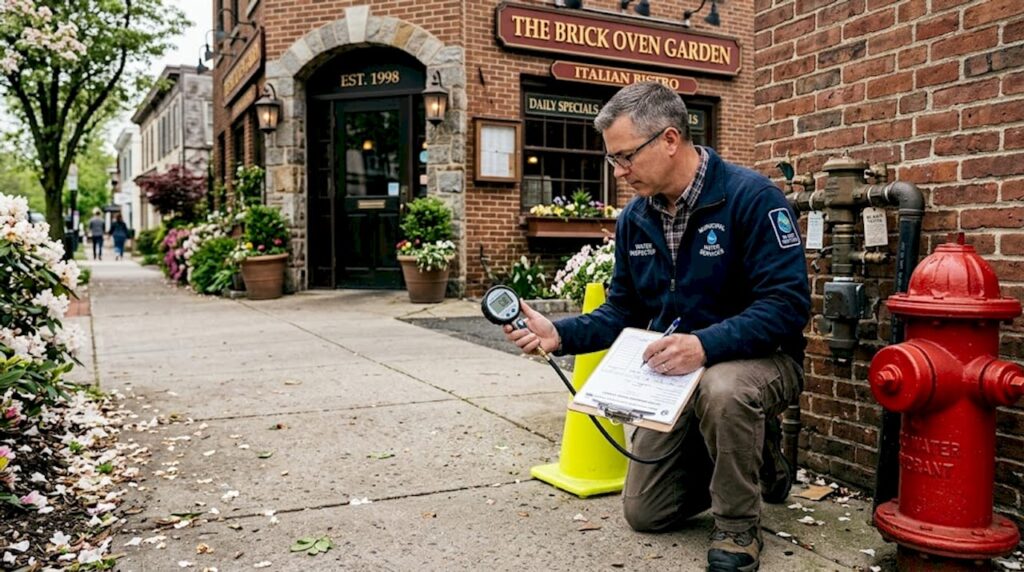
Here’s what most people don’t realize: your municipality isn’t just checking a federal box. They maintain active databases of every registered backflow prevention device in their system, along with the test status for each one. That’s how they track compliance and satisfy state and federal reporting requirements.
The health stakes are real. Consider what a backflow event at a commercial property with a boiler system, a lawn irrigation connection, or even a photographic processing lab can introduce into the water supply. Cross-connections at industrial and commercial properties carry significant contamination risks for the entire neighborhood served by that water main.
“Municipal cross-connection control programs have shifted focus toward educating property owners on the actual health risks posed by their specific equipment, not just code language.”
Key reasons municipalities enforce backflow testing:
- Pressure fluctuations in public mains create recurring backflow risks throughout the year
- Cross-connections in older New Jersey buildings may not have been identified or protected
- Contamination incidents can affect hundreds of households before the source is located
- Federal and state reporting requires documented proof of device testing status for every connection
Backflow prevention devices and annual testing requirements
If your property has a connection to the public water supply that creates a cross-connection risk, you are required to have a backflow prevention assembly installed. The specific device required depends on the hazard level of the connection.
The three most common assemblies you’ll encounter in New Jersey are:
- Reduced Pressure Zone (RPZ) assembly — used for high-hazard applications such as irrigation systems, boilers, and commercial connections where contamination could be toxic or carry pathogens
- Double Check Valve assembly (DCVA) — typically used for lower-hazard connections like fire sprinkler systems in residential and light commercial settings
- Pressure Vacuum Breaker (PVB) — commonly installed on lawn irrigation systems, though local rules on acceptable device types vary
Annual testing is required because device failure rates increase measurably after 12 months of continuous use. Springs wear, rubber seals harden, and internal check valves lose their ability to hold against backpressure. A device that passed its test last year can fail silently before this year’s test if no one checks it.
Beyond compliance, annual testing serves a diagnostic function that many property owners overlook entirely. A qualified tester identifies system pressure irregularities and early signs of failure that, if caught early, prevent expensive repairs down the line.
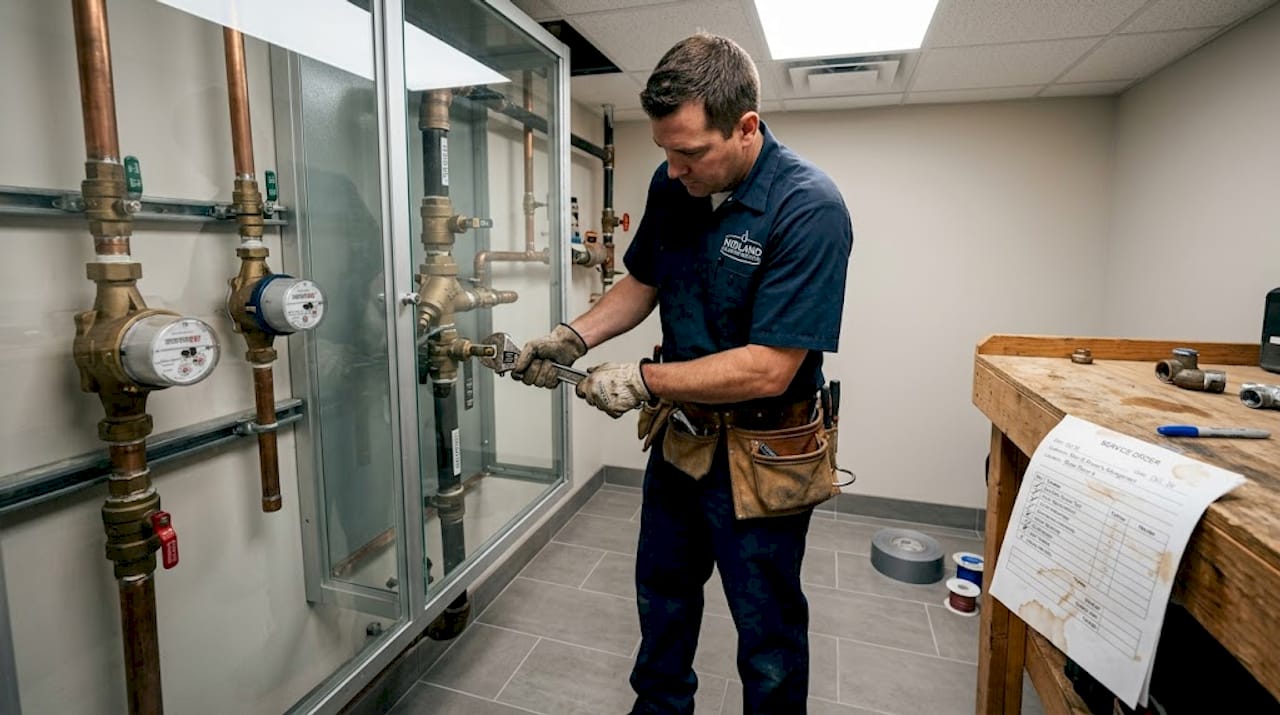
In New Jersey, local enforcement varies significantly from one municipality to the next. Some towns require testing every calendar year by a specific date. Others issue individualized deadlines based on when your device was first registered. The consequence for missing your deadline is not a gentle reminder. You may face water service interruption, financial penalties, or both. Some jurisdictions also charge a surcharge for city-managed testing when property owners fail to schedule their own, covering the administrative cost plus the full testing fee billed directly to the property owner.
Pro Tip: Check your local municipality’s water utility website every January. Many NJ towns publish their certified tester lists and testing deadlines at the start of the year. Getting ahead of this by February means you’re never scrambling in the fall.
For a detailed breakdown of how these rules apply across New Jersey, the NJ backflow compliance roadmap at Southjerseybackflow covers municipality-specific variations worth reviewing before your next deadline.
Certified testers and the compliance process in New Jersey
Not every plumber can perform a backflow test that your municipality will accept. The test involves calibrated differential pressure equipment and interpretation of readings against device-specific thresholds. It’s not a visual inspection; it requires technical training and the right tools.
New Jersey municipalities maintain lists of approved testers. Some utilities require American Water Works Association (AWWA) certification as the baseline standard. Others have additional local certification requirements layered on top. If your tester is not on your municipality’s approved list, the test report is rejected regardless of how accurate the results are. That puts you in violation as if you had never scheduled the test.
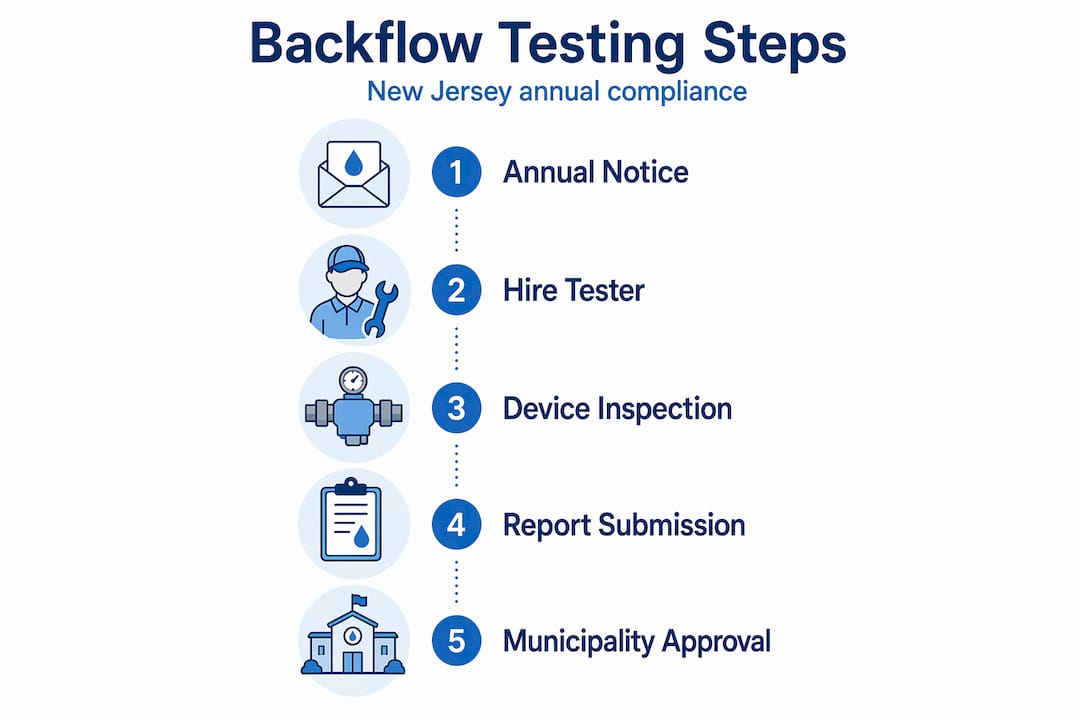
Here’s what the compliance process looks like for most NJ property owners:
- Receive notice from your local water utility with your testing deadline and a reference to their approved tester list
- Contact an approved, certified tester and schedule the inspection before the deadline
- The tester performs the test using calibrated equipment and documents the results on a state-recognized form
- The completed report is submitted directly to your water utility, either by you or by your tester
- Your municipality updates its database to reflect your device’s current test status
- If the device fails the test, repairs or replacement must be completed and a retest scheduled promptly
Property owners who learn to manage this process proactively rather than reactively rarely face penalties. Those who ignore the first notice, miss the deadline, and respond only after a water shutoff warning typically pay far more in fees and emergency service costs than the original test would have cost.
For guidance on the submission process specific to New Jersey, the NJ backflow regulations overview breaks down what your water utility is actually looking for in a compliant test report.
When hiring a tester, verifying credentials before you schedule the appointment is worth the few minutes it takes. A helpful reference for hiring certified inspectors for your property covers what credentials to ask for and why local approval matters more than general licensing in many cases.
Common pitfalls in backflow testing compliance
Even property owners who try to stay compliant run into problems. Knowing where things typically go wrong saves you time, money, and frustration.
| Pitfall | What goes wrong | How to prevent it |
|---|---|---|
| Below-grade device installation | Soil infiltration and freeze damage cause frequent failures and require intensive inspection | Inspect valve boxes before winter and after thaw; verify water drainage away from the assembly |
| Using an unlisted tester | Report is rejected; property is recorded as non-compliant | Always verify tester against your municipality’s current approved list, not last year’s list |
| Ignoring the first notice | Late fees, service shutoff risk, and emergency costs accumulate fast | Treat the first notice as the only notice; respond within the first two weeks |
| Missing repair deadlines after a failed test | A failed device left in place creates both health risk and ongoing violation status | Ask your tester for repair timelines at the time of the failed test, not after |
| Assuming rules match another town | New Jersey municipalities have significant local variations | Confirm requirements directly with your water utility each year |
Devices installed below grade are especially vulnerable to freeze damage during New Jersey winters. A device that looks intact in November may have internal damage by April. Municipalities can and do require additional inspections or corrective action when seasonal damage is suspected.
Pro Tip: If you manage multiple properties across different NJ municipalities, create a compliance calendar with each property’s water utility contact, approved tester list URL, and testing deadline listed separately. Municipal rules do not transfer between towns.
Decentralized regulations mean the biggest compliance risk is assuming your experience with one municipality applies to the next. It often doesn’t.
My take on municipal backflow requirements
I’ve worked directly with property owners and managers across New Jersey long enough to recognize a pattern. Most people who call us after getting hit with a penalty weren’t negligent. They genuinely didn’t understand what the municipality was asking for or why. They thought backflow testing was a checkbox exercise managed entirely by their plumber. It isn’t.
In my experience, the property owners who handle this best are the ones who treat the municipality as a partner rather than an adversary. Your local water utility isn’t trying to generate revenue through fines. They are legally responsible for the water that reaches every tap in their service area. When a cross-connection event happens, it is their name on the public health notice.
What I’ve found works: ask your water utility directly which testers they currently recognize, get confirmation of your specific deadline in writing, and don’t let your tester submit the report without following up to confirm it was received and logged in the system. That last step is where compliance falls apart more often than you’d expect.
The myth I hear most often is that backflow testing is only relevant for commercial properties. I’ve seen residential irrigation systems in South Jersey cause real compliance issues for property owners who assumed their simple sprinkler connection didn’t apply. If there’s a cross-connection on your property, the requirement applies regardless of whether you’re running a warehouse or a split-level.
— Jordan
Stay compliant with Southjerseybackflow
Staying on top of backflow test requirements in New Jersey is straightforward when you work with a certified team that already knows your local municipality’s rules.
Southjerseybackflow provides certified backflow testing across New Jersey, including service in Salem County and Gloucester County. The team handles the full compliance process, from scheduling and testing to submitting results directly to your water utility. If your device fails, repairs and retesting are handled without you having to coordinate multiple contractors. For a clear walkthrough of how to pass, submit, and stay compliant with New Jersey’s testing requirements, that resource is a strong starting point before your next deadline.
FAQ
Why do municipalities require annual backflow testing?
Backflow device failure rates increase significantly after 12 months of use, and annual testing is the minimum standard required to verify that devices protecting the public water supply are still functioning correctly. Municipalities are also legally obligated under the Safe Drinking Water Act to maintain documented proof of device test status.
What happens if I miss the backflow testing deadline in New Jersey?
Missing your deadline can result in water service interruption, administrative penalties, and in some cases the municipality hiring a private tester at your expense, with additional surcharges added to your utility bill.
Can any licensed plumber perform my backflow test?
No. Tests must be performed by testers on your municipality’s current approved list. Reports from unlisted testers are rejected and treated as a compliance violation, even if the test itself was technically accurate.
Do backflow testing rules differ between New Jersey towns?
Yes. New Jersey municipalities frequently impose requirements that exceed the state minimum, including different approved tester lists, device-specific rules, and unique reporting deadlines. Always confirm your local requirements directly with your water utility each year.
Does backflow testing apply to residential properties?
Yes. Any property with a cross-connection to the public water system, including residential irrigation connections, is subject to municipal backflow test requirements. The type of device required depends on the hazard level of the connection.