TL;DR:
- New Jersey property owners must comply with layered backflow regulations that include state codes, local ordinances, and water purveyor requirements to prevent contamination.
- Annual testing by certified technicians, timely reporting, and adherence to local rules are essential for proper compliance and water safety.
Most New Jersey property owners assume that having a backflow prevention device installed is enough. It isn’t. Backflow ordinances explained in full reveal a layered system of state codes, local rules, and water purveyor requirements that go well beyond the device itself. Miss any one layer, and you could face fines, failed inspections, or worse. contaminated drinking water flowing back through your building’s plumbing. This guide breaks down exactly what applies to you as a New Jersey property owner or manager, what the law actually requires, and how to stay fully compliant without guessing.
Table of Contents
- Key Takeaways
- Backflow ordinances explained: NJ’s regulatory framework
- How backflow actually happens
- Property scenarios and your compliance obligations
- Steps to staying compliant with NJ backflow laws
- What I’ve learned from years of NJ backflow compliance work
- Get your NJ backflow compliance handled right
- FAQ
Key Takeaways
| Point | Details |
|---|---|
| Regulations are layered | NJ backflow rules combine state codes, NJDEP standards, and local water purveyor requirements that vary by location. |
| Device type depends on hazard | Low-hazard properties use a DCVA; high-hazard connections like chemical feeds or healthcare require an RPZ assembly. |
| Certified testers only | Annual testing must be done by an ASSE-certified backflow tester, not simply any licensed plumber. |
| Reporting deadlines matter | Test results must be submitted to your water purveyor within 30 days of testing or you risk a compliance violation. |
| Local rules can be stricter | Counties like Hudson and Bergen may require quarterly testing for high-hazard properties, far exceeding state minimums. |
Backflow ordinances explained: NJ’s regulatory framework
New Jersey does not run on a single backflow rulebook. NJ’s backflow framework is layered, pulling from the NJ Uniform Construction Code, the NJDEP’s cross-connection control standards under N.J.A.C. 7:10, and the enforcement authority of local water purveyors. Each layer can add requirements on top of the one below it.
The NJ Department of Community Affairs oversees the Uniform Construction Code, which sets the baseline for installation and permitting. The NJDEP’s cross-connection control program then adds the health and contamination prevention layer, specifying what types of hazards require protection and at what level. From there, your local water purveyor picks up enforcement, which is where things get specific to your zip code.
Understanding backflow regulations in this context means recognizing that local municipalities can exceed state minimums. Higher-density counties like Hudson and Bergen, for example, often impose stricter local backflow ordinances, including more frequent testing cycles and mandatory on-site surveys for properties with elevated risk profiles.
Pro Tip: Contact your water purveyor directly and ask for a copy of their cross-connection control program. This document tells you exactly what testing frequency and reporting rules apply to your property, beyond what the state requires.
Standard backflow ordinance guidelines across NJ call for annual testing of most assemblies. High-hazard properties can face quarterly requirements. The key takeaway for property managers is this: knowing the state rules is the starting point, not the finish line.
How backflow actually happens
Before you can understand which device you need, you need to understand why backflow is a real threat. Backflow occurs through two hydraulic conditions. The first is backsiphonage, which happens when negative pressure in the supply line literally pulls water backward through a cross-connection. Think of it like a straw being sucked in reverse. The second is backpressure, where downstream pressure from a heating system, pump, or elevated water source exceeds the incoming supply pressure, pushing contaminated fluid backward into the clean water system.
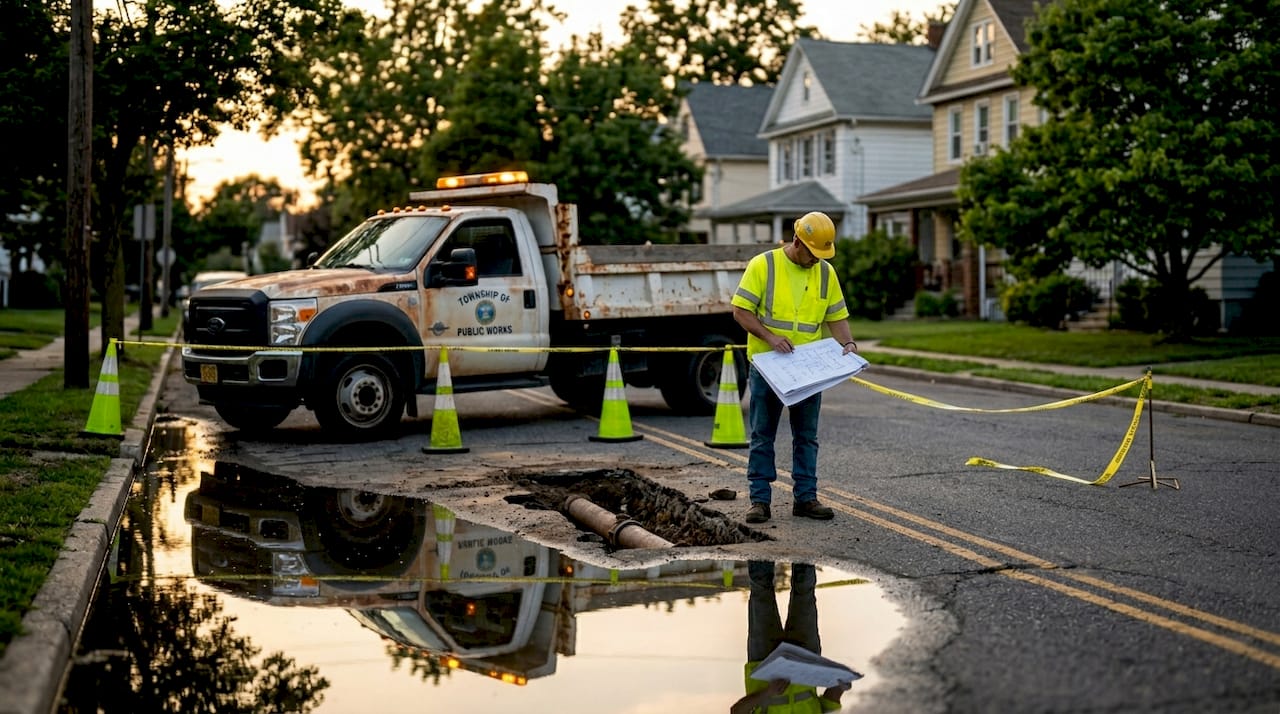
Both conditions can happen in any building. A pressure drop in the municipal main during a water main break can trigger backsiphonage in a connected irrigation system. A boiler system running at elevated pressure can create backpressure. The contamination risk in both cases is real, and the legal and health consequences of a backflow event include illness, property damage, fines, and liability exposure for the property owner.
New Jersey’s backflow prevention laws exist specifically to stop these events at the property level, before contamination reaches the public supply.
Approved assembly types in New Jersey
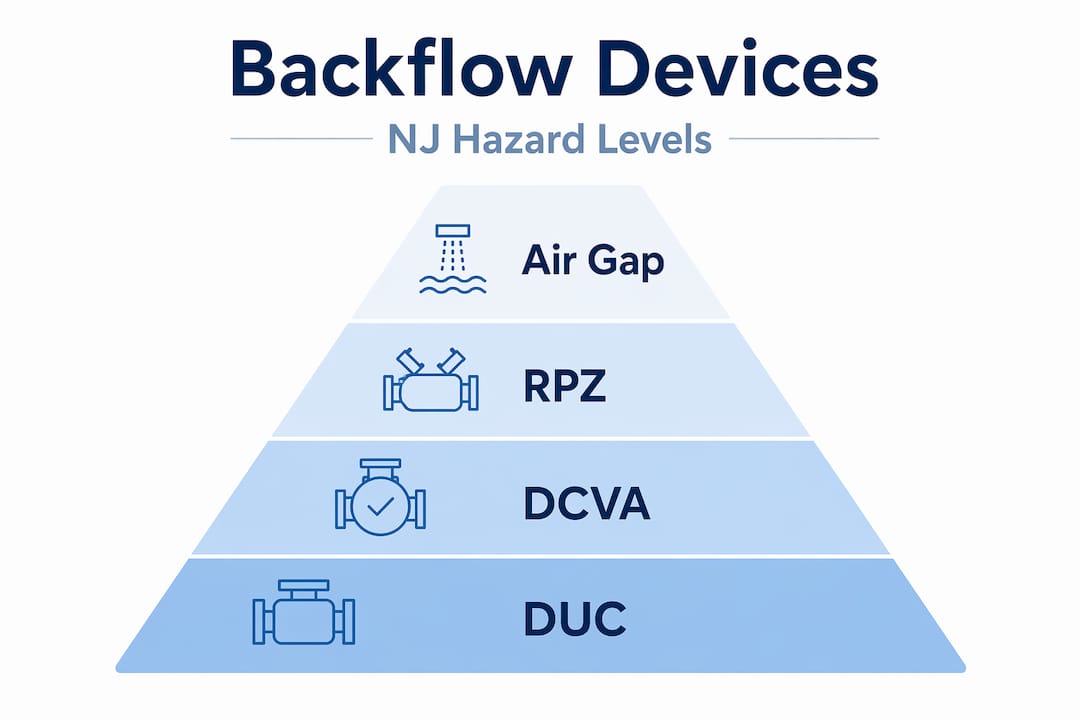
NJ recognizes several backflow prevention assemblies, and the right choice depends entirely on the hazard classification of your cross-connection. Here is a comparison of the most common types:
| Assembly | Hazard level | Typical use |
|---|---|---|
| Air Gap | Highest | Direct separation, no physical connection |
| Reduced Pressure Zone (RPZ) | High | Chemical feeds, healthcare, irrigation with fertilizers |
| Double Check Valve Assembly (DCVA) | Low to moderate | General commercial, fire suppression, boilers without additives |
| Pressure Vacuum Breaker (PVB) | Moderate | Outdoor irrigation above ground |
| Atmospheric Vacuum Breaker (AVB) | Low | Hose connections, isolated fixtures |
RPZ assemblies are the gold standard for high-hazard connections. If your property has any connection to chemical processing, a healthcare operation, or an irrigation system that applies fertilizers or pesticides, an RPZ is most likely what backflow device regulations require for your situation.
Pro Tip: Never downgrade your assembly type without written confirmation from your water purveyor. Installing a DCVA where an RPZ is required is a compliance violation, even if the device passes its annual test.
Property scenarios and your compliance obligations
Backflow compliance is not one-size-fits-all. What applies to a single-family home with an in-ground sprinkler system is very different from what applies to a commercial food service operation. Here is a breakdown by property type:
- Residential with irrigation: Irrigation systems using chemigation require an RPZ device. Even a standard irrigation system without chemical injection typically requires at least a PVB or DCVA, depending on your local rules.
- Residential with boilers: Boilers that operate with chemical water treatment additives are a cross-connection hazard. An RPZ is usually required. Boilers without chemical additives may qualify for a DCVA.
- Commercial and industrial: Any connection to process fluids, cleaning chemicals, or industrial water systems requires a high-hazard assembly. No exceptions under NJ backflow prevention laws.
- Healthcare facilities: These carry the highest contamination risk profile in NJ regulations. Expect RPZ requirements across all connections and potentially more frequent testing requirements from your water purveyor.
- Food service operations: Equipment like steam kettles, dishwashers, and carbonation systems all represent cross-connection points. Each must be assessed and protected individually.
For a deeper look at what your residential property specifically requires, the NJ residential backflow guide from Southjerseybackflow covers the most common homeowner scenarios in detail.
Regarding permits, installation and initial device setup requires a permit pulled by a licensed contractor and a local code inspection. Annual operational testing does not require a new permit each year, but it must still be performed and documented according to your water purveyor’s program.
Cross-connection hazards span a wide range of property uses, including boilers with chemical additives, reclaimed water usage, and food service equipment. If you are unsure whether a specific connection at your property qualifies, assume it does until a certified tester confirms otherwise.
Steps to staying compliant with NJ backflow laws
Backflow compliance explained in practical terms comes down to four ongoing responsibilities: testing, certification, reporting, and record keeping. Here is how each one works in New Jersey:
-
Schedule annual testing with a certified tester. This is the step where most property owners make a critical mistake. Annual testing must be performed by a tester holding ASSE Series 5000 certification or an equivalent program. A licensed plumber without this specific certification cannot legally perform or certify your backflow test. Test reports submitted by uncertified testers are rejected by utilities as noncompliant, leaving you exposed.
-
Submit results within 30 days. Once your assembly is tested, the results must go to your water purveyor within 30 days. Missing this window can trigger a notice of violation even if your device passed.
-
Handle failures immediately. A failed test means the assembly did not perform as required. You cannot simply retest and hope for better results. The device must be repaired or replaced by a qualified contractor, retested by the same certified tester, and the passing results submitted before the deadline window closes.
-
Keep your own records. Do not rely solely on your water purveyor’s filing system. Maintain copies of every test report, repair receipt, and correspondence with your water authority. If a dispute arises about your compliance history, your records are your defense.
-
Track local amendments. Backflow prevention rules in NJ get updated. Water purveyors revise their programs, and municipalities amend local ordinances. Set a reminder to check with your local water authority annually, because what was compliant last year may require additional steps this year.
Pro Tip: Ask your certified tester to walk you through the test results before they leave. Understanding what passed and what showed signs of wear helps you anticipate repairs before the next cycle rather than scrambling after a failure.
For a step-by-step walkthrough of the full compliance process, Southjerseybackflow’s NJ backflow prevention guide is a practical resource worth bookmarking.
What I’ve learned from years of NJ backflow compliance work
The thing that surprises most property owners when I talk through their situation is how many layers of obligation they didn’t know existed. They knew they had a backflow preventer. They thought that was it. What they didn’t know was that their water purveyor had a separate compliance program with its own deadlines, and that their county had specific requirements that went beyond the state minimum.
In my experience, the property owners who stay out of trouble are not necessarily the ones with the most complex systems. They’re the ones who treat backflow compliance as an annual business process, not a one-time installation task. They schedule their testing the same month every year, they keep a compliance folder with every report and receipt, and they’ve built a working relationship with their certified tester.
The biggest recurring mistake I see is the confusion between a licensed plumber and a certified backflow tester. These are not the same credential. I’ve seen property managers receive violation notices because a plumber on their maintenance team performed the annual test without holding ASSE certification. The work looked fine. The paperwork was rejected anyway.
My honest advice: don’t wait for a letter from your water authority to take this seriously. A proactive approach to understanding backflow regulations and keeping up with local amendments costs you almost nothing compared to the cost of a compliance failure, a contamination event, or a liability claim.
— Jordan
Get your NJ backflow compliance handled right
Staying on top of backflow compliance in New Jersey is straightforward when you work with a team that knows the state and local rules in detail.
Southjerseybackflow provides certified backflow testing, inspection, installation, and repair services across New Jersey. Every test report is handled by ASSE-certified technicians and submitted to your water purveyor on time. If you’ve received a notice from your water authority, the received backflow letter guide explains exactly what it means and what to do next. For full testing and certification services, visit the NJ backflow testing page to schedule service or get your questions answered by a certified professional.
FAQ
What are backflow ordinances in New Jersey?
Backflow ordinances are local and state rules requiring property owners to install, maintain, and annually test backflow prevention devices that protect public drinking water from contamination. In New Jersey, they are governed by the NJ Uniform Construction Code, NJDEP standards, and individual water purveyor programs.
How often is backflow testing required in NJ?
Most backflow assemblies in New Jersey require annual testing, but local water purveyors can require quarterly testing for high-hazard properties. Always check your specific water purveyor’s cross-connection control program for the exact schedule that applies to your property.
Can any licensed plumber test my backflow device?
No. Annual backflow testing must be performed by a tester holding ASSE Series 5000 certification or an equivalent credential. A standard plumbing license does not qualify someone to certify backflow assemblies in New Jersey.
What happens if my backflow preventer fails a test?
A failed test means the device must be repaired or replaced, then retested by a certified technician. You cannot simply resubmit a failed result. The passing test report must be submitted to your water purveyor within the required timeframe to avoid a violation.
Do I need a permit every year for backflow testing?
No. Annual operational testing does not require a new permit each year. Permits are required for the initial installation or any replacement of a backflow prevention device, which must be pulled by a licensed contractor and inspected by local code officials.