
TL;DR:
- A faulty backflow valve can allow contaminated water to flow into the public supply without visible signs, risking health and regulatory penalties. Different device types have unique failure modes, with some showing clear warnings and others requiring professional testing to detect silent failures. Regular, timely testing by certified professionals is essential to maintain safety, stay compliant with New Jersey regulations, and prevent costly emergency repairs.
A failing backflow valve in your building’s plumbing system can allow contaminated water to flow backward into the public supply, putting tenants and neighbors at risk without a single visible warning sign. For New Jersey property owners and managers, the stakes are even higher because the state mandates annual testing under N.J.A.C. 7:10-10, and missed deadlines or failed devices can trigger fines and emergency water shutoffs. Knowing how to read the early warning signs, understand your device type, and stay ahead of regulatory deadlines is the fastest way to protect both your water system and your bottom line.
Table of Contents
- Understanding backflow valve types and why they fail
- Top warning signs: How to spot a faulty backflow valve
- Field testing and silent failures: What can’t be seen
- Regulatory musts: New Jersey backflow valve testing requirements
- What most experts miss: The importance of acting quickly
- Protect your property: Expert backflow valve testing and repair in New Jersey
- Frequently asked questions
Key Takeaways
| Point | Details |
|---|---|
| Know your device | Different valve types show different failure signs, so check your system’s specific model. |
| Spot warning signs early | Watch for leaks, unusual noises, pressure changes, or water quality shifts to catch problems fast. |
| Field testing is vital | Some failures are invisible without specialized annual inspections, especially for DCVA and PVB devices. |
| Compliance is mandatory | Annual certified testing is legally required in New Jersey to avoid costly fines or water shutoff. |
| Proactive action saves money | Fixing minor issues early prevents bigger repairs and keeps your water supply safe and legal. |
Understanding backflow valve types and why they fail
Now that you understand the importance of spotting issues, it helps to know the devices themselves and why they fail. Not all backflow preventers work the same way, and the type installed on your property directly determines what failure looks like and how you will detect it.
New Jersey properties use three primary device types, and each has a distinct failure mode. Learning the types of backflow devices in your system is the first step toward accurate diagnosis.
RPZ (Reduced Pressure Zone) assemblies use two independent check valves and a differential pressure relief valve in the middle. When either check valve fouls or weakens, the zone pressure drops and the relief valve opens to discharge water visibly. That discharge is actually a built-in alarm.
DCVA (Double Check Valve Assembly) units use two check valves in series but have no relief valve. When either check fails, contaminated water can reverse flow right through the assembly without any external sign whatsoever.
PVB (Pressure Vacuum Breaker) devices protect against backsiphonage only. They contain an air inlet valve that opens during negative pressure events to break the siphon. If that inlet valve jams shut due to mineral deposits or debris, the protection disappears without any visible clue.
Here is a quick comparison of device types, typical failure modes, and how they are detected:
| Device type | Typical failure mode | Detection method |
|---|---|---|
| RPZ assembly | Fouled or weakened check valves | Visible relief valve discharge |
| DCVA | Failed check valves, reverse flow | Certified field testing only |
| PVB | Fouled air inlet valve | Certified field testing only |
Backflow preventer failure signs research confirms that RPZ provides visible failure indication via relief discharge, making it self-reporting for high-hazard uses, while DCVA and PVB require testing as they fail silently. This difference is critical. If your property uses a DCVA or PVB, you cannot rely on your eyes alone.
Key takeaways for device awareness:
- RPZ assemblies are the most self-reporting device type
- DCVA and PVB failures are largely invisible without specialized equipment
- Knowing your device type shapes your entire inspection and testing strategy
- High-hazard properties in New Jersey most commonly require RPZ assemblies
Top warning signs: How to spot a faulty backflow valve
With a handle on the types, let’s break down exactly what warning signs to watch for. Some indicators show up in your everyday experience of the building’s plumbing, long before an annual test flags the problem.
According to backflow failure research, low or fluctuating water pressure, visible leaks, unusual noises such as gurgling, rattling, or whistling, discolored or foul-tasting water, and higher water bills are all common indicators of backflow preventer failure. Each of these deserves attention as a potential early warning.
Watch for these specific warning signs:
- Low or fluctuating pressure: A sudden pressure drop that you cannot explain through normal usage often means a check valve is no longer holding.
- Visible leaks around the device body: Moisture, corrosion stains, or pooling water near the assembly housing signal seal wear or body cracks.
- Continuous relief valve discharge on RPZ units: A small stream or steady drip from the relief port is not normal operation.
- Gurgling, rattling, or whistling sounds: These acoustic clues often indicate debris fouling a check valve or a partially open valve chattering under flow.
- Discolored or foul-smelling water: If water at your tap looks brown or smells off, the device may have already failed and backflow may have occurred.
- Unexplained spikes in your water bill: A leaking relief valve or cracked body can waste hundreds of gallons daily without an obvious puddle on the floor.
For RPZ assemblies specifically, the continuous relief discharge from the relief valve indicates check valve fouling or failure. The relief valve opens when the zone pressure drops to within 2 psi of supply pressure, meaning a failed first check valve immediately triggers discharge.
Visit common backflow issues for detailed repair guidance once you have identified a potential failure, and check backflow preventer FAQs for answers to the questions property managers ask most often.
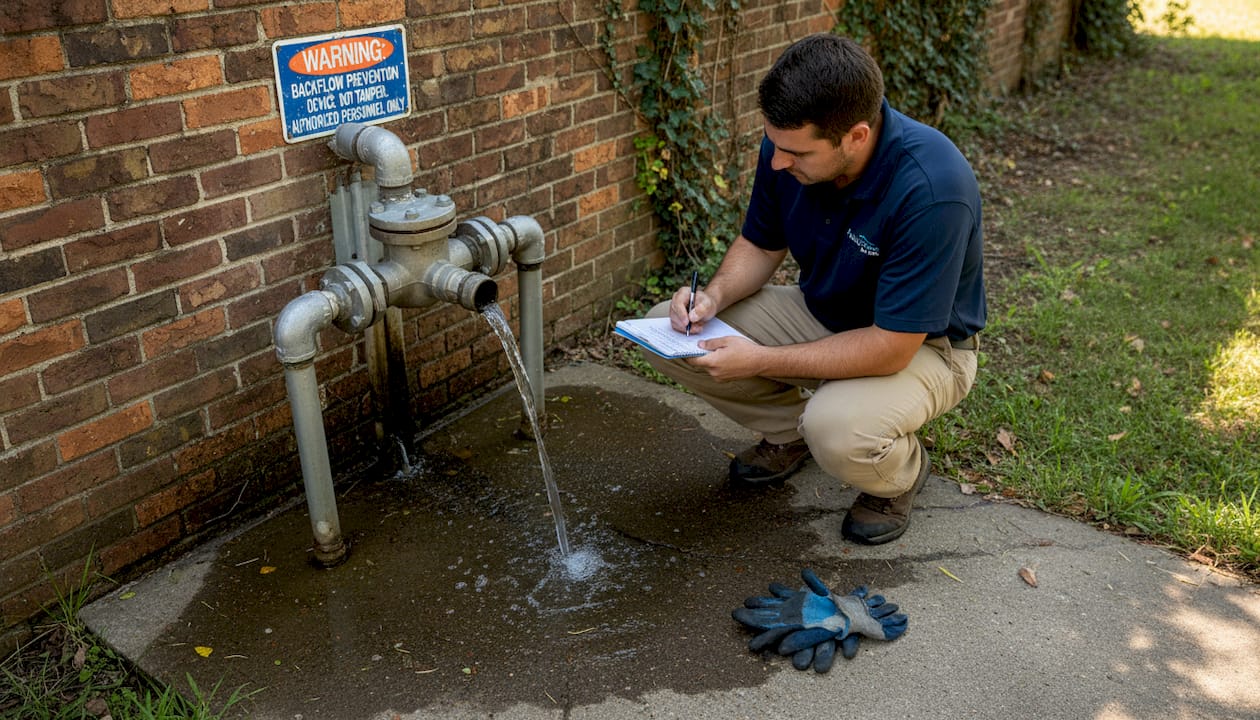
Pro Tip: Short-lived discharge from an RPZ relief valve right after a sudden pressure fluctuation or main break in the street is normal and expected. What is not normal is discharge that continues for more than a few minutes or recurs repeatedly throughout the day. That pattern almost always signals a fouled or weakened check valve that needs immediate attention.
Field testing and silent failures: What can’t be seen
Some symptoms are easy to spot, but others are hidden. Let’s tackle those next, because the most dangerous backflow failures are the ones you never see coming.
DCVA failures represent the clearest example of a silent failure. Research confirms that DCVA failures allow reverse flow without visible discharge, requiring field testing for detection, unlike RPZ which shows discharge. A DCVA can be completely non-functional while looking perfectly normal on the outside. Without a differential pressure test by a certified tester, you simply cannot know whether it is protecting your system.
PVB failures carry their own hidden risk. A fouled air inlet valve that remains closed eliminates all backsiphonage protection. Because the valve only needs to open during negative pressure events (which do not happen every day), the device can sit in a failed state for months before anyone notices a problem.
Failures only detectable through certified field testing:
- A DCVA first check valve that passes low pressure but fails under test differential
- A DCVA second check valve that holds visually but leaks under reverse pressure
- A PVB air inlet valve jammed shut by mineral scaling or debris
- An RPZ relief valve that opens at the wrong threshold due to spring fatigue
- A device body crack so small it only manifests under pressurized test conditions
“Regular field testing is the only reliable method for detecting silent failures in DCVA and PVB assemblies. Waiting for a visible sign from these devices is like waiting for a smoke alarm to ring when there is no smoke detector installed.”
This point matters deeply for New Jersey property managers who rely on visual inspections between scheduled tests. Checking the area around the device for moisture or listening for odd sounds is valuable, but it will not catch the failures that matter most. Those require pressure differential gauges and certified eyes. Learn more about the importance of testing and why skipping even one cycle creates real risk.
Pro Tip: Schedule your annual test in the spring, before irrigation systems and cooling towers start their high-demand season. Devices under peak demand stress are more likely to show marginal performance during testing, making it easier for the tester to catch borderline failures before they become full failures.
Regulatory musts: New Jersey backflow valve testing requirements
Detecting an issue is crucial, but you also need to know the law. Here is what’s required in New Jersey so you can stay compliant and avoid serious consequences.
The state’s requirements are not optional guidelines. Annual testing under N.J.A.C. 7:10-10 is mandatory, with results submitted within 30 days, making a failed annual test the most authoritative indicator that a device has reached the end of its serviceable life. New Jersey does not allow property owners to self-certify. Testing must be performed by professionals certified under the ASSE Series 5000 program.
New Jersey’s backflow requirements specify that annual testing by ASSE Series 5000 certified testers is required for most properties, with more frequent testing mandated for high-hazard sites such as hospitals, chemical plants, and food processing facilities. Non-compliance leads directly to fines or water service shutoff.
Here is how requirements differ between property categories:
| Property type | Testing frequency | Device typically required | Report deadline |
|---|---|---|---|
| Standard commercial or residential | Annually | DCVA or RPZ | Within 30 days of test |
| High-hazard (medical, chemical, food) | More frequently, per utility | RPZ assembly | Within 30 days of test |
| Irrigation systems | Annually | PVB or RPZ | Within 30 days of test |
Compliance checklist for New Jersey property owners:
- Identify every backflow preventer on your property and confirm the device type
- Confirm your tester holds a current ASSE Series 5000 certification
- Keep copies of all test reports on file at the property
- Submit results to your water purveyor within 30 days of the test date
- Address any failures immediately and arrange a retest before the deadline
- Schedule high-hazard retests according to your utility’s specific frequency
Review the full NJ compliance requirements and understand NJ backflow testing obligations so your property never faces an unexpected shutoff notice.
Missing your annual test window is not a minor paperwork problem. Water purveyors in New Jersey have real authority to terminate service until compliance is demonstrated. For a commercial property, that means operations shut down. For a residential building, it means tenants without water, and the liability that follows is significant.
What most experts miss: The importance of acting quickly
Most compliance-focused articles stop at reminding you to schedule your annual test. That is good advice, but it misses a more practical reality we see constantly in the field.
Property managers frequently notice a small sign, such as a slight pressure drop in the morning, a faint rattling sound near the mechanical room, or a minor drip from the relief valve, and make a mental note to mention it at next year’s test. That delay is where real problems begin. A minor check valve issue left unaddressed for 8 to 10 months does not stay minor. Debris accumulates, springs weaken further, and what might have been a $200 seat replacement becomes a full assembly replacement costing several times more.
There is also a compliance dimension that most experts understate. If a visible failure sign appears in October and your annual test is scheduled for March, you are operating a non-functional device for nearly five months. If the water utility conducts a spot inspection during that window, your exposure is the same as if you had never tested at all. The testing frequency in NJ guidance is clear that annual testing is a floor, not a ceiling.
Our perspective, built from years of serving New Jersey property owners, is simple. Treat any warning sign, regardless of how minor it seems, as a reason to call a certified tester within a week, not a note to file for later. The cost of a diagnostic visit is a fraction of the cost of an emergency repair, and it is negligible compared to the cost of a shutoff notice arriving at your tenants’ doors. Proactivity is not just smarter from a safety standpoint. It is the more cost-effective strategy by a wide margin.
Protect your property: Expert backflow valve testing and repair in New Jersey
If any of the warning signs or compliance details in this article made you pause and think about your own property, that instinct is worth following right now.

South Jersey Backflow provides certified backflow testing, repair, and reporting services across New Jersey. Our testers hold current ASSE Series 5000 certification and know exactly what each water utility in the state expects from your test documentation. Whether you need a standard annual test, help addressing a failed device, or guidance on passing NJ backflow tests on the first try, we make the process straightforward. Schedule your NJ backflow testing and certification today and get a test report you can submit with confidence, along with expert guidance on fixing backflow issues if repairs are needed.
Frequently asked questions
What are the first symptoms of a faulty backflow preventer?
Early signs include low or fluctuating pressure, visible leaks around the device body, and unusual sounds like rattling or gurgling near the assembly. Discolored water or an unexplained spike in your water bill also point to a potential device failure.
How often must backflow valves be tested in New Jersey?
Annual testing by certified testers is required for most New Jersey properties, with results submitted to the water purveyor within 30 days. High-hazard sites must test more frequently per their utility’s specific requirements.
Why does my RPZ valve discharge water sometimes?
Brief discharge after a pressure fluctuation is a normal part of RPZ operation, but continuous or frequent discharge indicates check valve fouling or failure. If discharge continues more than a few minutes, contact a certified tester immediately.
How can I tell if my PVB or DCVA is failing?
DCVA failures allow reverse flow without any visible discharge, and PVB inlet valve failures show no external signs either. Only a certified field test using pressure differential equipment can reliably detect failures in these device types.
What happens if I miss my annual backflow test?
Non-compliance under New Jersey’s testing requirements can result in fines or water service shutoff until testing is completed and results are submitted. Restoring service after a shutoff often takes additional time and expense, making it far better to stay current.