
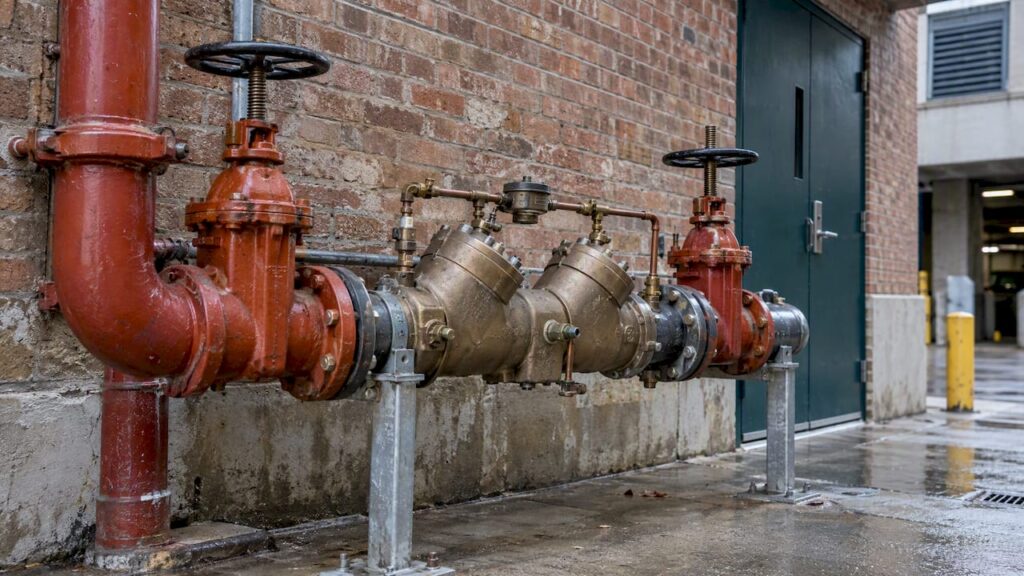
If you own or manage a building in Jersey City, backflow compliance has three parts: a device the water authority says you need, a test every year by a certified tester, and a report filed with the city. Commercial buildings are the clearest case. Homeowners are usually treated differently. This guide covers what the Jersey City Municipal Utilities Authority (JCMUA), the city’s construction code office and the State of New Jersey each require, and what to do when a device fails.
TL;DR
- JCMUA requires a reduced pressure zone (RPZ) assembly on domestic service wherever it finds a possible cross-connection hazard, and on every commercial building. Where an RPZ is not required, a dual check device goes on the domestic line.
- Jersey City requires all backflow devices to be tested by a licensed plumber. It charges a $75.00 annual administrative fee per device, and the test report goes to the plumbing subcode.
- Replacing a backflow preventer needs a permit. Larger services and all two-family or larger residences also need engineer-sealed plans sent to JCMUA.
- Only a tester certified through an agency recognized by NJDEP can test. Owners cannot sign off their own results.
- A device that fails must be repaired or replaced, and the retest result must reach the city.
Table of Contents
- Who needs a backflow preventer in Jersey City
- Annual testing and the city’s $75 fee
- Who can test your backflow preventer
- Permits for installing or replacing a device
- Is backflow work plumbing?
- What happens when a device fails
- Typical costs
- Our perspective
- Get your Jersey City device tested and filed
- FAQ
- Sources
Who needs a backflow preventer in Jersey City
Backflow is water flowing the wrong way, from a building’s plumbing back into the public main. A backflow preventer stops that. In Jersey City the requirement comes from the utility that supplies the water, and from the state plumbing and drinking-water rules behind it.
JCMUA’s backflow program requirements say an approved RPZ is required on a domestic service when JCMUA determines there might be a cross-connection hazard. The same document says all commercial buildings must have RPZs on their domestic services. So a restaurant, an office, a retail unit or a mixed-use building should assume it needs one.
JCMUA’s Water Rules and Regulations name facilities that may need reduced pressure devices. They include:
- hospitals and schools
- fire sprinkler systems
- chemical plants and factories
- wastewater treatment plants
- facilities with sewage ejectors
If your property is not in a category that calls for an RPZ, the same rules require a dual check device on the domestic service. It goes downstream of the test tee and before the gate valve.
Fire lines are a separate case
Fire service is treated differently from domestic service. For an existing fire suppression system without additives, JCMUA’s upgrade program calls for a double check detector assembly on the main fire line. A system with additives needs a reduced pressure detector assembly instead. If you manage a sprinklered building, confirm which of the two you have, because they are tested differently.

What about homes and small buildings?
This is where owners get confused. The state’s plumbing guidance exempts field-testable preventers in one- and two-family dwellings from annual testing, and NJDEP’s physical connection permit is not required for private residences. That does not mean a house can never have a device. A lawn irrigation system, a boiler feed or a well on the lot can still call for protection. JCMUA decides what your service needs, so ask before assuming you are exempt.
Multi-unit buildings are different again. We cover how apartment buildings are treated in our guide on whether apartment buildings need backflow preventers.
Annual testing and the city’s $75 fee
Jersey City’s construction code office explains the process on its ongoing inspections and invoices page. The city charges an annual administrative fee of $75.00 per backflow device. It requires every device to be tested by a licensed plumber. The annual test report then goes to the plumbing subcode for review, along with the fee. The same page says that failing to do this can lead to a violation.
That is why many owners first hear about the rules through an invoice. The fee is billed by the type and number of devices registered to the property, and it covers the annual inspections the state requires. Three practical points follow:
- The $75 fee is the city’s administrative charge. It is not the cost of the test.
- A building with three devices pays the fee three times.
- A passing test does nothing for you until the report is filed.
The state’s Department of Community Affairs says field-testable preventers that isolate cross-connections must be tested before final inspection and then annually. Treat annual as the baseline for any commercial or multi-unit device.
Quarterly testing for some facilities
A separate state program applies to facilities with an unapproved water supply alongside the public supply. These facilities need an NJDEP physical connection permit. The permits are renewed annually and each covered device is tested quarterly, with renewals submitted through NJDEP Online. Most Jersey City buildings are not in this group. A plant with its own well or process water source could be.
Who can test your backflow preventer
You cannot test it yourself and file the result. State guidance requires testers to be qualified and certified by an agency recognized by the NJDEP Bureau of Safe Drinking Water. Jersey City adds its own condition: the tester must be a licensed plumber.
Code inspectors do not do the test either. They check that owners have had devices tested by qualified people, either by witnessing the test or by receiving the certification. NJDEP keeps a page of certifying agencies and their tester lists, so you can verify a tester’s credentials before hiring.
What to check before you book:
- An active tester certification from a recognized agency
- A plumbing license that satisfies the city’s requirement
- Gauge calibration records, which should appear on the report
- Whether the company files the report for you
The last item matters more than it looks. A test that is done but never filed leaves you exposed to a violation. Our compliance guide for property managers explains how to confirm that a filing went through.
Permits for installing or replacing a device
The rule is short. A permit is required for all backflow preventer replacements. Dedicated fire-service replacements need a Fire Protection Subcode technical section application. This applies to a swap as well as a first installation. Replacing a like-for-like device without pulling a permit is a common mistake.
JCMUA adds a plan requirement for larger jobs. Plans for water services two inches or larger, and for all services to two-family or larger residences, go to JCMUA’s Bureau of Water Engineers. They must be signed and sealed by a New Jersey-licensed professional engineer or registered architect. If you are building or converting something larger, bring this up with your designer early. Even a modest plumbing design benefits from planning a maintainable water system from the start, with accessible shutoffs and test points.
What we file on a typical replacement is laid out in our guide to the backflow replacement permit in NJ. Properties heading for a sale or a new tenant should also read about the certificate of occupancy and backflow testing.

Is backflow work plumbing?
Yes. The state treats testing and replacement under the Plumbing Subcode of the Uniform Construction Code. The Department of Community Affairs bulletin cites Section 10.5.6 of the National Standard Plumbing Code and N.J.A.C. 5:23-2.23(l) and 5:23-3.15. NJDEP rules apply alongside them. NJDEP and the Division of Consumer Affairs regulate cross-connections and backflow-device installation. So there are two layers: the plumbing code that governs the work, and the water supply rules that govern protecting the public system.
What happens when a device fails
The state’s rule is plain: devices that do not pass the test must be repaired or replaced. In practice most failures are worn internal parts such as seats, discs and springs. A rebuild with the right parts often fixes it. A device that is corroded, damaged or the wrong type for the hazard needs replacing, and that needs a permit.
A sensible order of operations:
- Get the failed test report in writing, with the readings.
- Ask the tester whether a rebuild is realistic or whether the body is the problem.
- Complete the repair, then retest.
- File the passing report with the plumbing subcode and keep a copy.
If you have already received a notice, our page on a backflow violation notice in NJ walks through the response.
Typical costs
The city’s $75 fee is separate from what a tester charges. These are our published ranges for work in New Jersey:
| Service | Our published range |
|---|---|
| Annual residential certification test | $150 to $250 |
| Commercial device testing | $200 to $450 per device |
| Rebuild kit service (residential) | $125 to $250 |
| Protective enclosure installation | $200 to $500 |
| Residential installation | $300 to $800 |
The final price depends on the device type, its size, access and the condition it is in. Property managers with many devices can see more on our backflow testing budget guide and our cost and pricing FAQ. Outdoor devices are exposed to freezing and tampering, which is why many owners add an enclosure. See backflow enclosure requirements in NJ for what the rules say.
Our perspective
Most compliance trouble we see in Hudson County is not about failed devices. It is about paperwork. A device tests clean in the spring, nobody sends the report, and months later an invoice and a violation notice show up. Owners then assume the test was wasted.
Our advice is to treat the test, the filing and the calendar as one job. Know how many devices are registered to each address, because the city bills per device. Keep one record of every device, with its location, size, type and last test date. Fix failures the same visit when you can. We stock OEM parts so most rebuilds do not wait on a second trip, and we file reports directly with the water authority so the paperwork does not depend on anyone remembering.
If you manage several buildings, ask for consolidated billing and a single schedule. It is easier to stay compliant when every device renews on a calendar you can see.
— Jordan
Get your Jersey City device tested and filed
We are a family-owned, licensed and insured company serving New Jersey, including Hudson County. We test, certify, repair, rebuild and install enclosures, and we offer emergency service. We also handle the filing with the water authority. See our backflow testing and certification service or contact us to schedule.
FAQ
Do I need a permit to replace a backflow preventer in Jersey City?
Yes. State plumbing guidance requires a permit for all backflow preventer replacements. Fire-service replacements need a Fire Protection Subcode technical section application. Larger services may also need engineer-sealed plans sent to JCMUA.
Can I test my own backflow preventer?
No. Testers must be certified through an agency recognized by NJDEP, and Jersey City requires testing by a licensed plumber. Inspectors verify that a qualified person tested the device. They do not accept an owner’s own test.
How much does Jersey City charge for backflow devices?
The city charges a $75.00 annual administrative fee per device. The tester’s own fee for the test is separate and depends on the device.
Does a single-family home need annual backflow testing?
State plumbing guidance exempts field-testable preventers in one- and two-family dwellings from annual testing. Your water authority can still require protection if a hazard such as irrigation exists. Ask JCMUA about your specific service.
Sources
- JCMUA requirements for fire and domestic waterline installations and backflow upgrade program
- JCMUA Water Rules and Regulations
- City of Jersey City: Ongoing Inspections & Invoices
- NJ Department of Community Affairs bulletin on backflow preventers
- NJDEP Physical Connection Permit Processing
- NJDEP Certified Backflow Prevention Device Testers
- NJDEP regulatory guidance on physical connection permits
- Planning a maintainable tiny house water system