Trenton Water Works enforces cross-connection control for every property connected to its public water system, working alongside New Jersey Department of Environmental Protection (NJDEP) and Department of Community Affairs (DCA) rules. Most commercial and multi-unit devices generally need annual testing, while devices tied to a Physical Connection Permit require more frequent testing, and residential exceptions may apply in specific cases. Testing must come from an NJDEP-certified tester, and a passing result earns a Certificate of Compliance. Start by auditing irrigation, fire, boiler, and beverage lines, then book a certified test.
TL;DR:
- Most commercial and multi-unit systems require annual backflow testing by NJDEP-certified testers, with quarterly testing needed for devices under Physical Connection Permits.
- Private residential properties are generally exempt from permit requirements unless they present specific cross-connection hazards, such as auxiliary wells.
- Proper device installation and testing follow strict hazard classification rules, with device access and placement critical for successful inspection.
- Property owners must audit all cross-connection points, schedule certified testing, and promptly address failures to avoid enforcement actions and fines.
- Trenton Water Works enforces cross-connection rules through separate permit and testing tracks, with recent efforts increasing oversight and record accuracy.
Table of Contents
- Who enforces backflow rules in Trenton and the relevant laws
- Physical Connection Permits: triggers, testing obligations, and renewal
- Testing requirements, who may test, and how certificates are issued
- Device types, hazard classification, and special rules for fire systems
- Step-by-step compliance checklist for property owners and managers
- Common inspection failures, repairs, and realistic timelines
- Local capability: how South Jersey Backflow supports Trenton compliance
- A property manager’s view on sequencing audits and records
- How South Jersey Backflow can help you meet Trenton requirements
- FAQ
- Sources
Who enforces backflow rules in Trenton and the relevant laws
Trenton Water Works acts as the water purveyor and carries direct authority over cross-connection control for properties it serves, and the utility has recently sharpened its oversight of permit records. Two state frameworks sit underneath that local authority:
- N.J.A.C. 7:10 governs physical connections to public water systems, including Physical Connection Permit rules.
- The Uniform Construction Code’s Plumbing Subcode (N.J.A.C. 5:23 series) governs device installation and testing for most commercial and multi-unit buildings.
- Dedicated fire service lines typically fall under the purveyor or fire subcode official, while shared domestic and fire lines fall under the Plumbing Subcode.
For forms and guidance, Trenton Water Works and NJDEP’s water supply pages remain the starting point for any property owner unsure which track applies.
Physical Connection Permits: triggers, testing obligations, and renewal
A Physical Connection Permit becomes necessary when a property connects an unapproved water supply, an auxiliary system, a private well, or certain fire hookups to the public main. NJDEP’s physical connection triggers guidance lists laboratories, irrigation systems, boilers, and beverage dispensers among the facility types that commonly create this obligation.
Once a permit applies, the requirements are specific:
- Every device covered under the permit needs testing on a quarterly schedule.
- The permit itself must be renewed annually with the state.
- Owners apply through NJDEP’s physical connection forms, submitting documentation on the supply source, device type, and intended use.
- Private single-family residences are generally exempt from this permit track unless they present a specific cross-connection hazard, such as an auxiliary well.
These two compliance paths, the state permit track and the Uniform Construction Code track, run separately. A property can fall under one, the other, or both, depending on its water sources and systems.
Testing requirements, who may test, and how certificates are issued
Only a tester holding NJDEP-recognized certification can legally perform a backflow test. Municipal plumbing inspectors are barred from conducting the test themselves under DCA Bulletin B-99-2, which keeps inspection and testing roles separate.
A complete test report typically includes:
- Device identification, including make, model, and serial number.
- Test date and the specific results recorded for each check valve or relief valve.
- Tester name, certification number, and signature.
Statistic callout: A passing test under DCA guidance earns a Certificate of Compliance that typically remains valid for about a year before retesting is advised to renew it.
Testing cadence depends on which track applies: quarterly for devices under a Physical Connection Permit, annual for most commercial and multi-unit devices, with residential one- and two-family exceptions. Owners submit the signed certification to the municipality or water purveyor to secure that one-year certificate.
Device types, hazard classification, and special rules for fire systems
Device selection depends on what the connection protects against. Common types include double check valve assemblies (DCVA), reduced pressure zone assemblies (RPZ), pressure vacuum breakers (PVB), and detector assemblies for fire lines.
- Pollutional hazards often permit a DCVA.
- Health or severe hazards, like chemical feed lines or beverage dispensers, generally require an RPZ or air gap.
- Dedicated fire service lines often fall under the purveyor or fire subcode official, while shared domestic and fire lines fall under the Plumbing Subcode, as FTO 7 explains.
Device choice for fire connections also varies by local practice: some municipalities accept a DCVA where hydrant pumper supply is the only source, while others require an RPZ when tank trucks or nonpotable water could enter the system.
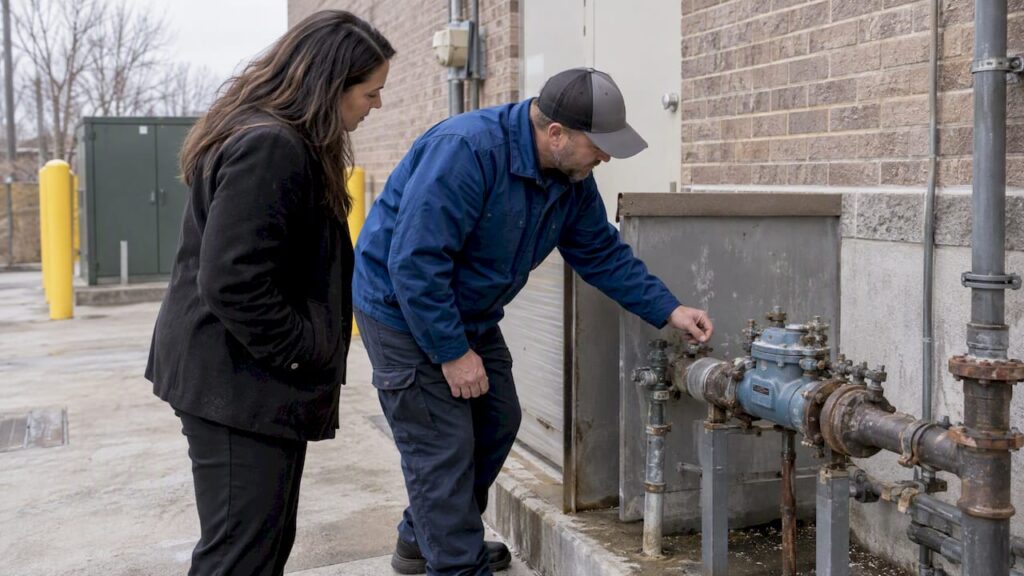
Pro Tip: Mount devices with straight-line access and full valve clearance so a tester can complete the check without removing panels or piping.
Step-by-step compliance checklist for property owners and managers
A clear sequence keeps a property out of enforcement trouble and avoids scrambling before a deadline.
- Audit every system that could create a cross-connection: irrigation, fire service, boilers, beverage or chemical dispensers, and hose bibbs.
- Determine whether any connection triggers a Physical Connection Permit, and identify whether Trenton Water Works or the municipal plumbing subcode office is the correct contact.
- Schedule an NJDEP-certified tester for the cadence that applies, quarterly or annually, and have the device field-tested.
- File the completed test report promptly to secure the Certificate of Compliance, and keep copies for future audits or ownership transfers.
- If a device fails, arrange immediate repair or rebuild and retest within the municipal reinspection window rather than waiting for a renewal cycle.
Trenton’s heightened permit auditing makes step two worth doing early. A device inventory compiled before a utility request arrives saves time and avoids a compressed compliance deadline.
Common inspection failures, repairs, and realistic timelines
Several issues repeat across failed inspections:
- Devices buried behind landscaping or locked mechanical rooms that a tester cannot reach.
- The wrong device type installed for the hazard level present.
- Internal parts worn or corroded past tolerance.
- Enclosures that trap debris or freeze the assembly.
Minor repairs with parts on hand can often be completed the same day, while a full replacement on a fire-protection supply may need a Fire Protection subcode filing and a longer, permit-based turnaround. Submitting retest certifications within the municipal reinspection window, rather than after it closes, is the simplest way to avoid fines.
Local capability: how South Jersey Backflow supports Trenton compliance
We operate as a New Jersey-based backflow testing and service company and serve Trenton properties directly. Keeping parts on hand lets us complete many rebuilds and repairs in the same visit instead of scheduling a return trip, and we handle enclosure installation alongside testing. We also file completed test reports with the municipality on the property owner’s behalf, removing a step that often causes compliance deadlines to slip.

A property manager’s view on sequencing audits and records
Sequencing matters more than speed. High-hazard systems, laboratories, fire lines, and beverage or chemical dispensers, deserve testing priority over a low-risk hose bibb, since a failure there carries more consequence. A centralized compliance folder, holding permits, Certificates of Compliance, and repair receipts, also saves the next manager from reconstructing history during a handover. With Trenton actively updating its permit database, a proactive audit now reduces the odds of a surprise notice later.
— Jordan
How South Jersey Backflow can help you meet Trenton requirements
Meeting Trenton’s backflow rules gets easier when testing, repairs, and paperwork come from one source instead of three. We offer certified testing, repairs and rebuilds, enclosures, and direct filing of test reports to the municipality on your behalf.
- Same-day repairs when parts are already on hand.
- Administrative filing that keeps your Certificate of Compliance on schedule.
- Consolidated billing for property managers overseeing several addresses.
If a device audit, a missed test, or an enforcement letter is on your plate right now, schedule backflow testing and certification and get the paperwork handled alongside the test itself.
FAQ
What is the NJ plumbing code requirement for backflow preventers?
New Jersey’s Uniform Construction Code, through the Plumbing Subcode, requires backflow preventers on connections that could let contaminated water enter the public supply, with device type set by hazard level. Most commercial and multi-unit devices under this code need annual testing, with exceptions for one- and two-family residences.
Is backflow testing required in NJ?
Yes, backflow testing is required for most commercial, multi-unit, and permitted connections across New Jersey. Devices under a Physical Connection Permit need quarterly testing, while most other covered devices need annual testing performed by an NJDEP-certified tester.
Who owns Trenton Water Works?
Trenton Water Works operates as the municipal water utility for the City of Trenton, serving as the water purveyor responsible for cross-connection control enforcement in its service area. The utility recently issued a request for proposals to help administer Physical Connection Permits and strengthen its oversight program.
Do I need a backflow preventer on my water line?
A backflow preventer is typically required if your property has irrigation, fire service, boilers, beverage or chemical dispensers, or any connection to an unapproved water supply. A straightforward way to confirm your obligation is a system audit followed by a consultation with an NJDEP-certified tester.
Sources
For official forms and code language, start with NJDEP’s Physical Connection Permit page, DCA Bulletin B-99-2 on backflow preventer testing, and DCA’s Formal Technical Opinion FTO 7 for fire-protection specifics. Trenton’s 2025 request for proposals shows the city’s current direction on permit administration. Confirm property-specific requirements directly with Trenton Water Works or the municipal building office before scheduling work, since local practice can vary within the state framework.
- REQUEST FOR SOLICITATION FOR PROPOSALS — City of Trenton — RFP2025-13
- Physical Connection Permit Processing | NJDEP
- Physical connection triggers and facility guidance — NJDEP (physcon triggers)