
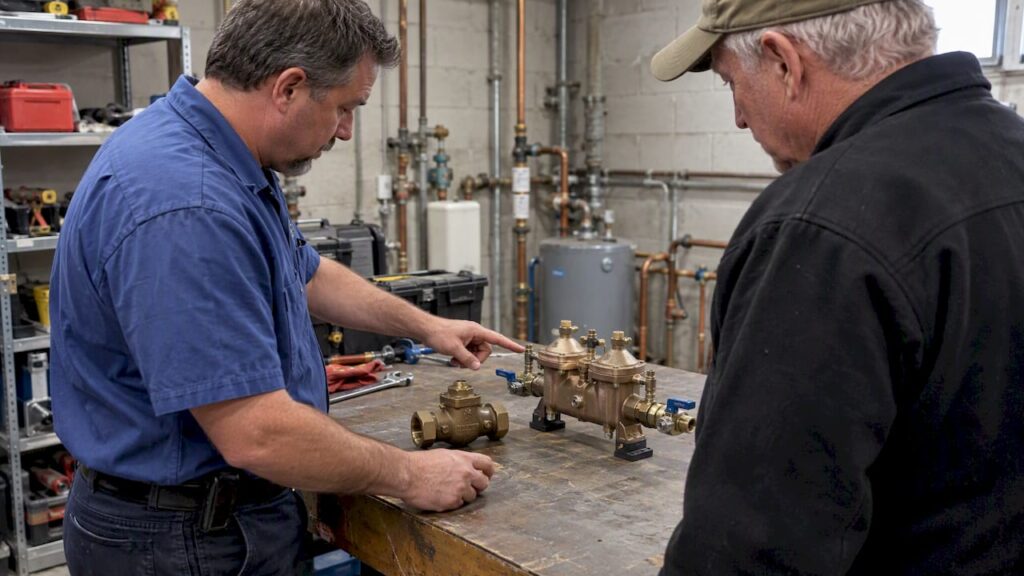
A check valve is a simple one-way valve that keeps water from flowing backward through a pipe. A backflow preventer is a testable assembly required wherever contamination risk or local code demands documented protection, following guidance from the EPA’s cross-connection control manual and standards from ASSE. If your water authority requires annual testing, you need a backflow preventer, not a check valve, and a certified tester to sign off on it.
TL;DR:
- Check valves are suitable only for equipment protection and are not acceptable for backflow prevention in hazardous or health-sensitive applications.
- Backflow preventers like RPZ assemblies and double check devices are required for high- and medium-hazard connections and must be installed according to strict placement and testing guidelines.
- Annual testing and proper installation of backflow preventers are essential, with most devices failing inspections due to incorrect placement or damage rather than internal defects.
- Check valves lack test ports, can leak or jam, and are unsuitable where backpressure or health hazard protection is necessary.
- Confirm hazard level and local code requirements before selecting a device, and always use certified testers for annual verification to ensure ongoing compliance.
Table of Contents
- How a Check Valve Works and Where It Falls Short
- What a Backflow Preventer Actually Protects Against
- Which Backflow Preventer Matches Which Hazard
- Side by Side: Protection, Testing, and Upkeep
- How to Choose the Right Device for Your Property
- Testing, Lifecycles, and the Mistakes That Cause Failed Inspections
- What We See in the Field
- Get Your Backflow Device Tested and Certified
- FAQ
- Sources
How a Check Valve Works and Where It Falls Short
A check valve lets water move in one direction and shuts when flow reverses. It opens once pressure reaches its “cracking pressure” and snaps shut the moment flow tries to reverse. That mechanical simplicity is exactly why it protects equipment but not public water.
Several designs exist, each suited to a different job:
- Swing check valves use a hinged disc and work well in horizontal lines with steady flow.
- Spring-loaded check valves close faster, which helps limit water hammer in vertical or high-velocity lines.
- Ball check valves suit slurries or lines carrying debris since the ball seats regardless of orientation.
- Dual-plate check valves are compact and common in larger industrial piping.
- Lift (silent) check valves close quietly, often specified near pumps to cut noise.
- Foot valves sit at the base of a suction line to keep a pump primed.
Check valves fail in predictable ways: worn seats leak, debris jams the disc open, and fast closure causes water hammer that stresses fittings over time, as trade literature on check valve types and applications explains. They’re appropriate on pump discharge lines, sump systems, and other spots where backflow would simply be a nuisance rather than a health hazard.
What a Backflow Preventer Actually Protects Against
Backflow happens two ways. Backsiphonage occurs when negative pressure in the supply line pulls contaminated water backward, often from a drop in main pressure during a water main break or firefighting draw. Backpressure occurs when downstream pressure exceeds supply pressure, pushing contaminated water back into the potable system. The EPA’s Cross-Connection Control Manual documents both mechanisms and the historical outbreaks that led water authorities to require testable protection at hazardous connections.
A backflow preventer is built to be checked, not just trusted. Most assemblies include:
- Test cocks that let a certified tester measure differential pressure across internal check valves.
- Shutoff valves on each side so the device can be isolated for testing or repair.
- A relief or vent mechanism, present on reduced pressure assemblies, that opens to atmosphere if internal checks fail.
Because these devices protect the shared water supply, utilities and local jurisdictions frequently specify exactly which assembly type is acceptable for a given hazard level, and they require proof of annual testing to keep that protection documented.
Which Backflow Preventer Matches Which Hazard
Device selection follows hazard level, not personal preference, and ASSE’s product standards spell out what each class is built to do.
- Reduced pressure zone (RPZ) assemblies handle high-hazard connections, such as chemical feed systems, dental offices, or commercial boilers, because they protect against both backsiphonage and backpressure. They must mount above grade with a visible drain path, since the relief valve needs somewhere to discharge if the internal checks fail, a placement detail covered in municipal backflow prevention guidance.
- Double check assemblies suit low-to-medium hazard uses like fire sprinkler lines or irrigation systems without chemical injection. They’re testable and simpler to install than an RPZ, but they aren’t rated for situations where the contaminant poses a direct health hazard.
- Pressure and atmospheric vacuum breakers guard against backsiphonage only, which limits them to irrigation systems and hose bibs where backpressure isn’t a realistic scenario. They must be installed with the critical level above the highest downstream outlet.
- Residential dual check valves and other non-testable devices cover low-hazard residential service lines, often at the water meter. They aren’t tested annually in most jurisdictions, but they still wear out and typically need periodic rebuild or replacement rather than ongoing certification.
Choosing the wrong category here is the single most common reason a property fails a compliance inspection.
Side by Side: Protection, Testing, and Upkeep
The practical differences come down to four questions: what each device blocks, whether it can be tested, how it must be installed, and how much upkeep it needs.
- Protection scope: A check valve resists simple reverse flow; only RPZ assemblies protect against both backsiphonage and backpressure, per ASSE’s device classifications.
- Testability: Backflow preventers include test cocks built for certified annual verification; standard check valves have none.
- Installation constraints: RPZs need above-grade mounting with drain access; vacuum breakers need height above the highest outlet; check valves generally just need correct flow direction.
- Maintenance signals: A failing device often shows continuous discharge from an RPZ relief port, inability to hold test pressure, or a double check that won’t seat fully.
Double check assemblies are not acceptable where the contaminant would create a direct health hazard, according to utility backflow prevention guidance, which is why RPZs remain the default for chemical and medical connections despite their stricter placement rules.
How to Choose the Right Device for Your Property
Start by identifying the actual hazard downstream, not just the device that’s currently installed. A boiler, irrigation chemical feeder, or commercial kitchen carries different risk than a residential hose bib.
- Determine whether backpressure is physically possible at your connection, which rules out vacuum breakers if it is.
- Call your local water authority to confirm which assembly types and models they accept before buying anything.
- Check that there’s room for above-grade mounting and a drain path if an RPZ is required.
- Confirm there’s accessible clearance for a tester to reach test cocks and shutoffs every year.
When interviewing a plumber or tester, ask about the specific model and listing they plan to install, where the test ports sit, their testing certification, and a realistic cost and timeline if a rebuild becomes necessary instead of a simple repair.
Pro Tip: Ask to see the tester’s current certification card before scheduling, since many jurisdictions only accept reports filed by licensed testers.

Testing, Lifecycles, and the Mistakes That Cause Failed Inspections
Most testable backflow assemblies need annual certification, performed with a calibrated gauge connected to the test cocks and filed with the water authority or property’s compliance records.
- RPZ placement failures are common: devices buried below grade, mounted where the relief port can’t drain visibly, or installed in flood-prone crawl spaces negate the device’s protection, a pattern noted across state cross-connection guidance.
- Freeze damage hits unprotected outdoor assemblies hard; an unheated enclosure or exposed pipe run is a frequent cause of winter failures.
- Wrong device for the hazard shows up often in field inspections, where a check valve or double check sits where an RPZ was actually required.
- Repair versus rebuild versus replace depends on whether the internal seals and seats can be restored with a kit or whether the body itself is damaged; a tester can usually tell during the annual check which path makes sense.
What We See in the Field
Across New Jersey properties, the most common compliance gap isn’t a broken device. It’s a check valve installed where code actually required a testable RPZ or double check assembly, often discovered only after a failed inspection. We handle backflow device testing, rebuilds, and enclosure installation for properties facing compliance issues. If your property has never been tested or you’re not sure what’s currently installed, that’s the moment to call a certified tester rather than guess.
— Jordan
Get Your Backflow Device Tested and Certified
We provide backflow preventer testing and certification across New Jersey, along with rebuilds, repairs, and custom enclosure installation for properties facing freeze risk or drainage constraints on an RPZ.

Our service covers the full compliance loop: an onsite test, any repairs or rebuild the device needs, and direct filing of the results with your water authority. We stock OEM parts so most rebuilds happen in a single visit instead of a second appointment. If you manage several properties, consolidated billing options are available to keep testing records organized across multiple sites. Reach out through our backflow services page to schedule your test or request a quote.
FAQ
Do I need a check valve or a backflow preventer?
It depends on the hazard downstream: equipment protection like a sump pump or pump discharge line needs only a check valve, while any connection with health, chemical, or backpressure risk needs a testable backflow preventer under ASSE classifications. Your local water authority can confirm which category applies to your specific connection.
When should you not use a check valve?
Skip a check valve wherever code requires a testable assembly or wherever backpressure is possible, since a check valve has no test ports and can’t protect against pressure pushing water back from the downstream side. It’s also unsuitable for any connection carrying a direct health hazard, where utility guidance calls for a double check or RPZ assembly instead.
What is the difference between a check valve and a backwater valve?
A check valve stops water or fluid from reversing direction in a supply or discharge line, while a backwater valve is installed in a drain or sewer line to stop sewage from backing up into a building during a main blockage or flood. They solve different problems: one protects potable supply or equipment, the other protects a building’s drainage system.
What are the disadvantages of check valves?
Check valves can leak as seats wear, jam open from debris, and cause water hammer when they close quickly against fast-moving flow, issues documented in trade coverage of check valve types. They also offer no way to verify performance since they lack test cocks, which makes them unsuitable anywhere testing is legally required.
Sources
- Cross-Connection Control Manual (EPA)
- ASSE product standards
- Common Methods of Backflow Prevention (American Water)
- Check valves explained: understanding different types and applications