
TL;DR:
- The EPA establishes federal standards for backflow prevention but defers enforcement and device requirements to state and local agencies. In New Jersey, property owners must adhere to utility-specific testing deadlines, device types, and internal plumbing codes, with annual testing mandated for backflow assemblies. Compliance involves working with certified testers, understanding hazard classifications, and maintaining proactive management of internal cross-connection risks.
The EPA’s role in backflow prevention is to establish federal public health standards under the Safe Drinking Water Act and publish technical guidance that state agencies, local utilities, and property owners then implement. The agency’s Cross-Connection Control Manual serves as the national blueprint, not a direct enforcement tool. For homeowners and property managers in New Jersey, this distinction matters because your actual compliance obligations come from state primacy agencies and your local water utility, both of which build on the EPA’s framework. Understanding where federal authority ends and local enforcement begins is the first step toward staying compliant and protecting your water supply.
What is the role of EPA in backflow prevention?
The EPA sets the floor, not the ceiling, for backflow prevention standards across the United States. Under the Safe Drinking Water Act, the EPA requires every public water system to operate a cross-connection control program. The agency’s Cross-Connection Control Manual provides hazard classifications, device recommendations, and program design guidance. However, the EPA does not regulate backflow prevention at individual properties. That responsibility flows down to state and local authorities.
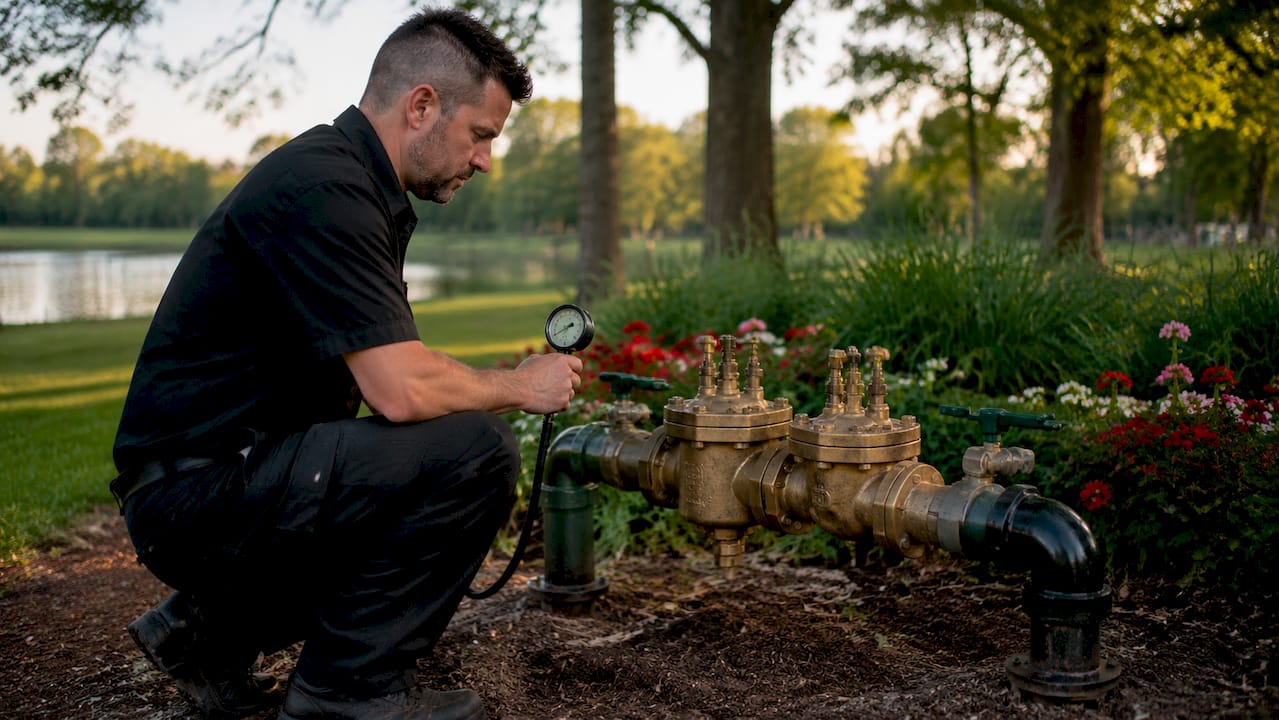
This delegation model is intentional. Water systems vary enormously across the country, and local utilities understand their infrastructure, pressure zones, and community hazards far better than a federal agency can. The EPA’s framework gives states the authority to adopt or exceed federal guidance, which most do. New Jersey’s Department of Environmental Protection operates as the state primacy agency, meaning it has accepted responsibility for enforcing the Safe Drinking Water Act within state borders.
For NJ property owners, the practical impact is direct. Your local water utility administers the cross-connection control program, maintains a list of approved testers, issues compliance notices, and enforces testing deadlines. The EPA’s backflow prevention guidelines shape those programs, but your utility is the entity that will contact you, fine you, or shut off your water service.
Pro Tip: Contact your local water utility directly to get the current list of approved backflow testers and your specific testing deadlines. Searching for “EPA backflow permits” online will not give you the local compliance requirements that actually apply to your property.
Key outcomes of this delegation structure include:
- State primacy agencies adopt EPA guidance and often add stricter requirements, such as more frequent testing cycles or additional device certifications.
- Local utilities administer testing mandates and maintain approved tester lists based on certifications like ASSE Series 5000.
- NJ property owners receive compliance notices from their utility, not from the EPA directly.
- State-specific regulations often impose stricter testing frequencies and certification requirements beyond the EPA baseline.
Which backflow prevention devices does EPA guidance recommend?
Device selection under the EPA framework depends entirely on hazard classification. The EPA’s Cross-Connection Control Manual defines two primary hazard categories: health hazards, which involve substances that could cause illness or death, and non-health hazards, which involve substances that affect taste, odor, or appearance but pose no direct health risk. The device required at your property is determined by which category applies to your water use.
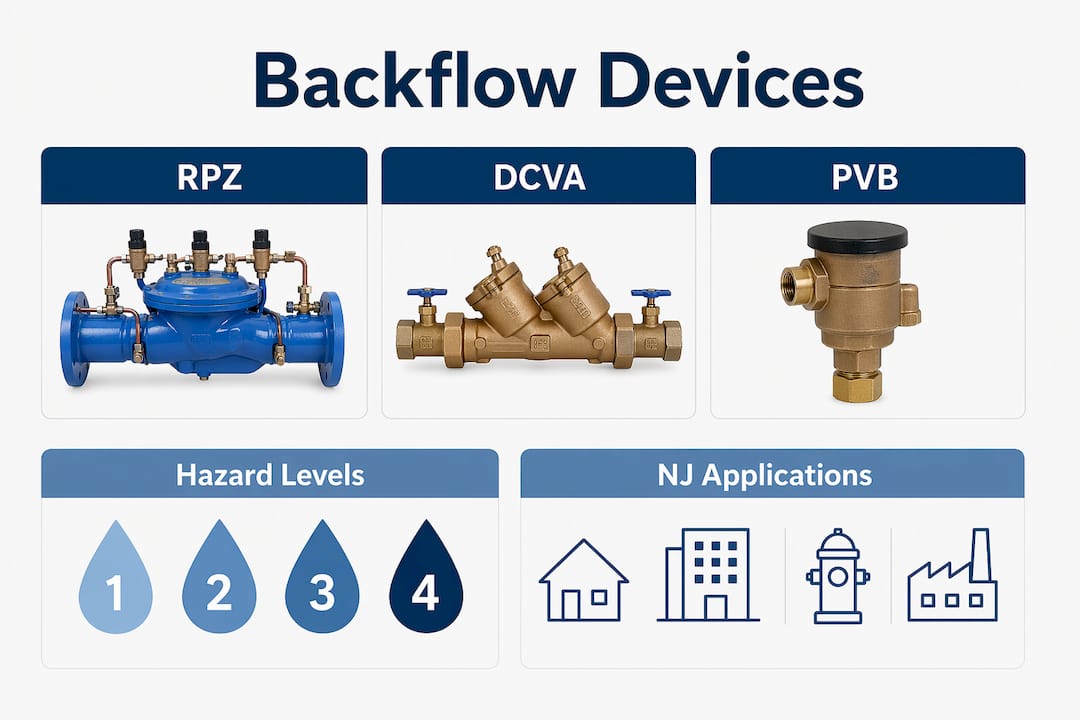
The table below summarizes the three main device types, their hazard applications, and typical NJ use cases.
| Device | Hazard level | Typical application |
|---|---|---|
| Reduced Pressure Zone (RPZ) assembly | High hazard (health risk) | Irrigation with fertilizer injection, fire suppression systems, commercial facilities |
| Double Check Valve Assembly (DCVA) | Low hazard (non-health risk) | Residential irrigation without chemical injection, commercial buildings with low-risk connections |
| Pressure Vacuum Breaker (PVB) | Backsiphonage only | Residential lawn irrigation in low-pressure scenarios |
RPZ assemblies meet ASSE Standard 1013 and include a relief valve that opens if the differential pressure between the two check valves drops, providing a physical barrier against contaminated water entering the supply. DCVAs meet ASSE Standard 1015 and rely on two independent check valves without a relief port, making them appropriate only where a health hazard does not exist. PVBs protect against backsiphonage but not backpressure, which means they are unsuitable for any scenario where downstream pressure could exceed supply pressure.
In New Jersey, your local utility and the NJ Uniform Construction Code determine which device is required at your service line. High-hazard facilities such as medical offices, car washes, and properties with chemical injection systems are almost always required to install RPZ assemblies. Residential properties with standard irrigation systems may qualify for a DCVA or PVB, depending on the utility’s hazard assessment.
Pro Tip: Never select a backflow device based on cost alone. Installing a DCVA where an RPZ is required is a code violation that can result in failed testing, fines, and liability if contamination occurs. Ask your certified backflow tester to confirm the correct device for your hazard classification before purchasing.
What are the backflow testing requirements in New Jersey?
Annual testing is the standard requirement for backflow prevention assemblies across New Jersey, with initial testing required upon installation and after any repair. The EPA’s influence on water safety establishes this as the minimum expectation, but NJ utilities and the state primacy agency enforce the actual deadlines. High-hazard facilities may be required to test semi-annually or quarterly, reflecting the EPA baseline as a floor rather than a ceiling.
The testing process in NJ follows a defined sequence:
- Receive a compliance notice. Your local water utility sends a testing notice, typically 30 to 60 days before your deadline. This notice identifies the assembly, the required test date, and the submission process.
- Hire a certified tester. Only Backflow Prevention Assembly Testers (BPATs) on your utility’s approved list may conduct the test. These testers hold certifications such as ASSE Series 5000, and utilities verify credentials before adding them to approved lists.
- Complete the field test. The tester uses calibrated gauges to verify that each check valve and relief valve functions within acceptable pressure differentials. The test takes 15 to 30 minutes for most assemblies.
- Submit the test report. The tester submits results directly to your utility, or you may be required to submit them yourself depending on your utility’s process. Record retention of test results typically spans three to five years.
- Address any failures immediately. A failed test requires repair or replacement before the assembly can be returned to service. A follow-up test confirms the repair was successful.
Non-compliance carries real consequences. Failure to comply may result in daily fines or water service disconnection. NJ utilities take these enforcement actions seriously because the public water supply is at stake. Property managers overseeing multiple units or commercial spaces face compounded risk if they miss deadlines across several assemblies. Staying ahead of your testing calendar is far less expensive than responding to enforcement.
For a detailed walkthrough of the submission process specific to New Jersey, the NJ backflow testing guide from Southjerseybackflow covers each step from scheduling to report submission.
Common misconceptions about EPA’s role and homeowner duties
The most common misconception NJ property owners hold is that the EPA directly oversees their backflow assembly. The EPA does not send inspectors to your property, issue compliance notices, or fine you for a missed test. Your local water utility holds that authority, and it derives that authority from the state primacy structure the EPA created under the Safe Drinking Water Act.
A second misconception involves the scope of protection that a service line assembly provides. Many property owners assume that installing an RPZ or DCVA at the service line fully protects their building. It does not. Internal plumbing failures are the leading cause of cross-contamination inside buildings, and a service line assembly offers no protection against those internal hazards. A garden hose submerged in a bucket of fertilizer, a boiler connected to the potable system without isolation, or an improperly installed ice maker line are all internal cross-connections that bypass the service line device entirely.
Additional points NJ homeowners and property managers should understand:
- Service line assemblies protect the public water supply but do not guarantee internal plumbing safety. Both layers of protection are required.
- NJ plumbing codes govern internal cross-connection controls. Compliance with those codes is the property owner’s responsibility, separate from the utility’s backflow program. Review the NJ plumbing code requirements to understand what applies to your building.
- Backflow prevention success depends on cooperation among the EPA, state agencies, utilities, and property owners. No single party controls the entire system.
- Internal cross-connection control is frequently overlooked. Many property managers are unaware that service line devices alone do not provide protection throughout the building.
- The EPA’s role in water safety is to define the framework. Your role as a property owner is to maintain compliant equipment, meet testing deadlines, and address internal plumbing hazards proactively.
Key takeaways
The EPA sets the federal standard for backflow prevention, but local water utilities in New Jersey hold the actual enforcement authority over your property.
| Point | Details |
|---|---|
| EPA sets the framework | The Safe Drinking Water Act requires public water systems to run cross-connection control programs, but the EPA does not enforce at the property level. |
| State and local agencies enforce | NJ’s primacy agency and local utilities administer testing mandates, maintain approved tester lists, and issue fines or service disconnections. |
| Device type follows hazard level | RPZ assemblies are required for high-hazard connections; DCVAs and PVBs apply to lower-hazard scenarios per ASSE standards. |
| Annual testing is the minimum | NJ property owners must test assemblies yearly, with high-hazard sites often required to test more frequently. |
| Internal plumbing is your responsibility | A service line assembly does not protect against internal cross-connections. NJ plumbing codes govern those hazards separately. |
What I’ve learned after years of NJ backflow compliance work
Most property owners I speak with come in thinking the EPA is the entity they need to satisfy. That framing leads them in the wrong direction every time. The EPA built the house, but your local utility holds the keys. When you get a compliance notice, the clock is ticking on a local enforcement deadline, not a federal one.
The second pattern I see constantly is the assumption that one device solves everything. A property manager installs an RPZ at the service line, passes the annual test, and considers the job done. Then a tenant connects a chemical sprayer to a utility sink without a proper air gap, and suddenly there is a contamination event that the service line assembly was never designed to catch. The EPA’s framework accounts for this layered approach, but the property owner has to actually implement both layers.
My honest recommendation for NJ homeowners and managers: treat backflow compliance as a year-round responsibility, not an annual checkbox. Know your device type, know your hazard classification, and know your utility’s specific submission process. Work with a certified tester who understands NJ requirements, not just someone with a general plumbing license. The cost of proactive compliance is a fraction of the cost of a failed test, a fine, or a contamination event.
— Jordan
Stay compliant with Southjerseybackflow
If you own or manage property in New Jersey and need to meet your utility’s backflow testing deadline, Southjerseybackflow handles the entire process from scheduling to report submission.
Southjerseybackflow’s certified testers are on approved utility lists across South Jersey and understand the specific submission requirements for local water systems. Whether you need an annual test, a repair after a failed inspection, or guidance on the right device for a new installation, the team provides documentation that satisfies your utility’s compliance requirements. If you recently received a notice from your utility, the backflow compliance letter guide explains exactly what to do next. For full testing and submission support, visit the NJ backflow testing page to get started.
FAQ
Does the EPA directly enforce backflow rules at my property?
No. The EPA does not regulate backflow prevention at individual properties. Your local water utility administers the cross-connection control program and holds enforcement authority, including the power to issue fines or disconnect water service.
How often does my backflow preventer need to be tested in NJ?
Annual testing is the standard requirement in New Jersey, with an initial test required upon installation and after any repair. High-hazard facilities may be required to test semi-annually or quarterly depending on the utility’s program.
Who is qualified to test my backflow preventer in New Jersey?
Only Backflow Prevention Assembly Testers (BPATs) certified to ASSE Series 5000 standards and listed on your utility’s approved tester roster may conduct official tests. Using an uncertified tester results in a non-compliant test report.
Does a service line backflow assembly protect my entire building?
No. A service line assembly protects the public water supply from contamination originating at your property, but it does not address internal cross-connections within your building. Internal plumbing hazards are governed by NJ plumbing codes and are the property owner’s separate responsibility.
What happens if I miss my backflow testing deadline in NJ?
Non-compliance can result in daily fines or termination of water service by your local utility. Test records must typically be retained for three to five years, and utilities track compliance history when evaluating enforcement actions.