TL;DR:
- RPZ devices prevent backflow contamination by using dual check valves and a monitored pressure zone.
- They are mandatory in high-hazard situations like chemical injection systems and boiler processes in New Jersey.
- Annual testing by certified professionals ensures ongoing compliance and safeguards community water safety.
If your water utility or local municipality recently told you that your property needs an RPZ device tested or installed, you are not alone in feeling confused. Many New Jersey property owners hear the term “RPZ” and immediately picture a complicated piece of equipment buried somewhere in a mechanical room. The truth is simpler, though the stakes are real. This guide breaks down exactly what an RPZ device is, why New Jersey regulations require it in certain situations, how it compares to other backflow prevention options, and what you need to do to stay compliant without the guesswork.
Table of Contents
- What is an RPZ device?
- Why RPZ devices matter: Protecting your water supply
- How RPZ devices compare to other backflow preventers
- New Jersey RPZ compliance: What property owners must do
- Our take: Why RPZ compliance is worth it for New Jersey owners
- Get expert help with RPZ devices and testing in New Jersey
- Frequently asked questions
Key Takeaways
| Point | Details |
|---|---|
| RPZ definition clarified | An RPZ device is a specialized backflow preventer protecting drinking water from contamination. |
| Critical in high-risk areas | New Jersey law requires RPZ devices for properties with high-hazard cross-connections like chemicals or irrigation. |
| Annual testing is mandatory | State rules demand yearly inspections of RPZ devices by certified professionals. |
| Compliance protects everyone | Meeting RPZ rules keeps your property, occupants, and community water supply safe. |
| Expert help is available | Certified services help you install, test, and maintain RPZ devices in your New Jersey property. |
What is an RPZ device?
An RPZ device is a backflow prevention assembly used to protect a potable (drinkable) water supply from contamination. RPZ stands for Reduced Pressure Zone, which describes the mechanical principle that makes the device work. Put simply, it is a safeguard installed on your water supply line to make sure that dirty or chemically contaminated water can never flow backward into the clean water system serving your home, building, or neighborhood.
Here is how the mechanics work. An RPZ device contains two independently operating check valves. Between these two valves sits a monitored pressure zone that is kept at a lower pressure than the supply water coming in. A relief valve is also built into the assembly. If either check valve fails or if pressure conditions reverse, the relief valve opens and physically discharges water to the outside rather than letting contaminated water sneak back into the supply. This makes an RPZ one of the most reliable forms of backflow prevention available for high-risk situations.
| Component | Function |
|---|---|
| First check valve | Prevents backward flow from the property side |
| Second check valve | Secondary barrier against backflow |
| Reduced pressure zone | Maintained at lower pressure to detect failure |
| Relief valve | Opens to discharge water if pressure drops or valves fail |
RPZ devices are used in both residential and commercial properties. On the residential side, you will commonly find them connected to irrigation systems, boilers, or pools. On the commercial side, they protect buildings that use chemical dispensing equipment, fire suppression systems, or any process that connects to the public water supply.
“An RPZ assembly is designed so that even if both check valves were to fail simultaneously, the relief valve would prevent contaminated water from entering the potable supply.”
You can find answers to common questions about these devices through our backflow preventer FAQs or learn more about how backflow preventers work in the context of New Jersey’s water infrastructure.
Pro Tip: If you are not sure whether the device on your property is an RPZ or something simpler, look for a visible relief port on the side of the assembly. Most RPZ valves have a small opening that discharges water to drain when the device is doing its job or malfunctioning.
Why RPZ devices matter: Protecting your water supply
Understanding what an RPZ device is only gets you halfway there. The more important question is why your municipality is requiring one in the first place, and what the real risks are when a property does not have the right protection in place.
Backflow happens when water in your plumbing system reverses direction. This can occur when there is a sudden pressure drop in the main supply line, which is more common than you might think. Water main breaks, firefighting operations pulling large volumes of water, and heavy demand during peak hours can all temporarily drop pressure on the supply side, allowing whatever is on the property side to flow backward.
Here is where the danger lives. If your property has what is called a cross-connection, meaning a point where the potable water line is physically connected to a non-potable source, a backflow event could push contaminated water into the public supply. Common sources of cross-connection on New Jersey properties include:
- Lawn irrigation systems with fertilizer or pesticide injection
- Swimming pool and hot tub fill lines
- Boiler systems using chemical treatments
- Industrial equipment with chemical feed lines
- Fire suppression systems with stagnant or chemically treated water
In New Jersey, RPZ assemblies are typically required where cross-connections are classified as high-hazard, which includes scenarios like chemical feed systems and other situations that present a real health risk to the water supply. High-hazard is not a scare tactic. It is a technical classification that describes any situation where backflow could introduce substances dangerous to human health into the drinking water.
The consequences of missing or malfunctioning backflow protection can go well beyond a fine. Contamination events have resulted in entire neighborhoods losing access to safe drinking water for days. Properties connected to municipal systems in New Jersey carry a responsibility to the wider community, not just their own tenants or family members.
There are also practical financial risks. If a backflow event is traced back to your property and you did not have the required protection in place, you could be looking at liability claims, service shutoffs, and expensive remediation. Understanding the full range of backflow prevention methods helps you see why the RPZ sits at the top of the protection hierarchy.
Investing in proper RPZ compliance is fundamentally a risk management decision. The cost of annual testing is modest compared to the cost of a contamination incident, a property insurance claim, or a regulatory enforcement action.
How RPZ devices compare to other backflow preventers
Not every backflow situation calls for an RPZ device. New Jersey properties use several types of backflow preventers depending on the level of hazard and the type of cross-connection involved. Knowing the difference helps you understand why your property might require an RPZ rather than a simpler option.
Here is a quick side-by-side look at the most common devices used in New Jersey:
| Device type | Best for | Hazard level | Testable? |
|---|---|---|---|
| Atmospheric vacuum breaker | Low-hazard, non-continuous pressure | Low | No |
| Double check valve assembly | Moderate-hazard cross-connections | Moderate | Yes |
| RPZ (Reduced Pressure Zone) | High-hazard cross-connections | High | Yes |
Atmospheric vacuum breakers are simple, inexpensive, and work well for situations like garden hose bibs or low-risk irrigation zones. They are not testable and they cannot be used under constant pressure, which limits their usefulness in most property-wide applications.
Double check valve assemblies step up the protection level and are commonly used for fire sprinkler systems that do not use chemical additives and for moderate-hazard commercial applications. They have two check valves like an RPZ, but they lack the pressure-monitored relief zone that makes an RPZ so reliable under failure conditions.
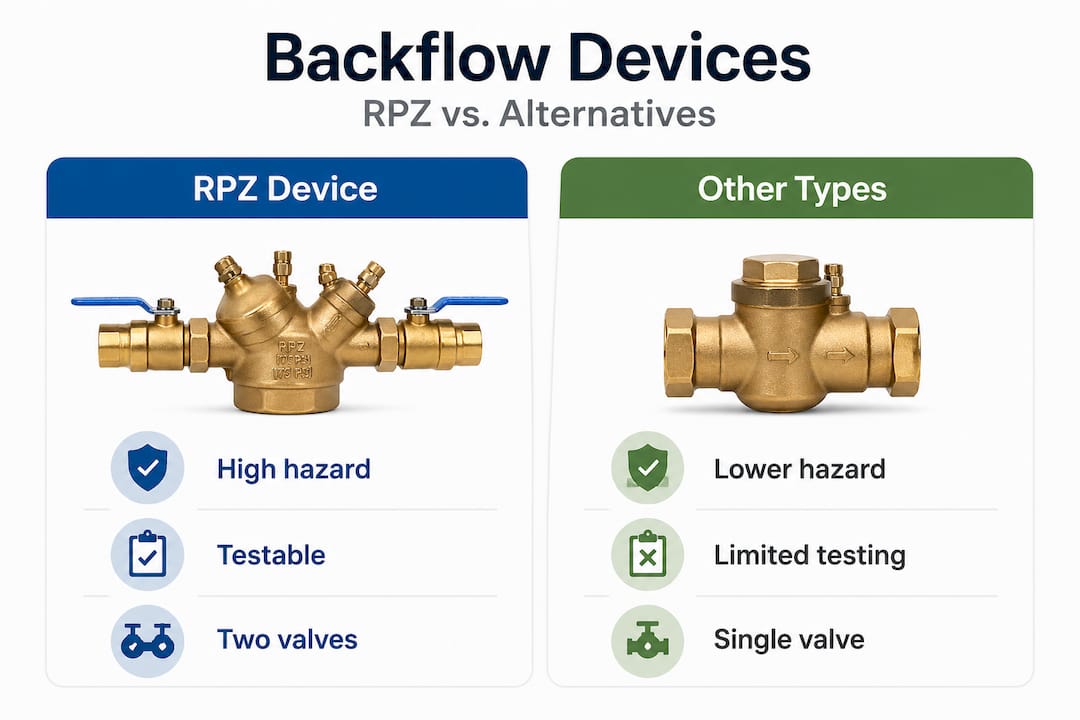
RPZ devices are the highest level of field-testable backflow protection available. RPZ assemblies are required for high-hazard cross-connections, which is a legal requirement in New Jersey, not just a recommendation.
Here is a practical numbered list of situations that typically call for an RPZ in New Jersey:
- Irrigation systems with fertilizer or chemical injection equipment
- Properties with boilers treated with corrosion inhibitors or biocides
- Commercial facilities using any form of chemical processing connected to the water line
- Swimming pools with automated chemical dosing systems
- Any cross-connection where contamination could cause illness or injury
Irrigation system owners in particular should review the full irrigation backflow compliance requirements before assuming a simpler device will pass inspection. A real-world example from Medford, NJ shows how local property owners navigate device selection and testing in practice.
The key decision point is simple: if your cross-connection is classified as high-hazard under New Jersey standards, only an RPZ device will meet the requirement. Choosing a lower-tier device to save money upfront almost always results in a failed inspection and the cost of replacing the equipment anyway.
New Jersey RPZ compliance: What property owners must do
Knowing which device you have (or need) is only the first step. Staying compliant in New Jersey means meeting specific requirements around installation, testing, and record-keeping. These rules exist at both the state level and the local municipal level, so requirements can vary depending on your municipality.
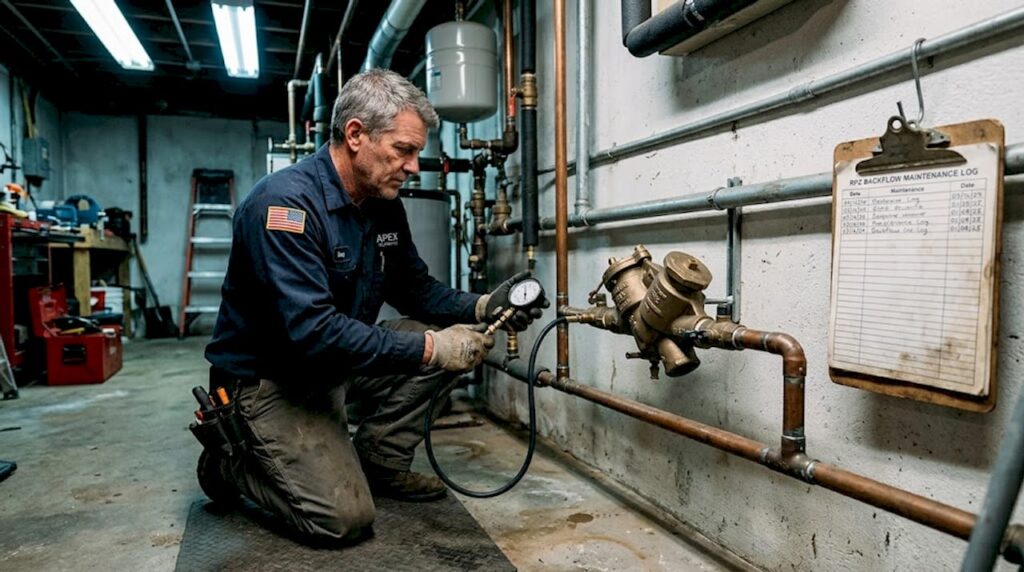
At the state level, New Jersey requires that backflow prevention assemblies be installed by licensed plumbers, that all testable devices (including RPZ assemblies) be inspected and tested annually, and that test results be submitted to the appropriate authority, typically your water supplier or local health department. Annual testing for testable devices must be performed by a certified tester, meaning someone who holds the appropriate backflow prevention certification recognized in New Jersey.
Here is a straightforward numbered checklist to help you stay on top of RPZ compliance year after year:
- Confirm your device type and its location on the property
- Identify whether your cross-connection is classified as low, moderate, or high-hazard
- Hire a certified backflow tester to conduct your annual inspection
- Make sure the tester submits the results to your water utility or local authority
- Keep a copy of your test report for your own records
- Schedule your next test before the current compliance period expires
- If the device fails a test, arrange for repair or replacement immediately
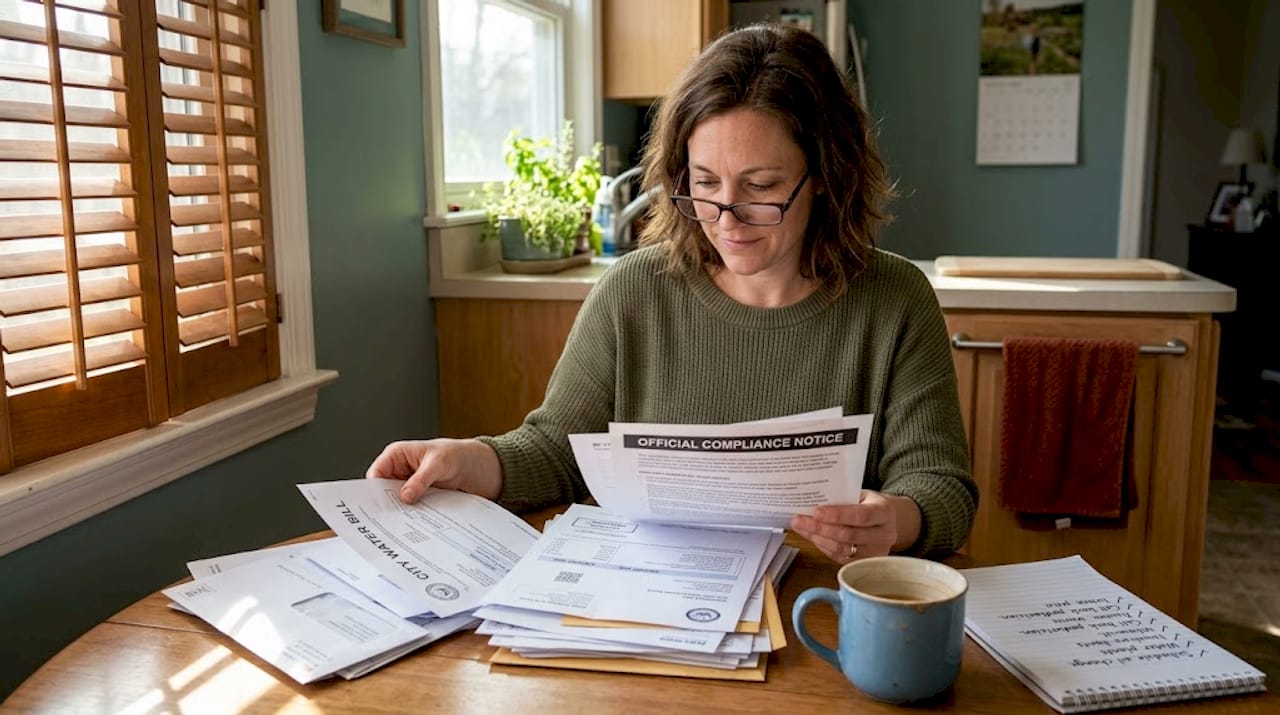
Pro Tip: Many municipalities in New Jersey send compliance notices by mail, but some do not. Do not wait for a reminder. Put your annual RPZ test on a recurring calendar alert so you are never caught out of compliance.
There are some additional local considerations worth knowing. Certain municipalities require testing more frequently than once per year for properties with particularly high-hazard cross-connections. Others have specific approved tester lists or require submission through an online portal. Always check with your local water authority in addition to following state-level guidance.
Your backflow preventer FAQ resource is a great place to look up common compliance questions, and the article on the importance of backflow testing gives you deeper context on why these inspections matter beyond just paperwork.
The compliance process does not have to be stressful. With the right certified tester and a simple tracking system, most property owners complete their annual RPZ compliance without any issues. The problems arise when property owners ignore notices, delay testing, or assume a device that passed last year will automatically pass this year.
Our take: Why RPZ compliance is worth it for New Jersey owners
Here is something we see all the time. A property owner calls us frustrated, saying they just got a compliance notice and they do not understand why they have to spend money on a test for a device that “has never caused a problem.” We get it. When something works quietly in the background and never triggers a visible issue, it is easy to see the annual testing requirement as bureaucratic friction rather than genuine protection.
But here is the thing. The fact that your RPZ device has never caused a problem is exactly why it is working. Backflow incidents are rare on properties with properly functioning, regularly tested assemblies. That is not a coincidence. That is the system doing what it was designed to do.
The deeper value of staying current on RPZ compliance is something most property owners underestimate. Documented compliance history is a real asset when it comes to property insurance. Insurers increasingly ask about water safety records for commercial properties, and a clean testing history can prevent coverage disputes if a water-related incident does occur on your property. Tenants in commercial and residential rental properties also notice when landlords take safety seriously. It signals competent management and reduces liability exposure.
Beyond your property line, your RPZ device connects to a regional water system that serves thousands of households. Every property owner who maintains compliant backflow prevention contributes to a safer water supply for the entire community. That is not a small thing. Addressing common backflow issues proactively keeps you out of trouble and keeps your neighbors safe at the same time.
We think the framing of RPZ compliance as “red tape” is exactly backwards. It is a small, predictable annual cost that protects you from unpredictable, potentially enormous risks. Any property owner who has dealt with a water contamination incident, a failed inspection, or a service shutoff will tell you the annual test fee looks like a bargain in hindsight.
Get expert help with RPZ devices and testing in New Jersey
Navigating RPZ requirements on your own can feel like reading a regulation document in a foreign language, especially when local rules layer on top of state requirements.
Our team specializes in backflow testing and certification for New Jersey property owners, handling everything from initial device assessment to test submission and follow-up. If you are unsure whether your current device meets the RPZ standard required for your specific cross-connection, we can walk you through it clearly. Our resource on passing NJ RPZ testing covers exactly what happens during the inspection and how to prepare. And if you want to stay ahead of potential issues before your next test, our guide to preventing backflow issues gives you the practical steps to protect your property and your compliance record.
Frequently asked questions
What does RPZ stand for in plumbing?
RPZ stands for Reduced Pressure Zone, referring to a backflow prevention device that protects the potable water supply from contamination by maintaining a lower-pressure buffer zone between two check valves.
How often do RPZ devices need to be tested in New Jersey?
RPZ devices must be tested at least once per year by a certified tester, with some municipalities requiring additional inspections based on the hazard level of the cross-connection.
Where are RPZ devices required in a New Jersey property?
RPZ devices are required wherever high-hazard cross-connections exist, such as irrigation lines with chemical injection, boiler systems with chemical treatment, and commercial equipment connected to the public water supply.
Who can install or test an RPZ device in New Jersey?
Only licensed plumbers and certified backflow testers are authorized to install and test RPZ devices in New Jersey, ensuring that results meet state and local submission requirements.