
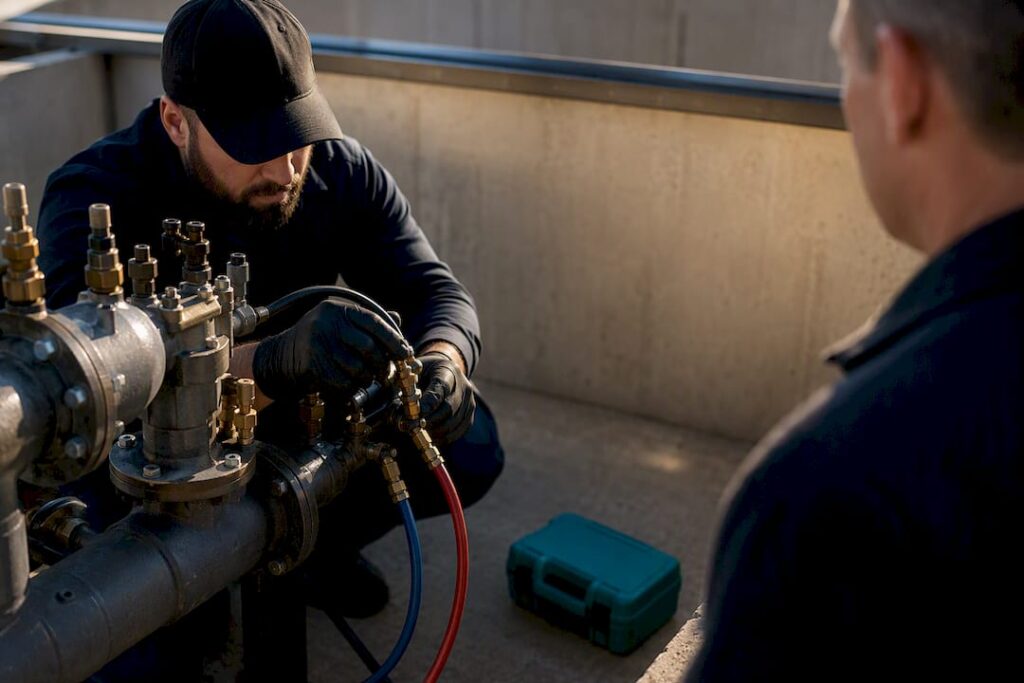
A backflow assembly that has been repaired or physically disturbed must pass a certified retest before it counts as compliant again, and the passing result has to reach the utility’s records. The fastest path is a single appointment that covers both the repair and the retest. Book it now, and get the tester’s credentials and proof of filing in hand before the crew leaves.
TL;DR:
- A retest must be conducted by a certified tester with calibrated equipment and submitted through the proper municipal portal for the assembly to be considered compliant.
- Utilities require retests within tight deadlines, typically five business days, with delays risking fines, noncompliance notices, or water restrictions.
- Performing the retest during the same appointment as repairs, with all documentation prepared upfront, ensures faster record updates and avoids administrative rejections.
- A second failure usually indicates a mechanical issue, often caused by non-OEM parts or worn components, requiring immediate follow-up repairs or replacement.
- Property managers should bundle repair and retest into one visit, verify tester credentials, and keep a complete packet of documents to prevent noncompliance or fines.
Table of Contents
- 1. What a backflow assembly does and why repairs reset its status
- 2. Why utilities demand a retest after repair: enforcement, timelines, and risk
- 3. Who may perform a retest: certifications, equipment, and paperwork that matter
- 4. What happens during a post-repair retest and what you should collect
- 5. If a retest fails again: repair vs replace, cost drivers, and next steps
- 6. A short checklist property managers can use immediately after repair
- 7. How South Jersey Backflow handles post-repair retests
- 8. A property manager’s take on avoiding repeat backflow headaches
- 9. How South Jersey Backflow can help you meet post repair testing requirements
- 10. Primary sources for standards and municipal test procedures
- Sources
- FAQ
1. What a backflow assembly does and why repairs reset its status
A backflow prevention assembly stops contaminated water from siphoning backward into the public drinking supply when pressure drops or reverses. Inside, check valves and relief mechanisms depend on tight seals and specific spring tension to hold that line.
Any repair touches those same parts: replacing a seal, cleaning a check valve, or swapping a spring changes the pressure characteristics a test is designed to catch. That’s why utilities generally treat a repaired assembly as changed, not restored, until a certified tester confirms it. EPA cross-connection control guidance states that installations, repairs, and alterations must be verified by testing before an assembly is returned to service.
What this means in practice for a property owner:
- A repaired device is not automatically compliant, no matter how routine the fix looked; installing proper water treatment systems for Florida homes helps maintain the overall integrity of plumbing and irrigation systems.
- The utility’s record stays flagged until a passing test result is entered.
- Skipping the retest leaves the property in the same compliance position as a device that failed outright.
2. Why utilities demand a retest after repair: enforcement, timelines, and risk
Utilities require a documented retest because a repair is only a claim until a field test proves the assembly holds pressure the way it should. Municipal systems generally lock a property’s compliance status at “failed” or “needs retest” and won’t clear it until a new passing entry lands in the database.
Timelines vary by system but are consistently tight. The San Francisco Public Utilities Commission’s tester instructions require testers to enter results within five business days of the test, with failures reported immediately and corrections following a defined procedure. That five-day entry window illustrates how little slack utilities build into their reporting rules, even when the physical retest already happened on time.
Missing a deadline, or filing through the wrong channel, can trigger a cascade: a notice of noncompliance, escalating fines, and in persistent cases a water service restriction until the record is corrected. The order matters too. A retest that happens before the repair is properly logged, or one submitted before the failed test is closed out in the system, can bounce back as an administrative rejection even though the plumbing itself is fine.

3. Who may perform a retest: certifications, equipment, and paperwork that matter
Not every plumber can sign off on a backflow retest. Utilities generally require testers to hold a recognized credential and use equipment that meets calibration standards, because the result feeds directly into a public health record.
Certifications worth confirming before you hire:
- ASSE 5110 certification, which covers training and a practical exam based on field test procedures, according to ASSE International.
- ABPA Tester Certification, which references the USC Manual of Cross-Connection Control field test procedures that many jurisdictions accept as the standard method.
- A state-recognized or municipal certification where the local utility maintains its own approved tester list.
Beyond the certificate itself, ask whether the tester’s gauge has a current calibration sticker and whether they can file directly to the utility’s portal or database. Reports get rejected for reasons that have nothing to do with the plumbing: an unapproved tester, an out-of-calibration gauge, or a report submitted through the wrong channel. Any of those can leave a property listed as noncompliant even after a real, passing retest took place.
4. What happens during a post-repair retest and what you should collect
A post-repair retest follows a fairly fixed sequence, and knowing it ahead of time helps you get what you need from the technician before they leave.
Before the visit:
- Confirm the tester’s certification number and ask when their gauge was last calibrated.
- Ask which portal or submission method the utility requires and whether the tester files directly.
- Have the assembly’s make, model, and serial number ready, along with notes from the original failed test.
During the visit:
- The tester locates and verifies the assembly’s ID against utility records.
- They log what was repaired and when, tying the paper trail to the earlier failure.
- They run the field test using the calibrated gauge and record pass or fail readings for each check valve and relief valve.
- They note the gauge’s serial number on the report, along with repair details.
After the visit:
- Request written proof that the passing report was submitted, not just a copy of the report itself.
- Save the invoice, the repair notes, and the test report together as one record.
- Follow up with the utility, or ask the tester to confirm, that the property’s status has updated to compliant.
Pro Tip: Ask the tester to text or e-mail the submission confirmation the same day. A verbal “it’s filed” is not proof if the utility’s record disagrees later.
5. If a retest fails again: repair vs replace, cost drivers, and next steps
A second failure usually points to a mechanical issue rather than a testing error. Common culprits include worn rubber seals, debris caught in a check valve, weakened springs, or freeze damage from a cold snap.
Whether the fix is a repair or a full replacement depends on a few practical factors:
- The assembly’s type and model, since parts availability differs widely between older and current designs.
- Whether OEM parts are on hand or need to be ordered.
- Site accessibility, since assemblies buried in tight vaults or behind other equipment take longer to service.
Non-OEM parts are a common cause of repeat failures. Technicians report that generic seals and springs often can’t hold the precise pressure-differential tolerances an assembly needs, according to ASSE’s certification guidance, which is one reason OEM rebuild kits are worth the extra cost. After a second failure, document everything again, book the follow-up retest as soon as parts are available, and file the new evidence with the utility promptly to avoid the case escalating into a formal enforcement notice.
6. A short checklist property managers can use immediately after repair
Once repairs are scheduled, the fastest way to close the compliance record is to line up the paperwork before the tester arrives.
- Ask for a combined repair-and-retest appointment, and request a same-day passing report if the fix is straightforward.
- Collect the original failed test report, the repair invoice with parts and labor notes, and the assembly’s make, model, and serial number.
- Get the test gauge’s serial number and the tester’s license or certification number on the paperwork.
- Confirm which portal the utility uses for submissions and get written confirmation once the report is filed.
- Store all of it together: failed report, repair notes, passing report, and submission receipt, as one packet per assembly.
7. How South Jersey Backflow handles post-repair retests
South Jersey Backflow structures its retest-after-repair process around a straightforward goal: get the utility’s record closed as fast as possible. The company offers retest turnaround within 5 to 10 days after a repair, along with filing support so property owners aren’t left guessing whether the paperwork went through.
After a completed retest, the packet typically includes:
- The passing test report with readings for each valve.
- The calibrated gauge’s serial number, matching what utilities expect to see on file.
- Confirmation that the report was filed with the correct water authority.
That combination, a fast turnaround plus documented filing, addresses the two most common reasons a technically fine repair still shows up as noncompliant: slow scheduling and paperwork that never reaches the right desk.
8. A property manager’s take on avoiding repeat backflow headaches
The biggest mistake property managers make with backflow repairs is treating the fix and the paperwork as two separate jobs. They aren’t. A repair that isn’t retested and filed within the utility’s window is functionally the same as no repair at all, at least on paper, and paper is what triggers fines.
My recommendation: always bundle the repair and retest into one visit when you can, never hire a tester without checking their certification and gauge calibration, and keep one complete packet per assembly, ready to hand over if the utility or an auditor ever asks.
— Jordan
9. How South Jersey Backflow can help you meet post repair testing requirements
If you’re staring at a failed test notice, the fastest way out is a single call that covers the repair, the retest, and the filing. South Jersey Backflow handles Backflow Preventer Rebuilds & Repairs and follows through with Backflow Preventer Testing & Certification so the record gets closed instead of sitting in limbo while parts and paperwork bounce between different providers.
The company is family-owned, licensed, and insured, and stocks OEM parts to facilitate rebuilds and repairs. If your property just failed a test or you know a repair is coming, book a combined repair-and-retest visit or request a retest-only appointment to get the utility record closed before deadlines turn into fines.
10. Primary sources for standards and municipal test procedures
For readers who want to verify tester qualifications or municipal filing rules directly:
- ASSE International’s backflow prevention certification page explains tester training and field test procedure standards.
- ABPA’s Tester Certification Program outlines the USC field test manual that many jurisdictions reference.
- San Francisco Public Utilities Commission’s tester instructions show a real example of filing deadlines and portal rules.
- EPA’s cross-connection control fact sheets cover the broader public health reasoning behind testing requirements.
Sources
- San Francisco Public Utilities Commission – Instructions for Authorized Backflow Prevention Assembly Testers (2026)
- ASSE International – Backflow prevention tester certification
- EPA — Cross-Connection Control toolbox fact sheets
- American Backflow Prevention Association – Tester Certification Program
FAQ
How much does it cost to repair a backflow assembly?
Costs depend on the assembly type, parts needed, and labor involved, so no single figure applies across the board. South Jersey Backflow lists rebuild kit service starting between $125 and $250, with fuller repair and rebuild pricing available on request through its cost breakdown page.
Can I test my own backflow assembly?
Generally no. Most utilities require the field test to be performed by someone holding a recognized tester certification, such as one based on ASSE 5110 standards, using a calibrated gauge, so a self-administered test typically won’t be accepted for filing.
Who is responsible for fixing a failed backflow assembly?
The property owner is generally responsible for repairing a failed backflow assembly and covering the cost, since the device protects the public water supply that serves their property. Once repaired, the owner is also responsible for scheduling and paying for the certified retest that closes the compliance record.
What is a backflow retest and what does it typically cost?
A backflow retest is a certified field check confirming that a repaired or previously failed assembly now holds pressure correctly and protects the water supply. Pricing varies by device and provider. South Jersey Backflow’s annual residential certification test runs $150 to $250, and commercial device testing runs $200 to $450 per device, according to its FAQ page.