TL;DR:
- Many property owners in New Jersey mistakenly assume backflow prevention is a simple installation and annual test process. In reality, multiple layered codes from state and local authorities govern device selection, installation, and testing, requiring careful compliance to avoid fines or water supply shut-offs. Proper device choice, licensed installation, and thorough recordkeeping are essential, with local AHJ requirements often exceeding state minimums, so ongoing communication and expert help are strongly advised.
Most property owners and managers across New Jersey assume backflow prevention is a simple checkbox: install a device, test it once a year, done. The reality is far more complicated. New Jersey operates under a layered system of state and local codes, meaning what passes in one municipality may not satisfy the requirements two towns over. Missing even one regulatory detail can trigger fines, force a water supply shut-off, or put your tenants at genuine health risk. This guide breaks down every layer of NJ backflow code in plain language and gives you a clear action plan for staying compliant.
Table of Contents
- How New Jersey building codes define backflow prevention
- Approved backflow prevention devices and choosing the right one
- Installation and permitting: who can install, when you need a permit
- Testing, certification, and recordkeeping requirements
- Local variations and what to ask your authority having jurisdiction (AHJ)
- Common pitfalls and what most guides don’t tell you about backflow code compliance
- Get expert help for NJ backflow compliance
- Frequently asked questions
Key Takeaways
| Point | Details |
|---|---|
| State and local codes | Backflow requirements are set by both NJ state law and your local municipality. |
| Annual certified testing | Most devices must be tested by a certified professional each year, with results submitted promptly. |
| Device selection matters | Choosing the right backflow device depends on hazard risk and property use to stay compliant. |
| Permits and professional installation | New installations require a plumbing permit and a licensed plumber; annual tests don’t. |
| Recordkeeping | Keep all backflow testing records for at least 3 years to avoid compliance issues. |
How New Jersey building codes define backflow prevention
New Jersey does not rely on a single rulebook for backflow prevention. Instead, the state stacks multiple regulatory frameworks on top of each other, and every property owner needs to understand how they interact.
The NJ backflow regulations sit under three primary pillars. First, the New Jersey Uniform Construction Code (UCC) governs plumbing installation statewide and adopts either the International Plumbing Code (IPC) or the National Standard Plumbing Code (NSPC) depending on the jurisdiction. Second, the New Jersey Department of Environmental Protection (NJDEP) enforces Safe Drinking Water rules under N.J.A.C. 7:10. Third, local municipalities can layer their own stricter requirements on top of both state frameworks. Backflow prevention requirements are governed by this UCC plumbing subcode, the IPC or NSPC, and NJDEP Safe Drinking Water regulations under N.J.A.C. 7:10.
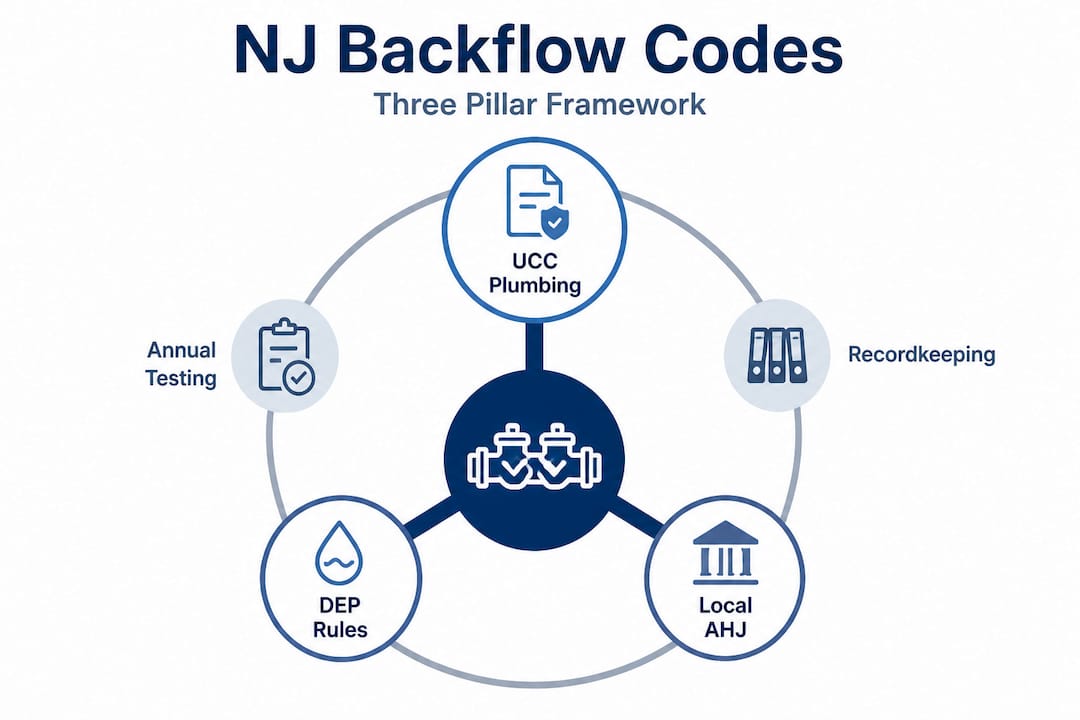
This layered approach means enforcement comes from multiple directions. The NJDEP oversees public water system protections, while local plumbing subcode officials handle inspections and permit approvals. Your water purveyor may also impose connection requirements as a condition of service. All three can have authority over your property simultaneously.
The codes apply broadly across property types:
- Residential properties, including single-family homes and multi-unit buildings
- Commercial properties with irrigation, fire suppression, or industrial water connections
- Mixed-use or change-of-use properties that transition from one classification to another
- Properties in flood-prone areas where additional safeguards may be mandated
“Local municipalities in New Jersey may adopt requirements that exceed state minimums, particularly in densely populated counties. Always verify what applies to your specific property address, not just your county.”
One of the most common mistakes property managers make is treating the state code as the ceiling. It is actually the floor. For NJ residential backflow protection, this distinction matters especially for homes connected to irrigation systems or in-ground pools, where local rules often go further than the state baseline.
Approved backflow prevention devices and choosing the right one
Knowing which codes apply is only part of the equation; selecting the right device is critical to staying compliant and protected.
Device selection in New Jersey is not a matter of personal preference. It is driven by a formal hazard assessment that considers two key factors: the level of potential contamination risk (health hazard vs. non-health hazard) and the type of backflow risk present (back-siphonage vs. backpressure). Approved devices include the Double Check Valve Assembly (DCVA) for low to moderate hazards and the Reduced Pressure Zone Assembly (RPZ) for high hazards, plus Pressure Vacuum Breakers (PVB), Atmospheric Vacuum Breakers (AVB), and air gaps, each matched to hazard level, pressure conditions, and backpressure risk.
Here is a comparison of the main device types to help you understand which situation calls for which solution:
| Device | Hazard level | Typical use case | Test frequency | Key installation note |
|---|---|---|---|---|
| Air gap | Highest | Lab sinks, chemical fill | No testing required | Requires physical separation; rarely practical for outdoor use |
| RPZ assembly | High | Irrigation, fire suppression, chemical processes | Annual | Must be installed above ground; requires relief valve clearance |
| DCVA | Low to moderate | General commercial, residential service lines | Annual | Cannot be used where high hazard exists |
| PVB | Low to moderate | Irrigation only; no backpressure risk | Annual | Must be installed 12 inches above highest outlet |
| AVB | Low | Hose connections, simple fixtures | No testing (non-testable) | Single-use only; cannot be under continuous pressure |
Understanding the difference between types of backflow prevention devices is not just academic. Choosing a DCVA in a situation that requires an RPZ is a code violation, and it will not protect your water supply in a contamination event.
Pro Tip: If your property has ever flooded, undergone a renovation, or changed its primary use, you may be required to upgrade to a higher-protection device even if your current one passed its last annual test. A change in hazard profile changes the device requirement.
Air gaps offer the absolute highest level of protection because they rely on physical separation rather than mechanical parts. However, they are impractical for most plumbing connections outside of laboratory or industrial settings. For most NJ properties, the real choice comes down to RPZ versus DCVA, and that choice depends entirely on the hazard classification. To understand how backflow preventers work in practice, the mechanics of each device type also matter for troubleshooting and maintenance decisions.
Installation and permitting: who can install, when you need a permit
Once you know the right device, getting it installed safely and legally is the next big hurdle. Here is what NJ codes demand for installation and permitting.
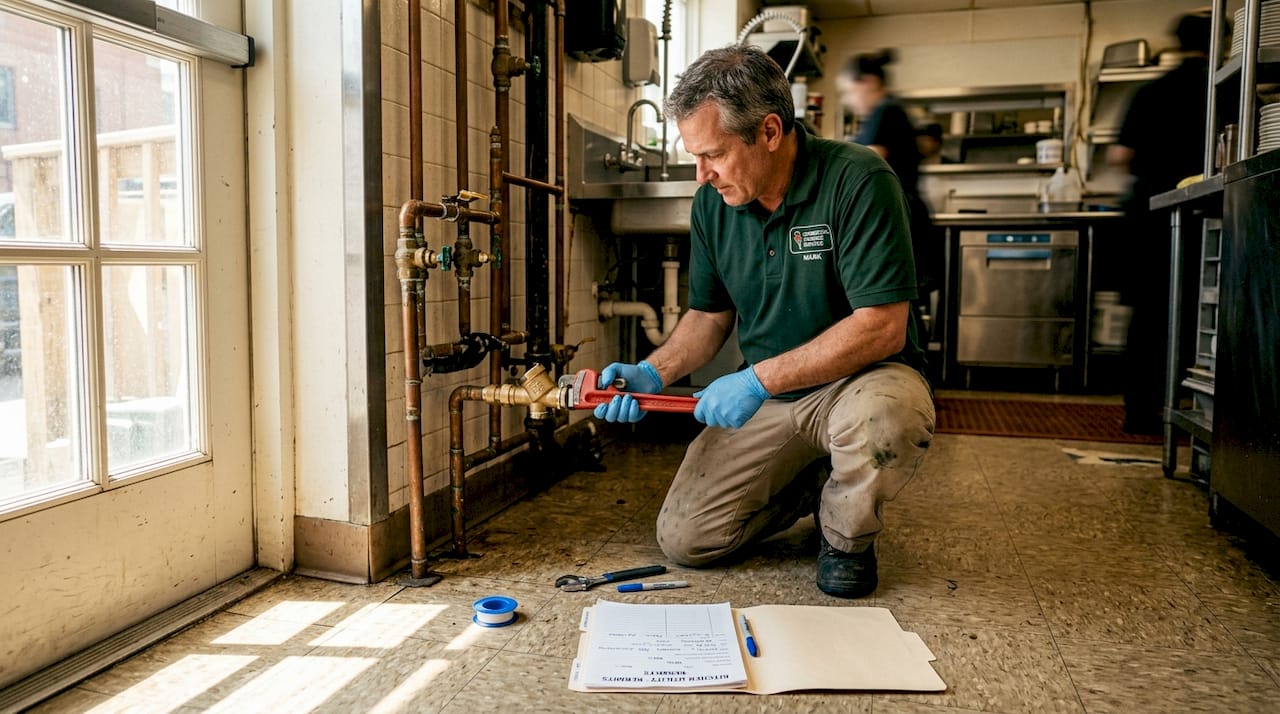
The rule is clear: only a licensed plumber can install a backflow prevention device under a UCC plumbing permit, with inspection required by the local plumbing subcode official. Annual testing is a separate activity and does not require a new permit. This is an important distinction that trips up a lot of property managers who assume the certified tester handles everything.
The standard installation process in New Jersey follows these steps:
- Submit a plumbing permit application to your local construction office before any work begins. Include device specs and installation drawings if required by your municipality.
- Hire a New Jersey licensed plumber to complete the installation. The plumber must pull the permit in their name.
- Schedule a rough-in inspection with the local plumbing subcode official once the device is in place but before walls are closed or the installation is finalized.
- Pass the final inspection after all installation work is complete and the device is fully commissioned.
- Commission the device through an initial certified backflow test, which establishes the baseline performance record.
- Submit initial test results to your water purveyor within 30 days of installation.
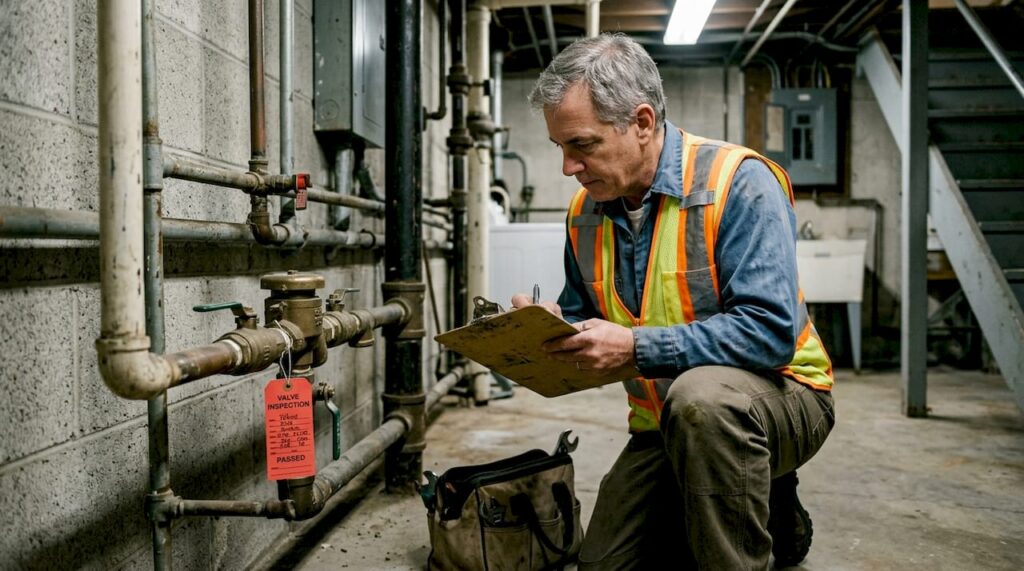
“Do not confuse your annual certified tester with your installation plumber. These are two different licensed roles under NJ code. Your tester verifies performance; your plumber is legally responsible for the physical installation.”
The NJ backflow device installation guide covers specific scenarios for commercial properties, but the framework above applies universally. Special situations that may trigger re-permitting include flood zone overlaps where the installation elevation must meet FEMA standards, property renovations that move or replace existing devices, and any formal change in property use that reclassifies the hazard level.
Annual testing does not require a new permit as long as the existing device is simply being tested and certified. The moment you replace or relocate the device, a new permit is required. This is a commonly misunderstood point that can lead to costly violations discovered only during a subsequent inspection.
Testing, certification, and recordkeeping requirements
Installing the right device is not enough. Ongoing testing and paperwork are where many properties quietly lapse in compliance.
New Jersey mandates that all testable backflow assemblies on public water systems undergo an initial test at installation and annual testing thereafter, with results submitted to the water purveyor within 30 days per N.J.A.C. 7:10-10. Air gaps are exempt because they have no mechanical components to test.
Here is what the testing schedule looks like by device type:
| Device type | Test frequency | Submission deadline | Required tester credential |
|---|---|---|---|
| RPZ assembly | Annual | Within 30 days of test | NJDEP-approved, ASSE 5000 certified |
| DCVA | Annual | Within 30 days of test | NJDEP-approved, ASSE 5000 certified |
| PVB | Annual | Within 30 days of test | NJDEP-approved, ASSE 5000 certified |
| AVB | Not testable | N/A | N/A |
| Air gap | Not testable | N/A | N/A |
Who can actually perform these tests matters enormously. Testing must be performed by a tester holding ASSE Series 5000 certification or equivalent, as approved by the NJDEP. The tester does not need a plumbing license, but must have current certification, calibrated test equipment, and documented training. This is a specialized credential, not just general plumbing knowledge.
Solid NJ backflow recordkeeping requires property owners to retain all test reports, certification documentation, and related permits for a minimum of three years. During an audit or water purveyor inspection, you will need to produce this paperwork on demand.
Key recordkeeping requirements include:
- Completed test reports signed by the certified tester for every annual cycle
- Proof of tester credentials at the time of each test
- Initial commissioning report from installation
- Any repair or replacement documentation if a device failed a test
- Permit records for each installation or device replacement
Pro Tip: Set a calendar reminder 60 days before your device’s annual test due date. That window gives you time to schedule a certified tester, receive the report, and submit results to your water purveyor within the 30-day deadline, all without scrambling at the last minute.
Understanding NJ compliance tester certification requirements also helps you vet the person you hire. Always confirm active NJDEP approval status before scheduling a test. For a clearer picture of NJ backflow testing intervals and how deadlines are calculated, reviewing the full testing schedule by device class can help you plan across multiple properties.
Local variations and what to ask your authority having jurisdiction (AHJ)
Because not all municipalities play by the same rules, due diligence with your local AHJ prevents costly mistakes.
New Jersey has 21 counties and hundreds of municipalities, and each one can exceed state minimums on device requirements, test frequency, or submission timelines. Dense urban counties like Hudson, Essex, and Bergen have historically imposed stricter standards than rural areas, but this is not a hard rule. You must verify directly with your AHJ every time a property changes status or a new installation is planned.
Here are the most important questions to bring to your authority having jurisdiction before any backflow project:
- Does this municipality require an RPZ where the state code would permit a DCVA?
- Are there stricter test submission deadlines beyond the 30-day state standard?
- Does the local water purveyor accept digital test submissions or require paper filings?
- Are there additional fees or inspection steps for commercial change-of-use properties?
- What is the fine schedule for late submissions or non-compliant devices?
- Does the local code require a specific ASSE certification level beyond the state minimum?
Finding your AHJ is straightforward. Contact your municipality’s construction office, which is usually listed on the township or borough website. Your water purveyor can also direct you to the correct enforcement contact. Understanding the nuances covered in passing NJ backflow testing at the local level often comes down to knowing exactly who to call before a project begins rather than after a violation notice arrives.
Common pitfalls and what most guides don’t tell you about backflow code compliance
Most compliance articles give you the rules. What they skip is the context that turns a missed deadline into a water shutoff notice or a surprise reinspection fee.
The most underestimated risk we see in practice is the change-of-use scenario. A property that converts from residential to commercial, or adds a food service operation, or expands an irrigation system, can silently cross into a higher hazard classification. The state code is not always explicit about exactly when this threshold is crossed, which means some property owners operate with the wrong device for months before anyone catches it. The time to evaluate device adequacy is before you start a renovation, not after the permit is pulled.
Self-testing is another area where well-meaning property managers create serious compliance problems. Even if a facilities manager holds a general plumbing certification or has deep technical knowledge of the device, NJ backflow inspection requirements demand a certified third-party tester. Self-certification is never accepted. This is not bureaucratic fine print; it is the mechanism that keeps the testing process independent and legally defensible.
On recordkeeping, three years of test logs is not optional even if your water purveyor has never asked for them. Audits happen, and when they do, an incomplete paper trail is treated the same as non-compliance. Digital recordkeeping systems are perfectly acceptable, but you need to maintain them consistently, not reconstruct them when a notice arrives.
Finally, the gap between what a code says and what an inspector enforces is real. We have seen properties in the same county operate under meaningfully different practical standards because one municipality actively enforces its stricter local rules while another defers almost entirely to state minimums. The only way to know which situation you are in is to ask your AHJ directly, document the conversation, and revisit the question whenever codes are updated or your property status changes.
Get expert help for NJ backflow compliance
Staying current with NJ backflow codes across multiple layers of state and local requirements is genuinely complex, and the stakes for getting it wrong are high.
South Jersey Backflow makes the entire process manageable. From selecting the correct device for your hazard classification to scheduling backflow testing and certification with NJDEP-approved testers, every step is handled by specialists who know New Jersey codes inside and out. Whether you need to get current on overdue testing, replace a non-compliant device, or set up a multi-property annual testing schedule, the team can manage every detail for you. Explore NJ backflow testing compliance services or review device options explained on the site to find the right starting point for your property.
Frequently asked questions
Who enforces backflow codes for residential homes in New Jersey?
Local plumbing subcode officials and the NJDEP both have enforcement authority, and local municipalities can adopt standards stricter than the state baseline under the UCC and N.J.A.C. 7:10.
How often do I have to test my backflow device in New Jersey?
Most testable assemblies require testing at installation and every year after that, with results submitted to your water purveyor within 30 days; air gaps and AVBs are exempt from this requirement.
Can I test my own backflow prevention device if I am trained?
No. Only NJDEP-approved testers with current ASSE Series 5000 certification and calibrated equipment are authorized to test and certify devices, regardless of your personal technical background.
What should I do if my municipality has stricter backflow rules?
Always follow the stricter local AHJ requirements over state minimums, and document your communication with the AHJ to protect yourself if enforcement questions arise later.
What records do I need to keep for backflow testing in NJ?
You must retain all test results, tester certifications, and relevant permits for at least 3 years to satisfy audit and water purveyor review requirements.
Pingback: How to Find, Test, and Maintain Backflow Preventers in NJ
Pingback: Water system safety checklist for NJ backflow owners