TL;DR:
- Missing a backflow certification deadline in New Jersey can lead to service shutoffs and fines before you realize there’s a problem. Property owners must ensure they hire certified testers, submit accurate reports on time, and keep records organized to maintain compliance annually. Proactive planning and proper documentation help avoid costly violations and support ongoing water system safety.
Missing a backflow certification deadline in New Jersey is not a minor oversight you can quietly fix later. Your local water authority or the NJDEP can shut off your service or issue fines before you even realize there’s a problem. This guide covers everything property owners and managers in New Jersey need to know about backflow certification: what triggers the requirement, how to prepare, the exact steps to complete the process, mistakes that derail compliance, and how to stay current year after year.
Table of Contents
- What is backflow and who needs certification?
- What you need before starting the certification process
- Step-by-step: The backflow certification process in New Jersey
- Common mistakes and how to avoid failed certifications
- How to maintain compliance year after year
- The biggest compliance myth: Why shortcuts will cost you more
- Need help with backflow certification? Stay compliant the easy way
- Frequently asked questions
Key Takeaways
| Point | Details |
|---|---|
| Certification is mandatory | NJ law requires annual backflow certification for most commercial and multi-unit properties. |
| Only certified testers allowed | You must use NJDEP- or ASSE-certified testers or your certification will not be valid. |
| Keep records up to date | Proper documentation and timely submission prevent fines and water service interruptions. |
| Plan ahead | Gather documents and schedule tests early to avoid last-minute problems or penalties. |
| Prevention saves money | Staying compliant and addressing issues early is always cheaper than emergency repairs or fines. |
What is backflow and who needs certification?
Backflow happens when water flows in the wrong direction through your plumbing, pulling potentially contaminated water back into the public supply. It sounds unlikely, but pressure changes from main breaks, firefighting activity, or even heavy irrigation can create the conditions for it. That’s why New Jersey law requires backflow prevention devices on many properties, and more importantly, why those devices must be tested and certified regularly.
Understanding the backflow certification importance goes beyond just following a rule. A failed or untested backflow preventer puts your tenants, your neighbors, and the broader municipal water supply at risk. The certification process confirms that your device is physically working and that it can stop contaminated water from reversing into the system.
So who in New Jersey is actually required to certify? The answer covers more property types than most owners expect:
- Commercial properties of almost any type, including retail, office, restaurants, and medical facilities
- Industrial facilities that use chemicals, process water, or have specialized plumbing connections
- Multi-unit residential buildings such as apartment complexes and condominiums
- Some single-family homes, specifically those with irrigation or pool systems that create a cross-connection risk
- Non-residential buildings of all types, from schools to churches to warehouses
Enforcement falls under both the NJDEP and your local water authority. Local utilities often take the lead on sending notices and tracking submission deadlines, but state regulations back them up. If your local authority flags you for non-compliance, NJDEP rules give them real teeth to act on it.
Key fact: Most properties with any type of cross-connection between the public water supply and a secondary system are required to certify their backflow prevention devices annually.
What you need before starting the certification process
Understanding the requirements is only half the battle. Here’s how to prepare for the actual test and certification process so you’re not scrambling at the last minute or wasting money on avoidable delays.
The single most important piece of preparation is hiring the right tester. In New Jersey, tester certification rules are strict. Testing must be performed by professionals certified under N.J.A.C. 7:10-10.8 by NJDEP or holding ASSE Series 5000 certification, and they must be registered with the relevant local authority. Hiring someone who doesn’t meet this standard means the test result is legally worthless, even if the device passes.
Here’s a quick overview of what you need to have in order before scheduling:
| Item | Why it matters | Where to find it |
|---|---|---|
| Previous test reports | Establishes device history | Your records or prior tester |
| Device location and model | Required for accurate testing | Mechanical room, utility closet |
| Local authority contact | For submission and questions | Water utility website |
| Certified tester credentials | Required by law | NJDEP tester list |
| Property address and account number | Needed for submissions | Utility bill |
Beyond the table above, make sure your backflow prevention device is physically accessible. Testers need clear access to the device to perform the inspection, and blocked utility rooms or locked mechanical spaces are a surprisingly common cause of rescheduled appointments. Label the device clearly, keep the area clean, and make sure anyone who needs to provide access on test day is available.
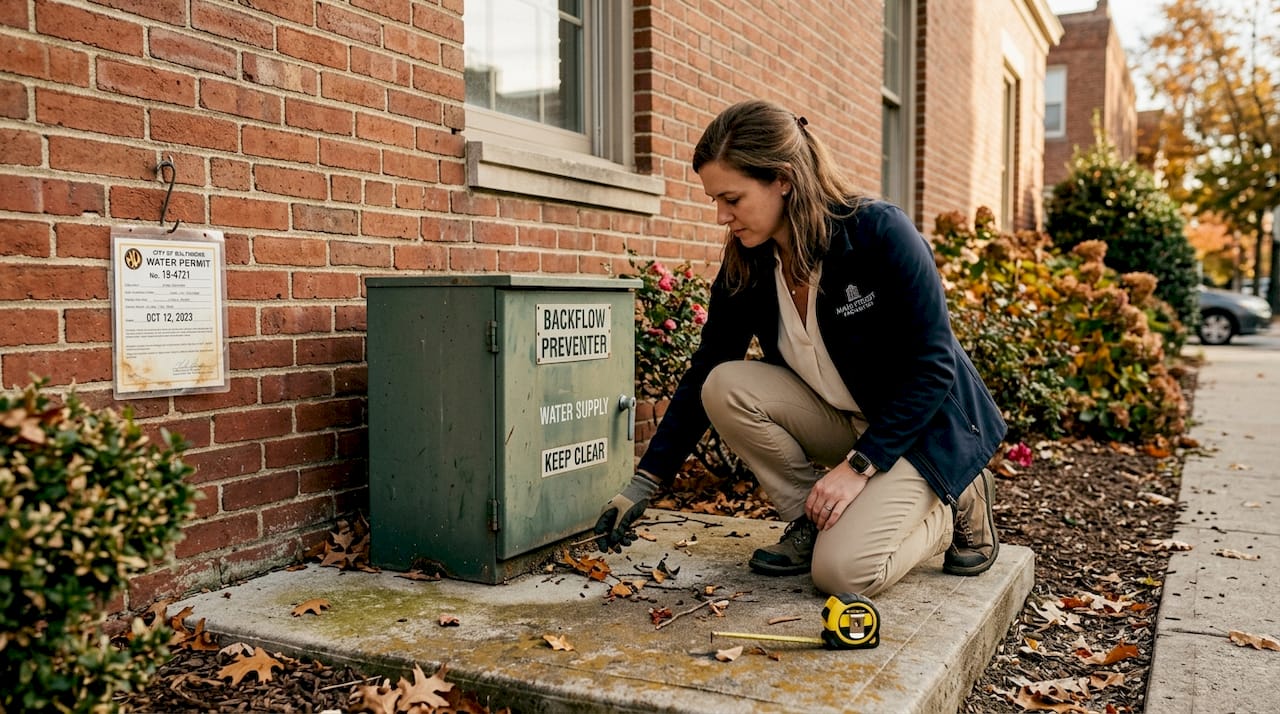
Pro Tip: Keep a physical or digital folder with all previous test reports, correspondence from your water authority, and device specifications. When an inspector asks about your compliance history, having those documents ready immediately signals that you’re a responsible property owner and can prevent unnecessary delays.
For a full walkthrough of NJ backflow compliance steps, having this preparation in place before the tester arrives can save hours of frustration and avoid the need for a return visit.
Step-by-step: The backflow certification process in New Jersey
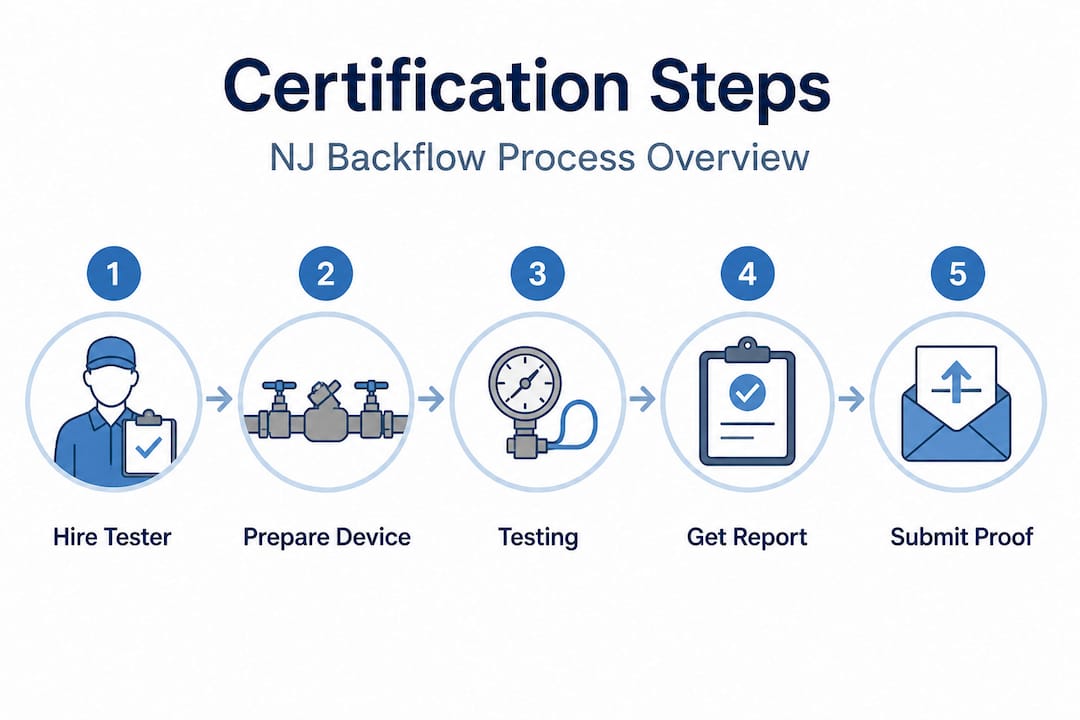
Once you have everything ready, here’s the exact sequence to ensure your property stays compliant.
-
Locate your certified tester. Use the NJDEP’s official tester directory to find someone certified under N.J.A.C. 7:10-10.8 or with ASSE Series 5000 standing. Confirm they are also registered with your local water authority.
-
Schedule the appointment. Contact the tester well ahead of your deadline. Annual deadlines can create backlogs in popular testing periods, particularly spring and fall, so booking early gives you flexibility if repairs are needed.
-
Prepare the property. Clear access to the backflow device. Have prior test reports and your utility account information ready. Confirm who will be on-site to provide access.
-
Tester conducts the inspection. The certified tester will physically inspect the device, verify it’s the correct assembly for your water connection, and run standardized pressure differential tests to confirm it’s working properly.
-
Receive the official test report. After testing, the tester provides a completed and signed test report. This document is your legal record of compliance. Review it immediately to confirm all sections are filled out correctly.
-
Submit documentation. Send the completed test report to your local water authority by their specified deadline. Some authorities now accept digital submissions; others require paper forms. Confirm the format they accept in advance.
-
File your copy. Store the report in your compliance folder for future reference.
“Only NJDEP- or ASSE-certified testers are legally recognized in New Jersey.”
Using the wrong tester is not a gray area. Here’s what the difference looks like in practice:
| Scenario | Outcome |
|---|---|
| NJDEP or ASSE-certified tester | Test result accepted, compliance confirmed |
| Non-certified or out-of-state tester | Test result invalid, compliance not achieved |
| Missed submission deadline | Property flagged, potential fines or shutoff |
| Device fails test but repairs made | Retest required, documented repair record needed |
Pro Tip: Ask your tester to provide a digital copy of the signed test report on the same day as the inspection. Physical paperwork can get lost, and a PDF in your email is much easier to retrieve when you’re submitting to your water authority or responding to a compliance inquiry.
For more detail on certification steps and exactly what passing a backflow test involves, those resources cover the technical side in detail.
Common mistakes and how to avoid failed certifications
Even with a step-by-step approach, simple errors can jeopardize your compliance. Here’s how to stay clear of common setbacks.
Missing the annual testing deadline. New Jersey requires annual certification for most covered properties. It’s the single most frequent compliance failure, and the most avoidable. Authorities don’t always send reminders, so the responsibility falls entirely on the property owner or manager.
Hiring a non-certified tester. This mistake is especially frustrating because it often looks fine on the surface. The tester shows up, runs a test, fills out a report, and charges a fee. But if they’re not on the NJDEP’s approved list or don’t hold current ASSE Series 5000 certification, that entire effort is legally invalid. Your water authority will reject the submission, and you’ll need to start over. NJDEP Regulations N.J.A.C. 7:10 make no exceptions for good-faith hiring errors.
Failing to submit the test report. Passing the physical test is not enough. You have to submit the completed documentation to your local authority within their required timeframe. Some managers assume the tester handles submission automatically. Many testers do not. Confirm this responsibility in writing before the appointment.
Device access issues. Backflow preventers installed in hard-to-reach locations, behind stored equipment, or in shared mechanical rooms create real problems on test day. If the tester can’t access the device, the test can’t happen, and you’re still on the clock toward your deadline.
Misidentifying the device. Some properties have multiple backflow preventers serving different systems such as irrigation, fire suppression, or domestic water. If you’re only testing one when the authority expects records for all of them, partial compliance is still non-compliance.
“Non-compliance can mean costly shutoffs or fines. Prevention is always cheaper.”
For deeper guidance on compliance for commercial properties and answers to common backflow questions, those resources can help you close any gaps in your current process.
How to maintain compliance year after year
Prevention doesn’t end after certification. Ongoing compliance is key to hassle-free management across multiple property cycles.
-
Build a recurring annual calendar entry. As soon as you receive your current compliance confirmation, set a reminder for 60 days before next year’s deadline. This gives you enough lead time to find a tester, schedule access, and handle any surprises.
-
Create a centralized compliance folder. Whether it’s a physical binder or a shared cloud folder, keep every test report, correspondence from your water authority, and repair record in one place. If your property changes managers, that record transfers with the building.
-
Contact your water authority once a year for updates. Local rules evolve. Submission procedures change. New device types get added to required lists. A brief annual check-in with your utility’s compliance contact takes 10 minutes and keeps you ahead of any rule changes.
-
Track every device, not just the primary one. If your property has separate backflow preventers for irrigation, fire suppression, and domestic water, all of them may require independent annual testing frequency records. Maintain a device inventory with individual test deadlines.
-
Confirm submission requirements annually. Some authorities update their preferred reporting forms or switch to online portals. Checking before you submit prevents the frustrating experience of having a valid test rejected because it was submitted on the wrong form.
Pro Tip: Set your calendar reminder 60 days before the deadline, not 2 weeks. The 60-day window covers you for tester scheduling backlogs, required repairs, retest scheduling if the device fails, and submission processing time. Two weeks is never enough if anything goes wrong.
For ongoing annual testing answers and a detailed breakdown of testing intervals by property type, that resource will help you stay current without second-guessing your schedule.
The biggest compliance myth: Why shortcuts will cost you more
Here’s the perspective most articles won’t give you. Across years of working with New Jersey property owners and managers, the pattern is consistent. The owners who end up paying the most are not the ones who skip compliance entirely. They’re the ones who do it halfway.
Halfway compliance looks like this: hiring whoever quotes the lowest price without checking NJDEP certification, submitting paperwork late and hoping the authority doesn’t follow up, or testing one device when three are required. These aren’t bold risks. They feel like reasonable, time-saving decisions in the moment.
But local water authorities are getting better at tracking compliance records. When they audit a property and find incomplete documentation or a tester who isn’t on their approved list, they don’t just send a friendly reminder. They issue fines. They schedule shutoffs. They require full re-documentation. And the cost of addressing all of that, on an emergency basis, with your tenants or operations affected, is far higher than doing it properly from the start.
The deeper shift is treating backflow prevention issues as part of your property’s maintenance investment rather than as a compliance checkbox. Properties that maintain clean, complete certification records are also properties that catch device failures before they become water damage events. They’re properties that transfer smoothly in real estate transactions because compliance documentation is already organized. They’re properties where tenants don’t face service interruptions at the worst possible moment.
The “bare minimum” approach to compliance is a false economy. Do it right, do it on time, and the annual cost is modest and predictable.
Need help with backflow certification? Stay compliant the easy way
Managing the full certification cycle, from finding the right tester to submitting documentation on time, takes attention and organization. If it’s not currently set up as a system in your property management process, gaps will appear.
Our team specializes in professional certification help for New Jersey property owners and managers. We handle the testing with NJDEP-certified professionals, provide complete documentation on the same day, and can help you build the records and reminder systems you need to stay compliant every year. If you want to know exactly how to pass your test and get your documentation submitted without the usual stress, reach out to us today. Compliance doesn’t need to be complicated when you have the right partner.
Frequently asked questions
Who can legally perform backflow testing in New Jersey?
Only testers certified under N.J.A.C. 7:10-10.8 by NJDEP or holding current ASSE Series 5000 certification and registered with local authorities can perform legally valid backflow tests in New Jersey.
How often does backflow certification need to be renewed?
Most New Jersey properties must renew certification annually to remain compliant, with commercial, industrial, and multi-unit residential properties facing the most consistent annual requirements.
What happens if I miss a backflow certification deadline?
Missing the deadline can result in water service shutoff or fines issued by your local authority, and NJDEP regulations give enforcement agencies the authority to act without extended grace periods.
Where can I find a list of certified backflow testers?
The NJDEP website maintains a current list of certified testers for New Jersey, searchable by name and credential status.
Do single-family homes need to worry about backflow certification?
Single-family homes with irrigation systems or pools may be subject to annual certification requirements, so homeowners in that situation should verify their obligations directly with their local water authority.