TL;DR:
- Only NJDEP-approved, ASSE 5000 certified technicians can legally perform backflow testing in New Jersey.
- Annual and event-triggered tests are required for high-risk properties and must be submitted within 30 days.
- Proper documentation, credential verification, and staying organized are key to maintaining compliance.
Plenty of New Jersey property owners assume that any licensed plumber can sign off on a backflow test. That assumption is wrong, and it costs people real money. Annual testing requirements apply to most properties, and results must be submitted to your water purveyor within 30 days. Hire someone without the right credentials, and that test is worthless on paper. Worse, you may still face fines or a water shutoff even though you paid for a service. This guide breaks down exactly what a certified backflow tester is, who qualifies, when testing is required, and how to protect yourself from the most common and costly compliance mistakes.
Table of Contents
- What is a certified backflow tester?
- When and where is certified backflow testing required?
- What does certified backflow testing actually involve?
- How to verify your tester and avoid common pitfalls
- Why most backflow compliance issues start before the test
- Stay protected and compliant with trusted NJ backflow testers
- Frequently asked questions
Key Takeaways
| Point | Details |
|---|---|
| Certification is essential | Only NJDEP-approved testers with backflow credentials can legally certify your property. |
| Annual testing required | Most New Jersey properties must get backflow testing every year to avoid penalties. |
| Paperwork matters | Test results must be submitted to water purveyors within 30 days to stay compliant. |
| Device selection is critical | Using the wrong backflow device can cause compliance failures regardless of the test result. |
| Property owners must verify | Always confirm your tester’s certification and keep accurate records to prevent fines. |
What is a certified backflow tester?
A certified backflow tester is not simply a plumber who happens to carry a gauge kit. In New Jersey, the title refers to a technician who holds a specific, state-recognized credential on top of any general plumbing license they may carry. The two are not interchangeable. A plumber can install pipes all day long and still not be authorized to certify a backflow preventer.
Here is what sets a certified tester apart:
- State-approved credentials. According to the NJDEP’s official tester registry, testers must be approved through certifying agencies recognized by the New Jersey Department of Environmental Protection. A plumbing license alone is not sufficient without a separate backflow certification.
- ASSE 5000 or equivalent. The most widely recognized credential is ASSE 5000, issued by the American Society of Sanitary Engineering. Some testers hold equivalent certifications, but those must still meet NJDEP standards.
- Testing, not just inspecting. A certified tester uses calibrated test kits to measure differential pressure across the device under controlled conditions. This is a functional test, not a visual walk-around.
- Documentation and submission. A key part of the job is completing the official test report and getting it to your water purveyor on time. The test only counts if the paperwork is filed.
- Advisory role. Good testers also flag devices that are aging, installed incorrectly, or mismatched to the property’s risk level.
Understanding who certifies backflow devices in New Jersey is the first step toward building a reliable compliance program. Property managers who skip this step often end up paying twice: once for an unqualified tester and again for a legitimate one after the water authority flags the issue.
Pro Tip: Before you schedule any backflow test, ask the technician for their NJDEP approval number. Cross-reference it on the DEP website. This takes five minutes and protects you from a very expensive mistake.
Knowing what a backflow preventer actually does helps you have smarter conversations with your tester and understand why this credential requirement exists in the first place.
When and where is certified backflow testing required?
With the role defined, it’s important to understand when and where certified testing is mandatory across New Jersey.
The short answer: more often than most property owners realize.
Required testing triggers
The following situations require a certified test, not just an inspection:
- At installation. Any new backflow preventer must be tested before the system goes live. Installation alone is not enough.
- After any repair or component replacement. If a tester or plumber services the device, a fresh test is required before the system is returned to normal operation.
- Annually. For the vast majority of properties, annual testing is mandatory. Missing a cycle puts you out of compliance immediately.
- After device replacement. Swapping in a new device triggers the same testing requirement as a fresh installation.
- When the water purveyor requests it. Local utilities can require additional testing at any time, especially if they identify a potential cross-connection hazard during an inspection.
Property types subject to testing
Not every property carries the same risk level, but the list of affected properties is broad. Under NJDEP enforcement, local water purveyors apply these requirements to:
- Commercial properties of virtually any type
- High-risk residential properties including homes with irrigation systems, boilers, or in-ground pools
- Industrial facilities and manufacturing sites
- Multi-unit residential buildings
- Properties with fire suppression systems connected to the public water supply
“Non-compliance with backflow testing requirements risks fines and water service interruption, enforced by local water purveyors acting under NJDEP authority.”
The 30-day submission deadline is firm. After the tester completes the inspection and documents the results, those test reports must be filed with your water supplier within 30 days. Miss that window and the test may not be counted as compliant for that cycle.
Understanding the full scope of NJ backflow rules helps property managers plan ahead rather than scramble to catch up. If you’re unsure about how often testing applies to your specific situation, look that up before your next renewal date.
| Property type | Typical testing frequency | Enforcement body |
|---|---|---|
| Commercial | Annual minimum | Local water purveyor |
| High-risk residential | Annual or more | Local water purveyor |
| Industrial | Annual or more | Local water purveyor |
| Post-repair (any type) | Immediate re-test | Local water purveyor |
| New installation (any type) | Before service begins | Local water purveyor |
What does certified backflow testing actually involve?
Knowing who and when to test, the next step is understanding what the service looks like and what you should expect from your certified tester.
A professional backflow test is a structured process. It is not a quick visual check. Here is what a standard appointment involves from start to finish.
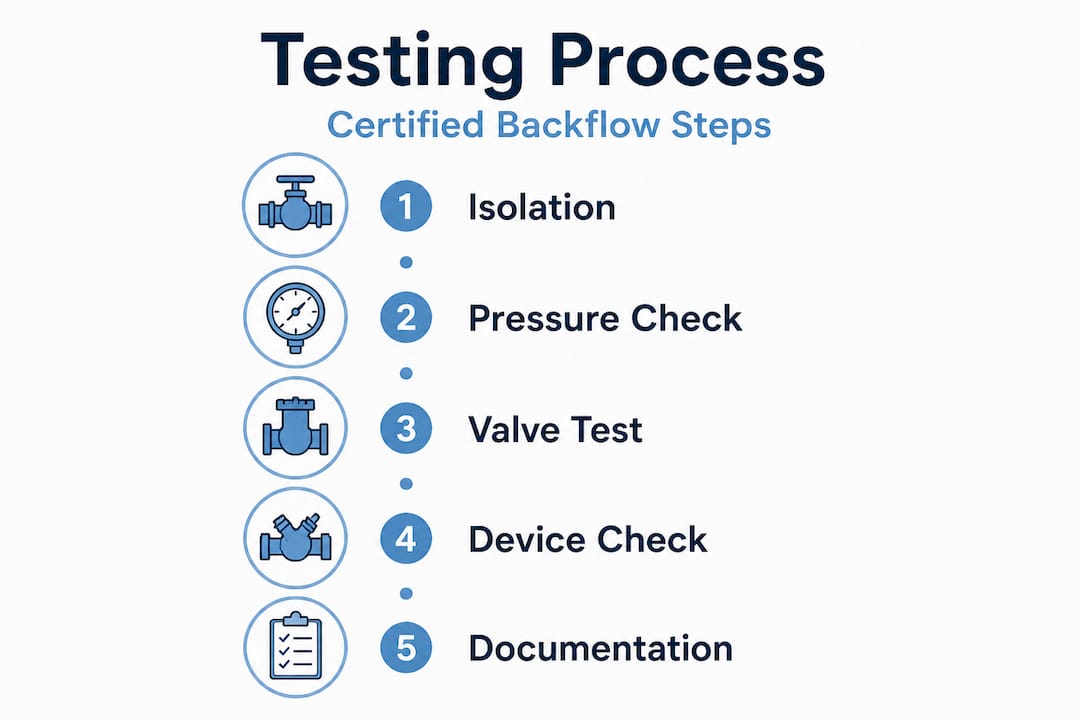
Step 1: Shutoff and isolation. The tester isolates the backflow preventer from both the upstream supply and the downstream system. This is necessary to get accurate readings without interference from demand fluctuations elsewhere in your plumbing.
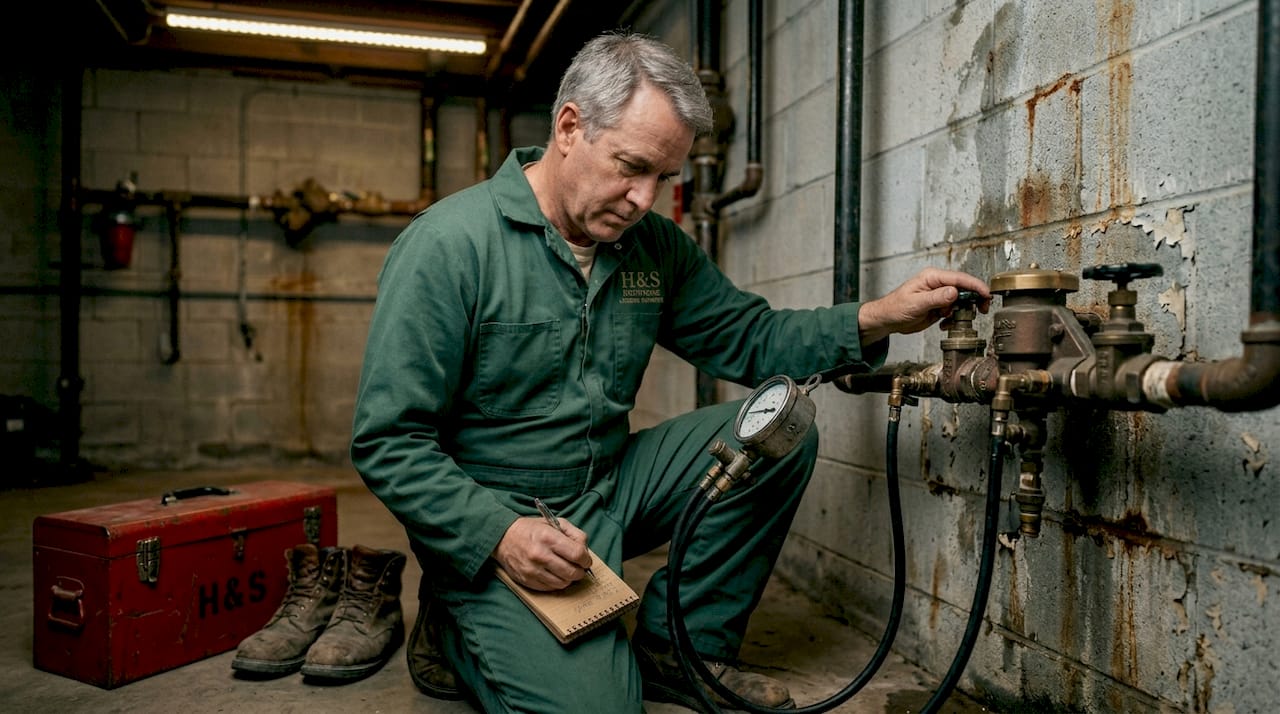
Step 2: Pressure differential checks. Using calibrated gauges connected to test cocks on the device, the tester measures pressure differences across each check valve. These readings determine whether the device is functioning within acceptable parameters.
Step 3: Relief valve operation (for RP devices). On reduced pressure zone assemblies, the tester verifies that the relief valve opens and closes at the correct differential. This is a critical safety mechanism that protects against high-hazard backpressure events.
Step 4: Device-specific checks. Different device types have different test sequences. A double check valve assembly (DCVA) test differs from a pressure vacuum breaker (PVB) test. The correct device type must match the hazard level of the property. Using a DCVA on a high-hazard connection, for example, is a compliance failure even if the device itself tests clean.
Step 5: Documentation. The tester completes an official test form recording all readings, pass or fail status, device serial number, location, and their own certification number. This form is what gets submitted to your water purveyor.
Here’s a useful comparison of common device types and where they are typically required:
| Device type | Typical application | Hazard level |
|---|---|---|
| Reduced pressure zone (RPZ) | High-hazard commercial, industrial | High |
| Double check valve assembly (DCVA) | Low-hazard commercial, irrigation | Low to moderate |
| Pressure vacuum breaker (PVB) | Irrigation (above-grade) | Moderate |
| Atmospheric vacuum breaker (AVB) | Simple residential uses | Low |
Pro Tip: Ask your tester to walk you through the test readings before they leave. A good tester can tell you not just whether the device passed, but how much margin it has. A device that barely passes today may fail before your next annual test.
Self-testing is not valid under any circumstances. Even if you own the same gauges a certified tester uses, the results carry no legal weight without the certified tester’s credential and signature. Property owners who try to self-certify to save money end up in a worse position than if they had done nothing at all, because they have a false sense of compliance without any actual protection.
Reviewing the device installation guide for NJ property owners is a smart move if you’ve recently had a device installed and want to understand what type you have before the tester arrives. The step-by-step prevention guide is another solid resource for building out your overall compliance plan.
How to verify your tester and avoid common pitfalls
To make sure your property stays safe and compliant, finish by learning how to check your tester’s credentials and avoid the issues that cost others dearly.
Here is a direct, actionable process you can follow every time you hire a backflow tester:
- Request the tester’s NJDEP certification number before booking. Any legitimate tester will provide this without hesitation. If they stall or claim it’s unnecessary, that is a red flag worth taking seriously.
- Verify on the NJDEP registry. The DEP maintains a public list of approved testers. Match the name and number before the appointment.
- Confirm ASSE 5000 or equivalent. Ask specifically which certification they hold and from which certifying body. Not all credentials are equal, and some are not recognized in New Jersey.
- Review the test report before the tester leaves. The report should include: device type, serial number, location, test date, all pressure readings, pass or fail status, and the tester’s certification number and signature.
- Track the 30-day submission deadline. Either confirm the tester will submit the report directly or get a copy and send it yourself. Missing this window has consequences even when the test itself passed.
- Keep copies of every test report. Store them by year and property location. If your water purveyor ever audits your compliance history, you’ll need these on hand.
Common mistakes that cost property managers:
- Hiring a general plumber who claims to do backflow testing without verifying their specific certification
- Trusting verbal confirmation that paperwork was submitted instead of getting written proof
- Missing the annual test because there was no reminder system in place
- Assuming that because a device was recently installed, no annual test is required yet
- Ignoring a failed test report instead of scheduling repairs and a retest promptly
Understanding what complying with backflow inspections looks like in practice makes the difference between smooth renewals and costly surprises. Property managers who build these verification steps into their standard process rarely face enforcement action.
Pro Tip: Set a calendar reminder 60 days before your annual test is due. That gives you time to schedule a certified tester, not scramble at the last minute and end up hiring someone unqualified because they were available quickly.
Why most backflow compliance issues start before the test
Here is something most articles on this topic will not tell you: the majority of compliance failures in New Jersey have nothing to do with a broken backflow preventer. The device often works fine. The problem is almost always paperwork, process, or the wrong person doing the job.
We see this consistently. A property manager schedules a test, the device passes, but the report never gets submitted on time. Or the tester was a licensed plumber without backflow certification, so the result is rejected entirely. Or the wrong device was installed for the hazard level years ago, and nobody caught it until a utility risk survey flagged the property.
These are not mechanical failures. They are process failures. And they are almost entirely preventable.
The real weak link in most compliance programs is the handoff: who is responsible for submission, how it gets tracked, and whether anyone checks that it was actually received. Property managers who treat backflow compliance as a one-step event (schedule test, done) are the ones who get surprised. The ones who build a short checklist around each test cycle almost never face fines or shutoffs.
Device selection is the other underestimated risk. Understanding the regulations in depth reveals that incorrect device installation is a compliance violation regardless of whether the test passes. A properly functioning device installed in the wrong application is still non-compliant. This is why working with a certified tester from the start, not just at annual renewal time, matters so much.
Our honest take: the property managers who stay ahead of this are not more technically sophisticated. They are simply more organized. They verify credentials, they track deadlines, and they treat the paperwork as part of the service, not an afterthought.
Stay protected and compliant with trusted NJ backflow testers
Armed with this knowledge, you’re ready for the next step: turning compliance into peace of mind with expert help.
Getting certified backflow testing right means working with someone who understands New Jersey’s specific requirements, not just general plumbing principles. South Jersey Backflow provides backflow testing and certification services performed by NJDEP-approved, ASSE-certified technicians who handle testing, documentation, and submission on your behalf.
You do not have to navigate submission deadlines and device requirements alone. Our team works with commercial, residential, and industrial property owners across New Jersey to keep compliance current and records clean. If you want to understand exactly how to pass and submit your backflow test results, we have the guidance and the certified professionals to back it up. Reach out today and take compliance off your worry list.
Frequently asked questions
Does my property need a certified backflow test every year in New Jersey?
Yes, most properties require annual certified backflow testing, and high-risk sites such as those with irrigation systems, boilers, or pools may need more frequent checks depending on what your water purveyor determines.
Who qualifies as a certified backflow tester in NJ?
Only technicians who are NJDEP-approved and hold a recognized credential such as ASSE 5000 qualify. A standard plumbing license does not authorize a person to certify backflow devices.
What happens if I skip required backflow testing?
Skipping tests puts you at risk of fines and water service interruption, because local water purveyors enforce these requirements under NJDEP authority and can shut off service for non-compliant properties.
Can I test my own backflow preventer if I have plumbing experience?
No. Self-testing is not valid regardless of your experience level. Only a certified tester can perform and document a legally recognized backflow test in New Jersey.