
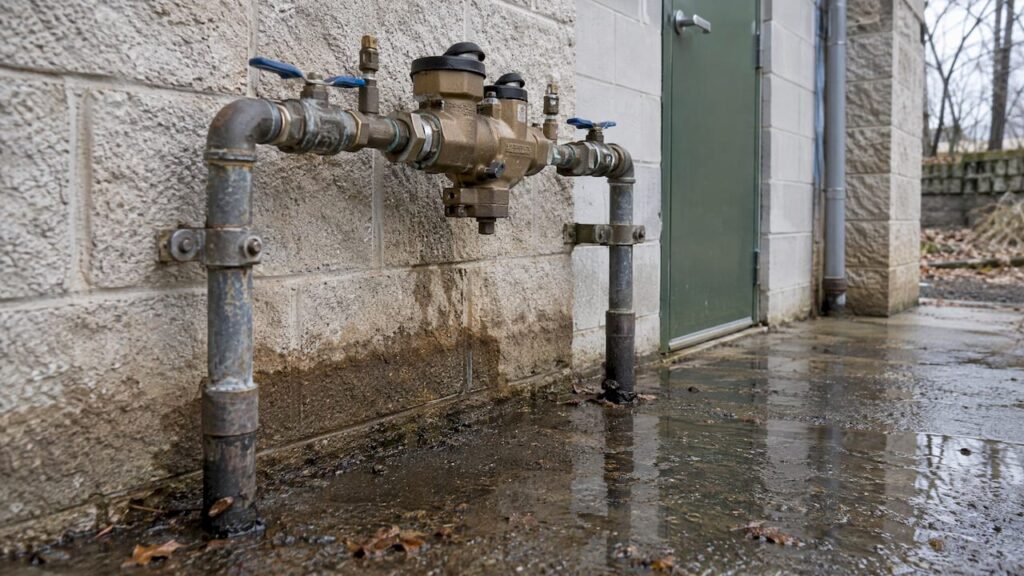
If your New Jersey property sits in a mapped flood zone, your backflow preventer needs three things: a location above the likely floodwater, protection that suits the site, and a test by a licensed tester after any flood that reaches it. A flood zone label does not change what a device is for. It does raise the odds that the device will be tested by the weather before you test it yourself.
This guide is for owners and property managers. It covers how flood zones relate to backflow risk, what New Jersey guidance says about placement, what to do after water reaches a device, and what to ask your water supplier.
TL;DR
- A flood zone designation tells you about potential flooding. It does not prove your site is safe or unsafe, so treat it as a starting point for a site review.
- NJDEP guidance recommends placing critical infrastructure above the 500-year flood elevation or the Uniform Construction Code elevation, whichever is higher. Elevation beats flood-proofing.
- Testable devices need annual testing to keep a valid Certificate of Compliance, with a specific exception for one- and two-family dwellings. Your water supplier sets the local rules.
- After floodwater reaches a device, have it inspected and tested before you rely on it again. Keep the water supplier and, for food businesses, the regulator in the loop.
- A raised, protected enclosure is the most common way we help flood-prone properties keep a device in service.
Table of Contents
- What backflow means when water is rising
- What a flood zone designation tells you, and what it does not
- Where New Jersey guidance says to put the device
- New Jersey rules that apply at flood-prone properties
- What to do when floodwater reaches a backflow device
- Reducing the risk before the next storm
- Our perspective
- Testing, repair and enclosure costs
- Get your device checked before or after the water
- What to ask your water supplier or municipality
- FAQ
- Sources
What backflow means when water is rising
Backflow is the unintended reversal of water flow through a cross-connection, the point where drinking water plumbing meets something that is not drinking water. EPA describes cross-connections as actual or potential links between a potable supply and nonpotable plumbing. A backflow preventer is the device that keeps that reversal from happening.
In a normal week, the risk comes from pressure changes in the main or in your own piping. In a flood, several things stack up at once.
The kinds of backflow a flood can set up
- Submerged outlets. A hose bib, irrigation head, fill line or hose left in standing water is a direct path between floodwater and your plumbing if pressure drops.
- Back-siphonage. A water main break or heavy firefighting demand can pull the pressure down in the supply. Water in connected equipment can then be drawn the wrong way.
- Backpressure. Boilers, pumps, fire sprinkler systems and irrigation pumps can push pressure higher than the supply. A leaking downstream valve makes this worse.
- Damaged or buried devices. A device that sits in a pit, a low vault or at ground level beside a yard can fill with silt and debris. Seals, springs and check discs can then foul.
Irrigation is the one many owners overlook. Lawn systems connect to potable water, and sprinkler heads sit at ground level, exactly where floodwater collects. If your property has one, a professional irrigation system service can inspect heads, valves and piping after water recedes, and a licensed backflow tester can look at the device that protects the line.
What a flood zone designation tells you, and what it does not
FEMA flood maps and the NJDEP Flood Indicator Report are useful screening tools. They show mapped flood hazard areas and indicators of potential flooding. NJDEP explains that these reports do not establish actual risk or confirm that a specific site is safe, and that a licensed professional engineer is the person to evaluate local topography and site conditions.
Two points follow from that:
- A clean report is not a guarantee. NJDEP notes that the absence of flood indicators does not mean a property is free from flood risk, because flooding can occur outside mapped areas as conditions change.
- Maps age. FEMA’s guidance on protecting building utility systems says risk assessments should be updated when site or watershed conditions have changed significantly since the hazard data were published. It also points out that historical mapping can understate risk.
In practice, treat a Zone A or AE label as a reason to plan for water at your device. If you are outside a mapped zone but your yard has flooded before, plan the same way. The documented history of your own property is often a better guide than the map.
Where New Jersey guidance says to put the device
The NJDEP infrastructure flood protection guidance recommends locating critical infrastructure above the 500-year flood elevation or the elevation required by the New Jersey Uniform Construction Code, whichever is higher. The same guidance ranks the options. Elevation or avoidance comes first. Flood-proofing, such as watertight shields or waterproof sealants, is the least desirable measure and is meant for cases where the other methods are not feasible.
That gives owners a practical order of decisions:
| Priority | Approach | What it looks like at a backflow assembly |
|---|---|---|
| 1 | Avoid the hazard | Locate the assembly in a higher, dry spot such as an interior mechanical room above flood elevation |
| 2 | Elevate | Raise the assembly and its supports so the relief valve and test cocks stay above expected water |
| 3 | Protect in place | Use a protective enclosure to shield from debris, freezing and damage, with proper drainage |
| 4 | Flood-proof | Use shields or sealants only where moving or elevating is not feasible |
Two cautions belong here. First, never plug or pipe a relief valve discharge to make a device look watertight. These devices need to discharge freely to work, and a blocked discharge defeats the protection. Second, an assembly’s height and orientation are governed by the manufacturer’s installation requirements and local code, so have the layout reviewed before anything is moved. Our page on backflow enclosure requirements in NJ covers what the rules say about enclosures.
New Jersey rules that apply at flood-prone properties
Flood zones do not create their own backflow rules. The usual New Jersey framework applies, and it varies by property type and by water supplier.
- Commercial and multi-unit properties. NJDEP’s physical connection guidance says facilities with cross-connection hazards may be required by their public community water system to install backflow prevention devices to protect the system.
- Private residences. The same guidance says the physical connection permit and device installation requirements generally do not apply to private residences under N.J.A.C. 7:10-10.1(e). Plumbing subcode rules still apply for preventing illegal cross-connections.
- Annual testing. The Department of Community Affairs bulletin on backflow preventers states that devices designed for field testing must be tested before final inspection and annually after that to maintain a valid Certificate of Compliance. It also states that testable devices for one- and two-family dwellings are not required to be tested annually.
So a single-family homeowner has more discretion, and a property manager with a commercial or multi-unit building has a compliance duty. Even where annual testing is not mandated, a home in a flood zone has good reasons to test after any water event. Your water supplier may also have its own program, which is why the last question in this guide matters.
If you manage several buildings, our property manager backflow compliance page explains how we confirm filings with water authorities, and the property manager checklist gives you a working list.
What to do when floodwater reaches a backflow device
This is the part that cannot wait. Take these steps in order.
- Stay safe first. Do not enter a flooded basement or mechanical room with live electrical equipment. Wait for the water to recede and for power to be made safe.
- Document the water level. Photograph the device, the high-water line and any debris. You will want this for insurance and for your water supplier.
- Do not assume the water is safe to drink. Follow your water supplier’s and the health department’s notices. If there is any sign of a pressure loss or a boil-water advisory, follow it.
- Notify the right parties. Contact your water supplier if the device is part of a required program. Food businesses have their own duty: New Jersey guidance for food production facilities says managers must immediately notify the regulatory authority and discontinue operations if safe operations cannot be maintained. Items that touched floodwater must be sanitized or destroyed.
- Schedule an inspection and test. Call a licensed backflow tester to clean, inspect and test the device before you rely on it again.
- Repair or rebuild what fails. Silt, corrosion and worn seals show up on the test. A same-visit repair is easier when the tester carries the right parts.
A word on household items: New Jersey health guidance says things such as wooden cutting boards, plastic utensils and baby bottle items that touched floodwater cannot be safely cleaned and must be discarded. The same caution applies to any water-contact material you are unsure about.
What testing finds after a flood
A testing visit measures whether the check valves hold and the relief valve opens at the right pressure. NJDEP’s test form guidance notes that if backpressure is detected, for example from a leaking downstream shut-off valve, the device cannot be fully tested until that condition is resolved or the valve is repaired or replaced. After a flood, shut-off valves and downstream equipment are common culprits, so budget for the possibility of a second step.

If the building was shut down for a long period, our guide to backflow testing after a building shutdown covers a related situation.
Reducing the risk before the next storm
You cannot control a flood. You can control how ready your device is for one.
- Know your elevation. Compare the device’s height to your flood hazard information, then ask a licensed professional engineer to evaluate the site, as NJDEP advises.
- Move or raise the assembly where feasible. Elevation is the preferred approach in state guidance.
- Add a protective enclosure. Enclosures guard against debris, impact and cold. Ours are custom built for New Jersey sites. The enclosure page shows what we install.
- Keep hoses disconnected and keep irrigation outlets clear of standing water before a forecast storm.
- Test on a schedule. A current test on file gives you a baseline, and a flood-triggered retest becomes simpler to compare against.
- Keep paperwork in one place. Test reports, permits and certificates should be findable the day after a storm. If you are replacing a device, see our note on the replacement permit in NJ.
Our perspective
In flood-prone towns, we see the same pattern. The device is often installed low and close to the ground because that was the easiest place to run the pipe. Then a storm arrives, and the owner has a test report from last spring and no idea what the device looks like today.
Our view is simple. Treat the device as part of the building’s drinking water protection, not as a fixture to forget. Raise it where you can, enclose it where it makes sense, and test it after any flood that touches it. The cost of a test is small next to the cost of a contaminated line or a violation notice.
We are family-owned, licensed and insured, and we stock OEM parts so a repair or rebuild can often happen on the same visit. For property managers, we also file test reports directly with the water authority, so the paperwork does not sit in someone’s inbox while a building waits.
Jordan
Testing, repair and enclosure costs
These are the prices published on our site. Your property, device size and access can affect the final quote.
| Service | Published price |
|---|---|
| Annual residential certification test | $150–$250 |
| Commercial device testing | $200–$450 per device |
| Rebuild kit service (residential) | $125–$250 |
| Protective enclosure installation | $200–$500 |
| Residential installation | $300–$800 |
Rebuilds and repairs, and custom enclosures, are quoted per job. See our cost FAQ for details, and our budget planning page if you manage multiple devices.
Get your device checked before or after the water
We test, certify, repair, rebuild and enclose backflow preventers for residential, commercial and multi-unit properties across New Jersey, including emergency calls. We also handle filing with your water authority.
Start with our backflow testing and certification service, or reach us through the contact page to schedule.
We serve counties where flooding is a regular concern, including Hudson County, Passaic County and Monmouth County.
What to ask your water supplier or municipality
Local rules vary, so call before you decide anything. Ask these questions:
- Does my property need a backflow device, and what type does the supplier require?
- Is annual testing required for my property type, and who receives the report?
- Are there rules for the location, height or enclosure of the assembly in a flood hazard area?
- Do I need a permit to relocate or replace the device? Your municipality and construction office may also have a say.
- What should I report after a flood, and by when?
If you are in a city with its own program, our pages on Jersey City requirements, Trenton and Camden are a good start. If you have already received a notice, read what to do after a backflow violation notice.
FAQ
Does living in a flood zone mean I need a backflow preventer?
Not by itself. The requirement comes from your water supplier and the type of property. NJDEP guidance says facilities with cross-connection hazards may be required to install devices, while the physical connection permit rules generally do not apply to private residences. Confirm with your water supplier.
Should I test my backflow preventer after a flood?
Yes, have a licensed tester inspect and test it before you rely on it again. Floodwater can leave silt and debris, and valves downstream can leak and prevent a full test. Testable devices in commercial settings also need annual testing to keep a valid Certificate of Compliance.
Where should a backflow device go in a flood-prone area?
NJDEP recommends placing critical infrastructure above the 500-year flood elevation or the Uniform Construction Code elevation, whichever is higher. Elevation or relocation is preferred over flood-proofing. Have a licensed professional review your site before moving anything.
Does a clean flood report mean my property is safe?
No. NJDEP says the absence of flood indicators does not guarantee a property is free from flood risk, and reports do not confirm site-specific safety. A licensed professional engineer can assess your actual conditions.
Sources
- EPA: Cross-Connection Control and Backflow Prevention fact sheet
- NJDEP: Understanding the Flood Indicator Report
- FEMA: Protecting Building Utility Systems From Flood Damage
- NJDEP: Infrastructure Flood Protection Guidance and Best Practices
- NJDEP: Regulatory Guidance, Physical Connection Permit
- NJ DCA: Backflow preventer bulletin
- NJDEP: Backflow test report guidance
- NJ Health: Food production facilities flood guidance
- NJ Health: After a flood, what the public should know
- Irrigation services