
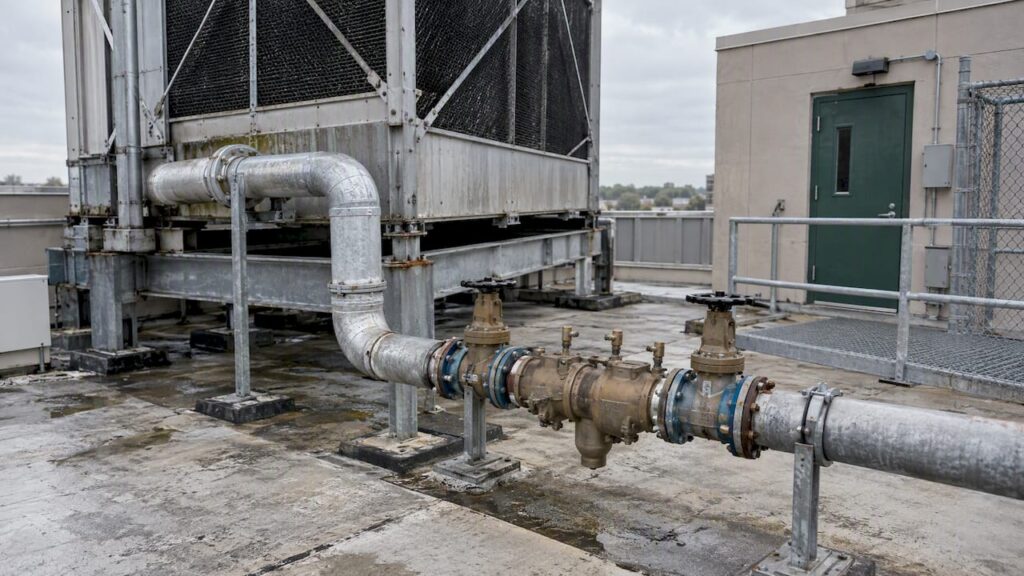
If your New Jersey building has a cooling tower fed by the public water supply, the make-up water line needs a backflow preventer. That device is usually a reduced pressure zone (RPZ) assembly. It has to be installed where it cannot pull tower vapor back in, tested by a qualified tester, and reported to the right authority. Your local water purveyor may add rules on top of the state’s. This guide covers each step in the order a property owner or manager meets it.
TL;DR
- A cooling tower is a contamination risk to drinking water. Warm, moist conditions can grow slime and algae that harbor organisms such as Legionella, so the potable make-up line must be isolated.
- New Jersey rules name two approved devices, a double check valve assembly (DCVA) or an RPZ. An RPZ is mandatory when the other water source is non-potable or exceeds contaminant limits.
- Test frequency depends on which rule applies to you. The plumbing code calls for annual tests, and NJDEP physical connection permits can call for testing every three months.
- A failed device must be repaired or replaced. Replacement needs a permit, and the NJDEP form calls for a retest within 30 days.
- Backflow rules and Legionella control are separate obligations. Passing a backflow test does not cover your water management program.
Table of Contents
- Why a cooling tower needs backflow protection
- Which New Jersey rules apply
- Which device you need: DCVA or RPZ
- How often to test
- Who can test, and what the test report must show
- If the device fails
- Backflow protection is not Legionella control
- Our perspective
- What testing and repair cost
- Book testing, repair and filing in one visit
- A compliance checklist for tower owners
- FAQ
- Sources
Why a cooling tower needs backflow protection
A cooling tower rejects heat by evaporating recirculating water. It is topped up continuously from the building’s potable supply. That makes it a direct link between a system full of treated, warm, sometimes stagnant water and the drinking water line. If pressure in the supply drops, for example during a main break or heavy fire flow, water in the tower can be siphoned backward into the supply.
The Foundation for Cross-Connection Control and Hydraulic Research at USC explains that contaminated water or vapor can be drawn into the water supply, and that warm, moist conditions foster slime and algae that may harbor harmful organisms such as Legionella. The same document notes that make-up lines need protection, often an RPZ assembly when connected to pressurized recirculating systems.
The New Jersey Department of Health says neglected cooling towers can facilitate Legionella growth. Bacteria can then spread through aerosolized water droplets and cause Legionnaires’ disease. Backflow protection does not stop that on its own, but it keeps the tower’s water out of the supply that serves everyone else in the building and on the street.
Which New Jersey rules apply
Three layers apply to most cooling towers: NJDEP’s physical connection rules, the state plumbing code, and your local water purveyor.
NJDEP physical connection rules
Under N.J.A.C. 7:10-10.1, NJDEP requires a permit, design and testing of a backflow prevention device for facilities where a public community water system is physically connected to an unapproved water supply. NJDEP’s regulatory guidance defines a physical connection broadly: any cross-connection, bypass, valve, pipeline, auxiliary intake or device that permits or may permit water to flow from an unapproved supply into the approved public potable supply.
Whether your tower triggers a state permit depends on how it is connected and what else is on the property. If you are unsure, ask the purveyor or the tester who inspects the site.
Your water purveyor
The purveyor is often the first party to ask for proof of a test. Under N.J.A.C. 7:10-10.9, a public community water system may require customers to install backflow prevention on service lines when a facility threatens water quality. NJDEP guidance adds that purveyors can impose requirements for cross-connection control by containment beyond the state minimums. So the paperwork, forms and deadlines can differ between two towers a few miles apart. Our Atlantic City backflow guide shows how local filings sit on top of state rules in one city.
The plumbing code
The Department of Community Affairs addresses testing in Bulletin 99-2. Plumbing subcode officials do not perform the tests. The facility owner must have a qualified individual do it and submit certification.
Which device you need: DCVA or RPZ
N.J.A.C. 7:10-10.3 requires an approved physical connection installation to be either a double check valve assembly or a reduced pressure zone backflow preventer. The deciding factor is the hazard level. An RPZ is mandatory when the unapproved source is non-potable or exceeds maximum contaminant levels set by state regulation.
| Factor | DCVA | RPZ |
|---|---|---|
| Approved under N.J.A.C. 7:10-10.3 | Yes | Yes |
| Use where the other source is non-potable or above contaminant limits | Not permitted | Required |
| Typical cooling tower make-up line | Rarely chosen | Commonly specified |
| Relief valve that discharges on a failure | No | Yes, so it needs drainage |
Because a tower’s recirculating water is treated with chemicals and can carry biological growth, treat it as a high hazard unless your purveyor tells you otherwise. Confirm the device type with the purveyor before you buy hardware.
Placement matters
The USC foundation also warns that placing a protective device inside the cooling tower enclosure can allow contaminated vapors to be siphoned back into the supply line. Keep the preventer outside the tower and in a spot where an RPZ relief valve can discharge safely and the device is reachable for testing.
A few practical points we check on site:
- Clearance around the assembly so a tester can reach every test cock and shutoff.
- Drainage for relief discharge, so a spitting RPZ does not flood a mechanical room.
- Freeze protection if the device is outdoors. Our enclosure requirements page explains what the rules say, and a custom enclosure can protect the assembly from weather and tampering.
- A permit for any replacement. See what to file for a replacement permit.
How often to test
Two rules matter here, and they do not say the same thing.
Bulletin 99-2 says testable devices that isolate contaminants must be tested before final inspection and annually, except in one- and two-family dwellings. That is the baseline for a commercial or institutional tower.
For physical connection permits, N.J.A.C. 7:10-10.6 requires testing for tightness under prevailing pressure conditions at least once every three months for existing permits, and before initial installation.
If your site has an NJDEP physical connection permit, read its conditions and plan on the stricter schedule. If it does not, annual is the code floor, and your purveyor may still ask for more. When in doubt, ask for the schedule in writing.
Who can test, and what the test report must show
The test must be done by a qualified individual, and NJDEP’s form requires the signature of a certified backflow prevention device tester. A building inspector will not do it for you. Under Bulletin 99-2, the inspector may witness the test or have you submit certification.
That certification must identify:
- The device type and location.
- The test date and results.
- The tester’s name, qualifications and signature.
NJDEP’s Form BWSE-CITR-IQ, updated in 2022, is used to certify inspection and test results for backflow prevention devices. Your purveyor may also require its own form or portal upload, so ask who receives the report before the tester arrives.
What test day looks like
The tester isolates the assembly, connects a test kit to the test cocks and checks that the check valves hold and the relief valve opens at the right pressure differential. Plan for a short water interruption to the tower’s make-up line. Schedule it when the tower can run on its basin volume, or when load is low. Clear access, a known shutoff location and a drain make the visit quicker.
If the device fails
A failed assembly must be repaired or replaced, and Bulletin 99-2 requires a permit for all replacements. The NJDEP form calls for a retest within 30 days of the failure.
Most failures are fouled or worn check valves, torn seats or a leaking relief valve. A rebuild with the manufacturer’s parts is often enough. Replacement makes sense when the body is corroded, the model is obsolete or the size no longer matches the demand. We stock OEM parts so most repairs and rebuilds can be done in the same visit. If you have already received a notice, our page on what to do after a backflow violation notice walks through the response.
Backflow protection is not Legionella control
The backflow preventer protects the public supply. It does nothing for the quality of water inside your tower. Those are separate duties.
The New Jersey Department of Health recommends offline cleaning and disinfection of cooling towers at least annually. It also advises consulting a water treatment professional on Legionella testing frequency, suggesting a minimum of every three months while the tower operates. Its building water management pamphlet lists large, complex water systems, including those with cooling towers, as higher risk because of stagnant water and low disinfectant levels.
A sensible schedule lines up the two. Many owners book the backflow test around the same time as the annual tower shutdown and cleaning, so the make-up line is already isolated and accessible.
Our perspective
Most of the cooling tower calls we get follow the same pattern. The tower has been running for years, the preventer was installed by whoever built the mechanical room, and nobody has the paperwork. The purveyor sends a letter and the owner has a short deadline.

We see three avoidable problems. First, the device is the wrong type or sits in a spot where nobody can test it. Second, the test was done but never filed, so the purveyor’s records show nothing. Third, a failed test sits for months because the owner is waiting on a quote. A tester who can also rebuild on the spot and file the report removes most of that delay, which is why we do all three.
Our advice: find out who your purveyor is, ask what they require for cooling towers, and put the test and the Legionella tasks on one calendar. Do it before a letter arrives, not after.
— Jordan
What testing and repair cost
Our published ranges are on our pricing FAQ. Commercial device testing runs $200–$450 per device. Residential rebuild kit service is $125–$250, and a protective enclosure installation is $200–$500. A cooling tower is a commercial job, so the commercial range applies. Final cost depends on device size, access and condition. Our budget guide for property managers shows how to plan this across several buildings.
Book testing, repair and filing in one visit
We test and certify backflow preventers on commercial, multi-unit and residential properties across New Jersey. We also rebuild and repair them, install enclosures and file test reports directly with the water authority. We are family-owned, licensed and insured, and we offer same-day service where schedules allow.
To schedule a cooling tower backflow test, start with our testing and certification page or contact us with your address and your purveyor’s name. Managing several properties? Read how we confirm filing for property managers. Other plant types face their own rules too, as in our manufacturing backflow guide.
A compliance checklist for tower owners
- Identify your water purveyor and ask for its cross-connection control requirements in writing.
- Confirm whether an NJDEP physical connection permit applies to your site.
- Verify the device type (RPZ or DCVA) and that it sits outside the tower enclosure with clear access and drainage.
- Hire a certified tester and set the test schedule that matches your permit or code.
- Make sure the report goes to the purveyor, using its required form or portal.
- Repair or replace any failed device, pull a permit for replacements and retest within 30 days.
- Keep Legionella cleaning and testing records separate and current.
FAQ
Does every cooling tower in New Jersey need an RPZ?
Not by name. State rules approve a DCVA or an RPZ, and require an RPZ when the unapproved source is non-potable or exceeds contaminant limits. Cooling tower water usually falls in that category, and your purveyor may specify the device. Confirm with it before purchasing.
How often does a cooling tower backflow preventer need testing?
The plumbing code calls for testing before final inspection and annually for testable devices that isolate contaminants. NJDEP physical connection rules call for testing at least every three months for existing permits. Check which applies to your site and what your purveyor requires.
Can the building inspector test the device?
No. Under Bulletin 99-2, plumbing subcode officials do not perform the tests. The owner hires a qualified tester who submits certification showing the device, results and the tester’s credentials.
What happens if the preventer fails its test?
It must be repaired or replaced. Replacements require a permit, and NJDEP’s form calls for a retest within 30 days of the failure. Book the repair quickly, because the clock starts at the failed test.
Does a passing backflow test satisfy Legionella requirements?
No. They are separate. The Department of Health recommends annual offline cleaning and disinfection and regular Legionella testing with a water treatment professional.
Sources
- Cooling Towers, Foundation for Cross-Connection Control and Hydraulic Research, USC
- Cooling tower operator letter, New Jersey Department of Health
- Building water management pamphlet, New Jersey Department of Health
- NJDEP regulatory guidance: physical connection permit
- N.J.A.C. 7:10-10.9, cross-connection control by containment
- N.J.A.C. 7:10-10.3, approved physical connection installations
- N.J.A.C. 7:10-10.6, inspection and testing
- Bulletin 99-2, New Jersey Department of Community Affairs
- Form BWSE-CITR-IQ, NJDEP
Pingback: RPZ Drain Requirements in NJ: Air Gap, Height and Code