
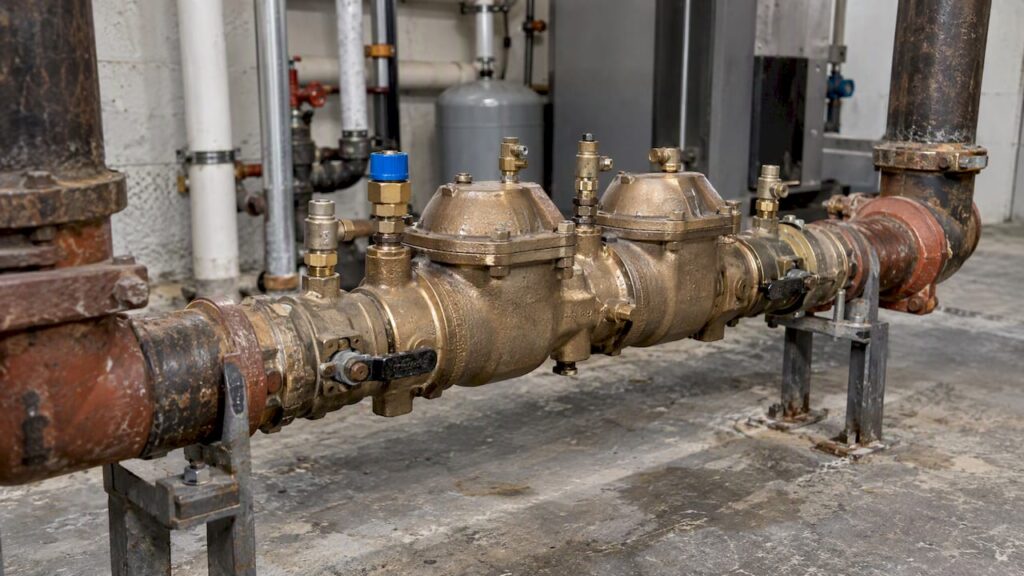
If you own or manage a property in Newark, backflow testing is governed by two layers of New Jersey rules plus the city’s own water department. The state sets who needs a permit, how often devices are tested and who may test them. The Department of Community Affairs (DCA) sets annual testing for many building-code devices. Newark’s Water and Sewer Department approves work on water connections. Below is how those pieces fit together, what to file, and what to do when a device fails.
TL;DR
- Devices under an NJDEP physical-connection permit must be tested at least every three months by a certified tester. Private residences do not need that permit.
- Field-testable devices protecting against contamination, such as irrigation, fire-protection and boiler lines, must be tested before final inspection and then annually under DCA guidance.
- The test report goes to the administrative authority and your water supplier within five days, and records stay on site.
- A failed device must be repaired or replaced. Replacement needs a permit, and fire-line devices must be approved for fire service.
- Newark requires city Water and Sewer Department approval before work that affects its water system, so check before you swap a device.
Table of Contents
- Why Newark owners deal with state rules first
- Which Newark properties need backflow protection and testing
- How often you have to test
- Who is allowed to test
- Reporting: the five-day rule and what the report must show
- The Newark layer: city approval and standard details
- What if the test fails
- What happens if you miss a test or a deadline
- Our perspective
- What testing and repairs cost
- Need a Newark test or a repair?
- Frequently asked questions
- Sources
Why Newark owners deal with state rules first
Backflow is the reverse flow of water or other substances into the public supply. Preventers (double-check valve assemblies and reduced-pressure-zone assemblies) keep that from happening. In New Jersey, the main rulebook is the Safe Drinking Water Act rules, N.J.A.C. 7:10. They define a physical connection as a link between a public community water system and an unapproved water supply, and they name double-check valve and reduced-pressure-zone assemblies as the covered devices.
We get this question often from Newark readers: is there a separate city testing ordinance? What we can point to is the state framework, the DCA guidance that building inspectors apply, and Newark’s own permitting and design documents. Your water supplier and the local construction official are the final word on your specific connection, so confirm with them before you set a schedule.
Which Newark properties need backflow protection and testing
The answer depends on what your building does with water, not just where it is.
Facilities with an unapproved water supply
NJDEP requires a physical-connection permit for a facility that contains an unapproved water supply and connects to a public community water supply. Permits are not required for private residences. The covered devices generally sit where public-supply lines enter the facility, near domestic meters, and before fire-line alarm-check and siamese connections.

The logic is containment: stop a questionable supply at the point where it could enter the public system.
Buildings with cross-connection hazards
Much more common in Newark is the building that has no second water source but does have equipment that could contaminate drinking water. DCA Bulletin 99-2 says field-testable backflow preventers isolating cross-connections between potable water and contaminants must be tested before final inspection and annually. Its examples include:
- irrigation systems
- fire-protection systems
- laboratories
- chemical and industrial plants
- boilers
- hospitals
- wastewater-treatment plants
If you manage apartments, a warehouse, a school or a mixed-use building with a lawn sprinkler, a fire sprinkler riser or a boiler feed, you likely own at least one device that falls here. Manufacturers have their own wrinkles, which we cover in our guide to manufacturing backflow requirements in NJ.
Single-family homes
Homes are outside the physical-connection permit. But a house with a lawn irrigation system or a fire sprinkler system commonly has a device that needs annual testing, and utilities and local officials can require it. Our residential backflow guide for New Jersey homeowners walks through the device types.
How often you have to test
There are two clocks, and owners often mix them up.
| Situation | Testing interval | Source |
|---|---|---|
| Device under an NJDEP physical-connection permit | Tightness test at least every three months | N.J.A.C. 7:10-10.6 |
| Field-testable device isolating a contamination hazard (DCA) | Before final inspection, then annually | DCA Bulletin 99-2 |
| Internal inspection, permitted devices | Generally within six months before permit renewal | N.J.A.C. 7:10-10.6 |
The permit rule has two exceptions. A reduced-pressure-zone assembly has its own exception on the internal inspection. And NJDEP can approve a reduction for a facility that is not operating during a calendar quarter. NJDEP confirms on its certified tester page that each permitted device must be tested quarterly by a certified tester.
For most Newark buildings that are not under a permit, the annual test is the one to calendar. Ask your water supplier whether it asks for a more frequent schedule.
Who is allowed to test
The state rule is specific. Under N.J.A.C. 7:10-10.6, testing must be done by one of two people:
- A certified tester holding a valid certificate from an NJDEP-approved certifying agency.
- An authorized representative of the facility owner, in the presence of an authorized representative of the administrative authority or water supplier.
NJDEP publishes the approved certifying agencies and points users to them for the current list of certified testers. Check that list before you hire anyone. DCA adds that building inspectors may not perform the test for you: the owner must use a qualified individual.
A plumber’s license alone is not the test. The tester’s certification is what the paperwork depends on.
Reporting: the five-day rule and what the report must show
The owner must send the Quarterly Physical Connection Test and Maintenance Report to the administrative authority and the water supplier within five days. NJDEP’s test and maintenance form repeats that copies must be submitted within five days of each test and inspection, and that records are kept at the facility and shown on request.
For a DCA-type annual test, the certification submitted should identify:
- the device type and location
- the test date
- the result
- the tester’s name, qualifications and signature
A tester who files for you saves the most common failure point: a passing test that never reached the right office. If you manage several buildings, our page on confirming backflow filing for property managers explains how we track it.
The Newark layer: city approval and standard details
Newark’s Water and Sewer Department publishes a backflow-preventer detail, plus separate domestic reduced-pressure-zone and double-check-valve connection schematics, among its forms and standard details. If you are installing or replacing a device, your installer should build to those drawings.
The city also states on its permits and prices page that work directly or indirectly affecting the public water or sewer systems, including work involving water connections, needs Water and Sewer Department approval. A device swap on a service line can fall under that, so ask before the work starts, not after.
What if the test fails
A failed device must be repaired or replaced. DCA’s Bulletin 99-2 adds two points:
- Replacement requires a permit.
- A device on a fire-protection system must be approved for fire-protection service and must not reduce the fire system’s effectiveness.
A sensible sequence:
- Get the failed-test report in writing with the reading and the failed component.
- Ask whether a rebuild (new seats, springs, discs, check assemblies) will restore the device, or whether it is past repair.
- If replacing, confirm the permit and the city approval, then retest the new device.
- File the passing report within the reporting window.
See our guides on the replacement permit and on what to do after a violation notice.
What happens if you miss a test or a deadline
The state’s enforcement tools are broad. Under N.J.A.C. 7:10, the Department may issue an order requiring compliance, bring a civil action for injunctive relief, and assess civil administrative penalties. Violations are rated by seriousness, and the rule treats anything with potential for serious harm to human health as major. The rules also set out how penalties are noticed, assessed and settled.
In practice, the first sign is usually a notice from the water supplier or an inspector. Beyond penalties, a lapse can hold up a certificate or a final inspection. We do not publish a Newark fine schedule because we cannot support one. Ask your supplier what it applies.
Our perspective
Most of the trouble we see in Essex County is not a failed device. It is paperwork: a good test that was never filed, a device nobody knew was on the property, or a replacement done without a permit. Backflow preventers are mechanical parts with rubber and springs. They wear out, and a freeze or a pressure surge can foul one overnight.

Our advice is to treat the test as a routine, not an emergency. Put each device on a calendar, have one certified tester handle the test and the filing, and stock the repair parts so a failed check valve is fixed in the same visit. We carry OEM parts for that reason. A same-visit rebuild avoids the second trip and the second wait for a retest.
For managers with several buildings, ask for one consolidated report and one invoice. It is much easier to audit.
— Jordan
What testing and repairs cost
These are the prices published on our FAQ:
| Service | Published price |
|---|---|
| Annual residential certification test | $150 to $250 |
| Commercial device testing | $200 to $450 per device |
| Rebuild kit service (residential) | $125 to $250 |
| Protective enclosure installation | $200 to $500 |
| Residential installation | $300 to $800 |
Rebuilds and repairs for commercial devices are quoted by device. Our budget guide for property managers shows how to plan across a portfolio.
Need a Newark test or a repair?
We are licensed and insured, family-owned, and serve New Jersey statewide, including Essex County. We test, certify, rebuild, install enclosures and file reports with the water authority. See our backflow testing and certification service or contact us to schedule.
Frequently asked questions
Does my Newark home need backflow testing?
A private residence does not need an NJDEP physical-connection permit. But if your home has an irrigation system or a fire sprinkler system, its device is a cross-connection protector that DCA guidance expects tested annually. Check with Newark’s water department or your construction official.
How often does a Newark backflow preventer need testing?
Under an NJDEP permit, at least every three months. For field-testable devices under DCA guidance, before final inspection and then annually. Your supplier may ask for more.
Can I test my own device?
Only an authorized owner representative may do so, and only in the presence of a representative of the administrative authority or water supplier. Otherwise you need a certified tester from an NJDEP-approved certifying agency.
Where do I send the test report?
To the administrative authority and your water supplier, within five days of the test. Keep a copy at the facility, since it can be requested on inspection.
Do I need a permit to replace a failed device?
Yes. DCA says replacement requires a permit, and a device serving fire protection must be approved for that service. Newark also requires city approval for work affecting its water connections.
Sources
- NJDEP Physical Connection Permit Processing
- N.J.A.C. 7:10 Safe Drinking Water Act rules
- N.J.A.C. 7:10-10.6 Inspection and testing
- NJDEP Certified Backflow Prevention Device Testers
- NJDEP Test and Maintenance Report form
- DCA Bulletin 99-2
- City of Newark Forms and Standard Details
- City of Newark Permits and Prices
Pingback: Backflow Testing After a Building Shutdown: NJ Guide
Pingback: How to Find Your Backflow Preventer's Serial Number