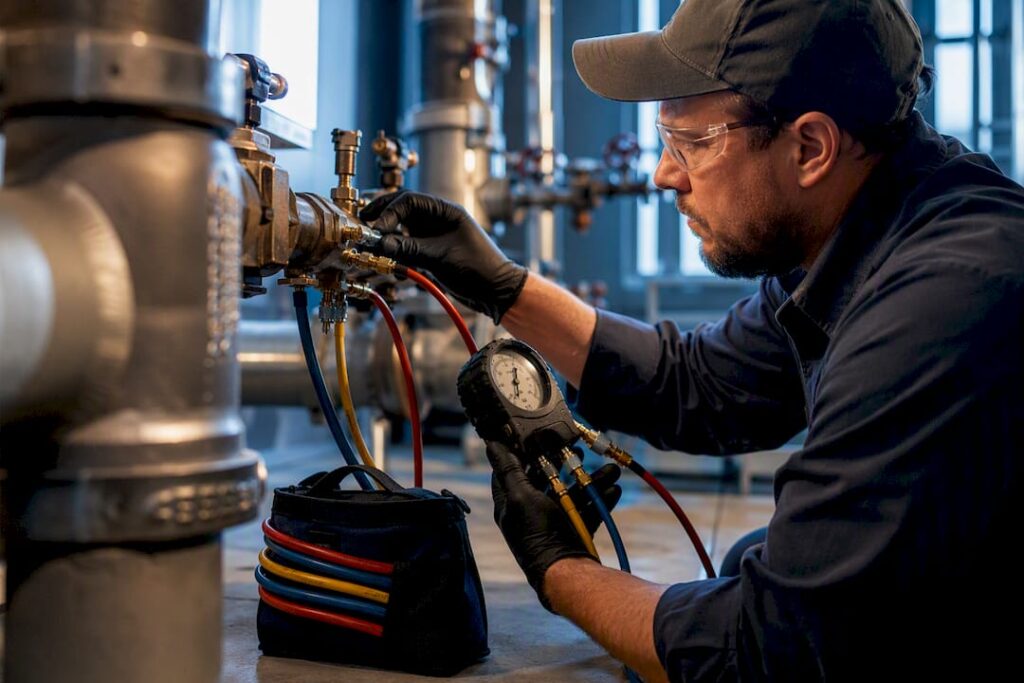
Three things determine whether your school passes a backflow inspection: a complete inventory of every device on campus, testing done annually plus after any install, repair, or incident, and paperwork filed with your water authority before anyone asks for it. School backflow compliance breaks down when one of those three slips, usually the paperwork. Start there, then work backward through your device list.
TL;DR:
- Regular testing must be completed annually, but high-hazard devices like irrigation RP assemblies may require semiannual checks depending on local water authority requirements.
- Proper documentation submission to the water authority is critical, and delays or failures in reporting from school staff often cause violations rather than equipment faults.
- Certified testers need current calibration proof for their gauges and valid state or local credentials; unverified certification can lead to inaccurate test results.
- Schools should maintain a centralized, accessible device registry and assign a dedicated compliance owner to prevent missed testing or report filings.
- Seasonal systems like irrigation lines should be checked and documented before being reactivated in spring to avoid inspection violations caused by oversight.
Table of Contents
- Which Campus Systems Need Backflow Protection?
- How Often Must Schools Test Backflow Assemblies?
- Who Is Qualified to Test Backflow Devices at a School?
- Building a Compliance Checklist Schools Can Actually Follow
- What South Jersey Backflow Sees Going Wrong at Schools
- How South Jersey Backflow Supports School Compliance Programs
- Where to Verify Local Backflow Rules
- Sources
Which Campus Systems Need Backflow Protection?
Every point where a hose, pipe, or fixture connects to a non-potable source or a chemical is a cross-connection risk, and schools tend to have more of these than a typical commercial building. A cafeteria kitchen, a science lab with acid traps, and an irrigation system for the football field all pose different levels of hazard, and the assembly required scales with that hazard.
The systems that most often get flagged during a school backflow compliance review include:
- Irrigation and athletic-field connections — fertilizer and pesticide exposure make these high-hazard, typically requiring a reduced-pressure (RP) assembly.
- Fire-service lines — sprinkler systems need fire-service backflow assemblies sized for high flow without restricting pressure during an emergency.
- Kitchens and cafeterias — dishwashers, grease traps, and chemical dispensers create moderate to high hazard depending on the connection.
- Science labs — acid-neutralization systems and lab sinks are almost always treated as high-hazard.
- Boilers and mechanical rooms — glycol and treatment chemicals mean these lines need dedicated protection, not just a single check valve.
- Maintenance hose stations and custodial closets — often overlooked, these low-visibility connections are exactly the kind that fail an inspection nobody saw coming.
The assembly you install depends on that hazard rating. A double-check valve (DC) works for low-hazard, non-toxic connections. A reduced-pressure principle assembly (RP) is required wherever a backflow could introduce a health hazard, which covers most irrigation and lab connections. Atmospheric vacuum breakers (AG-type) handle simpler, non-continuous-pressure situations like hose bibs. Fire lines get their own detail assemblies rated for the system’s flow demand.
Placement matters too. Containment at the water service protects the public main from anything happening inside the building, while internal isolation protects specific zones (the kitchen, the lab wing) from each other. Many schools need both, and each protected zone gets logged and tested separately.
How Often Must Schools Test Backflow Assemblies?
Annual testing is the floor, not the ceiling, for cross-connection control programs, and EPA’s own guidance for schools echoes that same once-a-year minimum for backflow prevention devices. Some water purveyors require semiannual testing for high-hazard connections like RP assemblies on irrigation systems, so check your local program before assuming the annual baseline applies to every device on your list.
Pro Tip: Pull your water purveyor’s specific testing frequency in writing before budgeting for the year. A verbal answer from a customer-service line isn’t something you can point to during an audit.
Beyond the calendar, several events trigger an immediate retest regardless of when the last one happened:
- New installation of any backflow assembly.
- Repair or rebuild of an existing assembly.
- Relocation of the device, even a few feet.
- Any depressurization event on that line (a water main break nearby, for example).
- A known or suspected backflow incident, which typically requires notifying the water authority the same day.
Repair windows are tighter than most facility teams expect. Program guidance commonly gives 10 to 30 days to fix a failed assembly and retest. However, enforcement authorities can shorten that window or terminate water service for a device left in failed status. A test report generally includes the assembly’s make, model, and serial number, static line pressure, and pass/fail readings for each check and relief valve. Some jurisdictions let the certified tester submit directly to the public water system; others expect the facility to file it. Either way, someone on your team needs to confirm which report actually reached the authority, not just that a tester showed up and did the work.
Who Is Qualified to Test Backflow Devices at a School?
A test result only counts if the person who performed it holds the right credential, and the credential requirements are set by the state or local program, not by the tester’s own business card. Look for one of these before you book anyone:
- State-authorized Backflow Prevention Assembly Tester (BPAT) certification.
- American Water Works Association (AWWA) cross-connection control section certification.
- American Backflow Prevention Association (ABPA) certification, where your local program recognizes it.
- Direct authorization or registration with your local public water system.
Certification alone isn’t enough. Testers use calibrated field gauges, and a gauge that’s out of calibration can produce a passing result on a device that’s actually failing. Ask for proof of calibration within the last 12 months before the test date, not after you’re questioning a result.
Pro Tip: Keep the tester’s certificate number and gauge calibration date in the same file as the test report. If your water authority ever audits a specific test, you want both documents in hand within minutes, not days.
Verifying a tester takes five minutes: ask for the certification number, cross-check it against your local water system’s published tester list if one exists, and get a written certificate rather than a verbal assurance. A tester who can’t produce a certificate number on request is a red flag worth walking away from.
Building a Compliance Checklist Schools Can Actually Follow
A checklist only works if it lives somewhere your team checks regularly, whether that’s a CMMS, a shared spreadsheet, or a wall calendar in the facilities office. The structure matters more than the tool.
Build the registry first. For every device, log the type (DC, RP, AG, fire-service), exact location, hazard rating, last test date, and next due date. This single document is what most schools are missing when an audit request lands, according to common patterns in cross-connection program enforcement.
Assign one owner. Someone specific, not “facilities,” needs to own scheduling, vendor communication, and filing confirmation. Split ownership is how test cycles get missed.
Set both calendar and event triggers. Annual testing goes on the calendar for every device; installation, repair, winterization, and incident triggers get built into your maintenance workflow so they fire automatically rather than depending on someone remembering.
Follow a consistent remediation sequence when a device fails:
- Device fails testing.
- Notify the water authority per your local program’s timeline.
- Complete repair or rebuild within the regulatory window.
- Retest the assembly.
- File the passing report.
- Archive both the failed and passing reports together.
A downloadable version of this kind of checklist can save your team from rebuilding the format from scratch every school year.
What South Jersey Backflow Sees Going Wrong at Schools
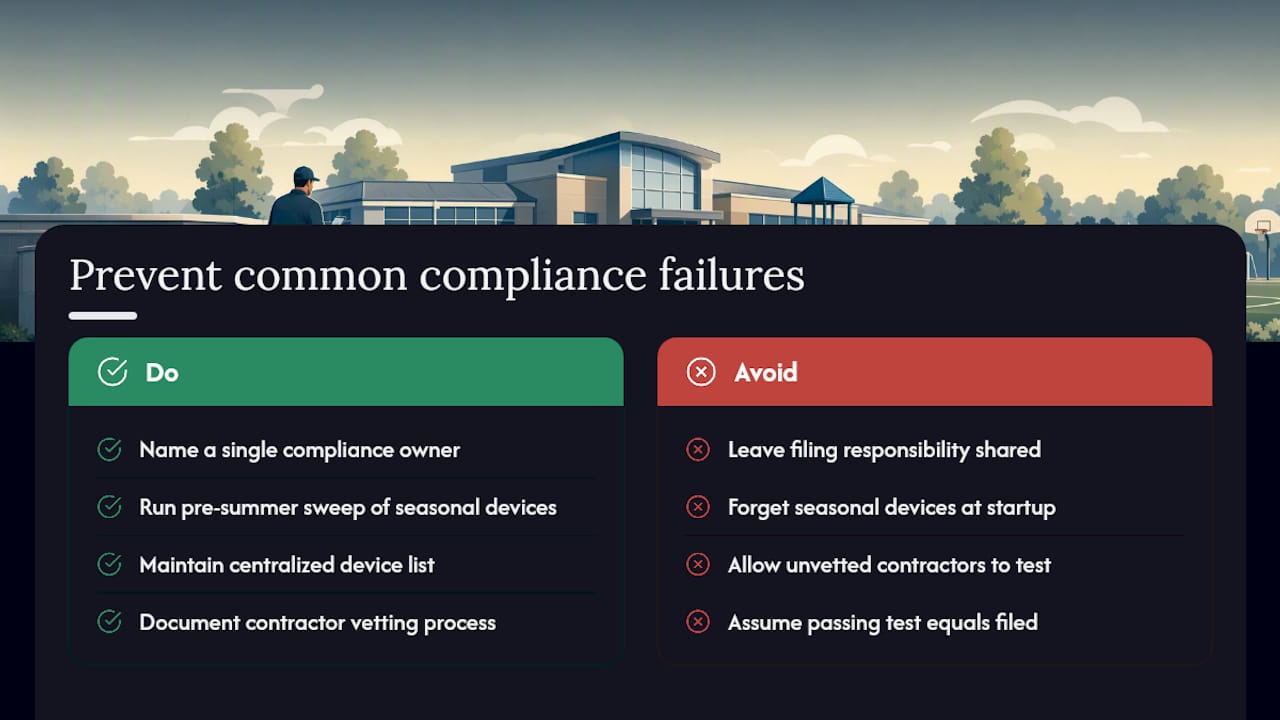
The most common failure isn’t a broken device. It’s a missing filing. A test gets performed, the assembly passes, and the report never reaches the water authority because nobody confirmed who was responsible for submitting it. Administrative gaps like this cause about as many violations as actual equipment failure, which is why we push every school client to name a single compliance owner rather than leaving it as a shared responsibility across facilities and business office staff.
Seasonal systems are the other recurring blind spot. Irrigation lines and athletic-field connections get shut down for winter and forgotten during spring startup, right when a depressurization event during the off-season would have triggered a retest requirement. Schools that run a pre-summer sweep of every seasonal device, checking each one against the registry before turning water back on, catch these gaps before an inspector does. A centralized device list and a documented contractor vetting process, checking certification and calibration proof before any tester steps on campus, fix most of what we see flagged during reviews.
— Jordan
How South Jersey Backflow Supports School Compliance Programs
Some service providers handle the parts of this checklist that eat the most staff time: testing, repair and rebuild work, emergency service when a device fails unexpectedly, and direct filing of test reports with the water authority so nothing sits waiting on a desk. For a school running multiple buildings and seasonal systems, some providers can also build the device registry itself and set up a scheduled testing program tied to your academic calendar, so irrigation and athletic-field assemblies get tested before spring startup instead of after a violation notice arrives.
If your school already has a device list, that’s the fastest starting point for a quote. If you don’t, tell us your building count and approximate device types (irrigation, fire service, kitchen, lab) and we’ll build the inventory as part of the first engagement. From there, a typical first year covers a full campus sweep, the annual test cycle, and report filing, so your team has one contact rather than juggling multiple vendors. Start by requesting testing and certification for your New Jersey campus and we’ll map out what your specific buildings need.
Where to Verify Local Backflow Rules
Federal guidance sets the baseline: the Safe Drinking Water Act treats cross-connection control as core to public water safety, and EPA’s school-specific best practices recommend annual device testing alongside outlet-level flushing. Beyond that, your state’s cross-connection control program page holds the specifics that actually govern your campus: approved assembly lists, hazard classification rules, and testing frequency requirements. Many local water purveyors, Portland’s backflow prevention program is one example, publish their own tester lists and submission forms directly on their utility website. Check your purveyor’s site before assuming statewide rules apply exactly as written to your district.
Sources
- Safe Drinking Water Act (EPA)
- Drinking Water Best Management Practices for Schools and Child Care Facilities (EPA)
- Cross-Connection Control Policy Handbook (State Water Boards/CCCPH)
- Establishing and Managing an Effective Cross-Connection Control Program (TCEQ RG-478)