
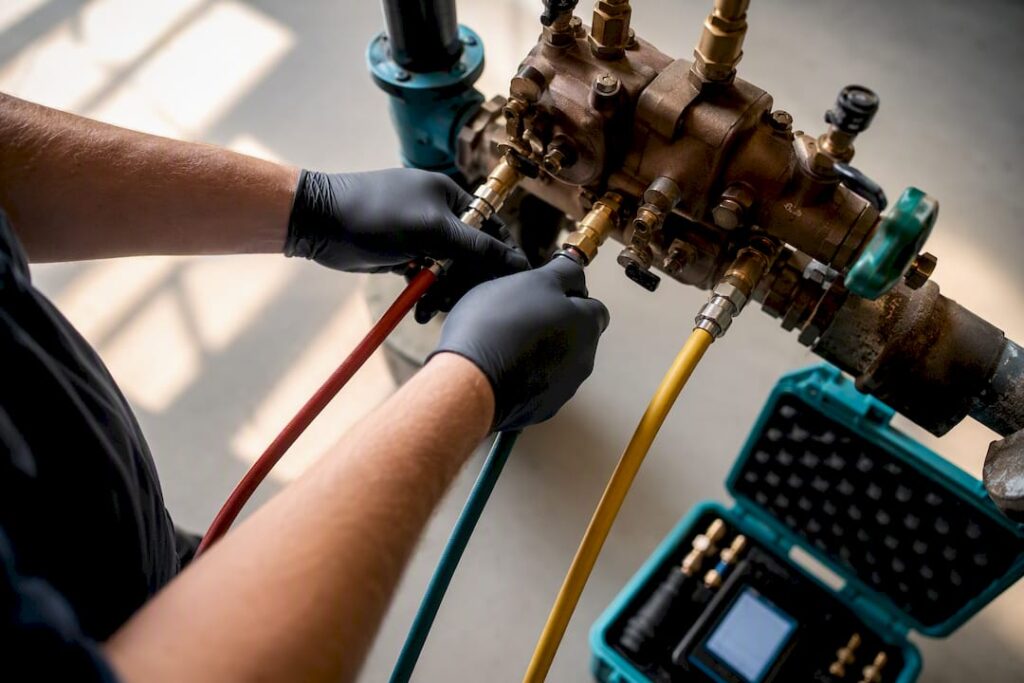
Yes — after any repair or adjustment to a backflow prevention assembly, a certified retest and a filed passing report are required before the device counts as recertified. Schedule the retest as soon as repairs finish, and keep copies of both the failed and the passing reports. Testers work under credentials like ABPA and ASSE, following field procedures set by the USC Foundation for Cross-Connection Control.
TL;DR:
- A certified tester must conduct a retest with calibrated equipment and produce a signed, dated report to validate the repair before recertification.
- Water authorities typically require filing the passing test report within 5 to 10 business days of the failed test to avoid fines or water shutoff notices.
- Only certified backflow assembly testers can perform the retest; unqualified personnel or general plumbers are not legally authorized.
- Property owners usually bear the costs for repair and retest, which can include parts, labor, testing fees, and possible filing fees, depending on lease terms and local rules.
- Repair is advisable for isolated issues with available parts, while replacement is recommended for recurring failures, corrosion, or obsolete devices.
Table of Contents
- What to Do Right After a Backflow Repair
- Who Can Legally Perform the Retest?
- How Fast Do You Need to File the Report After Retest?
- Who Pays for the Repair and the Retest?
- Repair or Replace: How to Decide
- South Jersey Backflow’s Practical Checklist for Repair and Retest
- Backflow Retest After Repair: What Actually Matters Most
- Get Your Backflow Assembly Retested and Filed, Fast
- Sources
What to Do Right After a Backflow Repair
The clock starts the moment your assembly fails its test, not when the repair gets finished. Here’s the sequence that keeps you out of trouble with your water purveyor.
- Pull the failed test report. Read exactly what part failed. A stuck check valve, a leaking relief valve, and a corroded seat all point to different repairs, and knowing the specifics before you call anyone saves a diagnostic trip.
- Call a certified tester fast. Many utilities give property owners a repair-and-retest window as narrow as 5 to 10 business days once a failure is logged. Waiting a week to make a phone call can burn through most of that window before a wrench even touches the device.
- Let the tester run the retest with calibrated gauges. They’ll verify both check valves, confirm the relief valve opens at the correct differential, and check for proper seating. This isn’t a visual inspection. It’s a pressure-differential test performed with equipment carrying a current calibration date.
- Expect a short water shutoff. Testing an assembly means isolating it from the line, so plan for a brief interruption, usually a matter of minutes, not hours.
Once the assembly passes, ask for these on the spot:
- A copy of the passing test report with readings recorded
- The tester’s certification number and signature
- Confirmation of when the report will be filed with your water authority
Don’t leave the property without that paperwork in hand, even if the tester says they’ll email it later. Verbal promises don’t hold up if a compliance letter shows up in your mailbox two months from now.
Who Can Legally Perform the Retest?
Only a certified backflow assembly tester can perform a legally recognized retest. This isn’t a job for your regular maintenance staff or a general plumber without the specific credential, no matter how competent they are with pipes.
Certification programs run through bodies like ABPA and ASSE set the training and exam bar, and ASSE 5110 and 5130 specifically define competency standards for testers and repairers, including certification renewal periods. Before you accept a report as valid, ask for:
- The tester’s certification number and expiration date
- The test gauge’s serial number and most recent calibration date
- A signed and dated report matching your device’s serial number or asset tag
- Recorded pressure readings, not just a pass/fail checkbox
Certification requirements vary by state and even by water purveyor. Some jurisdictions accept any nationally recognized certification; others maintain their own local registry of approved testers. A quick call to your water authority before scheduling saves you from finding out too late that your tester’s credential isn’t on their accepted list.
How Fast Do You Need to File the Report After Retest?
Timelines are where most compliance failures actually happen, not in the mechanical repair itself. Property owners assume a passing test is the finish line, when filing the paperwork is what actually closes out the violation.
Common patterns you’ll run into:
- Many utilities set a combined repair-and-retest window of 5 to 10 business days from the original failed test date.
- Public water systems generally require testing immediately after any repair or relocation, in addition to the standard annual test cycle, under guidance like TCEQ’s cross-connection control program.
- Most certified testers submit the passing report directly to the water authority, but you should still request your own copy and retain it. Agencies commonly keep records for at least three years, and you want your own file matching theirs if a dispute ever comes up.
Miss the window, and consequences escalate quickly: continued noncompliance status, administrative fines, and in some jurisdictions a formal service notice or threatened water shutoff. None of that is reversible with a phone call once it’s triggered.
Pro Tip: Ask your tester for a written confirmation the day they file, not just a verbal “it’s submitted.” Utilities occasionally lose or misfile reports, and a timestamped confirmation email is your proof the deadline was met on your end.
If you’ve already received a compliance notice, the clock is running differently than a routine annual cycle. See what steps apply if you’ve gotten a backflow letter in New Jersey.
Who Pays for the Repair and the Retest?
Repair costs break down into a handful of predictable line items: a diagnostic or trip fee, replacement parts, labor, and the retest fee itself. Some water authorities also charge a small filing fee to process the passing report.
Responsibility usually follows ownership, but not always cleanly:
- Property owners are typically on the hook for repair and retest costs on assemblies they own.
- Commercial lease agreements sometimes shift responsibility to the tenant, particularly for interior fire or irrigation lines, so check the lease language before assuming.
- Maintenance contracts covering multiple properties can bundle backflow service into a flat annual fee, which smooths out the unpredictability of repair timing.
Bundling your annual test with any known repair work in one service call, rather than scheduling them separately, typically cuts down on trip charges.
Repair or Replace: How to Decide
Repair makes sense when the failure is isolated. A worn rubber seal or a single stuck check valve with readily available parts is a straightforward fix, and a certified tester can usually turn that around in one visit plus a retest.
Replacement becomes the smarter call when you’re looking at severe internal corrosion, a device that’s failed the same test point two or three cycles running, or a model old enough that parts are hard to source. At that point, repair costs start creeping toward what a new assembly would run anyway.
- Repeated failures on the same component almost always signal a device nearing end of life, not bad luck.
- Obsolete or discontinued parts push the math toward replacement even for a device that otherwise looks fine.
- Local plumbing code sometimes dictates minimum standards for replacement assemblies, so factor that into the decision, not just cost.
Pro Tip: If your tester recommends replacement, ask them to put the specific failure history in writing. That documentation helps if you need to justify a capital expense to ownership or a board.
For a closer look at when an upgrade beats another repair cycle, this guide to backflow assembly upgrades breaks down the decision further.
South Jersey Backflow’s Practical Checklist for Repair and Retest
Our process on a failed assembly follows the same sequence every time: receive the failed report, diagnose the specific failed component, repair or rebuild as needed, retest with calibrated gauges, then file the passing report with the water authority.
Before a service visit, having a few things ready speeds up the whole process considerably:
- A copy of the failed test report showing which component didn’t pass
- A photo of the device tag or serial number
- Any access notes, locked mechanical rooms, gate codes, tenant contact info, that a technician would otherwise waste time tracking down on site
Same-day repairs are available in many cases, and retest-and-filing service means you’re not left chasing down the report yourself afterward. If your property has multiple backflow devices across different buildings, RPZ testing guidance for testers and property managers covers what a proper reduced-pressure-zone assembly test actually involves, which is useful background before your technician arrives.
Backflow Retest After Repair: What Actually Matters Most
Most guides on this topic bury the real risk under generic advice about “scheduling maintenance.” The actual risk isn’t the repair. Most certified testers can fix a stuck check valve or a worn seal in one visit. The risk is the gap between “repaired” and “filed,” because that gap is where property owners assume they’re compliant when, technically, they aren’t yet.
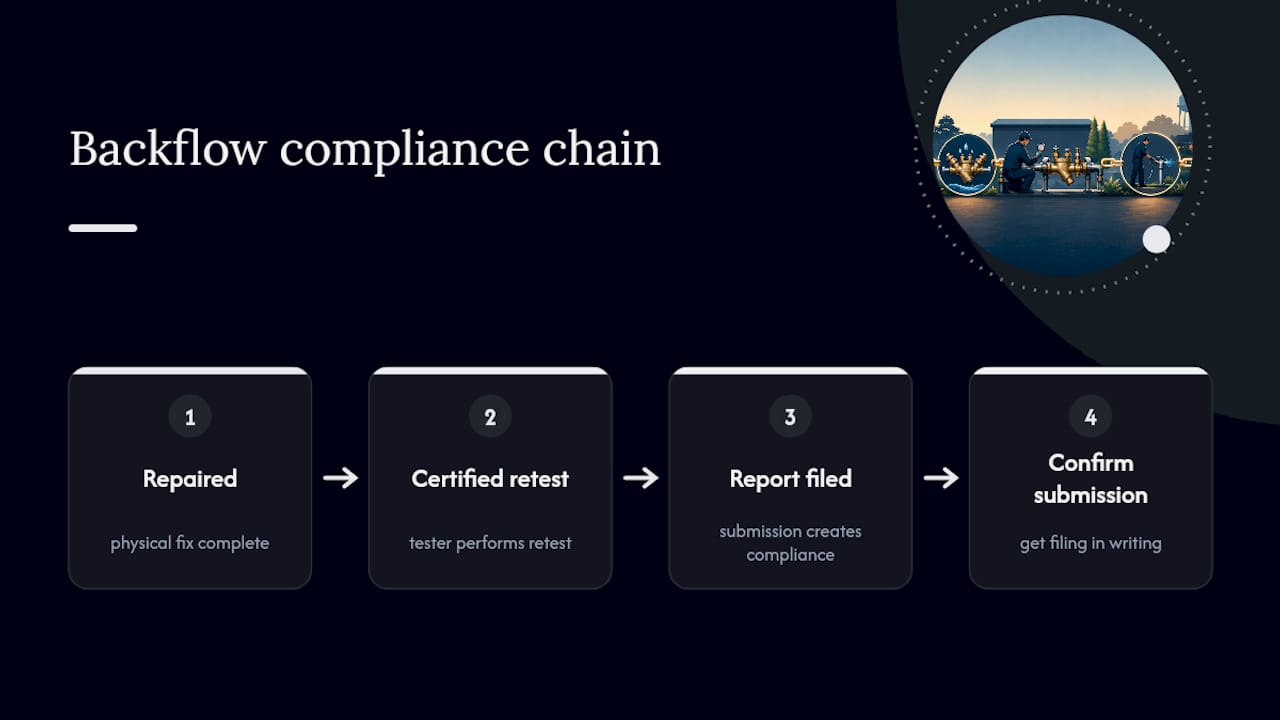
A passing test sitting on a technician’s clipboard doesn’t protect you from a compliance notice. Only a filed report does. That’s the piece conventional advice glosses over: property managers focus on getting the physical repair done and treat the paperwork as an afterthought, when the water authority treats it as the entire point.
If you take one thing from this, prioritize confirming submission, not just scheduling the repair. Ask your tester directly when and how they file, and get it in writing. For commercial properties juggling multiple devices across a portfolio, understanding a commercial plumbing renovation timeline also helps when a backflow repair overlaps with bigger facility work, since access windows for testing often need to line up with other contractors on site.
— Jordan
Get Your Backflow Assembly Retested and Filed, Fast
A professional backflow service handles the entire post-repair cycle in one continuous process: diagnosis, repair or rebuild, retest with calibrated gauges, and direct filing with your water authority, minimizing the burden of chasing down paperwork between multiple contacts.

That last part matters more than it sounds. A repair without a filed report leaves you technically noncompliant no matter how well the fix holds up, and many professional testers submit passing reports directly rather than leaving that step to the property owner. If you’re in New Jersey and juggling a failed test right now, see how backflow testing, submission, and compliance work across New Jersey and get a technician scheduled before your utility’s retest window closes.
Sources
- ASSE — Backflow prevention personnel certification
- Establishing and Managing an Effective Cross-Connection Control Program — TCEQ