Yes. New Jersey healthcare facilities with cross-connection hazards must install approved backflow prevention (a DCVA or an RPZ assembly), have certified testers perform mandated tests, and file required reports under N.J.A.C. 7:10-10 and the Uniform Construction Code’s Plumbing Subcode. Testing runs quarterly under a physical connection permit, and a certified tester must file results within five days. A failed device gets 30 days to repair and retest, or it needs an NJDEP-approved replacement.
TL;DR:
- Healthcare facilities with auxiliary water sources, lab processes, or dual plumbing lines must install approved backflow devices and submit quarterly test reports within five days.
- Testing must be performed by certified professionals, with high-hazard systems requiring more frequent checks such as annual testing or air gaps instead of mechanical assemblies.
- Failed backflow devices have 30 days for repair and retesting, with replacements needing NJDEP approval if repairs are not feasible within that period.
- Permits must be renewed annually, requiring internal inspections within six months of renewal, and failure to comply can lead to service disconnection or fines.
- Facility managers should proactively schedule testing, document records, and coordinate with certified testers to ensure compliance and avoid administrative delays.
Table of Contents
- Which Healthcare Facilities Need a Backflow Permit?
- What Devices Does NJ Require, and How Often Get Tested?
- Who Is Allowed to Test and Certify Backflow Devices?
- How Do You File the Required Test Reports?
- What Happens When a Backflow Device Fails Testing?
- When Do Backflow Permits Renew, and What Triggers Enforcement?
- A Realistic Compliance Timeline for Facility Managers
- A Publisher’s View on Where NJ Healthcare Compliance Breaks Down
- How South Jersey Backflow Keeps NJ Healthcare Facilities Compliant
- Where to Verify These Rules Yourself
- Sources
Which Healthcare Facilities Need a Backflow Permit?
Not every clinic needs a physical connection permit, but most hospitals, dialysis centers, surgical centers, and diagnostic labs do. New Jersey’s rule targets any “facility with cross-connection hazards,” which N.J.A.C. 7:10-10.1 defines broadly enough to sweep in most clinical operations with auxiliary water sources, chemical processes, or dual plumbing lines. NJDEP guidance flags healthcare as a high-priority category precisely because dialysis units, sterilizers, and lab drains create the kind of contamination pathway the rule exists to stop.
There’s a key distinction facility managers often miss: containment protects the public water main at the service line, while isolation protects specific equipment inside the building. A hospital typically needs both.
Private residences fall outside these rules entirely, but any commercial healthcare building can trigger them. Signs your facility likely needs a permit:
- You have a well, cistern, or other auxiliary water source on-site
- You run a lab, dialysis unit, or sterilization process
- Your building has dual water lines feeding different systems
- Your water supplier or municipality has already flagged your account for cross-connection review
What Devices Does NJ Require, and How Often Get Tested?
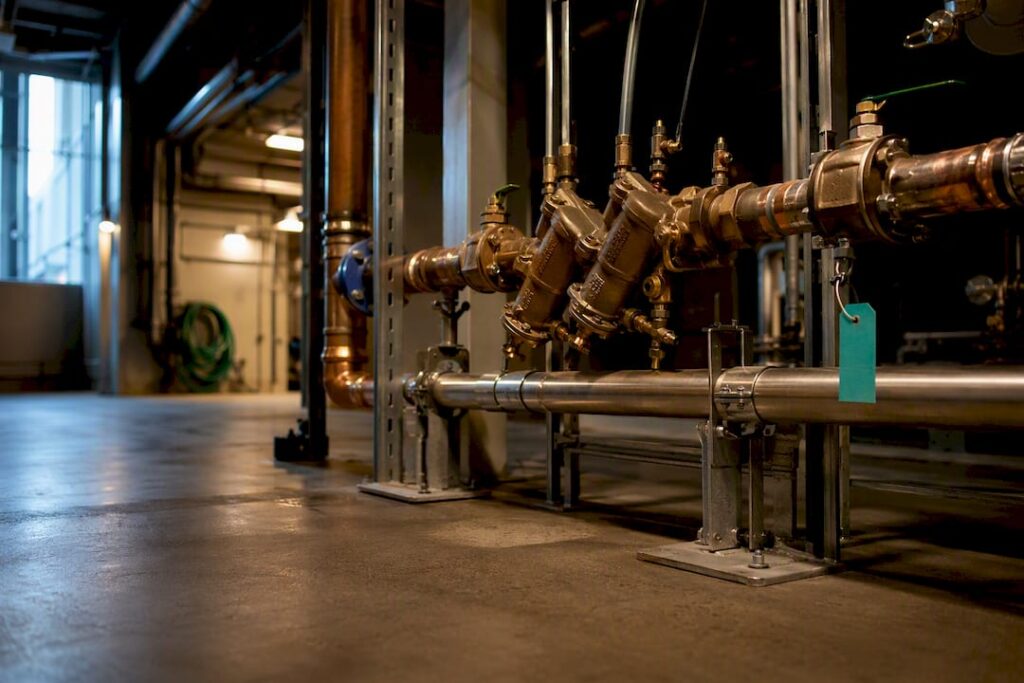
Two assemblies dominate healthcare compliance. A double check valve assembly (DCVA) uses two independent check valves to stop reverse flow and suits moderate-hazard connections. A reduced pressure zone assembly (RPZ) adds a relief valve between the checks and vents to atmosphere if pressure drops, making it the standard for high-hazard processes. NJDEP’s Physical Connection Permit program requires one or the other on every approved physical connection, tested quarterly once the permit is active.
Outside the permit context, the Plumbing Subcode still requires annual testing on backflow assemblies tied to cross-connection hazards, and high-hazard processes may call for an air gap instead of a mechanical assembly. A rough mapping for common healthcare systems:
- Dialysis water treatment: RPZ or air gap
- Sterilizers and autoclaves: RPZ or air gap
- Boiler feed and chemical injection lines: RPZ
- Irrigation or auxiliary wells feeding the building: DCVA at minimum, RPZ if cross-connected to potable lines
- Standard domestic service with no auxiliary source: DCVA typically sufficient
Who Is Allowed to Test and Certify Backflow Devices?
Testing isn’t a DIY job, and New Jersey is specific about who can sign off. Tests must be performed by a tester certified through an agency acceptable to NJDEP’s Bureau of Safe Drinking Water. Local plumbing subcode inspectors play a different role: they can witness a test or accept a submitted certification, but they’re barred from performing the test or repair themselves. That separation exists to prevent the same person from testing a device and then grading their own work.
A valid test report needs to include specific elements, and compliance officers should check for all of them before filing:
- Device type, make, model, and exact location in the building
- Date of test and pass/fail result for each check
- Certified tester’s name and the certifying agency
- Signed certification, valid for one year under DCA Bulletin 99-2
If you’re unsure whether a tester’s certificate qualifies, your water supplier or municipal plumbing subcode office can confirm which agencies it accepts.
How Do You File the Required Test Reports?
Every permitted physical connection generates paperwork, and the deadline is tighter than most facility teams expect. Results go on the Quarterly Physical Connection Test and Maintenance Report, and N.J.A.C. 7:10-10.6 requires it mailed within five days of testing. Beyond the quarterly report, assemblies (except RPZs, which are generally exempt) need an internal inspection within six months prior to permit renewal, dismantling the clapper and disc assembly for a physical check before reassembly and retest.
A single test event should follow this sequence:
- Schedule a certified tester ahead of the quarterly window
- Conduct the test and document results on-site
- Submit the Quarterly Physical Connection Test and Maintenance Report to both the administrative authority and the water supplier within five days
- Retain a copy for your facility’s compliance file
Municipalities may also charge reinspection fees, so budget for that alongside the Department’s own fee schedule.
What Happens When a Backflow Device Fails Testing?
A failed test starts a clock. Under N.J.A.C. 7:10-10.6, you have 30 days to repair and retest the device. If repair isn’t feasible, you need NJDEP approval before installing a replacement, and that replacement has to meet the same DCVA or RPZ standard the original permit required.
A few situations add complexity worth flagging early:
- Devices serving combination fire and domestic service lines need a joint plan review before a new permit is issued
- Fire-line replacements must carry an approval rated for fire service and account for NFPA-driven flow requirements, not just potable-water standards
- Every repair and retest needs documentation kept on file, since municipal or Department audits can request records going back multiple cycles
When Do Backflow Permits Renew, and What Triggers Enforcement?
NJDEP materials point to annual renewal for most physical connection permits, and the internal inspection has to land inside that six-month pre-renewal window discussed above. Miss it, and you’re renewing on an unverified device. Enforcement for lapses is not gentle: water suppliers can disconnect service, and municipal plumbing subcode officials can levy fines under the Uniform Construction Code framework NJDEP and local authorities jointly administer.
If your permit is approaching renewal, work through this before the deadline hits:
- Pull test history for every permitted device and confirm no gaps
- Schedule the internal inspection if it hasn’t happened in the last six months
- Gather signed test reports and certifications into one renewal package
A Realistic Compliance Timeline for Facility Managers
Turning these rules into a working calendar beats scrambling every quarter. Here’s how South Jersey Backflow recommends facility teams structure it:
Today: Inventory every backflow device on-site, note the last test date for each, and confirm tester credentials are current. Flag dialysis, sterilization, and lab lines as high-hazard first.
Every quarter: Book a certified tester before the window opens, complete testing, and file the Quarterly Physical Connection Test and Maintenance Report within five days. Log results in a device-specific file.
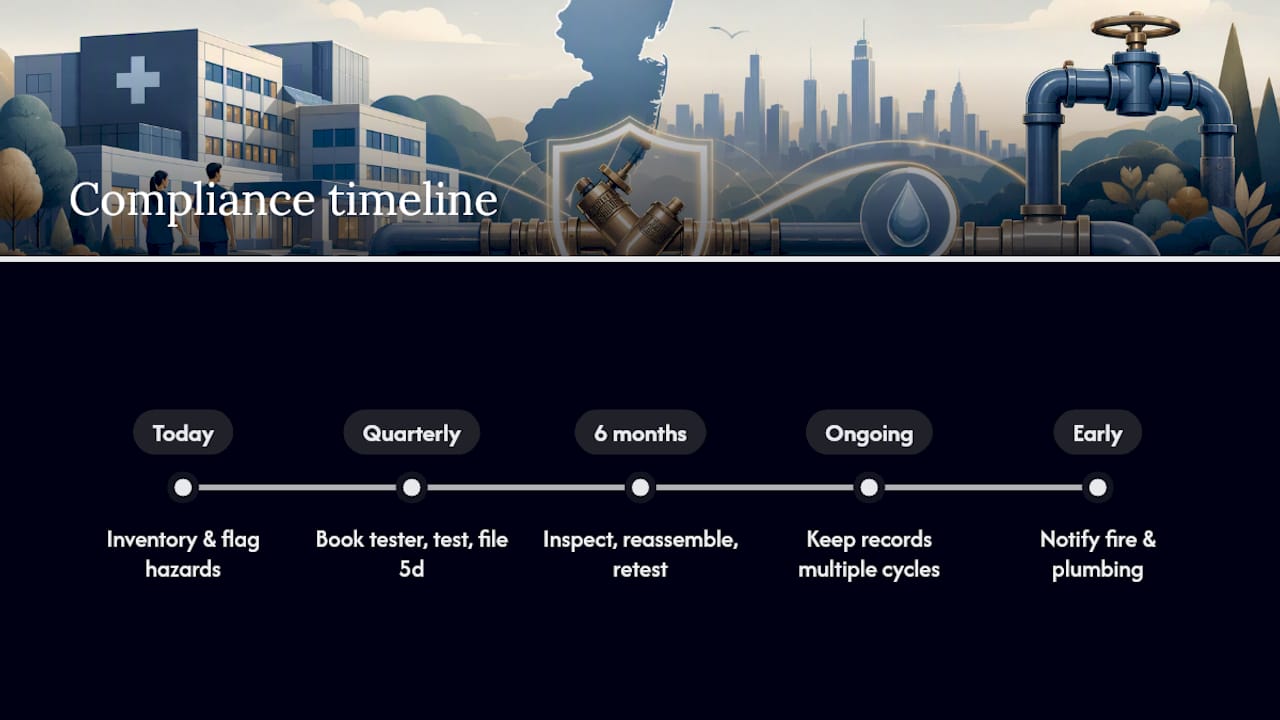
Six months before renewal: Run the internal inspection, reassemble and retest, and assemble your renewal package early rather than the week it’s due.
Document retention: Keep test reports, certifications, and repair records for several renewal cycles so an audit never catches you scrambling for old paperwork.
Pro Tip: If any device serves a combination fire and domestic line, loop in your fire-protection contractor and plumbing subcode official before you file for permit renewal. Combination-service reviews take longer, and starting late is the most common reason renewal packages stall.
A Publisher’s View on Where NJ Healthcare Compliance Breaks Down
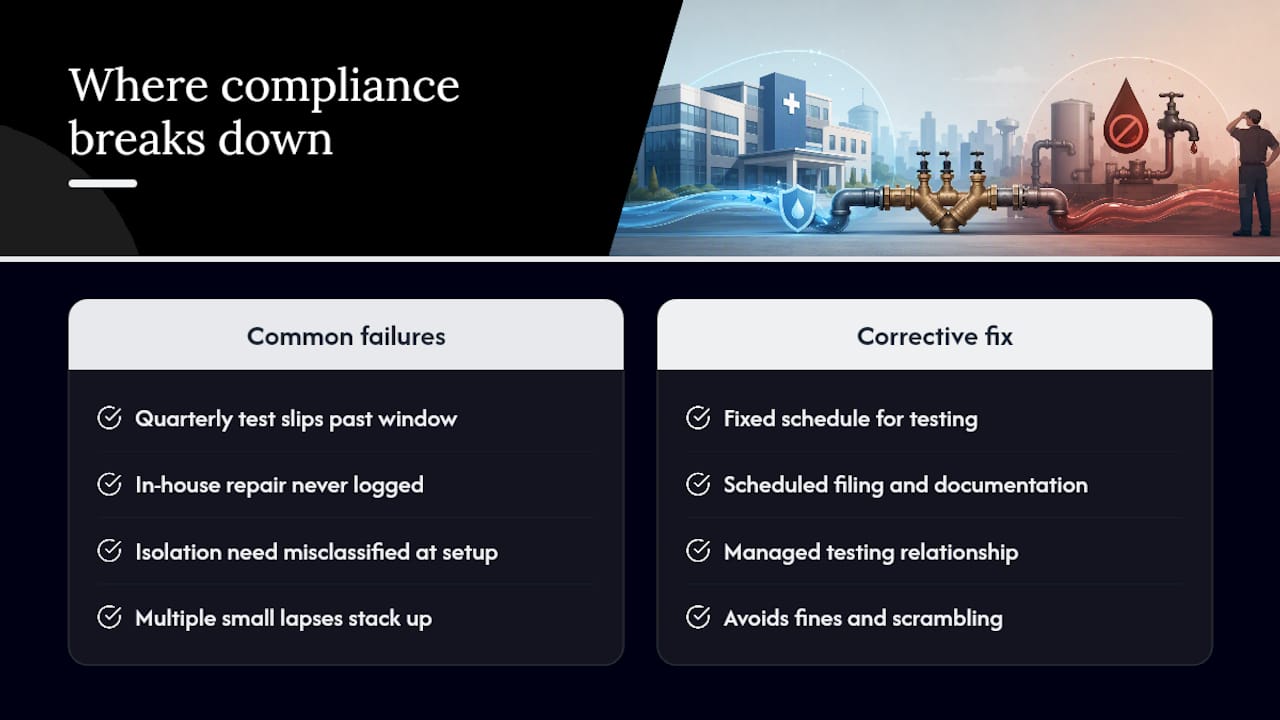
Most compliance failures we see aren’t about ignorance of the rule. They’re administrative drift: a quarterly test that slips two weeks past its window, a repair done in-house that never gets logged, or an internal isolation need on a lab sink that nobody classified correctly at setup. Each is survivable alone. Stacked together across a busy facility, they’re what turns a routine inspection into a disconnection notice.
The fix isn’t more paperwork. It’s a workflow where testing, filing, and repair documentation happen on a fixed schedule instead of by memory, which is exactly where a managed testing relationship earns its cost back in avoided fines and avoided scrambling.
— Jordan
How South Jersey Backflow Keeps NJ Healthcare Facilities Compliant
Some companies handle the parts of this process that eat the most facility-manager time: certified testing, emergency repairs, rebuilds, permit renewal assistance, and direct filing of test reports with your water authority so nothing sits on someone’s desk past the five-day deadline.
Before requesting service, pull together your device inventory, last test dates, and any prior repair records. That’s the information a technician needs to move fast on-site instead of spending the first hour diagnosing what should already be documented. South Jersey Backflow serves healthcare facilities across South Jersey’s service counties, and the backflow testing and certification guide walks through exactly what to prepare and submit. If your permit renewal is on the calendar, now is the time to schedule a certified test rather than wait for the six-month inspection window to close in on you.
Where to Verify These Rules Yourself
For the primary source material behind every requirement above: the NJDEP Physical Connection Permit page covers applications, N.J.A.C. 7:10-10.1 and 7:10-10.6 cover scope and testing procedure, N.J.A.C. 5:23-3.15 is the Plumbing Subcode reference, and DCA Bulletin 99-2 covers tester certification and internal inspection guidance.
This article is general information, not a substitute for advice from a qualified lawyer. Consult a qualified legal professional about your own circumstances before acting on anything here.