TL;DR:
- A cross connection is a potential physical link between potable and non-potable water sources, while backflow is the unintended reversal of water flow through that connection. Proper management requires recognizing that cross connections pose hazards, and backflow events can cause contamination, necessitating different prevention strategies. Conducting regular surveys, installing appropriate devices, and scheduling certified testing help New Jersey property owners ensure water safety and regulatory compliance.
A cross connection is any actual or potential physical link between a potable water supply and a non-potable source, while backflow is the unintended reversal of water flow through that connection. The difference between backflow and cross connection is not just semantic. Confusing the two leads property owners to install the wrong devices, skip the right inspections, or miss compliance requirements entirely. For New Jersey property owners and managers, understanding both terms is the foundation of every water safety and regulatory decision you will make.
What is the difference between backflow and cross connection?

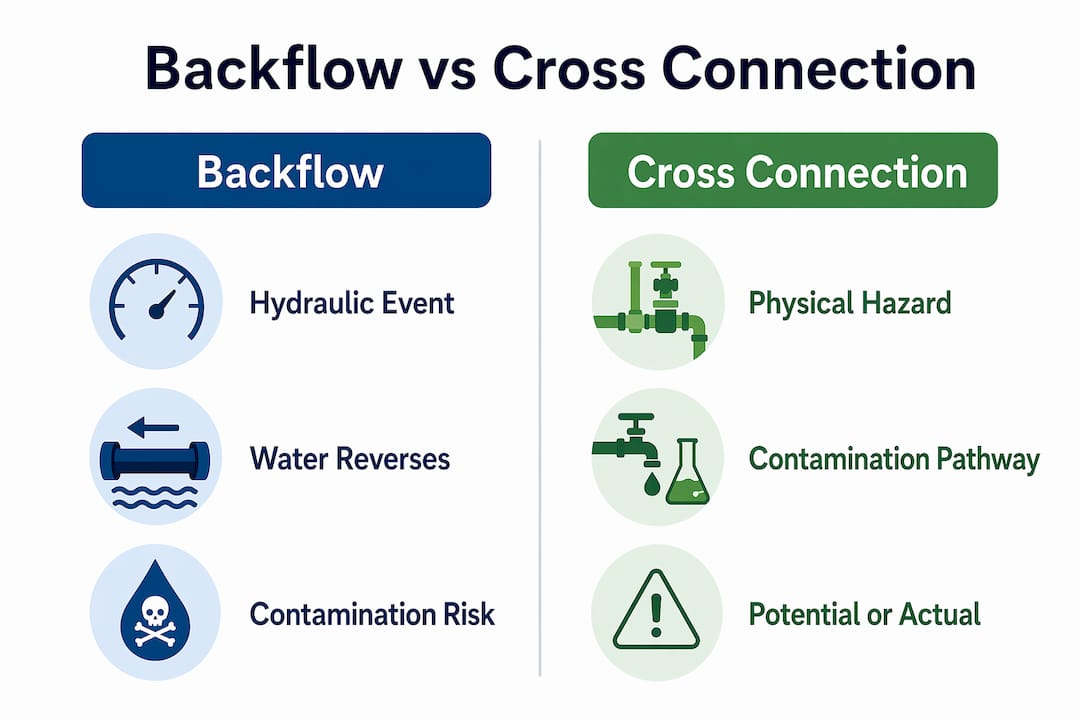
The clearest way to separate these two concepts is to think of them as hazard versus event. A cross connection is the hazard: the physical or potential pathway that exists between your clean drinking water and something that could contaminate it. Backflow is the event: the moment contaminated water actually moves backward through that pathway into your potable supply.
Cross-connections create contamination risk, while backflow is the hydraulic event that moves contaminants into potable water. This means a cross connection can exist on your property right now without causing any harm. The danger activates only when a pressure or vacuum event triggers backflow. Both conditions must be present for contamination to occur, which is exactly why managing each one requires a different strategy.
What is a cross connection and why does it matter in water safety?
A cross connection is any direct or indirect link from a safe potable water line to an unsafe or non-potable source. That definition covers a wider range of situations than most property owners expect.
Common cross connections found on residential and commercial properties include:
- A garden hose submerged in a bucket of fertilizer or pool water
- An irrigation system connected to the municipal water supply without a backflow preventer
- A boiler or heating system tied into the potable water line
- A fire suppression system filled with chemical additives
- Industrial process equipment connected to a building’s water supply
Cross connections are classified by hazard level. A potential cross connection exists when a pathway is present but contamination has not yet occurred. An actual cross connection is one where non-potable water is already in direct contact with the potable line. Both categories require control, but the device and program response differ based on the degree of hazard. A lawn irrigation connection at a residential property carries a different risk profile than a chemical feed line at a manufacturing facility.
The practical problem for NJ property owners is that many cross connections are invisible during a casual walkthrough. Temporary connections, such as a hose attached to a utility sink, also qualify as cross connections and must be controlled. Identifying every connection point on your property, both permanent and temporary, is the starting point for any effective water safety program.
Pro Tip: Walk your property with a licensed plumber once a year specifically to identify new or changed connection points. Renovations and equipment upgrades frequently introduce cross connections that were not present during the original inspection.
What is backflow and how does it cause contamination?
Backflow is the unintended reversal of water flow into the drinking water supply. It occurs through two distinct hydraulic mechanisms, and understanding both helps you match the right prevention device to the right risk.
| Backflow Type | Cause | Common Scenario |
|---|---|---|
| Backpressure | Downstream pressure exceeds supply pressure | Boiler systems, pumps, elevated tanks |
| Backsiphonage | Vacuum or negative pressure in the supply line | Water main break, high-demand firefighting draw |
Backpressure backflow happens when a downstream system, such as a boiler or a pump-fed irrigation system, generates pressure higher than the municipal supply line. That pressure differential pushes non-potable water backward into the clean supply. Backsiphonage works in the opposite direction: a sudden drop in supply pressure, caused by a water main break or a large draw on the system, creates a vacuum that pulls contaminated water back through any open cross connection.
Both types carry serious health risks. A backsiphonage event at a property with an unprotected irrigation system can pull fertilizers, pesticides, or soil bacteria directly into the drinking water line. A backpressure event at a commercial property with a chemical treatment system can introduce industrial compounds into the municipal supply, affecting not just your building but neighboring connections on the same line.
Pro Tip: If your property has a boiler, a fire suppression system, or an irrigation setup, assume both backpressure and backsiphonage are credible risks. Device selection should account for both, not just the more obvious one.
How do backflow prevention devices and cross-connection control programs work?
Backflow prevention devices ensure water flows only one way and block contamination from entering the potable supply. The device closes valves automatically when it detects reverse flow conditions. However, the device is only one part of a complete solution.
The table below compares the two main layers of protection:
| Protection Layer | What It Addresses | Examples |
|---|---|---|
| Backflow prevention device | Stops reverse flow at a specific point | Reduced pressure zone (RPZ) assembly, double check valve assembly, pressure vacuum breaker |
| Cross-connection control program | Identifies and manages all hazard pathways across the property | Hazard surveys, device selection protocols, annual testing schedules |
Common types of backflow prevention devices include reduced pressure zone assemblies, double check valve assemblies, and pressure vacuum breakers. RPZ assemblies provide the highest level of protection and are required for high-hazard connections such as fire suppression systems with chemical additives or industrial process lines. Double check valve assemblies are appropriate for moderate-hazard connections like irrigation systems on residential properties. Pressure vacuum breakers protect against backsiphonage only and are not suitable where backpressure is a risk.
A coordinated cross-connection control program combines hazard identification, device selection, installation, maintenance, and testing to protect potable water supplies. Installing a device without a program behind it leaves gaps. You might protect one connection point while missing three others.
In New Jersey, backflow devices must be tested annually by certified testers to confirm they are functioning correctly. Testing is not a visual check. A certified tester uses field equipment to verify that the device closes under actual pressure conditions. Skipping annual tests is one of the most common compliance failures NJ property owners face, and it is one that local water authorities actively enforce.
Key requirements for NJ property owners managing backflow prevention:
- Match the device type to the hazard level of each cross connection
- Use a New Jersey licensed and certified backflow tester for all annual tests
- Submit test results to your local water authority on time
- Keep records of all tests, repairs, and device replacements
- Replace failed devices promptly; a failed test result is not a pass with conditions
What practical steps should NJ property owners take?
Managing backflow and cross connections on your property follows a clear sequence. Skipping any step creates gaps that inspectors and water authorities will find.
-
Conduct a cross-connection survey. Walk every water connection point on your property, including hose bibs, irrigation tie-ins, boiler connections, and any equipment fed by the potable supply. Document each one with its location and hazard classification.
-
Classify each connection by hazard level. High-hazard connections require RPZ assemblies. Moderate-hazard connections may qualify for double check valve assemblies. Consult a licensed plumber or certified backflow tester if you are unsure how to classify a specific connection.
-
Install the correct device at each connection point. Device placement matters. The preventer must be installed at the service connection or at the point of hazard, depending on your local water authority’s requirements. Review NJ plumbing code requirements before installation to confirm placement rules.
-
Schedule annual testing with a certified tester. Backflow testing requirements in NJ mandate annual field tests by a certified professional. Set a recurring calendar reminder so testing never lapses.
-
Submit results and maintain records. After each test, your tester submits results to the local water authority. Keep your own copies. If you receive a backflow compliance letter from your municipality, respond within the stated deadline.
-
Reinspect after any plumbing changes. Renovations, new equipment, or changes to your irrigation system can introduce new cross connections. Treat any significant plumbing work as a trigger for a fresh survey.
Identifying cross connections on your property, including both permanent and temporary connections, is the step most property owners skip. A garden hose left in a pool or a temporary connection during a renovation carries the same regulatory weight as a permanent installation.
Pro Tip: If you manage multiple properties in New Jersey, create a master compliance calendar that tracks each property’s device locations, last test dates, and submission deadlines. One missed deadline at one property can trigger a notice of violation that affects your entire portfolio.
Key takeaways
A cross connection is the physical hazard pathway, and backflow is the contamination event that occurs through it. Managing both requires different tools and a coordinated program.
| Point | Details |
|---|---|
| Cross connection is the hazard | Any physical or potential link between potable and non-potable water is a cross connection requiring control. |
| Backflow is the event | Backpressure or backsiphonage triggers reverse flow through a cross connection, causing contamination. |
| Device selection must match hazard level | RPZ assemblies for high-hazard connections, double check valves for moderate-hazard, vacuum breakers for low-hazard. |
| Annual testing is mandatory in NJ | Certified field testing confirms device function; visual inspection does not satisfy the requirement. |
| Programs beat devices alone | A cross-connection control program that covers identification, installation, and testing outperforms a single device with no oversight. |
Why the terminology gap costs NJ property owners money
Most compliance problems I see in New Jersey properties trace back to one root cause: the property owner or manager treated “backflow” and “cross connection” as the same thing. They installed a device on one connection point, checked a box, and assumed the job was done. Three years later, a water authority inspection finds two unprotected connections and a device that has never been tested.
The terminology matters because it drives the action. If you only think about backflow, you think about devices. If you also think about cross connections, you think about your entire plumbing system as a map of potential hazards, each one requiring a specific response. That shift in framing is what separates a property that passes inspection from one that gets a violation notice.
The risk-based approach is the only one that works at scale. I have seen commercial property managers with 20-unit buildings spend thousands on emergency repairs that a $150 annual test would have caught. Failure to test backflow assemblies as required increases the risk that contamination passes undetected, and by the time it is detected, the liability exposure is significant.
My practical advice: treat your cross-connection survey as a living document, not a one-time task. Update it every time a plumber touches your system. And never let a testing deadline slip because you assumed the device was fine. Devices fail silently.
— Jordan
Get professional backflow testing and compliance help in New Jersey
Southjerseybackflow provides certified backflow testing, device installation, and compliance support for property owners and managers across New Jersey. Whether you have received a compliance notice or want to get ahead of your next inspection cycle, the team at Southjerseybackflow knows exactly what your local water authority requires and how to meet it.
From Ocean County to Gloucester County, Southjerseybackflow handles the full process: surveying your cross connections, testing your devices, and submitting results directly to your water authority. If you need to understand how to pass and submit your NJ backflow test, that resource covers every step. For properties in Middlesex County or anywhere else in the state, contact Southjerseybackflow to schedule your annual test and stay fully compliant.
FAQ
What is the main difference between backflow and cross connection?
A cross connection is the physical or potential pathway between potable and non-potable water, while backflow is the hydraulic event where contaminated water reverses through that pathway. Both must be present for contamination to occur.
How often do backflow devices need to be tested in NJ?
Backflow devices must be tested annually by a certified tester in New Jersey. Test results must be submitted to the local water authority, and failure to test on schedule can result in a compliance violation.
What are the two types of backflow?
The two types are backpressure and backsiphonage. Backpressure occurs when downstream pressure exceeds supply pressure, and backsiphonage occurs when a vacuum or pressure drop in the supply line pulls water backward through an open cross connection.
Do temporary connections count as cross connections in NJ?
Yes. Temporary connections such as a garden hose submerged in a non-potable source or a temporary equipment hookup qualify as cross connections and require the same level of control as permanent installations.
What backflow prevention device do I need for an irrigation system?
Most residential irrigation systems in New Jersey require at minimum a pressure vacuum breaker or a double check valve assembly, depending on the hazard level. High-hazard irrigation connections with chemical injection require an RPZ assembly. A certified backflow tester can confirm the correct device for your specific setup.