
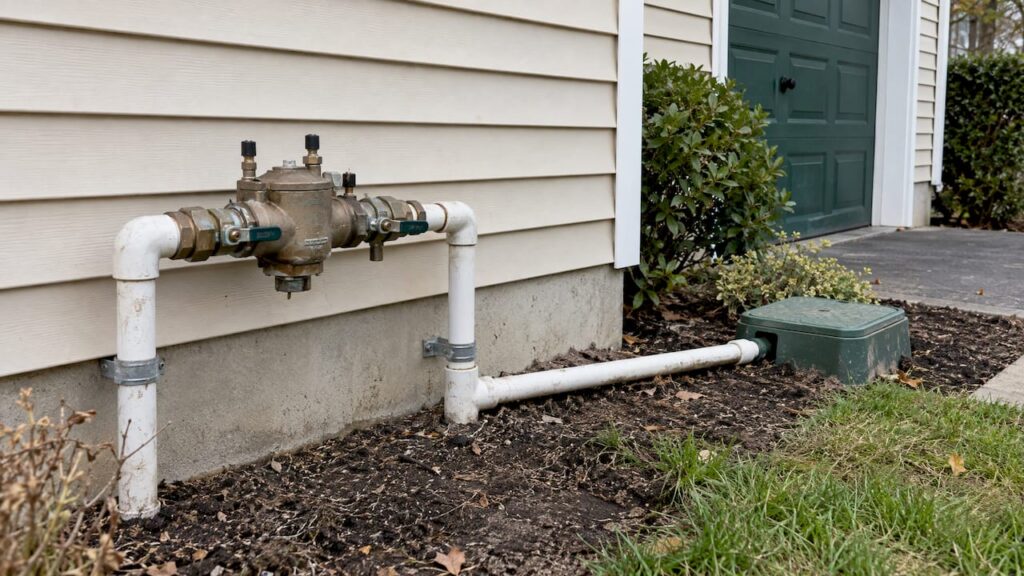
Water hammer after a backflow preventer is almost never caused by the preventer itself. It is a pressure surge created when moving water is stopped or redirected too quickly, usually by a fast-closing sprinkler zone valve, air trapped in the line, or a pump or valve being opened too fast. The preventer sits in the path of that surge and takes the punishment. Slow the water down, bleed the air out, and have a certified tester check the assembly if the banging continues.
TL;DR
- Water hammer is a shock wave caused by a sudden change in water velocity, such as a valve closing fast or a pump starting and stopping.
- A backflow preventer makes the line behave like a closed system, so pressure waves bounce off it and travel through the whole line.
- Repeated surges can damage the preventer, pipes and fittings. Do not remove or bypass the device to quiet the noise.
- Start with slow valve operation, air bleeding, and a pressure check. Add a pressure-reducing valve or arrestor if the pressure is the problem.
- Call a certified backflow tester if the relief valve spits, the noise follows a repair or shutoff, or the annual test is due.
Table of Contents
- What water hammer actually is
- Why it shows up right after a backflow preventer
- Can water hammer damage pipes or the backflow preventer?
- Sort out the cause: a quick diagnostic
- How to reduce water hammer without touching the backflow preventer
- Do you need a water hammer arrestor?
- When to call a certified backflow tester
- What testing and rebuilding cost in New Jersey
- Protect the assembly from the outside, too
- Have the banging checked by a tester
- FAQ
- Sources
What water hammer actually is
Water hammer is a high-pressure surge, a shock wave, that moves through a piping system when the velocity of the water changes suddenly. The University of Florida’s IFAS Extension describes it as destructive, and lists the rapid closure of irrigation valves and the starting and stopping of pumps as typical triggers (UF/IFAS, Water Hammer in Irrigation Systems).
The numbers are larger than most people expect. The same publication gives an example: water moving at 7 feet per second in Class 160 PVC can add roughly 100 psi of surge pressure on top of your normal line pressure. That is why a house at 60 psi can suddenly behave like a much higher pressure system for a fraction of a second.
The sound you hear, a bang, thud, shudder or chattering rattle, is the pipe and its supports reacting to that wave. The sound is a symptom. The pressure spike is the problem.
Why it shows up right after a backflow preventer
People usually notice the noise after the backflow preventer because of where the preventer sits and what is downstream of it. Three things come together.
The preventer turns the line into a closed system
A backflow assembly is built to stop water from flowing backward. That is exactly what you want for water safety, and it also means a pressure wave cannot simply flow back toward the main. It reflects. Irrigation tester and author Stu Asay has described how, with a preventer in place, waves bounce back and forth and hit components along the entire line, not just the valve that started the shock. So the banging you hear at the preventer may have started at a zone valve fifty feet away.

Sprinkler zone valves close too fast
The most common trigger on residential and commercial properties is an irrigation zone valve that shuts quickly. When a zone ends, the water column racing through the pipe stops almost instantly. The energy has nowhere to go, so it hits the closed valve, then reverses toward the preventer, then back again. Homeowners describe this in the same way: a loud slam at the end of a cycle, or a hammering when a drip zone starts.
Irrigation consultant Jess Stryker has argued that responsibility for preventing this rests largely with the system designer, who has to account for valve closing speeds and the hydraulic conditions of the site (Michigan State University turf archive). In practice, that means a system designed years ago with different pipe sizes or higher pressures may now be hammering because conditions changed, not because anything is broken.
Trapped air and fast startups
Air in a line compresses and then snaps, and water rushing in to fill an empty pipe slams into the first closed valve or elbow it meets. This is why the noise is often worst in spring after a system is turned on, or after any repair that drained the line. UF/IFAS advises filling empty lines as slowly as possible so trapped air can escape, and making sure all air has been discharged before the system runs at full throttle.
Can water hammer damage pipes or the backflow preventer?
Yes. Repeated pressure spikes accelerate wear on pipes, fittings, fixtures and the backflow device. Zurn, a manufacturer of backflow assemblies, states in its installation guidance that water hammer that creates excessive line pressure can damage the device (Zurn IS375).
Whether it bursts a pipe on a single event depends on the pipe material, its age, joints and the size of the spike. A single bang is unlikely to destroy sound plumbing. Years of bangs are a different story, because they fatigue glued joints, loosen threaded connections, and wear the internal parts of the preventer: the check valves, springs and seats that keep the assembly doing its job.
A damaged assembly is a safety issue as much as a plumbing one. The EPA notes that unprotected cross-connections can cause serious contamination and that public water customers should understand their responsibility for testing and repairing backflow assemblies (EPA cross-connection fact sheet). A preventer that has been hammered and no longer seals properly is not protecting your drinking water, even if water still flows through it.
Sort out the cause: a quick diagnostic
Use the pattern of the noise to narrow it down before you call anyone.
| What you notice | Likely cause | First thing to try |
|---|---|---|
| Bang or slam when a sprinkler zone ends | Zone valve closing too fast | Adjust the flow control stem on the valve if it has one, or reduce flow to that zone |
| Spitting, sputtering and banging when the system is first turned on | Trapped air | Refill slowly, then bleed air from the high points |
| Banging throughout the house when any fixture shuts | High static pressure or failed pressure-reducing valve | Check pressure with a gauge on a hose bib |
| Relief valve on the preventer dripping or discharging intermittently | Pressure fluctuation or water hammer | Check pressure, then have the assembly tested |
| Noise began right after a repair, shutoff or new equipment | Air, a partly open valve, or a changed component | Check that all valves are fully open and the line is bled |
| Noise only at one zone | Closing speed, undersized pipe, or a tight run | Slow that zone’s valve and look at the pipe layout |
Zurn’s guidance points to the same logic for relief-valve discharge: intermittent discharge can result from pressure fluctuation or water hammer, and in that case pressure-reducing valves or water-hammer shock arrestors should be installed as needed. A relief valve that discharges on a reduced pressure zone assembly is the device telling you something. Do not plug it or cap it.
Check your static pressure
A $10 to $20 pressure gauge that screws onto a hose bib gives you a number in one minute. Readings that creep up overnight or when no one is using water can point to a failing pressure-reducing valve or thermal expansion in a closed system. The preventer is one of the things that makes a system closed, so expansion has fewer places to go. A pressure reading is worth writing down before you speak to a plumber or tester, because it saves a diagnostic visit.

How to reduce water hammer without touching the backflow preventer
The fixes below leave the preventer in place and intact. Removing, bypassing or modifying a required assembly can put your water supply at risk and can put you out of compliance with your water purveyor.
- Slow the valves down. UF/IFAS recommends closing manual valves over at least 10 seconds, with 30 seconds or more preferable, and opening pump-discharge valves slowly. Many automatic zone valves have a flow control knob. Turning it partway down slows the water and softens the closing event.
- Fill lines slowly. When you turn the system on after winter or after work, open the supply gradually. Rushing water into empty pipe is one of the easiest ways to cause a slam.
- Bleed the air. After the preventer is pressurized, vent trapped air through its test cocks by opening each of the four slightly, then open the downstream isolation valves slowly and check for leaks before running the system at full flow. Those steps follow the standard startup sequence for these assemblies. If you are not sure how the test cocks work on your model, leave this to a tester.
- Lower the pressure. If your static pressure is above what your system was designed for, a pressure-reducing valve brings it down. Surge pressure adds to the starting pressure, so a lower base gives you more margin.
- Add arrestors where they belong. A water-hammer arrestor absorbs the shock near the fixture or valve that causes it. They are useful, but they treat the surge locally. They do not replace slowing the valve down or correcting the pressure.
- Reduce velocity. Water moving fast through undersized pipe produces larger surges. A designer or irrigation contractor can look at zone sizes and pipe runs if one zone is the repeat offender.
Restarting after a shutoff or repair
Most noise complaints begin right after someone drains and refills a line. The principle is the same for any equipment with a check valve: restore pressure slowly and let air escape before you ask for full flow. The same slow-restart habit applies to spa plumbing, and a guide to spa check valve replacement shows how much a worn or poorly seated check valve matters to a quiet, safe restart. For commercial buildings, our guide to backflow testing after a building shutdown explains what should be checked before the system returns to normal use.
Do you need a water hammer arrestor?
Not always. If the noise comes from one fast-closing valve, slowing that valve is cheaper and more effective. If pressure is too high, fix the pressure first. An arrestor makes sense when you have done those things and still have a quick-closing source of surge, such as a washing machine, dishwasher or solenoid valve, or when the surge is brief but sharp and you cannot slow the source.
The reasoning is simple. An arrestor is a cushion. It deals with the energy of a surge after it forms. Slowing the valve prevents the energy from forming in the first place. If you have both a loud zone valve and a high-pressure reading, an arrestor on its own will only partly help.
When to call a certified backflow tester
Some situations are beyond a homeowner or even a general handyman:
- The relief valve on your preventer discharges, drips or spits on a regular basis.
- Water hammer started or got worse after a repair, a shutoff, or a freeze.
- The assembly has been hammered for a long time, and you do not know the last time it was tested.
- You have a missing, stuck or damaged test cock or shutoff valve.
- You manage multiple properties and need test reports filed and documented.
Colorado State University Extension notes that backflow prevention devices must be certified upon installation and at least annually by a backflow technician whose certification is current (CSU Extension). That is the Colorado rule, and New Jersey water purveyors set their own requirements, so confirm the schedule with your local water authority. In either state, the logic holds: a device that has been subjected to pressure spikes should not wait for its next scheduled test if you suspect it is not holding.
A test measures whether the check valves and relief valve are holding at the pressures the assembly should handle. It will tell you if the shocks have damaged the internals. If they have, a rebuild with new parts, rather than a replacement of the entire body, is often the answer.
Our perspective
We see the same pattern across New Jersey properties. A homeowner hears banging, assumes the backflow preventer is the problem, and either ignores it for years or asks someone to remove it. Both choices cost more later. The preventer is usually the messenger. The real cause is a quick valve, trapped air or high pressure, and the preventer is the part that absorbs the hits and wears out first.
That is why we treat noise as a reason to test, not a reason to bypass. When we test an assembly that has been hammered, we are checking the check valves, the relief valve and the seats, then rebuilding with OEM parts on the same visit where we can, so the property is not left waiting. We also look at the setup around the device: how the valves close, whether the pressure makes sense, and whether the assembly is protected from the weather.
Our view is simple. Keep the device, keep it tested, and fix what is making the surge. A tested, properly rebuilt preventer protects your water and your plumbing, and it does so for years. For property managers, we also handle the filing with the water authority, so the paperwork does not become a second problem.
Jordan
What testing and rebuilding cost in New Jersey
If you suspect the assembly was hurt, the cost of finding out is modest compared with what a failed device or a flooded building can cost. These are the published ranges for our work:
| Service | Published price |
|---|---|
| Annual residential certification test | $150 to $250 |
| Commercial device testing | $200 to $450 per device |
| Rebuild kit service (residential) | $125 to $250 |
| Protective enclosure installation | $200 to $500 |
| Residential installation | $300 to $800 |
Final pricing depends on the device, its size and its condition. Our pricing FAQ walks through what drives the numbers.
Protect the assembly from the outside, too
Water hammer is an internal stress. Freezing, impact and tampering are external ones, and a preventer weakened by repeated surges is less able to take them. A protective enclosure shields the assembly from weather and damage. If you are weighing one, see what the rules say in our guide to backflow enclosure requirements in NJ, or look at our custom backflow preventer enclosures.
Have the banging checked by a tester
We are a family-owned, licensed and insured New Jersey company. We test and certify backflow preventers, rebuild them, install enclosures, and file the test reports directly with the water authority. Our aim is same-day service across the state, and we carry OEM parts so most repairs and rebuilds can be finished on the same visit.

If your preventer is noisy, discharging or overdue, start with backflow preventer testing and certification. Property managers can see how we handle filings on our backflow compliance page. You can also contact us to book a visit.
FAQ
Will water hammer burst pipes?
It can, though a single bang rarely does. Surge pressure adds to your normal line pressure, and the UF/IFAS example of about 100 psi from 7 feet per second in PVC shows how quickly it climbs. Over time, repeated spikes loosen fittings and fatigue joints, so a noisy system deserves attention before it leaks.
Do I really need a water hammer arrestor?
Only if slowing the valve and correcting the pressure do not solve it. An arrestor cushions a surge after it forms, which helps with quick-closing sources like appliance valves. Check your pressure with a gauge first, because high pressure makes every surge worse.
Will air in the pipes go away on its own?
Sometimes a little escapes through a fixture or sprinkler head, but you should not rely on it. The better approach is to refill the line slowly and vent air at the high points and the preventer’s test cocks, as UF/IFAS advises. If you are unsure how to bleed your assembly, a certified tester can do it during a visit.
Can I remove the backflow preventer to stop the noise?
No. The preventer is there to keep contaminated water out of the drinking supply, and removing or bypassing a required device can put you out of compliance with your water purveyor. Fix the cause of the surge and have the assembly tested instead.
Why does my backflow preventer relief valve drip after the banging?
Zurn notes that intermittent discharge can come from pressure fluctuation or water hammer. It can also mean an internal check valve is no longer sealing. Have the assembly tested and, if needed, rebuilt rather than capping the relief port.
Sources
- UF/IFAS Extension: Water Hammer in Irrigation Systems
- Michigan State University turf archive: For Failed Sprinkler Systems!
- Zurn IS375 installation sheet
- EPA: Distribution System Water Quality, cross-connection control fact sheet
- Colorado State University Extension: Home Sprinkler Systems, Backflow Prevention Devices