
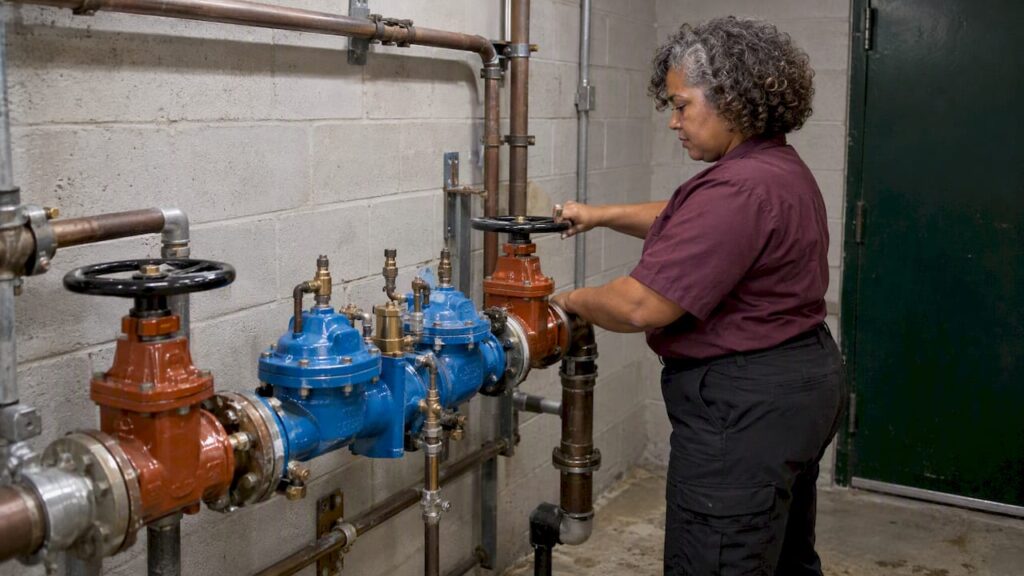
If a New Jersey building has been closed or barely used, have a certified tester check every backflow preventer before you return the building to full service, and flush the plumbing as part of the same reopening. New Jersey does not publish a single rule that says “test after every shutdown.” Your annual certification, your water supplier’s requirements and the condition of the assembly decide the timing. A shutdown is the best moment to confirm all three.
This guide is for property owners and managers who need a practical order of operations: what to check first, what the state’s rules say, how flushing fits in, and what testing and repair typically cost.
TL;DR
- Treat reopening as a trigger to inspect and test every backflow assembly, even if its annual certificate has not expired.
- Under N.J.A.C. 7:10-10.6, an owner can ask for reduced test frequency if the facility was not operating during a calendar quarter. Reduced frequency needs approval, so do not assume it.
- A failed assembly must be repaired and retested within 30 days, and certified-tester reports go to the water supplier and the administrative authority within five days.
- Flush cold water before hot water, from the service entrance out to the farthest fixtures, after the assembly is confirmed working.
- Our published price ranges: $150 to $250 for a residential annual test, $200 to $450 per device for commercial testing.
Table of Contents
- Why a shutdown puts backflow assemblies at risk
- What New Jersey rules say about testing and shutdowns
- A reopening sequence that works
- Which buildings need the most attention
- What it costs to test and repair
- Our perspective
- Book the reopening test
- Protecting the assembly going forward
- FAQ
- Sources
Why a shutdown puts backflow assemblies at risk
A backflow preventer sits between the public water supply and your building’s plumbing, fire sprinklers, irrigation or process equipment. Its job is to stop water from flowing backward into the public system. It has moving parts: check valves, springs, seats, and on a reduced-pressure assembly, a relief valve.
When a building sits idle, those parts sit too. Rubber seats can stiffen, debris can settle on a seat, and in an unheated space a closed assembly can freeze. Nobody is in the building to notice a dripping relief valve or a leak, so a small problem can run for weeks. When you reopen and demand returns suddenly, a worn assembly is more likely to show its weakness.
There is also a water-quality side. Water that stays in pipes for a long time loses its disinfectant residual. New Jersey’s health guidance on buildings affected by prolonged shutdown or reduced operation tells owners to follow manufacturer instructions for operating, maintaining and replacing system components, and backflow preventers are named among those components. That is your starting point: the assembly gets the same attention as the water heater and the cooling equipment.
What New Jersey rules say about testing and shutdowns
Who is responsible
The water customer carries the duty. According to New Jersey American Water, customers have ultimate responsibility for making sure required backflow devices are tested under state requirements and kept in operable condition. Your tenant, your contractor or your utility reminder letter does not move that responsibility off the owner. Property managers carry it on behalf of clients, which is why a shutdown checklist should list every assembly by address.
The same page explains that state and local plumbing inspectors generally oversee plumbing inside buildings, while state agencies and public water suppliers regulate protection of the distribution system at each service connection. In practice you may hear from your local plumbing or fire official, your water utility, or both, depending on what the assembly protects.
Test frequency and what a shutdown changes
The state’s rule on inspection and testing, N.J.A.C. 7:10-10.6, requires tightness tests under an existing physical connection permit at least every three months. It also says the Department shall approve a reduced frequency if the owner shows the facility was not in operation at any time during a calendar quarter.
Two points follow from that wording:
- A shutdown can justify a lower testing frequency, but only when you demonstrate it and the Department approves it. A building that was merely quiet is not the same as one that was not operating.
- The rule does not tell you to skip the test on reopening. It tells you the regulator expects the assembly to be tight when water is in service.
The same rule says the administrative authority or water supplier may require a representative to witness tests and inspections. If your utility has a witnessed-test policy, ask before scheduling the reopening test so the visit does not have to be repeated.
The annual certificate
For most buildings the practical clock is the annual one. The Department of Community Affairs states that a Certificate of Compliance, valid for one year, is issued by the inspector after passing test results are received. For dedicated fire water service lines, the same bulletin says the fire official will accept a current Certificate of Compliance to meet the NFPA 25 annual backflow-test requirement.
So if your shutdown spanned the renewal date, the certificate may have lapsed while nobody was looking. Check the date on the paperwork before anything else. If it expired during the closure, test before reopening. If it is still current but the building sat idle for months, a test is still the sensible way to prove the assembly came through intact.
Local rules differ. Our pages on Newark backflow testing requirements, Camden requirements and Atlantic City’s rules show how the details vary by municipality and utility.

A reopening sequence that works
Here is the order we recommend for a building that has been closed or run at reduced use. It protects the assembly first and the occupants second.
1. Pull the paperwork
Find the last test report, the Certificate of Compliance, the permit if there is one, and the manufacturer’s literature. Write down the location, size and type of each assembly: double check, reduced pressure zone, or another type. Many owners discover during this step that they have more assemblies than they remembered: a fire line, an irrigation line, a boiler feed, a kitchen or soda line.
2. Inspect before you open anything
Walk each assembly with the water still off or at minimum flow. Look for:
- Cracks, corrosion or physical damage, especially after a winter closure
- Missing or damaged enclosure, insulation or heat tape
- Debris, nesting or standing water around the unit
- Signs of past discharge from the relief valve, such as staining or a wet floor drain
- Test cocks and shutoff valves that are missing caps or are seized
If you are not sure whether a device exists or is working, a licensed tester can locate it. Assemblies are typically on the supply line near where it enters the building, but the location varies, and a reduced-pressure assembly will often have a relief port at its bottom. A drip from that port is a reason to call, not a reason to wait.
3. Bring water back slowly
Open the upstream shutoff gradually, then the downstream valve, and watch the assembly. Sudden pressure surges can stress parts that have been sitting. Any spitting, continuous discharge or leaking at the body means stop and call a certified tester.
4. Have a certified tester run the test
The tester connects a calibrated gauge kit to the test cocks and checks each check valve and, where present, the relief valve. A passing result is documented on a test report. New Jersey’s rule allows testing by a certified tester holding a Department-approved certificate, or by the owner’s authorized representative in the presence of an authorized representative of the administrative authority or supplier. Certified-tester reports must be mailed to both within five days. We file reports directly with the water authority for our customers, so that deadline does not rest on you.
If a double-check assembly needs an internal inspection within the six months before permit renewal, it must be dismantled. Reduced-pressure-zone assemblies are generally exempt from that internal step under the same rule. Your tester will tell you which applies.
5. Repair and retest on a clock
A failed assembly is not the end of the world, but it does have a deadline. Under the state rule, failed installations must be repaired and retested within 30 days. Most failures come down to a fouled seat, a worn disc or a tired spring, and a rebuild kit fixes them. When the tester carries OEM parts, the repair and retest can happen on the same visit, which is how we work.
6. Flush the building
Once the assembly passes and water is flowing normally, flush the plumbing. The New Jersey health guidance says to flush the water system at all points of use to replace stagnant water, flushing cold before hot, in segments if needed, and moving from the service entrance to the most distant points. Flushing cold first helps maintain the disinfectant residual.
The NJDEP’s flushing guidance adds that building-wide flushing can remove water left stagnant for an unusually long period, maximize disinfectant residual and remove contaminants such as lead. Test the assembly first and flush second, so that any backflow-related repair does not interrupt or contaminate a flush you have just finished.
For buildings with a hot water system, cooling tower or healthcare occupants, ask a water-management professional about Legionella controls in addition to flushing. That is outside what a backflow test covers.

Which buildings need the most attention
Not every shutdown carries the same risk. Prioritize these:
| Situation | Why it matters | What to do |
|---|---|---|
| Closed through a freeze | Cracked bodies, split test cocks | Visual check before pressurizing, then a full test |
| Certificate expired during closure | Out of compliance on reopening | Test and file before occupancy |
| Fire sprinkler line | Fire official relies on the certificate | Confirm the certificate is current for the NFPA 25 annual requirement |
| Irrigation or process lines | Seasonal use hides slow leaks | Test before first use |
| Multi-unit or managed portfolio | Many assemblies, many deadlines | Build a single schedule and one filing record |
Sector pages cover specific cases, such as nursing homes, veterinary clinics and soda fountain lines, where the assembly protects a particularly sensitive supply.
What it costs to test and repair
These are the ranges published on our site:
| Service | Published range |
|---|---|
| Annual residential certification test | $150 to $250 |
| Commercial device testing | $200 to $450 per device |
| Rebuild kit service (residential) | $125 to $250 |
| Protective enclosure installation | $200 to $500 |
| Residential installation | $300 to $800 |
Repairs and rebuilds for commercial assemblies are not listed with a price because the work depends on the assembly size and type. See our cost breakdown for installing, testing and rebuilding for what drives the number. If you manage several buildings, our backflow testing budget guide for property managers shows how to plan a portfolio.
One budgeting tip: a test that finds a failure costs more than a clean test, but a failure found at reopening costs far less than one found during an inspection, a utility notice or a contamination event. If the assembly is old enough that parts are hard to find, replacement may be cheaper than repeated rebuilds. A replacement can need a permit, which our replacement permit guide explains. Larger service connections may also need engineered plans: the Jersey City utility, for example, requires sealed plans from a New Jersey-licensed engineer or registered architect for fire-service applications and domestic-service applications two inches and larger.
Our perspective
We see the same pattern every time a building comes back online. The owner has a plan for the boiler, the HVAC and the cleaning crew, and the backflow assembly is last on the list because it is out of sight in a mechanical room or a pit.
Our view is that the assembly should be first. It is the one device whose only job is protecting the public water supply, and it is the one most likely to have been forgotten during the closure. A short visit before reopening costs far less than a failed inspection or a contaminated line.
We built our service around removing the usual delays. We are family-owned, licensed and insured, we stock OEM parts so most repairs and rebuilds are finished on the same visit, and we file the test report with the water authority ourselves. For property managers, that means one point of contact and consolidated billing across properties instead of a patchwork of vendors and deadlines.
Our advice: schedule the test before you open the doors, not after the first complaint.
Jordan
Book the reopening test
We test, certify, repair and rebuild backflow preventers across New Jersey for homes, commercial properties and multi-unit buildings, including emergency calls. Same-day service is our aim, and we file your report directly with the water authority so the paperwork is handled.

Start with our backflow testing and certification service, or contact us with the address and the number of assemblies. Managing several sites? Our property manager compliance page explains how we confirm filings.
Protecting the assembly going forward
A shutdown exposes weak points in routine planning. A few habits keep the next reopening simple:
- Keep one register. List every assembly with its address, type, size, last test date and certificate expiry.
- Winterize on purpose. If a building will sit empty in cold weather, an insulated, secure housing protects the assembly. Our enclosure requirements guide explains what the rules say, and our custom enclosure service covers installation.
- Plan the water, too. A Pennsylvania water utility’s reopening guidance suggests considering an ongoing water management plan so water quality does not depend on one-time flushing. It is a sensible habit for any building with seasonal or irregular use.
- Know your county. Utilities differ. We serve counties across the state, including Hudson, Essex, Union, Passaic, Somerset, Monmouth, Sussex and Warren.
FAQ
Do I have to test my backflow preventer after a building shutdown?
New Jersey does not set a standalone “post-shutdown test” rule that we can point to, but the water customer is responsible for keeping required devices tested and operable. If your annual certificate expired during the closure, you need a new test. Even if it did not, testing before reopening is the way to prove the assembly is working.
Can a shutdown reduce how often I have to test?
Possibly. N.J.A.C. 7:10-10.6 says the Department shall approve reduced frequency if the owner demonstrates the facility was not in operation during a calendar quarter. You have to apply and show the evidence. Ask your water supplier how to start, and do not reduce testing on your own.
How can I tell whether my backflow preventer is working?
Signs of trouble include steady dripping or discharge from the relief port, visible leaks, corrosion or a damaged enclosure. But a unit can look fine and still fail, so only a gauge test by a certified tester confirms it. If you are unsure whether you have an assembly at all, a tester can find it during a site visit.
What happens if the assembly fails the test?
It must be repaired and retested within 30 days under the state rule. Many failures are fixed with a rebuild kit, and our residential rebuild service is listed at $125 to $250. Once the retest passes, the report is filed and a new Certificate of Compliance can be issued.
Sources
- Maintaining and Reopening Building Water Systems Impacted by Prolonged Shutdown (NJ Department of Health)
- Cross Connection & Backflow Prevention (New Jersey American Water)
- N.J.A.C. 7:10-10.6, Inspection and testing
- NJ Department of Community Affairs, Bulletin 99-2
- Jersey City Municipal Utilities Authority, Water Service Requirements for Back-Flow Program
- NJDEP Drinking Water Flushing Guidance
- Guidance for Reopening Buildings after Shutdown (Brodhead Creek Regional Authority)
Pingback: Water Hammer After Backflow: Causes, Fixes and Risks