
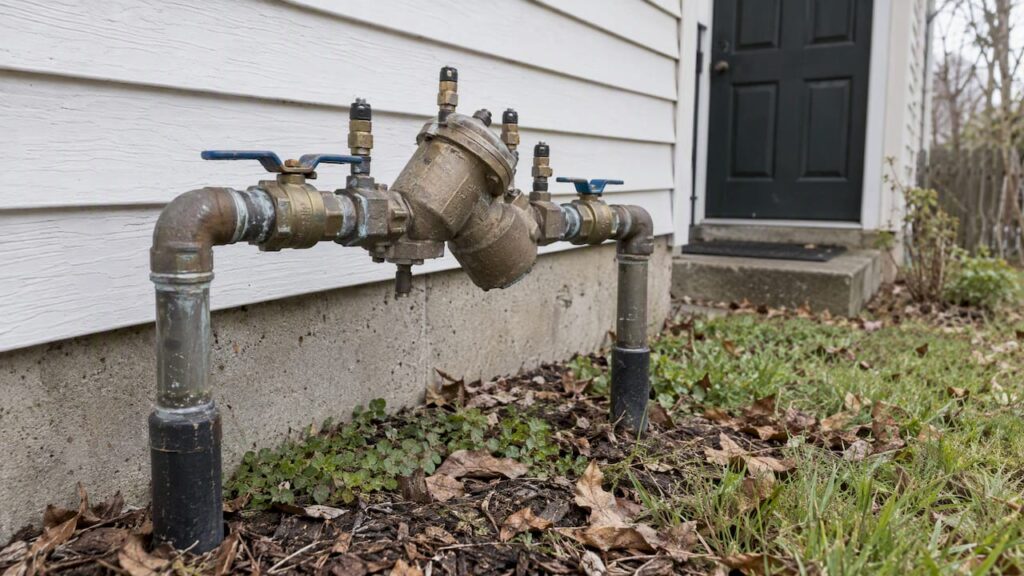
If you own or manage a building in Trenton, New Jersey, the rule comes from the state Uniform Construction Code. Field-testable backflow preventers that isolate a cross-connection must be tested before final inspection and then every year. One- and two-family homes are exempt from the annual test. Commercial, multi-unit, irrigation, fire protection and similar systems are not. A certified tester must do the work, and the passing result goes to the local plumbing subcode official.
This guide walks through which devices are covered, who can test them, what gets filed in Trenton, what happens when a device fails, and what the work typically costs.
TL;DR
- New Jersey’s Uniform Construction Code requires annual testing of field-testable backflow preventers, plus a test before final inspection.
- One- and two-family dwellings are exempt from the annual test. Irrigation, fire protection, boilers, labs and commercial buildings are not.
- The tester must be certified by an agency recognized by the NJDEP. Results go to the local plumbing subcode official, which in Trenton is the Division of Technical Services.
- A failed device must be repaired or replaced, and replacement needs a permit.
- Our published ranges: $150-250 for a residential certification test and $200-450 per commercial device.
Table of Contents
- Where Trenton’s backflow rules come from
- Which properties and devices need annual testing
- Quick reference: who has to do what
- Who can legally test your device in Trenton
- What gets filed, and with whom
- What happens when a device fails
- Fees and consequences of noncompliance
- What testing costs
- Our perspective
- Get it tested and filed
- Practical tips for Trenton owners and managers
- FAQ
- Sources
Where Trenton’s backflow rules come from
Trenton does not write its own backflow testing standard from scratch. The requirement flows from two state layers, and the city enforces the building-side one.
The Uniform Construction Code. The New Jersey Department of Community Affairs explains in Bulletin 99-2 (revised October 2008) that backflow preventers designed to be field tested, which isolate cross-connections between the water supply and contaminants, must be tested before final inspection and annually after that. This is the rule most Trenton owners run into.
NJDEP drinking water rules. The Department of Environmental Protection’s regulations at N.J.A.C. 7:10-10.6 cover inspection and testing for physical-connection installations and set out who may perform tests. These are stricter in some ways, and they mostly apply to specific permitted installations rather than a typical building.
In Trenton, the Division of Technical Services handles plumbing inspections and Uniform Construction Code enforcement. Questions about a notice or a filing can go to them at (609) 989-3546.
A note on search results: many pages that come up for this topic describe other places, such as Trenton, Ohio, or villages and cities elsewhere in the country. Their deadlines and forms do not apply to you. Use the New Jersey rules and the Trenton office.

Which properties and devices need annual testing
The test requirement attaches to the device, and the type of building decides whether the annual rule applies.
Properties that must test every year
Bulletin 99-2 lists the kinds of facilities where annual testing applies to field-testable preventers: lawn irrigation systems, fire protection systems, laboratories, chemical plants, boilers and hospitals. In practice, a Trenton owner should assume the annual rule covers:
- Commercial buildings with irrigation, fire sprinkler or boiler connections
- Multi-unit residential buildings with a testable device on a building-wide line
- Medical, institutional and care facilities
- Industrial and manufacturing sites with process water connections
If you manage a care facility, our guide to nursing home backflow testing in NJ covers what operators face. Plant owners can read about manufacturing backflow requirements in NJ.
The one- and two-family exemption
Per the same bulletin, testable backflow preventers serving one- and two-family dwellings are exempt from the annual testing requirement. That is the answer many homeowners are looking for. Two cautions:
- Exempt from the annual code test does not mean never test. A water supplier, an insurer or a lender can still ask for a test, and a device that is never checked can fail unnoticed.
- A lawn irrigation system is listed among the covered facilities. If a home has an irrigation connection, confirm with the Division of Technical Services how it treats that device before assuming it falls under the exemption.
Fire protection systems
Sprinkler systems have their own layer. The state’s Division of Codes and Standards notes in its Summer 2025 Construction Code Communicator that annual forward flow testing of automatic sprinkler systems is essential so valves open properly to meet system demand, as NFPA 25 and NFPA 13 require. That is a separate test from the backflow check on the same line, so buildings with sprinklers often schedule both visits together.
Quick reference: who has to do what
| Property type | Annual test under the UCC? | Typical next step |
|---|---|---|
| One- or two-family home | No, exempt | Test at install; consider periodic checks |
| Home with irrigation | Irrigation is a listed facility | Confirm with Trenton Technical Services |
| Multi-unit building | Yes, if the device is field-testable | Schedule certified annual test |
| Commercial building | Yes | Test every device, file results |
| Fire protection line | Yes | Backflow test plus sprinkler testing |
| Healthcare or institutional | Yes | Annual test, keep records |
Who can legally test your device in Trenton
Not every plumber can sign a backflow test report. Under NJDEP rules, individuals who test backflow devices must be certified by an agency the Bureau of Safe Drinking Water recognizes. Bulletin 99-2 adds that plumbing subcode officials may not perform the tests themselves. The inspector reviews the paperwork or witnesses the test, but the owner hires the certified tester.
Before you book anyone, ask for:
- The tester’s current certification and the agency that issued it
- Proof of license and insurance for the company
- How and where the report will be filed
- Whether repairs can be done on the same visit
That last point matters more than it sounds. A tester who has to leave, order parts and come back adds days and a second trip charge to a failed test. We stock OEM parts so most repairs and rebuilds can be done during the testing visit.
What gets filed, and with whom
The bulletin sets two ways for the local official to receive proof. The official can witness the test, or the owner can submit a certification that includes the test date, the results, and the tester’s name, qualifications and signature. Trenton owners should expect the second route to be the usual one, so the report needs every one of those fields filled in.
When passing results arrive, the local inspector issues a Certificate of Compliance valid for one year. Put the expiry on your calendar the day you receive it.
Special rules for physical connections
Some installations fall under the stricter NJDEP provisions. Under N.J.A.C. 7:10-10.6:
- A physical connection installed under an existing permit needs a tightness test at least once every three months.
- An internal inspection is required within six months before applying for permit renewal, with a tightness test after reassembly. RPZ assemblies are treated differently, subject to stated exceptions.
- After a test or inspection by a certified tester, the owner mails quarterly reports to the administrative authority and the water supplier within five days.
Most buildings do not have a physical connection of this kind. If yours does, the permit itself states the schedule, and missing a quarterly report is a different kind of problem from missing an annual test.
Keep your records
Retention periods vary by water supplier. Some suppliers elsewhere in the country require records for at least three years, as Texas guidance describes, and Trenton owners should simply keep every report. Filing a report digitally and holding a copy in your property file takes minutes and answers most future questions.
What happens when a device fails
A device that fails must be repaired or replaced, and the bulletin states that a permit is required for all backflow preventer replacements. The sequence usually looks like this:
- The tester identifies the failure, often a fouled check valve or worn seat.
- A rebuild with a new kit is quoted against full replacement.
- If the device is replaced, you pull a permit first. Our guide to the backflow replacement permit in NJ explains what to file.
- The device is retested and a passing report is submitted.
Rebuilds are usually the cheaper path when the body of the device is sound. Replacement makes sense when the unit is corroded, undersized or the wrong type for the hazard.
If you receive a notice
A notice means someone has noticed a missing report or an overdue test. Do not ignore it. Call the Division of Technical Services at (609) 989-3546 to confirm what they have on file, then book a certified test. If the letter is a formal violation, our walkthrough on a backflow violation notice in NJ lays out the next steps.
Fees and consequences of noncompliance
The state guidance lets municipalities set a flat fee for annual reinspections of backflow preventers. We have not found a published Trenton fee schedule specific to backflow, so ask the Division of Technical Services what applies to your property.
Beyond municipal fees, the practical risks are:
- A lapsed Certificate of Compliance on an inspected building
- Trouble with insurers or buyers during due diligence
- Contamination risk to the shared water supply when a device is failing silently
We do not quote penalty amounts because we have no official Trenton figure to cite. Confirm any penalty with the city office rather than relying on a third-party number.
What testing costs
These are the ranges published on our site, as read in 2026. Final pricing depends on the device, its size, access and condition.
| Service | Published range |
|---|---|
| Annual residential certification test | $150-250 |
| Commercial device testing | $200-450 per device |
| Rebuild kit service (residential) | $125-250 |
| Protective enclosure installation | $200-500 |
| Residential installation | $300-800 |
Rebuilds and repairs on commercial devices, custom enclosures and the testing and certification service have no published price. We quote those after seeing the device. Our cost breakdown for testing, installing and rebuilding goes through each line, and property managers can use the per-device testing budget guide to plan a portfolio.
Our perspective
Most Trenton owners who call us are not confused about whether to test. They are confused about whose job the filing is. A passing test that never reaches the local official counts for little when an inspection or a sale comes up.

We treat the report as part of the job. We test, file directly with the water authority or inspector as required, and tell you when the next one is due. For managers with many buildings, the real cost is not the test fee. It is the missed device on building number nine, the one nobody remembered had an irrigation line. A single list of every device, its location and its due date prevents most notices we see.
Our other advice is to keep the device accessible and protected. Frozen and damaged units are a common reason for rebuilds, and an enclosure costs less than a failed winter. If you are unsure whether a device is covered, ask before the deadline, not after the letter.
— Jordan
Get it tested and filed
We are a family-owned, licensed and insured New Jersey company. We test and certify devices, rebuild or replace failed ones, install protective enclosures and handle the filing, with same-day service available and consolidated billing for multi-property clients. See our backflow testing and certification service or contact us to book.
Managers handling many sites can read how we confirm filing for property managers.
Practical tips for Trenton owners and managers
Build a device inventory
Walk each property and list every backflow device: irrigation, fire line, boiler feed, domestic service. Record the location, size, type and last test date. Most missed tests come from devices nobody knew about.
Schedule testing before the certificate expires
Because the Certificate of Compliance lasts one year, book the next test a month or two ahead. That leaves time for a rebuild and a retest if the device fails, without the certificate lapsing.
Protect the device
Exposed devices suffer from weather, vandalism and age. Our enclosure requirements guide explains what the rules say, and our custom enclosure service covers installation.
Look after the rest of the plumbing too
A backflow test checks one device, not the whole system. Pairing it with routine plumbing maintenance catches leaks and worn fixtures before they turn into emergency calls.
Compare with neighboring cities
If you own property in more than one municipality, the process differs by office. See how it works in Camden and Jersey City.
FAQ
Does my Trenton home need an annual backflow test?
If it is a one- or two-family dwelling, the Uniform Construction Code exempts testable backflow preventers from the annual test. A home with an irrigation system is worth confirming with the Division of Technical Services at (609) 989-3546. Your water supplier or insurer may still ask for a test.
Who can perform a backflow test in Trenton?
A tester certified by an agency recognized by the NJDEP Bureau of Safe Drinking Water. Plumbing subcode officials do not do the tests themselves. Ask to see the certification before you book.
Where do I send the test results?
To the local plumbing subcode official, which in Trenton is the Division of Technical Services. The certification must show the test date, results, and the tester’s name, qualifications and signature. We file reports for our clients.
What if my device fails the test?
It must be repaired or replaced, and any replacement needs a permit. A rebuild is often cheaper when the device body is sound. After the work, the device is retested and the passing report is submitted.
How long is a Certificate of Compliance good for?
One year from issue, after the inspector receives passing results. Book the next test before it expires so a failed device does not leave you with a lapse.
Sources
- NJ DCA Bulletin 99-2: backflow preventers under the Uniform Construction Code
- N.J.A.C. 7:10-10.6, inspection and testing
- Trenton Division of Technical Services
- NJ Construction Code Communicator, Summer 2025
Pingback: Backflow Relocation Permit in NJ: What to File and Who Signs Off