If your hospital pulls water from a secondary source, feeds boilers or medical gas systems, or runs dual piping, you’re almost certainly on the New Jersey Department of Environmental Protection’s physical connection track, which means quarterly testing. If none of that applies, you’re likely on the municipal annual cycle instead. Either way, confirm your permit status this week, lock in a certified tester, and get ready to file the right form on time.
TL;DR:
- Hospitals with physical connections must undergo quarterly backflow device testing, requiring certified testers with specific device credentials and prompt report submissions.
- Devices under the physical connection permit require pressure tests at least every three months, while municipal certificates need annual testing, with separate tracking needed for facilities with mixed schedules.
- Installing redundant or heated enclosures can prevent operational failures, especially for critical devices exposed to winter conditions, reducing compliance risks.
- Failed devices must be repaired and retested within 30 days, with urgent replacement requiring construction permits for fire protection lines, to avoid fines or water service disruptions.
- Hospitals should maintain clear inventory, schedules, and documentation logs, and designate backup vendors to ensure seamless compliance and avoid lapses in testing or permit renewal.
Table of Contents
- Hospital Backflow Compliance NJ: NJDEP Rules vs. Municipal Subcode
- How Often Must Hospitals Test Backflow Devices in NJ?
- Applying for Permits and Filing Test Reports on Time
- RPZ, DCVA, and Installation Rules Hospitals Can’t Skip
- What Happens If a Backflow Device Fails Its Test
- A Prioritized Compliance Checklist for Hospital Facility Teams
- What Hospitals Get Wrong About Backflow Compliance in NJ
- Certified Testing and Same-Day Repairs for NJ Hospitals
- Sources
- FAQ
Hospital Backflow Compliance NJ: NJDEP Rules vs. Municipal Subcode
Hospital backflow compliance NJ starts with one question: does your facility have a “physical connection,” meaning any link, valve, or piping arrangement that could let an unapproved water source or contaminant reach the public water supply? NJDEP defines facilities with cross-connection hazards broadly, and its own physical connection guidance names hospitals and medical laboratories specifically, alongside boilers, dual-water feeds, and medical gas systems.
If your facility trips that wire, you fall under NJDEP’s permit program and N.J.A.C. 7:10-10.6. That means quarterly testing, internal inspections before permit renewal, and mandatory state reporting. If your hospital has no unapproved supply and no dual piping, you likely fall under the municipal plumbing subcode instead, governed by DCA Bulletin 99-2, with annual testing and a renewable Certificate of Compliance. Many hospitals actually carry devices on both tracks at once, which is exactly where compliance gaps start.
How Often Must Hospitals Test Backflow Devices in NJ?
Devices under an NJDEP physical connection permit need pressure tests for tightness at least once every three months, plus an internal inspection before the permit renews, all reported on the Quarterly Physical Connection Test and Maintenance Report. Devices under the municipal plumbing subcode only need testing once a year, before final inspection and again annually after that, per DCA Bulletin 99-2.

Testers themselves need to be certified by an agency NJDEP recognizes under N.J.A.C. 7:10-10.8, and that certification has to match the specific device type they’re testing. An RPZ certification doesn’t automatically cover a DCVA, so ask to see the tester’s paperwork before scheduling. Municipal plumbing subcode inspectors witness or accept the certified report; they don’t perform the test themselves.
Applying for Permits and Filing Test Reports on Time
New physical connection permits require an application, site drawings, a device list, and a fee submitted to NJDEP’s Bureau of Water System Engineering. Apply before you install anything that creates a new cross-connection hazard, not after.
Once you’re permitted, every quarterly test result goes on the BWSE-CITR-IQ form, and NJDEP’s own form instructions require testers to mail or email that report within five days of the test, both to your water supplier and to NJDEP’s administrative authority. Miss that window repeatedly and you risk permit renewal problems.
Municipal Certificate of Compliance renewals work on a simpler annual clock. Submit your certified test results and fee to your local plumbing subcode office, and keep every past certificate on file. Hospitals with dozens of testable devices should keep a running log rather than relying on memory. Retest and renewal dates for a five-device hospital rarely line up neatly, and that’s where a consolidated calendar earns its keep.

RPZ, DCVA, and Installation Rules Hospitals Can’t Skip
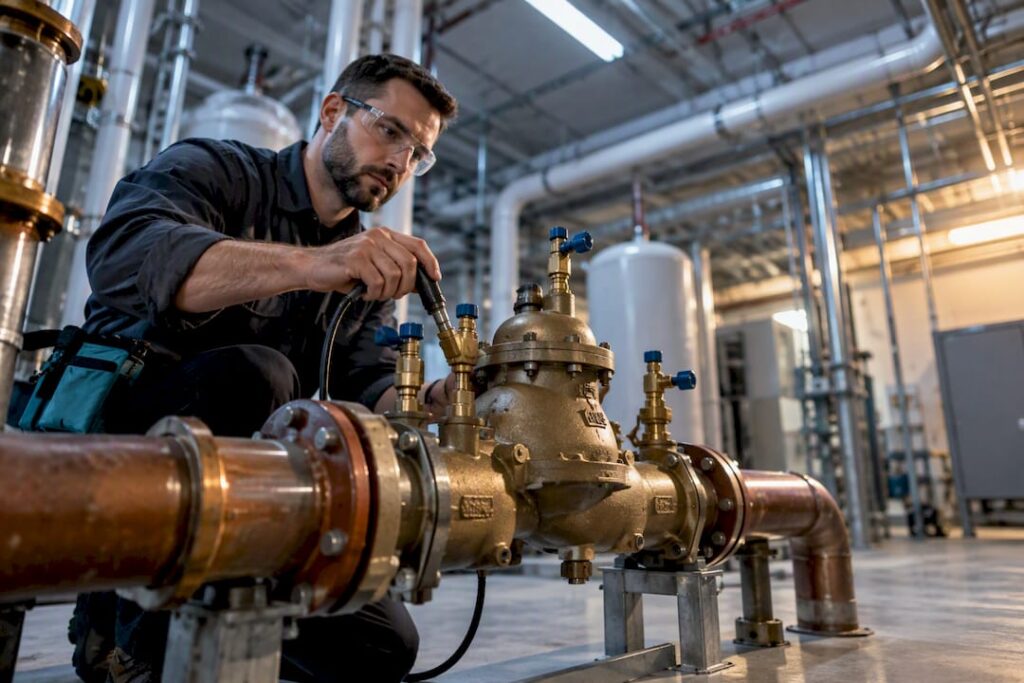
Reduced pressure zone (RPZ) assemblies are typically required wherever there’s a health hazard, which covers most hospital cross-connections involving chemicals, medical gas, or boiler additives. Double check valve assemblies (DCVA) cover lower-risk, non-health hazard connections. Manufacturer guidance and ASSE standards both back this split.
NJDEP’s installation checklist calls for test cocks, upstream strainers, mounting height between 12 and 60 inches, no below-grade pits, and a properly sized air gap on the relief drain. Freeze protection matters just as much. A device sitting exposed on an exterior wall through a New Jersey winter is a failure waiting to happen. For fire-protection lines and any service that can’t tolerate downtime, plan for a redundant device setup so one assembly stays in service while the other gets tested.
What Happens If a Backflow Device Fails Its Test
A failed device has to be repaired and retested within 30 days of the failed test. If it can’t be repaired, replacement on a fire-protection line often requires a construction permit and a device rated specifically for fire protection service, per DCA Bulletin 99-2.
If a municipal compliance letter shows up, don’t wait. Schedule a certified tester, document whatever repair work gets done, and submit the new certification and fee promptly. If the local plumbing subcode office wants to witness the retest, notify them before you schedule it. Ignore a lapsed Certificate of Compliance long enough and you’re looking at fines or, in the worst case, a water service interruption, which for a hospital is not a risk worth taking.
A Prioritized Compliance Checklist for Hospital Facility Teams
Getting hospital backflow compliance NJ under control comes down to four things: knowing what you have, knowing when it’s due, proving it on paper, and having a backup plan.
Inventory and permit check
- List every testable device with model, serial number, and exact location.
- Confirm which devices sit under an NJDEP physical connection permit versus a municipal Certificate of Compliance.
- Flag any device with no current permit or certificate on file.
Scheduling and staffing
- Set quarterly reminders for physical connection devices and annual reminders for municipal devices.
- Confirm your certified tester’s credentials match each device type before booking.
- Coordinate witnessing with your water supplier or plumbing subcode office when it’s required.
Documentation and filing
- Complete the BWSE-CITR-IQ form or municipal certificate paperwork immediately after testing.
- Mail or email NJDEP reports within five days, as the form instructions require.
- Retain every past report and certificate for at least the last three cycles, in case of an audit.
Contingency planning
- Line up a repair vendor that stocks OEM rebuild parts for same-day fixes.
- Identify which devices have redundant backup units and which don’t.
- Keep an internal escalation contact list so a failed test doesn’t sit unresolved over a weekend.
Pro Tip: Build one master spreadsheet that tracks both clocks side by side, quarterly NJDEP dates in one column and annual municipal dates in another. Most hospital compliance lapses happen because someone assumed a device was on the “easy” annual schedule when it was actually under a physical connection permit.
What Hospitals Get Wrong About Backflow Compliance in NJ
The single biggest pitfall hospitals hit isn’t a bad device. It’s confusing which clock applies to which device. A facility with fifteen backflow assemblies might have ten on the municipal annual cycle and five on NJDEP’s quarterly cycle, and if nobody separates them clearly, the quarterly devices quietly slip past deadline while the team is focused on the annual renewal.
Hospitals that avoid this usually do two things: they install redundant devices on any line that can’t go down, and they use heated enclosures to stop winter freeze failures before they start. Both are operational fixes, not regulatory ones, but they’re what actually keeps a facility off the enforcement radar. Southjerseybackflow’s RPZ testing guide and certified backflow tester explainer both walk through the credential and scheduling details facility managers ask about most.
— Jordan
Certified Testing and Same-Day Repairs for NJ Hospitals
Hospitals don’t have room for a missed retest deadline, and that’s the gap Southjerseybackflow was built to close. Instead of waiting weeks for a scheduled repair slot, Some vendors stock OEM parts for same-day rebuilds and repairs, and can file NJDEP or municipal test reports directly, so a failed test doesn’t turn into a 30-day scramble.
Before reaching out, have your device count, permit numbers, and last test dates on hand. That single step cuts scheduling time in half. Southjerseybackflow handles certified testing and certification for facilities across New Jersey, offers consolidated billing for hospitals managing multiple devices across one property or several, and can also install custom enclosures to protect exposed assemblies through winter. If your next test is due, request a quote and get a certified tester on the calendar before the deadline puts your Certificate of Compliance at risk.
Sources
- N.J. Admin. Code § 7:10-10.6 – Inspection and testing requirements and procedures for physical connection installations | LII
- DCA Bulletin 99-2: Testing of Backflow Preventers (NJ Department of Community Affairs)
FAQ
Is Backflow Testing Required in NJ?
Yes. Every testable backflow preventer in New Jersey needs testing, either quarterly under an NJDEP physical connection permit or annually under the municipal plumbing subcode, as outlined in DCA Bulletin 99-2. Hospitals frequently have devices on both schedules at once.
Do All States Require Backflow Testing?
Most states require backflow prevention on cross-connection hazards, but the testing frequency and reporting rules vary by state and even by municipality. New Jersey’s rules are set through N.J.A.C. 7:10-10.6 and the municipal plumbing subcode, and hospitals should confirm which applies rather than assume a national standard exists.
Where Are Backflow Preventers Required in NJ Hospitals?
Backflow preventers are required anywhere a hospital has a cross-connection hazard, which typically includes boilers, medical gas systems, laboratories, and any secondary or dual-water feed. NJDEP’s own physical connection guidance names hospitals directly as facilities that commonly trigger permit requirements.
How Often Do Backflow Devices Need to Be Inspected in NJ?
Devices under an NJDEP physical connection permit need pressure tests at least every three months plus an internal inspection before renewal. Devices under a municipal Certificate of Compliance need testing once a year, per DCA Bulletin 99-2.
What Does Backflow Testing Cost for a Hospital in NJ?
Commercial device testing typically runs between $200 and $450 USD per device, and current pricing details are available through Southjerseybackflow’s FAQ page. Hospitals with multiple devices can also request consolidated billing across a whole facility.