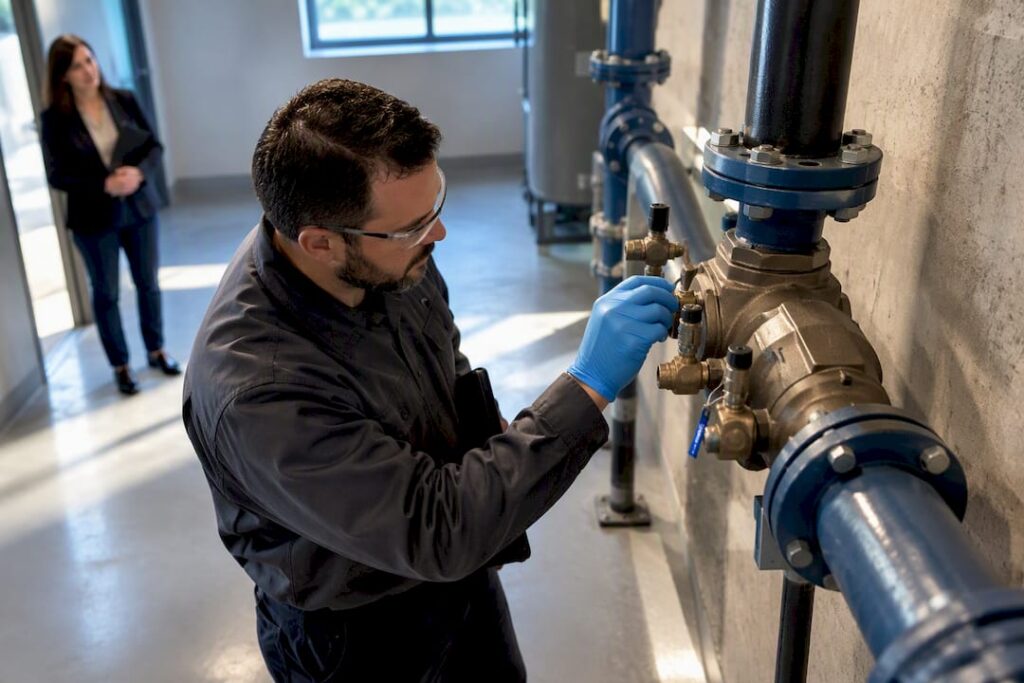
Commercial backflow assemblies generally require annual testing, with results filed by the municipal submission deadline. Miss it, and you risk a warning notice, a fine, or a water shutoff. The move: pull your device notice or portal account, confirm the exact due date, and book a state-certified tester before that date arrives.
TL;DR:
- Municipal testing deadlines vary, with fixed dates in some cities and rolling, zip-code-based windows in others, affecting how far in advance you must plan.
- All commercial backflow devices must be tested by certified professionals annually, with repair or component replacements requiring retesting before reactivation.
- Confirming your specific due date involves checking mailed notices, online portals, or contacting the water authority directly for an accurate testing window.
- Failing to file the test results on time can result in warnings, fines, or water shutoff, so maintaining organized records and workflow is crucial.
- Using a single provider that handles testing, direct filing, repairs, and recordkeeping helps ensure continuous compliance and avoids missed deadlines.
Table of Contents
- What a Commercial Backflow Schedule Usually Looks Like
- Who Has to Test, and How Often
- How to Find Your Property’s Exact Due Date
- Mapping Your Devices Before the Deadline Hits
- What Happens If You Miss a Filing
- Getting Ready for Test Day
- Handling Multiple Properties on Different Clocks
- A Workflow That Actually Keeps You Compliant
- Why the Deadline Itself Is the Real Risk
- Let South Jersey Backflow Handle Your Compliance Calendar
- Where to Verify Municipal Rules and Sample Schedules
- Sources
- FAQ
What a Commercial Backflow Schedule Usually Looks Like
Annual testing is the standard for commercial assemblies, but the scheduling details for this testing vary by municipality. Some municipalities assign every commercial account the same fixed date. Raleigh, for instance, sets July 1 as the annual submission date for commercial backflow testing, regardless of when the device was installed. Other cities stagger deadlines by zip code or account number, so two buildings across the street from each other might file six months apart.
A few patterns show up again and again once you look at enough municipal programs:
- Annual testing is standard for commercial assemblies; residential irrigation setups often run on a different cycle.
- Deadlines can differ by device type within the same property, not just by address.
- A new installation triggers an immediate test, not a wait for the next annual cycle.
- Any repair or component swap requires a retest before the device goes back into service.
- Fixed-date cities publish one deadline for everyone; other cities use rolling, zip-code-based windows.
Knowing which pattern governs your city changes how far ahead you need to plan.
Who Has to Test, and How Often
Commercial properties are treated as high-hazard by most cross-connection programs, which is why they carry stricter rules than a typical single-family home. JEA’s commercial backflow guidance classifies restaurants, healthcare facilities, multi-family buildings, and industrial sites as higher-risk categories that require approved assemblies at the point of service entry, tested annually.
The device installed usually depends on what the building does:
- Reduced Pressure Zone (RPZ) assemblies cover high-hazard connections like chemical feed lines, medical facilities, and food service.
- Double-check assemblies commonly protect fire sprinkler lines, where the hazard level is lower but backflow risk still exists.
- Pressure Vacuum Breakers (PVBs) show up frequently on irrigation systems.
- Detector assemblies pair with fire lines to catch unauthorized water use alongside backflow protection.
Every test, no matter the device, has to be performed by a state-certified tester. Municipalities routinely reject test reports filed by anyone lacking current BPAT (Backflow Prevention Assembly Tester) certification, which means an uncertified test is functionally the same as no test at all.
Pro Tip: Ask any tester you’re considering to show their current certification number before you book. If they hesitate, that’s your answer.
How to Find Your Property’s Exact Due Date
Guessing at your deadline is how properties end up filing late. Work through these steps in order:
- Check any mailed notice from your water authority first. It usually lists the device ID, location, and the exact due date.
- Log into your water authority’s online account portal. Most utilities now post the upcoming test window directly on the account dashboard.
- Search your municipality’s cross-connection control or public works page for a zip-code-based schedule or downloadable device list, similar to what Scottsdale’s water services program publishes for its commercial customers.
- If none of that turns up an answer, call the water authority directly. Have your account number and device inventory ready. Ask specifically for the test window, not just “when is it due,” since some cities give a 30 to 60 day range rather than a single date.
Mapping Your Devices Before the Deadline Hits
Before you can schedule anything, you need to know what you’re scheduling. Most commercial properties have more than one backflow assembly, and they’re rarely all in the same category.
RPZ assemblies typically sit at the main point of entry for high-hazard connections. Double-check assemblies tend to cluster around fire suppression lines, since they carry a lower hazard classification than a chemical or medical feed. Irrigation systems frequently have their own separate assembly and, in many cities, a different submission date entirely.
- RPZ assemblies typically protect high-hazard points of entry, usually requiring annual testing.
- Double-check assemblies commonly protect fire lines and often follow the same annual testing cycle as the primary device.
- PVB or irrigation-specific assemblies may follow different rules and could have fixed testing dates depending on the jurisdiction.
- Point-of-entry devices protect the whole building; point-of-use devices protect a single fixture or line.
When your notice references a specific device, confirm whether it’s talking about the main entry assembly or a secondary one before you assume the schedule applies property-wide.
What Happens If You Miss a Filing
Filing responsibility almost always sits with the property owner, even when a hired tester performs the actual work. Some municipalities allow the tester to submit results directly; others require the owner or manager to upload the report through a utility portal themselves. Either way, confirming who actually filed the paperwork is worth a five-minute phone call.
Retention matters too. Keep test and repair records for several years, since inspectors and water authorities can ask to see history well after a given cycle closes. IAPMO’s guidance on backflow prevention frames this as more than paperwork. Backflow failures are a public-health risk, and the liability for a contamination event generally falls on the property owner, not the tester or the city.
- First missed deadline: a warning letter or notice of non-compliance.
- Continued non-response: escalating fines, sometimes accruing daily.
- Extended non-compliance: water service suspension, which for a commercial property means an operational shutdown, not just an inconvenience.
Getting Ready for Test Day
A certified tester can usually move faster, and pass more devices on the first visit, when the property has done a little prep work first.
- Clear physical access to every device. Testers can’t gauge what they can’t reach.
- Confirm valves are labeled and functioning, especially shutoffs near the assembly.
- Pull recent repair history so the tester knows about any recent component swaps.
- Flag any device that was recently reinstalled after removal, since seasonal irrigation lines typically require an immediate retest after reinstallation rather than waiting for the annual cycle.
The test itself runs through a visual inspection, gauge measurements across the check valves, and functional checks of the relief valve and shutoffs. Standardized test protocols exist precisely so a pass in one city means the same thing as a pass in another. A failed device usually needs same-visit repair when possible, followed by an immediate retest before it can be marked compliant.
Pro Tip: If your tester carries common OEM rebuild parts on the truck, a failed valve often gets fixed and retested in the same appointment instead of costing you a second trip.
Handling Multiple Properties on Different Clocks
Portfolios with several sites rarely have the luxury of one deadline. A property in one town might file by a fixed date; another three miles away might run on a rolling zip-code window. Centralizing that information beats tracking it site by site.
- Keep one compliance calendar listing every device, its location, and its actual due date, not just the property address.
- Use a single provider to batch nearby sites into the same visit whenever municipal windows overlap, which cuts down on missed filings and simplifies invoicing.
- Set automated reminders 60 and 30 days out, not just at the deadline itself.
- Establish a priority repair agreement in advance so a failed test doesn’t turn into a week of downtime while you shop for parts.
A Workflow That Actually Keeps You Compliant
The pattern that works, in practice, is inventory, schedule, test, file, archive, repeated on a loop rather than reset every year from scratch.
- Build a device inventory once, then update it only when something changes.
- Schedule tests two to three weeks ahead of the municipal window, not the week it opens.
- File immediately after testing rather than batching paperwork for later.
- Archive every report and repair record in one place tied to the device, not the year.
This maintenance workflow also accounts for seasonal irrigation devices that get pulled for winter, since those need an immediate retest on reinstallation rather than sitting until the next annual date. A competent service partner should handle direct filing, carry common parts for same-visit repairs, and keep your records consolidated instead of scattered across separate invoices.
Why the Deadline Itself Is the Real Risk
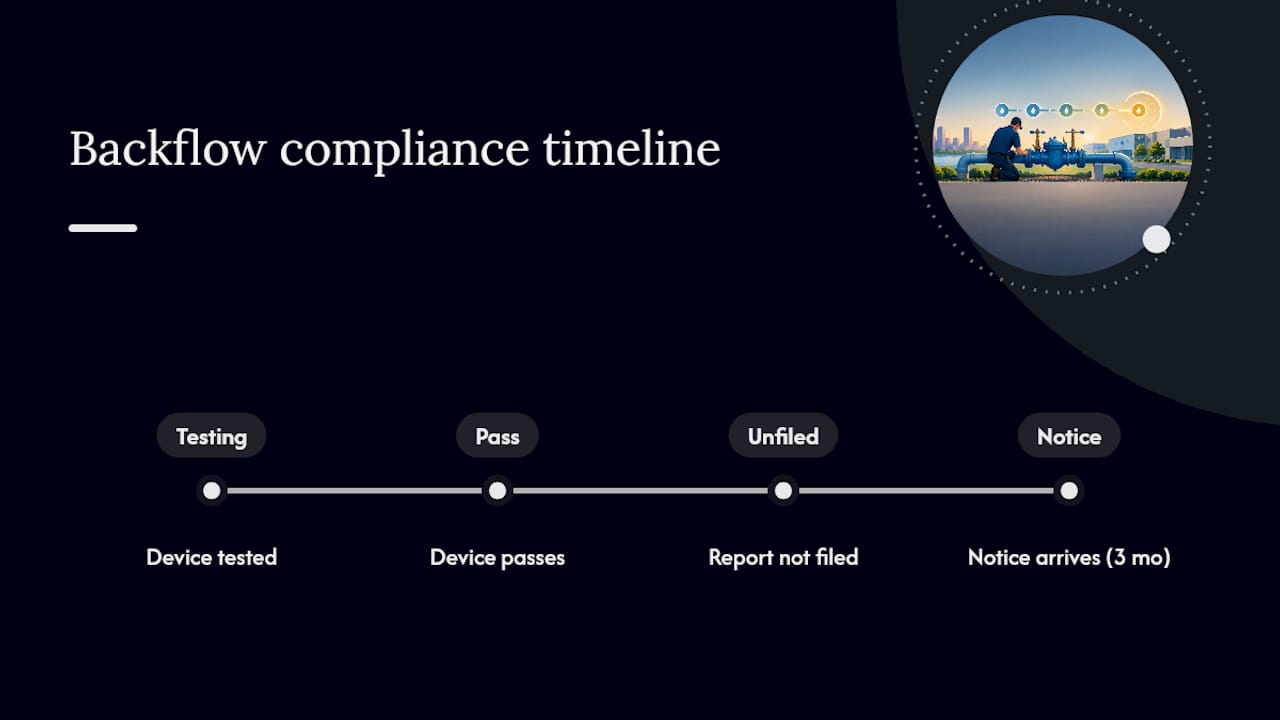
Most property managers treat backflow testing like an inspection to survive rather than a deadline to manage, and that’s backward. The test rarely fails a building; the missed filing does. I’ve seen the pattern repeat across different municipalities: a manager schedules the test, the tester shows up, the device passes, and then nobody actually confirms the report got filed. Three months later there’s a notice in the mail.
The fix isn’t more diligence. It’s a workflow that doesn’t depend on anyone remembering. Use the checklists here, put your due dates on a calendar tied to the device rather than the year, and bring in a certified provider who files on your behalf if you’re managing more than one site.
— Jordan
Let South Jersey Backflow Handle Your Compliance Calendar
South Jersey Backflow is the alternative to juggling multiple vendors, missed notices, and DIY paperwork for commercial compliance in New Jersey. Same-day service, statewide coverage, and direct filing mean your test results reach the water authority without you tracking down a portal login or chasing a tester for a report.
The company handles commercial device testing and certification, repairs and rebuilds when a device fails, and custom enclosure installation for assemblies exposed to weather or tampering. Because the team stocks OEM parts, a failed valve often gets rebuilt and retested in the same visit instead of costing you a second trip and a second invoice. Municipal filing is handled directly, so you’re not left wondering whether your report actually reached the water authority before the deadline. Pricing for commercial device testing runs $200 to $450 per device, and the company is family-owned, licensed, and insured across its New Jersey service area.
If you’ve already got a compliance notice or you just want your due dates confirmed, reach out through the testing and certification page to get a device on the books before your next municipal window closes.
Where to Verify Municipal Rules and Sample Schedules
- IAPMO BPI publishes backflow prevention standards and public-health guidance referenced by most cross-connection programs.
- Raleigh’s Cross-Connection Control Program shows a real example of a fixed-date commercial submission calendar.
- Scottsdale Water Services illustrates how a municipality structures tester lists, forms, and filing expectations.
- JEA’s commercial backflow requirements page breaks down high-hazard property classifications and device placement rules.
Sources
- Commercial backflow requirements | JEA
- IAPMO BPI — Backflow prevention resources
- Understanding backflow risks, regulations and prevention measures | Plumbing & Mechanical
- Raleighnc
- Commercial Services – Water | City of Scottsdale
FAQ
How Often Must You Test a Commercial Backflow Device?
Commercial backflow assemblies generally require annual testing by a state-certified tester. Some cities apply a fixed annual date for every account, while others assign rolling deadlines by zip code or account number, so your specific due date depends on your municipality’s program.
How Much Does It Cost to Install a Backflow Preventer for a Commercial Property?
Cost depends on the device type, hazard classification, and installation complexity. South Jersey Backflow’s residential installation service runs $300 to $800, and commercial installations are typically quoted individually based on device count and site conditions, so check current pricing directly.
Do All Commercial Buildings Need a Backflow Preventer?
Most commercial buildings need at least one approved backflow assembly, since cross-connection programs classify commercial properties as high-hazard by default. Restaurants, healthcare facilities, multi-family buildings, and any site with fire sprinklers or irrigation almost always require one.
What Counts as a Commercial Backflow Situation?
A commercial backflow situation is any connection where contaminated water could flow backward into the public water supply from a commercial property, such as a restaurant’s chemical feed line, a hospital’s plumbing, or a fire suppression system. These connections require an approved assembly, typically an RPZ or double-check device, tested annually and filed with the local water authority.
What Happens If I Miss My Backflow Testing Deadline?
A missed deadline usually starts with a warning notice or non-compliance letter from your water authority. Continued inaction can lead to escalating fines and, in more serious cases, suspension of water service to the property until the test is completed and filed.