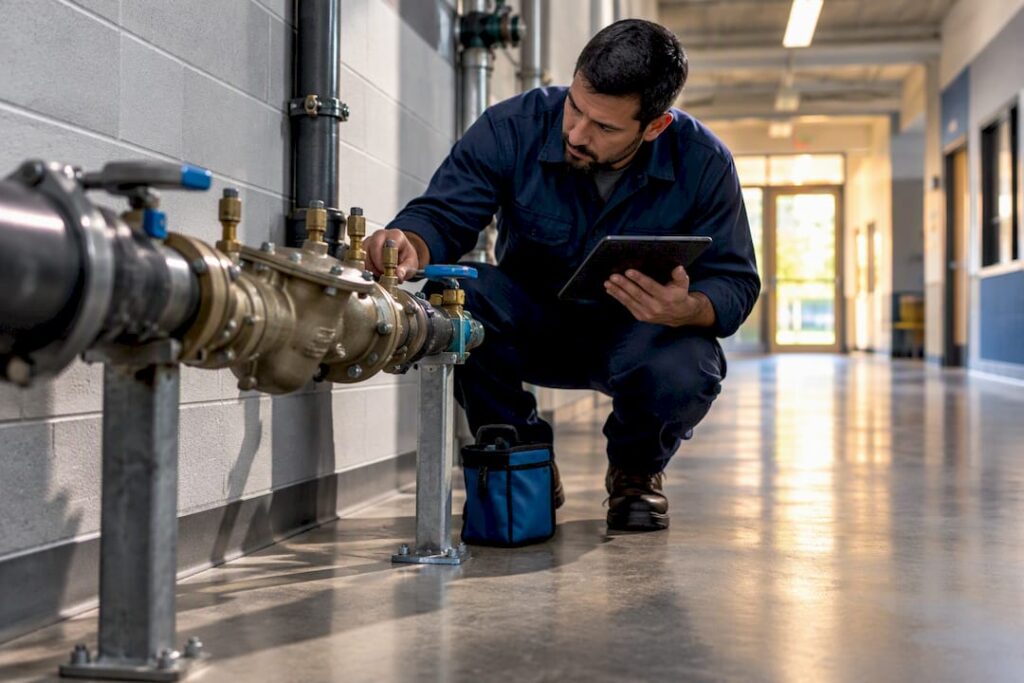
Any New Jersey school with a physical connection to an unapproved water source, be it an irrigation well, a boiler loop, or a lab supply line, falls under N.J.A.C. 7:10-10.1 and must install a double-check or reduced-pressure-zone assembly, tested by an NJDEP-recognized tester. If your facility has anything beyond a single domestic water tap, check with your water supplier now and build a device inventory before an inspector asks for one.
TL;DR:
- Schools must install qualified double-check or reduced-pressure-zone assemblies on all unapproved or hazardous water connections, tested annually by certified NJDEP-recognized testers.
- The physical connection rule applies whenever a school’s water supply links directly or indirectly to unapproved sources like wells, ponds, or chemical labs, often involving multiple entry points.
- Correct device type depends on hazard level; RPZs are required for chemical or nonpotable sources, while double-checks suffice for low-risk, domestic-only connections.
- Proper testing, permits, and recordkeeping involve separate local, state, and supplier approvals, with documentation retained in a central, accessible compliance packet.
- Non-compliance risks include service shutdowns, inspection delays, and liabilities from potential water contamination, so proactive inventory, scheduling, and record management are essential.
Table of Contents
- School Backflow Requirements NJ: When the Rules Apply
- Double-Check Vs. RPZ: Which Device Your School Actually Needs
- Who Can Test Your Devices, and How Often
- Permits and Filing: Two Layers You Can’t Skip
- The Compliance Checklist Every Facility Manager Needs
- How South Jersey Backflow Supports NJ School Compliance
- What Happens When a School Falls Out of Compliance
- Keeping Records That Actually Hold Up to an Audit
- Maintenance Habits That Keep Devices From Failing Early
- Field Notes: What Actually Trips Schools Up
- Get Your School’s Devices Tested and Filed Correctly
- Where to Verify These Rules Yourself
- Sources
- FAQ
School Backflow Requirements NJ: When the Rules Apply
The trigger isn’t the building type. It’s the connection. New Jersey’s physical-connection rule kicks in whenever a public community water system links, directly or indirectly, to a source the state hasn’t approved as safe, or to a system carrying elevated contaminant risk. For a school, that usually means more entry points than facility staff expect.
A “physical connection” is any pipe, valve, or fitting joining the public water main to something else, on purpose or by accident. Common school examples include:
- Irrigation systems drawing from a well or pond alongside the municipal supply
- Science lab plumbing tied to chemical mixing stations or eyewash stations with additive risk
- Boiler and heating loops with chemical treatment additives
- Dedicated fire lines connected to the same service as domestic water
- Auxiliary intakes, cisterns, or emergency water storage used for grounds or athletic fields
These rules run alongside the Uniform Construction Code’s plumbing subcode at N.J.A.C. 5:23-3.15, so a new irrigation line or lab renovation can trigger both a plumbing permit and a physical-connection review. Your water supplier holds real authority here: under NJDEP guidance, suppliers can require containment devices and enforce their own cross-connection control programs beyond the state minimum. Call your supplier first and ask for a written device inventory template and their specific filing instructions. Skipping that step is the single most common reason schools get flagged during a routine survey.
Double-Check Vs. RPZ: Which Device Your School Actually Needs
Not every connection needs the same level of protection, and picking the wrong assembly is one of the costliest mistakes a facility team can make. A double-check valve assembly uses two independent check valves to stop reverse flow. A reduced-pressure-zone assembly does the same job but adds a relief valve that vents to the atmosphere the moment either check valve fails internally, so contaminated water spills onto the floor instead of back into the main.
That difference in failure behavior is exactly why the state sets a hard line on when each is allowed. Under N.J.A.C. 7:10-10.3, an RPZ assembly is required whenever the unapproved source is nonpotable or its contaminant levels exceed state primary drinking-water standards. A double-check assembly is only acceptable for lower-hazard, non-health connections.
In practice, schools usually see this split:
- Likely RPZ territory: chemistry and biology labs, boiler rooms with treatment chemicals, irrigation tied to ponds or wells, greenhouse or agricultural science programs
- Likely double-check territory: straightforward fire sprinkler lines with no additives, simple domestic-only auxiliary connections
Pro Tip: Document the hazard assessment behind every device choice in writing, even when the answer seems obvious. If a device ever gets questioned during a supplier audit, “we assessed it and here’s why” beats a guess every time.
Who Can Test Your Devices, and How Often
Only a tester holding certification from an agency recognized by NJDEP’s Bureau of Safe Drinking Water may legally test a backflow assembly on your property. A facility maintenance staffer, however skilled, cannot self-certify a device. This single rule trips up more schools than any other part of the code.
Here’s the testing timeline that actually applies to a school building, which counts as non-residential regardless of enrollment size:
- Before final inspection. Every field-testable assembly gets tested before a building or renovation project closes out, per DCA bulletin B-99-2.
- Annually thereafter. Non-residential properties, schools included, require regular testing with no exception for smaller campuses. The residential testing exemption some homeowners rely on simply does not extend to educational facilities.
- Within 30 days of a failure. If a device fails its test, N.J.A.C. 7:10-10.6 requires repair and retesting within 30 days. Miss that window and the connection is technically out of compliance.
- NJDEP approval for certain replacements. If a repair changes the physical connection itself, rather than a simple in-kind part swap, NJDEP approval may be required before work proceeds.
A local building or fire inspector can either witness the test directly or accept your certified tester’s submitted report. Either way, B-99-2 confirms the resulting Certificate of Compliance is valid for one year, and results typically get filed with both the municipal inspector and your water supplier, not just one or the other.
Permits and Filing: Two Layers You Can’t Skip
Backflow compliance at a school touches two separate permit systems, and treating them as one is where projects lose weeks. Local construction permits, reviewed by plumbing and fire subcode officials, cover the physical installation of the device. NJDEP physical-connection permits govern the connection itself, separate from whether the pipe was installed to code.
Combination fire and domestic service lines add another wrinkle. These typically require joint plan review between the fire subcode official and the water purveyor, since one line now serves two systems with different hazard profiles.
Before you schedule anything, run through this sequence:
- Confirm with your municipal construction office whether local permit fees apply to your project
- File the physical-connection permit application with your water supplier or NJDEP as instructed
- Line up your certified tester’s schedule against your permit review timeline, not after it
- Keep copies of every permit number, since inspectors will ask for them alongside test certificates
Schools that align these three steps upfront routinely close out projects weeks faster than those that treat permits as an afterthought. For a fuller walkthrough of the filing sequence, see this guide to complying with backflow inspection requirements in New Jersey.
The Compliance Checklist Every Facility Manager Needs
Getting ahead of an inspection or supplier audit comes down to five habits, done consistently rather than scrambled together once a year.
- Build a complete device inventory and site map. Cover domestic service, fire lines, irrigation, labs, boilers, kitchens, pools, and any private or auxiliary source. Undocumented bypass valves are a common surprise during audits.
- Get filing instructions in writing from your water supplier. Confirm test intervals and reporting expectations directly, rather than assuming statewide minimums apply uniformly.
- Run one central compliance calendar. Many schools already track lead-in-water testing schedules under N.J.A.C. 6A:26-12.4; folding backflow testing into that same calendar prevents dates from slipping through the cracks.
- Plan physical access ahead of test day. Locked mechanical rooms, vaults, and risers need coordination with fire and life-safety staff, and some tests require a brief water shutdown.
- Retain every certificate, repair record, and permit number in one packet. When an inspector or supplier asks for proof, you want one folder, not a scavenger hunt across departments.
Pro Tip: Keep a single “compliance packet,” physical or digital, with every certificate, permit number, and repair invoice for each device. When an inspector shows up unannounced, that folder is worth more than any explanation.
How South Jersey Backflow Supports NJ School Compliance
A company provides NJDEP-compliant testing with direct filing to water suppliers, repairs and rebuilds, and enclosure installation for schools in New Jersey. This combination matters because a district juggling a lab renovation, a failed device, and a filing deadline doesn’t have time to coordinate three separate vendors.
A pre-inspection device inventory, done before the tester arrives, cuts down on repeat visits and reduces the odds of a filing error that delays your Certificate of Compliance. Before hiring any tester or service partner, ask these questions:
- Is the tester certified by an agency NJDEP recognizes?
- Who files the report, and with which agencies?
- What’s the turnaround time if a device fails and needs a retest within 30 days?
- Are OEM parts kept in stock for same-visit repairs, or does a failed device mean a second appointment?
What Happens When a School Falls Out of Compliance
Non-compliance rarely announces itself with a single dramatic penalty. It shows up as a stalled inspection, a supplier notice, or a fire marshal flagging a connection during an unrelated walkthrough, and from there the consequences compound quickly.
A water supplier that discovers an untested or unapproved connection can require immediate correction and, in some cases, restrict or shut off service to the affected connection until the device is brought up to code. That’s a serious operational risk for a school relying on that line for irrigation, fire suppression, or lab water. Local construction officials can also withhold a certificate of occupancy on a renovation project if the required backflow testing wasn’t completed before final inspection, which stalls move-in dates for new classrooms or lab spaces.
There’s also a liability dimension that doesn’t get discussed enough. If a cross-connection contaminates the potable water supply and a school failed to maintain a required device or skipped its annual test, that failure becomes a documented compliance gap, exactly the kind of record a district doesn’t want surfacing during litigation or a public health investigation.
Municipalities vary in how they enforce timelines and fees. Evesham Township’s backflow testing page is a useful example of how local governments translate the state rule into a concrete annual reinspection process with its own local contact points and fee schedule. Your own municipality likely publishes something similar, and it’s worth a call rather than an assumption.
Keeping Records That Actually Hold Up to an Audit
Every test result, repair invoice, and permit number connected to a backflow device needs a home, and “somewhere in the maintenance office” doesn’t count when an inspector asks for it on the spot.
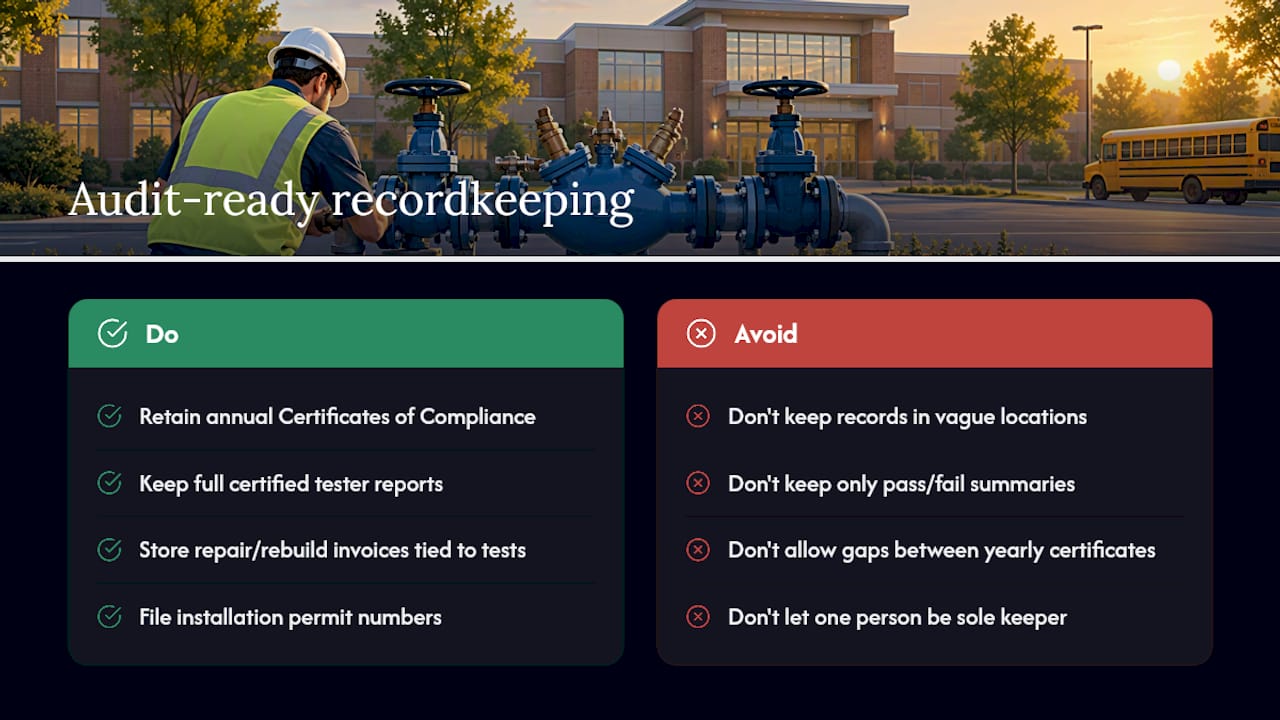
At minimum, retain the annual Certificate of Compliance for each device, the certified tester’s full report (not just a pass/fail summary), any repair or rebuild invoices tied to a failed test, the permit number from the original physical-connection installation, and proof that results were filed with both your water supplier and your municipal inspector. DCA guidance treats that Certificate of Compliance as valid for one year, so your records need to show an unbroken chain, one certificate picking up where the last one expired, with no gaps a reviewer could question.
Digital recordkeeping makes this dramatically easier than paper files scattered across departments. A shared folder or simple spreadsheet, organized by device location and renewal date, lets any staff member pull up a device’s full history in seconds rather than digging through filing cabinets during an unannounced audit. Cross-reference this same system with your lead-in-water testing records under NJDOE rules, since both fall under the same broader umbrella of school drinking-water compliance and often get reviewed together.
Whoever manages facilities should not be the sole keeper of this information. Build in a backup, whether that’s a business office administrator or a shared digital system, so a staff transition doesn’t leave your district scrambling to reconstruct years of testing history.
Maintenance Habits That Keep Devices From Failing Early
A backflow assembly that’s tested once a year and otherwise ignored is far more likely to fail that annual test than one getting basic attention in between. Internal check valve seats wear down, springs weaken, and debris from municipal line work can lodge in the assembly, all things a quick visual check can catch early.
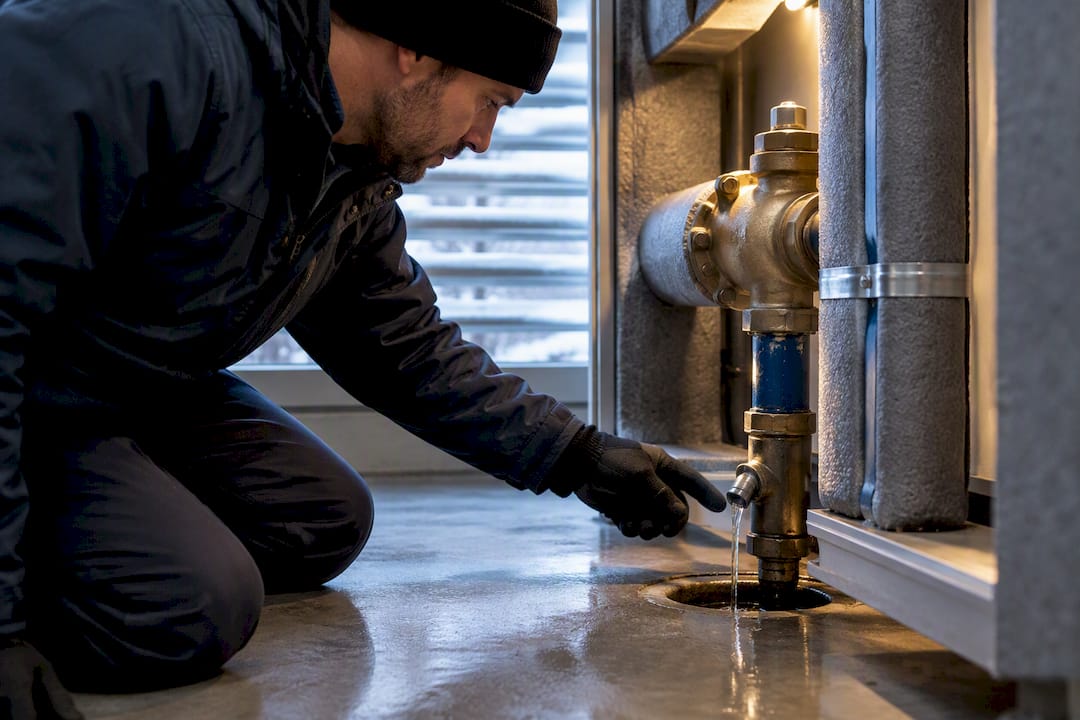
Walk your device locations a few times a year, outside of the formal annual test, and look for visible leaks, corrosion on fittings, or standing water near an RPZ’s relief valve, which often signals the valve is already discharging more than it should. For outdoor or unheated installations, freeze protection deserves real attention going into winter. A device that cracks from freeze damage in January doesn’t wait politely for your scheduled test date, and an enclosure built for New Jersey winters is far cheaper than an emergency replacement mid semester.
Keep a simple log of anything unusual, a slow drip, a valve that sounds different, a pressure reading that seems off, even if it doesn’t seem urgent at the time. Patterns matter more than single incidents, and a tester reviewing your maintenance log alongside test results gets a much clearer picture of a device’s real condition than an annual snapshot alone provides.
Field Notes: What Actually Trips Schools Up
The schools that struggle with compliance almost never have a complicated legal problem. They have an organizational one. Missing device inventories top the list, closely followed by confusion over which authority to notify, the water supplier, NJDEP, or the local inspector, when in fact all three often need something from you.
Access problems cost more testing days than anything else I’ve seen. A tester who shows up to a locked mechanical room with no one available to open it doesn’t get the job done, and that delay can push a retest dangerously close to the 30-day deadline. My advice stays consistent every time: build one compliance calendar, run a pretest access checklist before the tester’s truck pulls up, and treat your device inventory as a living document, not a one-time project.
— Jordan
Get Your School’s Devices Tested and Filed Correctly
A service provides NJ school facility teams a single point of contact for the compliance cycle, including testing and certification, repairs and rebuilds, enclosure installation, and direct filing with water suppliers, instead of juggling separate vendors for each piece.
That matters most during budget season and summer break windows, when districts need repairs done fast and paperwork filed correctly the first time, not bounced back for corrections weeks later. Before booking, pull together your device inventory and note which connections are due for annual testing. That single step cuts down on return visits and keeps your filing timeline intact. Ready to schedule an inspection or compliance audit? Start with NJDEP-compliant backflow testing and certification and get your district’s paperwork moving before your next deadline hits.
Where to Verify These Rules Yourself
- N.J.A.C. 7:10-10.1: defines when physical-connection permit and device rules apply
- NJDEP physical-connection permit guidance: explains triggers, definitions, and where to find certified testers
- DCA bulletin B-99-2: sets testing frequency and inspector procedures
- N.J.A.C. 6A:26-12.4: NJDOE lead-in-water testing rules that overlap with school water-safety compliance calendars
Sources
- N.J. Admin. Code § 7:10-10.1 – Purpose and scope
- Department of Community Affairs bulletin B-99-2: Testing of Backflow Preventers
- Regulatory guidance: Physical connection permit triggers (NJDEP)
FAQ
Is Backflow Testing Required in NJ Schools?
Yes. Any school with a physical connection to a public water system falling under N.J.A.C. 7:10-10.1 must test its backflow devices annually, since the residential testing exception does not apply to non-residential buildings like schools.
What Does the NJ Plumbing Code Require for Backflow Preventers?
The code requires an approved double-check or reduced-pressure-zone assembly at any qualifying physical connection, with the specific device determined by hazard level under N.J.A.C. 7:10-10.3. Installation also has to satisfy the plumbing subcode requirements in the Uniform Construction Code.
Does a Backflow Preventer Require a Permit?
Yes, in most cases. A new or altered physical connection typically needs both a local construction permit for the plumbing work and, depending on the connection, a state physical-connection permit, so check with your municipal construction office and water supplier before starting work.
Where Are Backflow Prevention Devices Required in a School?
Devices are required anywhere a public water system connects to an unapproved or potentially hazardous source, which in schools commonly includes irrigation systems, science labs, boiler loops, dedicated fire lines, and auxiliary water intakes. A full site inventory is the only reliable way to identify every qualifying connection on your campus.
How Much Does Backflow Testing Cost for a NJ School?
Pricing depends on device count and type, and current rates are listed on the South Jersey Backflow FAQ page. Commercial and institutional properties like schools typically involve multiple devices, so requesting a quote based on your actual inventory gives the most accurate number.