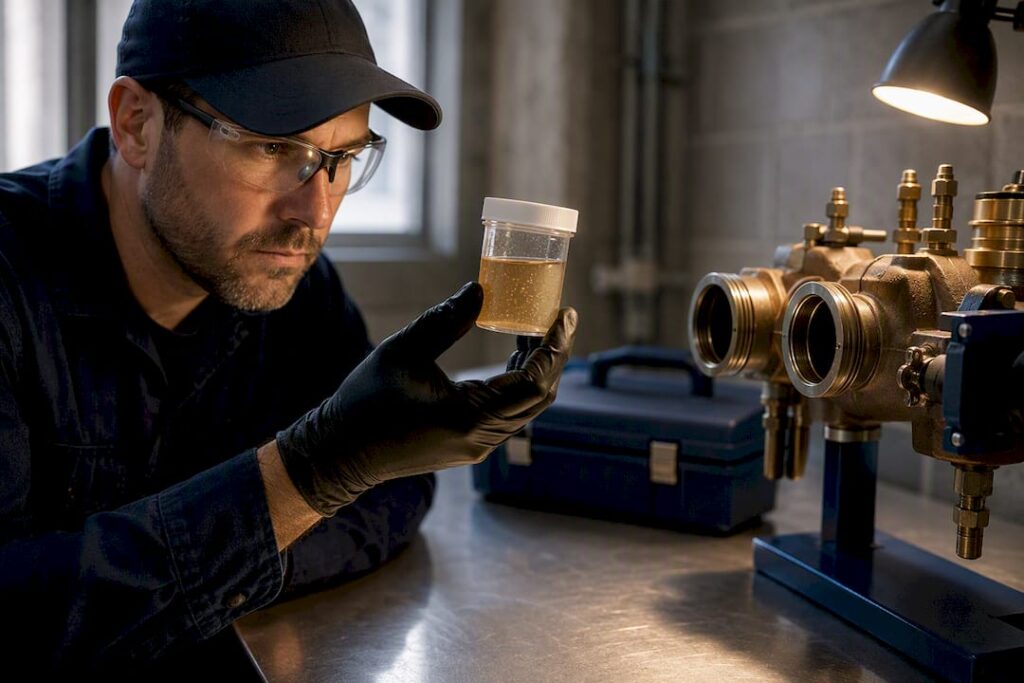
Stop using the water for drinking or cooking, and shut off the affected supply if you can do it safely. Call your water utility and a certified backflow tester right away. Then follow the utility’s advisory guidance while the technician diagnoses, repairs, and retests the device before anyone drinks from that line again.
TL;DR:
- Utility response timing depends on whether the property has high-hazard connections, with faster protocols in place for facilities like medical or food service sites.
- Signage at affected fixtures and localized shutoffs help limit disruption and contain hazards during the first 60 minutes of a backflow incident.
- Testing and documentation must be completed before resuming use, with scheduled regular testing critical to detecting silent failures in high-hazard systems.
- Clear communication with the water utility, health department, and certified testers ensures efficient incident management and compliance.
- Preparation, including current contact lists, device records, and emergency procedures, significantly reduces response time during a backflow emergency.
Table of Contents
- Backflow Emergency Response Checklist: The First 60 Minutes and Beyond
- Who Do You Call First in a Backflow Emergency?
- When Do You Shut Off Water or Issue a Do-Not-Use Advisory?
- Visible Signs vs. Silent Failures: What Should Worry You?
- What Happens After the Technician Arrives?
- How Can You Prepare Before the Next Emergency Happens?
- Why Documentation Speeds Every Backflow Emergency Response
- Emergency Backflow Repairs and Certified Testing from Southjerseybackflow
- Where to Find Official Backflow Emergency Guidance
- Sources
- FAQ
Backflow Emergency Response Checklist: The First 60 Minutes and Beyond
The order you take these steps in matters almost as much as taking them at all. A property manager who calls the plumber before the utility often ends up duplicating work, or missing a public notification window that the health department needed hours ago.
First 0 to 60 minutes:
- Post signage at every affected fixture, hose bib, and drinking fountain warning people not to use the water.
- Determine whether you can isolate the problem at a single valve near the backflow assembly, rather than killing water to the whole building. A localized shutoff limits disruption to tenants, patients, or customers while still stopping the hazard at its source.
- Call your local water utility’s emergency line first. They need to know immediately so they can assess citywide risk, not just your property’s risk.
- Call a certified, department-registered backflow tester. Testing must happen before service resumes, after any repair, and at least annually under most cross-connection control programs, and this is the moment that first requirement kicks in hardest, per the EPA’s Cross-Connection Control Manual.
- If the site has a high-hazard connection (a commercial kitchen, a medical facility, a mortuary, a chemical feed system), say so explicitly when you call. That detail changes how fast the utility responds.
Next 24 to 72 hours:
- Keep irrigation systems and hose bibs shut off until the tester clears the assembly. An irrigation line is one of the most common paths for lawn chemicals or pooled water to reverse into a potable system.
- Do not flush lines, toilets, or drains on your own initiative once a utility or health department has flagged the area. Unauthorized flushing can spread contamination further into the building or interfere with the sampling plan.
- Photograph the device, the relief port (if it’s a reduced pressure zone assembly, or RPZ), and any visible discoloration or discharge. Note the exact time you noticed the problem and the time you made each call.
- Keep a written log of who you spoke with at the utility and at the testing company, and what they told you to do next.
Pro Tip: Save your water utility’s emergency line and your certified tester’s after-hours number in your phone right now, before anything goes wrong. During an actual incident, you will not want to be searching a filing cabinet for a phone number while water is running somewhere it shouldn’t be.
Documenting the incident isn’t paperwork for its own sake. Insurers and local regulators will both want a timeline, and a clean one protects you if the question of liability ever comes up later.
Who Do You Call First in a Backflow Emergency?
Three parties typically get involved, and each one does something different. Knowing the division of labor keeps you from wasting time explaining the wrong problem to the wrong office.
- Your water utility assesses the risk to the broader distribution system, decides whether a boil water or do-not-use advisory is warranted, and coordinates any flushing or disinfection with its own crews.
- The local health department issues public notifications when an advisory affects multiple properties or a public water supply, and provides health-protection guidance for anyone who may have already consumed the water.
- A certified backflow tester documents the specific failure, isolates it to a component, performs the repair, and files the retest report that proves the hazard has been corrected.
Water system operators are expected to identify the cause and the affected area, notify customers, and coordinate flushing and sampling procedures once an incident is confirmed, according to Washington State’s Department of Health guidance on responding to backflow incidents. Notification windows vary by jurisdiction, but the pattern holds everywhere: the sooner you report, the sooner sampling and public notice decisions can start.
Before you make the first call, gather what you can: the device’s make, model, and serial number if you know it, photos of any visible discharge or discoloration, the exact time you first noticed something wrong, and a rough map of which parts of the building or property are affected. A tester who arrives with that information already in hand can move straight to diagnosis instead of spending the first fifteen minutes gathering facts you could have texted ahead.
When Do You Shut Off Water or Issue a Do-Not-Use Advisory?
The decision hinges on contaminant type, not gut feeling. A minor pressure drop that trips a relief valve is a different situation than confirmed chemical intrusion, and the appropriate public response differs accordingly.
- Boil water advisories apply when the contamination risk is primarily biological, since boiling kills most pathogens but does nothing for chemicals.
- Do-not-use advisories apply when a chemical, fuel, or other non-biological contaminant is suspected, because boiling would concentrate the problem rather than solve it.
- Full or partial shutoff should happen at the smallest valve that isolates the hazard. Cutting the main line unnecessarily can create pressure imbalances elsewhere in the distribution system and complicate the utility’s own response.
Utilities that maintain a formal emergency response plan, including pre-identified backup drinking water sources and mutual-aid contacts, tend to move through this decision faster because the framework already exists before the incident happens, based on EPA guidance on distribution system contamination response. That is exactly why flushing and disinfection should never happen on your own initiative. A utility crew coordinating a citywide flush needs to control the sequence, and a property manager flushing lines independently can push contaminated water into sections the utility had already cleared.
Visible Signs vs. Silent Failures: What Should Worry You?
Some backflow failures announce themselves. Others do not, and that gap is exactly why annual testing exists instead of relying on the naked eye.
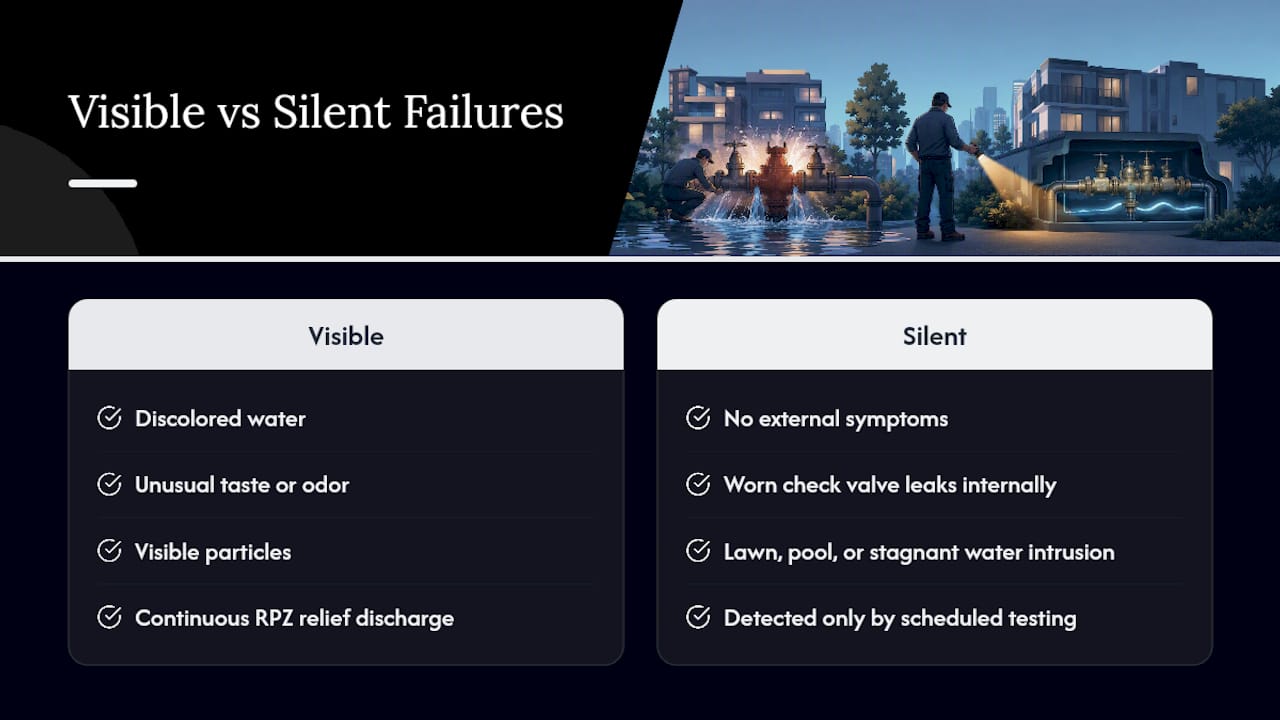
Visible signs include discolored water, an unusual taste or odor, visible particles, or a sustained discharge from an RPZ’s relief port. That last one is worth flagging specifically: a continuous relief port discharge is one of the most reliable field indicators that an internal check valve has failed, and it should trigger an immediate service call rather than a wait-and-see approach, per Backflow Authority’s breakdown of failure signs.
Silent failures are the harder problem. A worn check valve can leak internally without any external symptom at all, and lawn chemicals, pool water, or stagnant water can enter a system with no smell or discoloration you’d notice at the tap. That’s the core argument for testing on a schedule rather than waiting for a sign, since testing is the only reliable way to confirm a device is still functioning as designed.
Facilities with high-hazard connections, meaning medical buildings, food service kitchens, and childcare centers, need to treat every failed test as urgent regardless of whether there’s a visible symptom. A high-hazard connection typically involves an RPZ assembly, and a code violation there can’t be solved by swapping in a lower-rated device.
What Happens After the Technician Arrives?
A certified tester’s visit follows a fairly consistent sequence, and knowing it ahead of time helps you set realistic expectations with tenants, staff, or ownership while the work is underway.
- Diagnosis. The technician isolates the failure to a specific component, usually the check valve, the relief valve, or the air inlet, rather than treating the whole assembly as a black box.
- Repair or replacement decision. A field repair kit is appropriate when it restores the assembly to factory-specified performance. When it can’t, full assembly replacement and the associated permitting become necessary instead.
- Coordinated flushing and disinfection. If contamination reached the distribution system, this step happens in coordination with the utility, not independently, so the sequence matches whatever advisory is already in place.
- Lab sampling. Water samples confirm the system is clear before anyone lifts a do-not-use advisory.
- Mandatory retest. No repair is considered complete until the assembly passes a formal retest, which is the same requirement that applies after any repair or annually as routine maintenance.
Pro Tip: Ask your tester for a copy of the retest report the same day it’s filed, not weeks later. If your property manages multiple devices across several buildings, having that paperwork on hand immediately makes the next annual renewal cycle far less of a scramble.
The paper trail matters beyond your own files. Utilities use these reports to close out the incident on their end and to satisfy state-level compliance records, and a certified tester explains the compliance side of this process in more detail if you want the fuller regulatory picture. Certified testers should notify water suppliers quickly once a field test confirms an incident, since that notification shapes both the public notice and the sampling plan the utility puts in place.
How Can You Prepare Before the Next Emergency Happens?
The properties that handle a backflow emergency well are almost always the ones that did unglamorous prep work months earlier. That prep work is cheap compared to the cost of a slow, disorganized response.
- Keep an emergency contact list current, and actually test it once a year. A phone number for a utility office that changed its after-hours line two years ago is worse than useless.
- Store device details and the most recent test report somewhere staff can find fast, not buried in a property management system nobody remembers the login for.
- Build a simple emergency response procedure that borrows from the Incident Command System (ICS) structure utilities themselves use, so your team’s response integrates cleanly with outside responders instead of working against them.
- Schedule certified testing on a fixed calendar rather than waiting for a renewal notice, and consider a protective enclosure if the device sits somewhere exposed to freezing, vandalism, or accidental damage.
| Preparedness item | Why it matters | How often to review |
|---|---|---|
| Emergency contact list | Ensures the right calls happen in the right order | Annually |
| Device ID and last test report | Speeds diagnosis and utility reporting | Annually, or after any repair |
| Written emergency response procedure | Aligns your team with utility and health department response | Annually |
| Protective enclosure or winterization | Reduces exposure to freeze damage and tampering | At installation, then as needed |
If your facility shares systems with HVAC or other building infrastructure, it’s worth reading how contamination risk moves through connected building systems, since a backflow event rarely stays confined to a single line. And if annual deadlines across multiple properties are the real headache, a structured approach to managing backflow deadlines beats a spreadsheet nobody updates.
Why Documentation Speeds Every Backflow Emergency Response
Every fast response we’ve seen shares one trait: the property already had a tester relationship before the emergency started. Cold-calling a stranger during a crisis wastes the first hour on logistics instead of diagnosis. Good documentation does the same job in reverse. It shortens the argument with an insurer, and it gives a health department exactly what it needs to lift an advisory without a second round of questions.
— Jordan
Emergency Backflow Repairs and Certified Testing from Southjerseybackflow
A reliable backflow testing company offers same-day emergency response with parts on hand to avoid repair delays. Such companies typically file test reports directly with water authorities, easing the paperwork burden during a do-not-use advisory.

When you call, expect a straightforward process: an on-site diagnosis of the specific failed component, a decision on repair kit versus full replacement, coordinated retesting once the fix is in place, and documentation filed the same visit. Southjerseybackflow covers testing, certification, rebuilds, and enclosure installation for residential, commercial, and multi-unit properties across New Jersey. Check current pricing and service details or start with certified testing and certification if your device is due for its annual check before anything goes wrong.
Where to Find Official Backflow Emergency Guidance
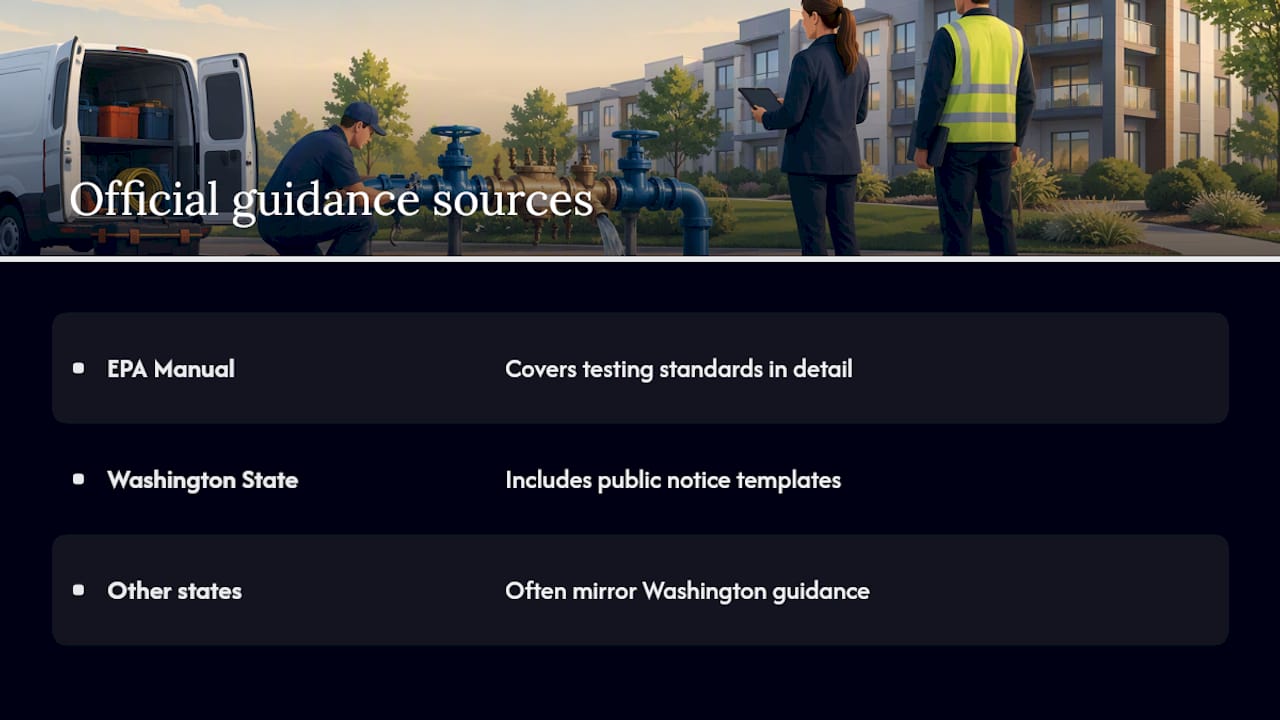
For the full regulatory picture beyond this guide, the EPA’s Cross-Connection Control Manual covers testing standards in detail, while Washington State’s incident response guidance includes public notice templates other states’ health departments often mirror.
This article is general information, not a substitute for advice from a qualified doctor. Consult a qualified healthcare professional about your own circumstances before acting on anything here.
Sources
- EPA: Cross-Connection Control Manual
- Washington State DOH: Responding to a Backflow Incident (PDF)
- Backflow Authority: Signs a backflow preventer is failing
FAQ
Does Water Need to Be Shut Off for Backflow Testing?
Routine annual testing usually requires a brief shutoff of just the assembly being tested, not the whole property, and a certified tester will tell you exactly how long that takes. During an actual emergency, isolating the smallest possible section is preferred over a full building shutoff whenever it’s safe to do so.
What Are the Two Main Types of Backflow Conditions?
Backpressure occurs when downstream pressure exceeds supply pressure and pushes water backward, while backsiphonage happens when a drop in supply pressure creates a vacuum that pulls contaminated water into the potable system. Both conditions are why a functioning check valve or RPZ assembly matters regardless of which one caused a given incident.
Is a Backflow Preventer Actually Necessary?
Yes. Any connection between a potable water system and a source of possible contamination, such as irrigation, a boiler, or a commercial kitchen, needs a backflow preventer, and most jurisdictions require annual certified testing to prove it’s still working.
What Happens When a Backflow Preventer Fails?
A failed device can allow contaminated water to enter the potable supply, and a sustained relief port discharge on an RPZ is one of the clearest signs that failure has happened. A certified tester diagnoses the failed component, repairs or replaces the assembly, and files a mandatory retest before the property is cleared to use the water normally again.