Dental backflow compliance, in the context that matters for building owners, means keeping the backflow prevention devices on your water lines tested, certified, and reported to your local water authority on schedule. If your device’s test is due or you don’t know its last test date, the immediate move is to book a certified backflow tester this week. Waiting risks fines or a shutoff notice from your water purveyor.
TL;DR:
- Regular testing is usually required annually, with higher-hazard properties potentially needing more frequent assessments, depending on local jurisdiction rules.
- Only certified Backflow Assembly Testers registered locally can legally perform and sign off on compliance tests, and reports must include current calibration and certification details.
- Most device failures are due to worn seals, O-rings, or springs that can often be repaired and retested on the spot, avoiding the cost of complete replacement.
- Submitting the test report to the water authority is essential, as failure to file can result in noncompliance even if the device passes the inspection.
- Proactive scheduling and choosing vendors who carry OEM parts and handle paperwork directly can prevent delays, fines, or service shutoff during deadlines.
Table of Contents
- What Dental Backflow Compliance Actually Requires
- Inside a Certified Backflow Test: Steps and Pass Thresholds
- Who Can Legally Test, and How to Read the Paperwork
- When a Repair Beats a Replacement, and What It Costs
- Why Backflow Compliance Protects More Than Your Water Bill
- Codes That Govern Backflow Prevention in Your Jurisdiction
- Preventive Maintenance That Keeps Devices From Failing Early
- Reading a Test Report: When to Approve Repairs vs. Replacement
- Why Scheduling Ahead of the Deadline Changes the Outcome
- Book Your Test Before the Deadline Books You
- Where to Verify Local Rules and Test Procedures
- Sources
- FAQ
What Dental Backflow Compliance Actually Requires
Property owners run into this term expecting something clinical. It is not. In the building water system sense used throughout this article, compliance means your backflow preventer, the mechanical device that stops contaminated water from siphoning back into the public supply, gets tested on a set schedule, passes inspection, and gets reported to the water authority that issued your permit. The EPA and AWWA’s cross-connection control guidance puts the burden on water purveyors to run ongoing testing and enforcement programs, and purveyors push that obligation straight down to property owners through permit conditions.
Four device types cover most properties:
- Reduced Pressure Zone (RPZ) assemblies — used where the hazard is severe, like properties with chemical feed systems, medical gas lines, or fire suppression tied into potable water.
- Double Check Valve (DCV) assemblies — common for irrigation systems and lower-hazard commercial connections.
- Pressure Vacuum Breakers (PVB) — typical on irrigation lines where backpressure isn’t a concern, only back-siphonage.
- Atmospheric Vacuum Breakers (AVB) — simple, low-cost protection for isolated fixtures with no shutoff valve downstream.
Most jurisdictions require regular annual testing, with some high-hazard connections requiring more frequent testing, and the local authority having jurisdiction, not a state default, sets the exact interval. Your water purveyor is almost always the one collecting the report, not a generic state office, and municipal programs frequently require both a state-level tester certification and local registration before a report gets accepted. Missing the reporting deadline can lead to escalating consequences, including late fees, formal notices, and in persistent cases, water service interruption until the device passes and the paperwork is filed.
Inside a Certified Backflow Test: Steps and Pass Thresholds
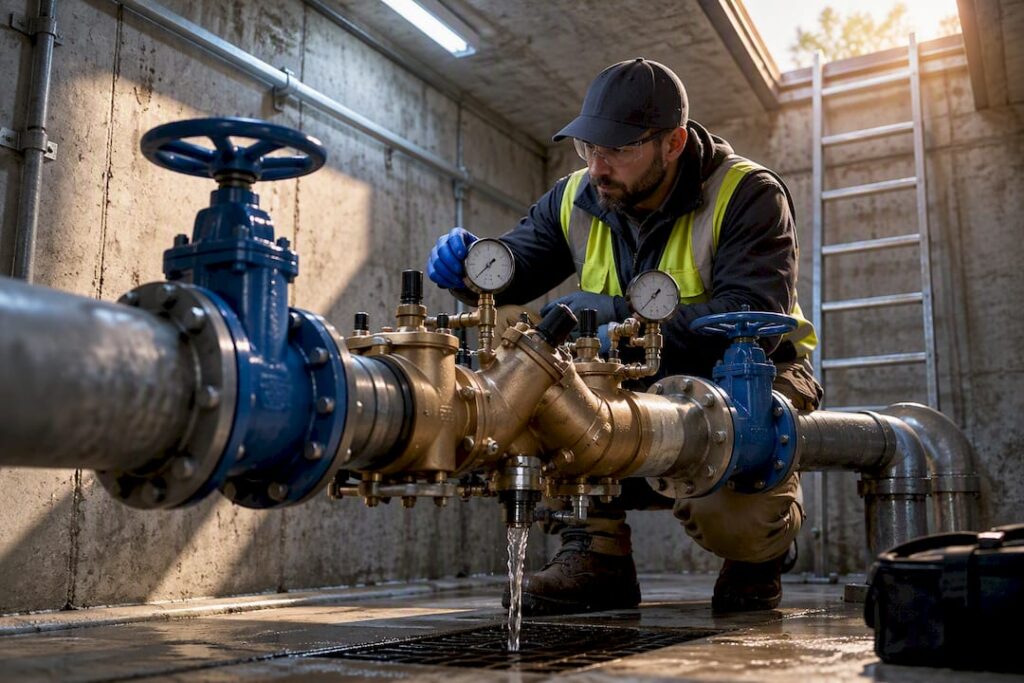
A field test isn’t a visual check. It’s a sequence of pressure measurements taken with a calibrated differential gauge, and the standard procedure looks roughly like this:
- The tester shuts down the assembly and bleeds pressure from the test cocks.
- The differential pressure gauge connects to the test cocks in a specific valve sequence, isolating each check valve.
- For a DCV, the tester measures the pressure differential across each of the two check valves independently, ensuring they meet required thresholds.
- For an RPZ, the tester takes those same two check valve readings, then opens the relief valve slowly to record its opening point.
- Every reading gets logged on the test report alongside the gauge’s serial number and calibration date.
Pro Tip: Ask your tester to show you the gauge’s calibration sticker before the test starts. A gauge calibrated more than a year ago is a red flag most water authorities will reject on sight.
Pass thresholds vary slightly by jurisdiction, but field guides commonly reference minimum pressure differentials that tests must meet. Your local authority’s standard sets the final thresholds. Treat these as the general range, not gospel. Your local water authority’s own standard governs the final call, and a tester who can’t tell you the exact number your jurisdiction enforces probably isn’t the right hire.
The gauge calibration date and the tester’s certification number aren’t paperwork trivia. Programs commonly reject test reports outright when either field is missing or expired, which means a “passed” test can still leave you noncompliant on paper.
Who Can Legally Test, and How to Read the Paperwork
Only a certified Backflow Assembly Tester (often shortened to BAT or BPAT, depending on the state) can legally perform and sign off on a compliance test. Many jurisdictions also require that tester to be individually registered with the local water purveyor, on top of holding a state or third-party certification. A tester who’s certified in one county isn’t automatically cleared to file in another. That gap catches out-of-area property managers more than anything else.
Rejected reports almost always trace back to the same handful of problems. According to the backflow inspection checklist commonly used by cross-connection programs, the top culprits are a missing or illegible tester certification number, an expired gauge calibration date, and incomplete pass/fail data on the required fields. None of that is complicated to catch, if you know what to look for.
When a technician hands you a completed report, check it against this list before you file it away:
- Tester’s printed name and certification number, matching a real, current credential.
- Gauge calibration date, current within the manufacturer’s or program’s required window.
- Actual numeric readings for each check valve (and relief valve, for RPZ units), not just a checked “pass” box.
- A clear pass/fail determination signed by the tester.
- Written or verbal confirmation that the report was actually submitted to your water authority, not just handed to you.
That last point trips up more property owners than any device failure does. A technician can run a flawless test and still leave you noncompliant if nobody files the form. South Jersey Backflow handles that submission directly as part of its testing service, which removes one more place for a compliance deadline to fall through the cracks.
When a Repair Beats a Replacement, and What It Costs
Backflow assemblies fail in predictable ways. Worn rubber seals, degraded O-rings, and weakened check valve springs account for most failed tests, and those are usually fixable on the spot rather than requiring a whole new unit.
A tester carrying OEM rebuild kits can often swap seals, springs, and O-rings during the same visit that caught the failure, then retest immediately. Licensed testing providers report that this kind of on-site repair and retest is common enough that many jurisdictions allow a same-day pass certification once the fix holds.
Replacement makes more sense when the housing shows corrosion, the unit is an older serial-numbered model no longer supported with parts, or the failure is catastrophic rather than a worn component. At that point you’re not paying for a rebuild kit. You’re paying for a new assembly and possibly new enclosure work.
Rough cost ranges property owners should expect in New Jersey:
- Annual residential certification test: $150 to $250.
- Commercial device testing: $200 to $450 per device.
- Residential rebuild kit service: $125 to $250.
- Residential installation of a new assembly: $300 to $800.
Most repairs and retests finish within the same visit, but filing deadlines set by your water authority still apply regardless of how fast the physical fix goes.
Why Backflow Compliance Protects More Than Your Water Bill
Backflow compliance exists because a pressure drop in the public main, from a water main break, firefighting draw, or even routine maintenance, can pull water backward out of a private plumbing system and into the shared supply. On a property with irrigation chemicals, boiler additives, or any cross-connection to non-potable water, that backward pull can put contaminants into drinking water for an entire block, not just your own building.
Those are the actual stakes behind dental compliance standards and every other version of backflow prevention protocols you’ll find written into a municipal code. It isn’t paperwork for its own sake. Water purveyors treat cross-connection control as a public health program, which is why enforcement can escalate all the way to a service shutoff when a property owner ignores repeated notices.
Property conditions change, and that matters more than most owners realize. Adding an irrigation system, a boiler, or any new equipment connected to the water line can shift your hazard classification and trigger a requirement for a higher-grade device than what’s currently installed. A DCV that satisfied your water authority five years ago might not satisfy it today if the property’s use has changed. That’s part of why annual testing exists even for assemblies that have never failed. It’s a checkpoint, not just a formality.
Codes That Govern Backflow Prevention in Your Jurisdiction
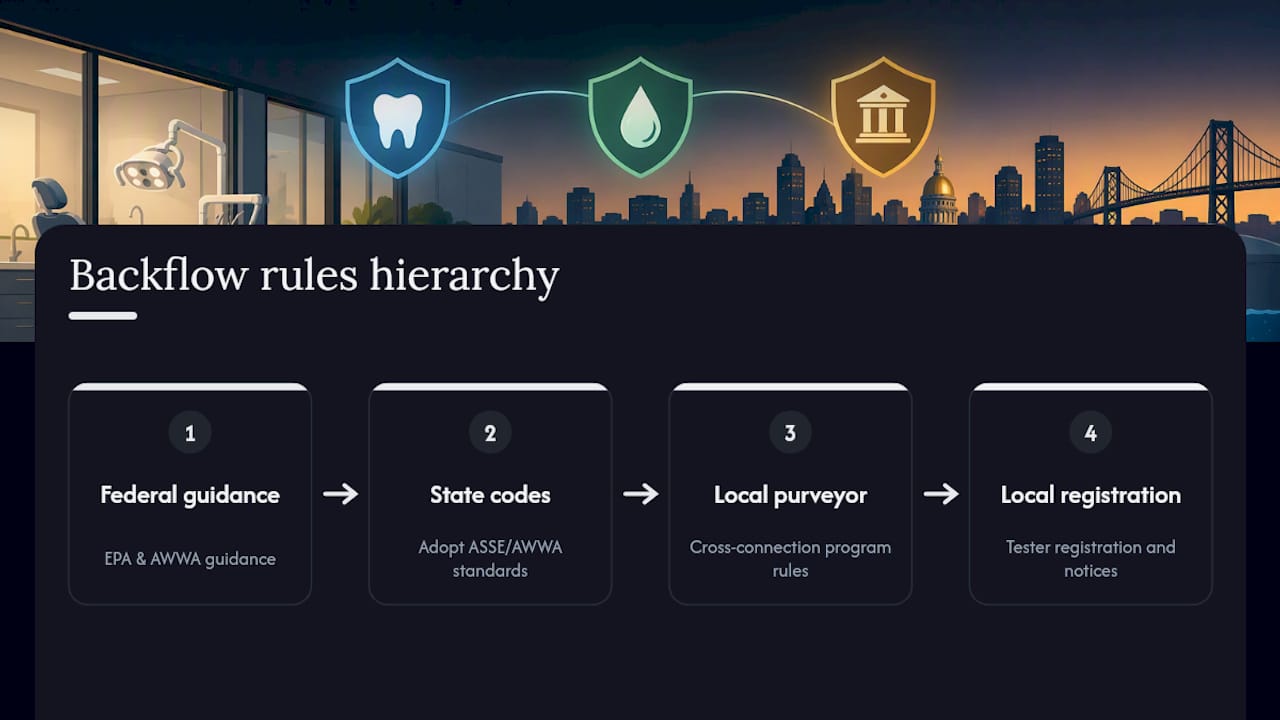
There’s no single federal backflow law that applies uniformly to every property. The EPA and AWWA publish cross-connection control guidance that establishes the framework, but your actual testing frequency, acceptable device types, and filing deadlines come from your state’s plumbing code and, more directly, your local water purveyor’s cross-connection control program.
Device-specific procedures generally trace back to ASSE 5000-series standards and AWWA M14 guidance, which most state health departments and water utilities adopt with local amendments. That’s why a DCV that’s perfectly acceptable for irrigation in one town might be rejected in favor of an RPZ in a neighboring municipality with a stricter hazard classification.
Municipal water authorities also frequently layer their own registration rules on top of state certification, requiring testers to register locally before their reports get accepted. A tester with a valid state certificate isn’t automatically cleared to file in every town they work in. That’s a detail worth confirming before you hire, not after a report bounces back.
If you’ve received a formal notice from your water authority about a compliance issue, that notice typically references the specific local code section and deadline you’re working against. South Jersey Backflow’s guidance on backflow notices walks through what those letters usually mean and how quickly you need to respond.
Preventive Maintenance That Keeps Devices From Failing Early
Annual testing catches failures after they happen. Preventive maintenance is what keeps a device from failing between tests in the first place, and it’s the piece most property owners skip entirely.
Freeze protection matters more than most owners assume. An RPZ or DCV installed outdoors or in an unheated space needs insulation or heat tape before winter, since a frozen and cracked housing turns a $150 test into a $500 replacement. Enclosures help here too. A properly installed protective enclosure shields the assembly from weather, debris, and accidental impact, all common causes of premature seal wear.
Debris and sediment intrusion is the other quiet killer. Older galvanized supply lines shed scale over time, and that grit works its way into check valve seats, preventing a full seal even when the springs and O-rings are otherwise fine. A visual inspection between annual tests, checking for weeping at the relief valve or unusual noise during flow, can flag a developing problem before it becomes a failed test.
Facilities managers overseeing multiple building systems tend to fold backflow checks into broader mechanical inspections rather than treating them as a standalone task, which is a reasonable approach as long as someone is actually tracking the calendar. The same logic that governs contamination risk in HVAC systems applies here: neglected building infrastructure fails quietly until it doesn’t.
Reading a Test Report: When to Approve Repairs vs. Replacement
A test report gives you three pieces of information that actually matter: the numeric readings, the pass/fail determination, and the tester’s notes on device condition. Learning to read those quickly saves you from either overpaying for an unnecessary replacement or delaying a repair that’s genuinely urgent.
A marginal fail, where a check valve holds just under the required differential, is usually a seal or spring issue. That’s a same-visit rebuild in most cases, and there’s little reason to hesitate approving it once the tester confirms parts are on hand. A hard fail, where a check valve holds no pressure at all or the relief valve won’t open, points to a more serious internal failure and sometimes a housing crack, which is where the repair-versus-replace conversation gets real.
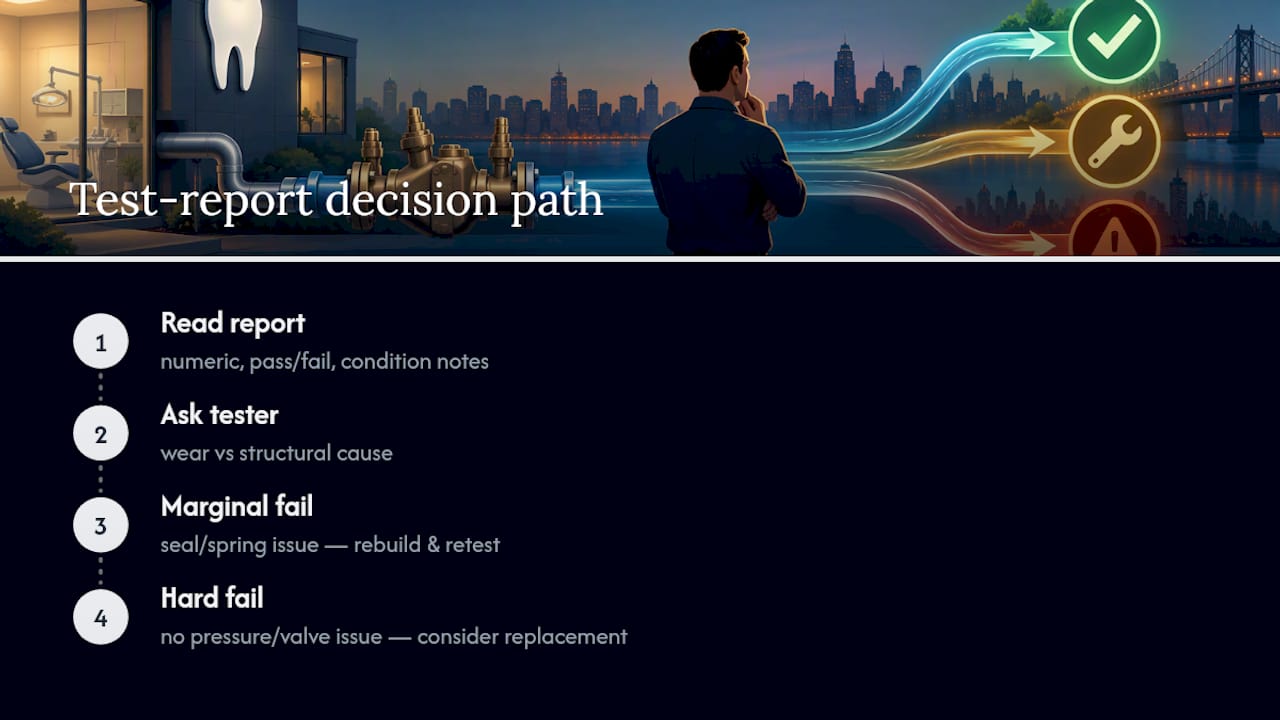
Ask your tester directly whether the failure is a wear-and-tear issue or a structural one. A wear issue justifies a rebuild and retest. A structural issue, especially on an older assembly with obsolete parts, usually justifies replacement even if the upfront cost stings more. Approving the wrong fix twice costs more than approving the right one once.
Why Scheduling Ahead of the Deadline Changes the Outcome
Most compliance failures aren’t caused by bad devices. They’re caused by bad timing. A property owner who waits until the renewal notice arrives to call a tester has already lost the negotiating room that comes with scheduling weeks in advance.
Some backflow testing and service companies operate in New Jersey, covering multiple counties in the region. Working across that footprint means a technician showing up with OEM rebuild parts already on the truck isn’t a lucky coincidence. It’s what happens when a company tests enough devices in a region to know which failures repeat most often. Proactive scheduling, paired with a tester who files paperwork directly rather than handing it back to you to submit, is the difference between compliance being a recurring headache and being a scheduled non-event.
— Jordan
Book Your Test Before the Deadline Books You
South Jersey Backflow gives property owners something most vendors don’t: same-day repair capability because technicians carry OEM parts on the truck, plus direct filing of your report with the water authority so the paperwork never lands back on your desk. That combination matters most when a device fails and you’re staring down a filing deadline.
Before you book any tester, ask three questions: What’s your certification number? When was your gauge last calibrated? Will you file the report with my water authority directly? A vendor who hesitates on any of those three is a vendor who might leave you noncompliant even after a passing test.
South Jersey Backflow’s testing and certification service covers residential, commercial, and multi-unit properties across its New Jersey service area, with consolidated billing available for property managers juggling multiple addresses. If you manage properties in Gloucester County or Middlesex County, request an on-site quote now and get written confirmation that your report will be submitted on your behalf.
Where to Verify Local Rules and Test Procedures
For readers who want to check thresholds and program requirements against a primary source rather than take a vendor’s word for it, the EPA and AWWA’s Cross-Connection Control Manual remains the foundational reference for device selection and program administration. Field-level testers rely on procedure guides like the one covering standard backflow assembly test steps to standardize the valve sequencing and readings described earlier in this article.
Property owners looking for a practical rundown of what a completed report should contain can reference the backflow preventer inspection checklist built for exactly that purpose. For New Jersey specifics on filing and staying ahead of deadlines, South Jersey Backflow’s own guide on passing, submitting, and staying compliant walks through the state’s process in more detail.
Sources
- Cross-Connection Control Manual (EPA/AWWA material)
- Backflow assembly test procedure field guide for testers – Anvilfield
- Backflow Preventer Inspection Checklist for Property Owners | Backflow Authority
- How Licensed Backflow Testing Is Performed Step by Step
FAQ
What Does Dental Backflow Compliance Mean for Property Owners?
In this context, it refers to keeping a building’s backflow prevention device tested, certified, and reported to the water authority on schedule, not anything related to dental office equipment. It covers RPZ, DCV, PVB, and AVB assemblies installed on commercial, residential, or multi-unit water lines.
How Often Does a Backflow Device Need Testing?
Most water authorities require annual testing, though high-hazard connections sometimes require testing twice a year. Your local authority having jurisdiction sets the exact interval, so check your permit or last test report for the specific requirement.
Who Is Legally Allowed to Test a Backflow Preventer?
Only a certified Backflow Assembly Tester, often called a BAT or BPAT depending on the state, can legally perform and sign a compliance test. Many water authorities also require that tester to be individually registered locally, on top of holding a state certification.
What Happens if a Test Report Gets Rejected?
Reports most often get rejected for a missing tester certification number, an expired gauge calibration date, or incomplete readings, according to the cross-connection inspection checklist used by many programs. A rejected report leaves you technically noncompliant even if the device itself passed.
How Much Does Backflow Testing Cost in New Jersey?
South Jersey Backflow lists residential certification tests at $150 to $250 and commercial device testing at $200 to $450 per device. Rebuild kit service for residential units runs $125 to $250, with current pricing available on the company’s site.
Can a Failed Backflow Test Be Fixed the Same Day?
Yes, in many cases. If the failure is a worn seal, O-ring, or spring rather than a structural issue, a tester carrying OEM rebuild parts can often repair and retest the assembly during the same visit.