HOAs must inventory every backflow assembly on the property, schedule testing with a certified tester at least once per year, and file the resulting certificates with the local water authority before the deadline lapses. Skip any one of those three steps and a board is technically out of compliance, even if every device on-site actually works. The fix is procedural, not mechanical: build the list, book the tester, submit the paperwork.
TL;DR:
- Most HOA compliance failures stem from poor recordkeeping rather than device malfunction, risking violations despite proper device operation.
- Annual backflow testing must be scheduled within a single window for all devices, including retesting after repairs, to avoid missing deadlines and penalties.
- Correct device selection depends on the hazard level, with higher-risk connections requiring more advanced assemblies like RPZAs, and mismatched devices increase failure risk.
- Utility notifications for missed tests follow a sequence of notices and possible service restrictions, making prompt scheduling and documentation crucial to avoiding shutoffs.
- Building an accurate inventory, consolidating testing, and assigning a single owner to the process are essential practices to ensure ongoing compliance and prevent program failure.
Table of Contents
- Understanding Backflow Compliance and Why Annual Testing Matters
- Who Actually Enforces Backflow Rules, and What Standards Govern Them
- Building Your HOA’s Backflow Compliance Workflow
- Which Backflow Devices Show Up on HOA Properties
- What Happens on Test Day and How to Plan Around It
- Building a Compliance Program That Doesn’t Fail Next Year
- What Happens When Testing Gets Missed
- Why South Jersey Backflow Understands HOA Portfolios
- The Gap Between Knowing the Rule and Running the Program
- Get Your HOA’s Backflow Program Under Control
- Where to Verify the Rules Yourself
- Sources
Understanding Backflow Compliance and Why Annual Testing Matters
Backflow happens when water reverses direction in a pipe and pulls contaminants into the drinking supply instead of pushing them out. It occurs two ways. Backsiphonage happens when pressure drops on the supply side, often from a water main break or heavy fire-hydrant use nearby, and creates a vacuum that sucks water backward. Backpressure happens when downstream pressure, from a boiler, pump, or elevated tank, exceeds the supply pressure and forces water the wrong way. An irrigation system with fertilizer in the line, a pool with treated water, or a fire suppression line with stagnant water are all realistic entry points for contamination into a community’s shared water system.
The consequences aren’t theoretical. A cross-connection incident can contaminate water for an entire building or block before anyone notices the smell or discoloration. That’s why annual testing isn’t a courtesy; it’s the baseline most water authorities require.
- The EPA’s Cross-Connection Control and Backflow Prevention Manual documents both failure modes and recommends testing, containment, and reporting as standard program elements for water purveyors.
- The 2024 International Plumbing Code, Section 608, ties device selection to hazard classification and treats annual testing as the common regulatory floor, not the ceiling.
- AWWA guidance frames testing as a shared responsibility between the utility and the property owner, not something either party can skip.
Who Actually Enforces Backflow Rules, and What Standards Govern Them
Three parties typically share oversight, and HOAs need to know which one to call. The water supplier runs the cross-connection control program and usually owns the enforcement authority. The state’s primacy agency (often the health or environmental department) sets the regulatory floor the supplier must meet. Local plumbing or building officials get involved at the permit and construction level, especially when a new assembly is installed or an old one gets swapped out.
Three references matter more than any others when a board needs to justify a decision to residents or a regulator:
- AWWA Manual M14 covers program design, testing frequency, and recordkeeping practices utilities model their own rules on.
- IPC Section 608 maps device type to hazard degree, which is what determines whether a hose bib needs a simple vacuum breaker or a fire line needs a reduced-pressure assembly.
- The EPA Cross-Connection Control Manual explains program roles and enforcement tools available to the supplier.
Tester credentials aren’t optional paperwork. Many utilities only accept reports from testers registered with that specific jurisdiction. Austin Water’s program, for example, requires BPAT licensing and registration before a tester can submit results, and it’s a pattern repeated across utilities nationwide. An HOA that hires an uncertified tester risks having a perfectly good test rejected on a technicality, which means starting the clock over.
Building Your HOA’s Backflow Compliance Workflow
Most compliance failures aren’t caused by bad devices. They’re caused by bad recordkeeping. A single missing spreadsheet row means a device’s test window closes unnoticed, and now the HOA is in violation without anyone realizing it until a notice arrives.
Here’s the workflow that actually holds up across a multi-device portfolio:
- Build the device inventory first. Track location, device type, size, install date, last test date, and which tester performed it. Every assembly on the property needs its own row, whether it’s on an irrigation main or a clubhouse fire line.
- Consolidate scheduling around one annual window. Block scheduling, testing every device in a single one to two-day period with one certified tester, cuts down on missed items and produces one report packet instead of a dozen scattered ones.
- Confirm the certificate includes everything the utility needs. That typically means device serial number, location, test date, tester name and registration number, and pass/fail results for each check.
- File directly with the water authority, or confirm your tester does it on your behalf. Some utilities only accept filings from registered testers, so this step can’t be an afterthought.
- Settle who pays before contracting. Most HOAs bill this through the operating budget as a common-area expense, though fire-line testing sometimes falls under a separate insurance or fire-safety line item worth checking with your carrier.
Pro Tip: Keep the device inventory in a shared spreadsheet or property management platform the board can access without calling the property manager. When a board member changes, the compliance history shouldn’t leave with them.
Which Backflow Devices Show Up on HOA Properties
Not every device fits every situation. The right one depends on what’s called degree of hazard, essentially how dangerous a backflow event would be if it happened at that specific connection point.
- Hose-bib vacuum breakers are the simplest device, used on individual outdoor spigots where the hazard is low.
- Pressure vacuum breakers (PVBs) typically protect irrigation systems, since lawn chemicals and fertilizer create a moderate hazard if they siphon back into the main.
- Double check valve assemblies (DCVAs) cover low-to-moderate hazard applications, often domestic water lines and some fire suppression systems.
- Reduced pressure zone assemblies (RPZAs) handle the highest-hazard connections, boiler feeds, pools, and any point where contaminated or chemically treated water could otherwise reverse into the drinking supply.
Irrigation systems, fire lines, pools, and any reclaimed-water connection are the four places HOAs most commonly discover they need a device they didn’t know about. Matching the wrong device to the hazard level, say, installing a PVB where code calls for an RPZA, is one of the most frequent and consequential errors boards make, and it’s usually caught only during an inspection or after a failure.
What Happens on Test Day and How to Plan Around It
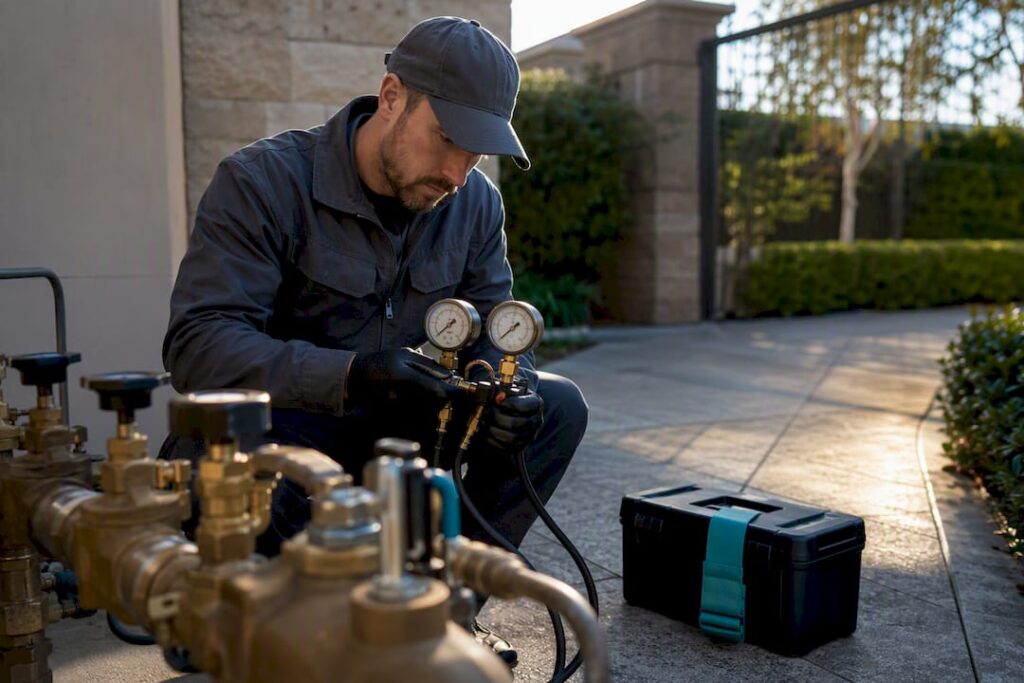
A certified tester runs a series of differential pressure checks on each assembly, verifying that the check valves and relief valve hold the pressure differential the device is rated for. A pass generates a signed certificate on the spot. A fail means the device needs repair or rebuilding, followed by a retest, usually within a window set by the local utility, often 10 to 30 days depending on jurisdiction.
For an HOA managing a dozen or more assemblies across clubhouse, pool, irrigation, and fire systems, the timeline matters as much as the test itself:
- Schedule the annual block test 60 to 90 days before your filing deadline. This leaves room for repairs and retests without missing the cutoff.
- Budget for at least one failed device per testing cycle. Rubber seats and springs wear out; assume some repairs every year rather than treating them as exceptions.
- Set the retest for as soon as the repair is complete, since most utilities won’t extend the original deadline just because a device failed.
- File the completed packet the same week testing wraps, not after every retest trickles in separately.
Keep a standing folder, physical or digital, with every signed certificate, repair invoice, and permit copy going back at least three years. Utilities and insurers both ask for this during audits, and reconstructing it after the fact from memory is nearly impossible.
Pro Tip: Ask your tester for editable digital certificates, not just scanned paper copies. When a utility requests a resubmission because of a formatting issue, you want to fix a field, not redo the entire test.
Building a Compliance Program That Doesn’t Fail Next Year
Most HOA compliance programs don’t fail because of one bad device. They fail because nobody owns the process end to end. Assign one person, whether that’s the property manager, a board member, or a management company contact, as the single point of accountability for the entire backflow program. Split ownership across three committee members is a near guarantee that something slips.
- Centralize every certificate, invoice, and inventory record in one location the next property manager can inherit without a scavenger hunt.
- Use one certified tester for the whole portfolio when possible; multiple vendors testing different devices multiplies scheduling conflicts and filing gaps.
- Vet vendors on registration status with your local utility, current insurance, and whether they file reports directly or hand you a PDF to submit yourself.
- Build the testing line item into next year’s budget before the current cycle closes, not after a surprise invoice lands.
Pro Tip: If your portfolio spans multiple counties or utility jurisdictions, confirm your tester is registered in each one. Registration in one town doesn’t automatically transfer to the next.
The clearest red flag that a program is about to fail: nobody can produce last year’s certificates without digging through email threads. If that’s your HOA, the inventory step above isn’t optional, it’s the fix.
What Happens When Testing Gets Missed
Water utilities generally follow a predictable enforcement sequence when a device’s test lapses. A first notice arrives, giving the property a set window to comply. A second notice follows if nothing happens, often with a fine attached. Continued noncompliance can escalate to water service restriction, which for an HOA means a shutoff affecting every resident, not just the party at fault.
If you’ve missed a deadline, the priority order is straightforward:
- Get an emergency test or repair scheduled immediately, don’t wait for the next scheduled cycle.
- If a device has failed and repair will take time, ask the utility about temporary measures rather than risking a shutoff.
- Document every step in board minutes and resident communications so there’s a paper trail showing corrective action was underway before any penalty hit.
Utility program pages, like Portland’s backflow prevention guidance, spell out these enforcement steps clearly, and it’s worth reading your own utility’s version before you’re in violation, not after.
Why South Jersey Backflow Understands HOA Portfolios
Southjerseybackflow works across residential, commercial, and multi-unit properties throughout New Jersey, which means handling the exact mix of irrigation, fire line, and domestic assemblies most HOA portfolios juggle. Testing, certification, repair, rebuilding, and direct filing with water authorities all fall under one contract, so boards aren’t coordinating three vendors for one compliance cycle.
Block scheduling and consolidated reporting, testing every device on a property in one visit and delivering one packet instead of a dozen scattered certificates, is standard practice for multi-property clients. That’s the operational difference between a compliance program that runs itself and one that generates a new fire drill every spring.
This article’s editorial perspective section is written by Jordan, drawing on the regulatory frameworks and utility program practices cited throughout.
The Gap Between Knowing the Rule and Running the Program
Most HOA boards already know they need annual backflow testing. What trips them up isn’t ignorance of the requirement, it’s the assumption that hiring a tester once solves the problem permanently. It doesn’t. A compliance program is a recurring administrative cycle, not a one-time purchase, and treating it like the latter is where deadlines get missed.
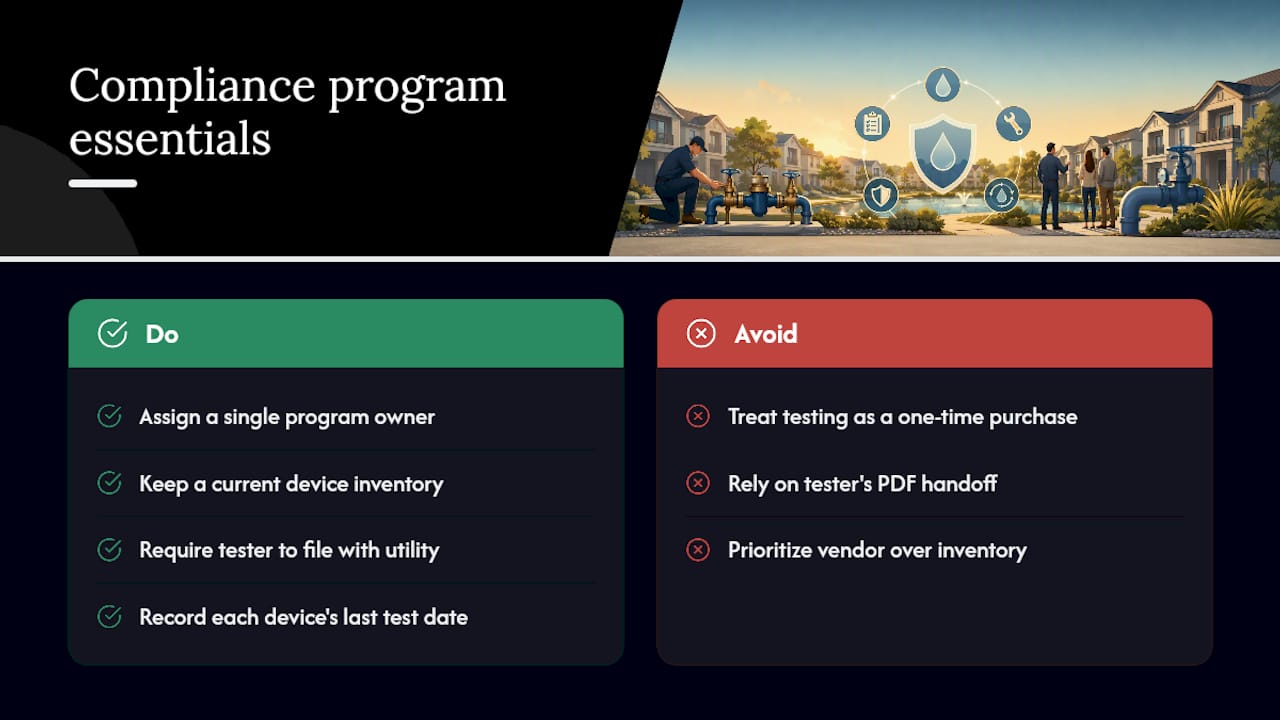
The conventional advice, “just call a plumber every year,” undersells how much of this is a recordkeeping problem, not a plumbing problem. The HOAs that stay compliant year after year aren’t the ones with the newest devices. They’re the ones with a single owner, a current inventory, and a tester who files directly with the utility instead of handing back a PDF for someone else to forget about.
If you take one thing from this guide, prioritize the inventory before you prioritize the vendor. A board that knows exactly what it owns, where it sits, and when it was last tested can fix almost any other gap in the program. A board without that list is guessing, no matter how good its tester is.
— Jordan
Get Your HOA’s Backflow Program Under Control
Southjerseybackflow is the direct route to annual compliance for HOAs juggling irrigation, fire line, pool, and domestic assemblies across a single property or an entire portfolio. Instead of coordinating separate vendors for testing, repairs, and filing, one contract covers certified testing, certification, rebuilding, and direct submission of results to your local water authority, with consolidated billing available for management companies overseeing multiple properties.

If your community is heading into its annual cycle or catching up after a missed deadline, Southjerseybackflow walks through how testing and filing works in New Jersey specifically, including what to confirm about tester registration before booking. HOAs with multi-county portfolios, from Ocean County to Middlesex County, can request a consolidated quote for block scheduling across every property in the association. Start by pulling your current device inventory and reaching out for a portfolio quote before your next filing deadline arrives.
Where to Verify the Rules Yourself
Cross-check anything in this guide against the primary sources: the EPA Cross-Connection Control Manual, AWWA Manual M14, and IPC Section 608 cover the national baseline. Your local water utility’s backflow program page will have the specific filing instructions and registration rules for your jurisdiction.
Sources
- EPA Cross-Connection Control and Backflow Prevention Manual
- Austin Water backflow prevention program overview