
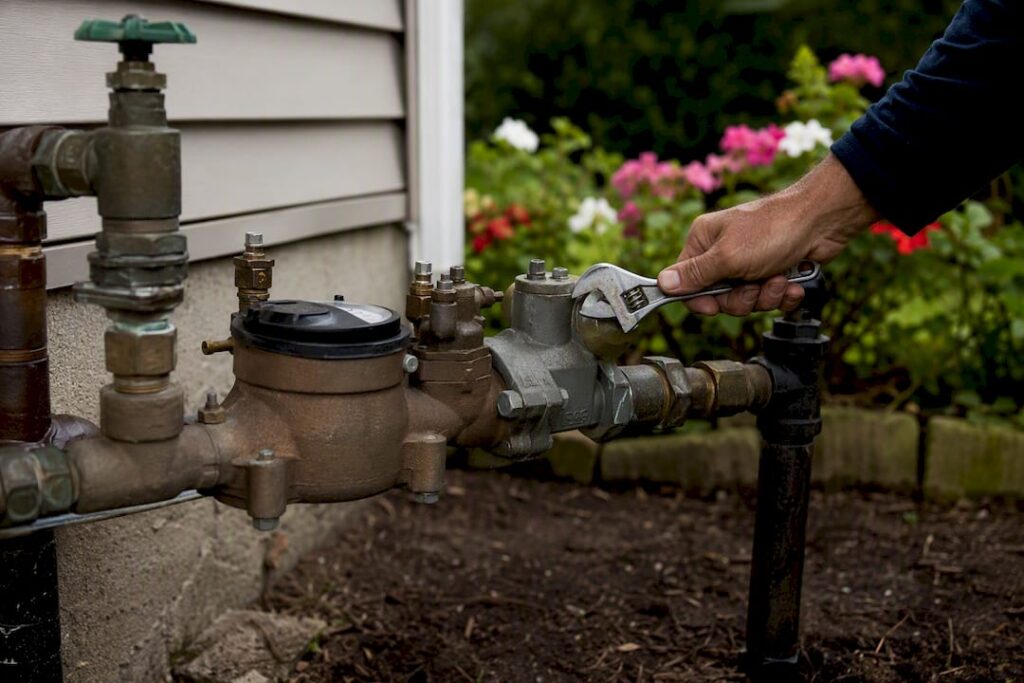
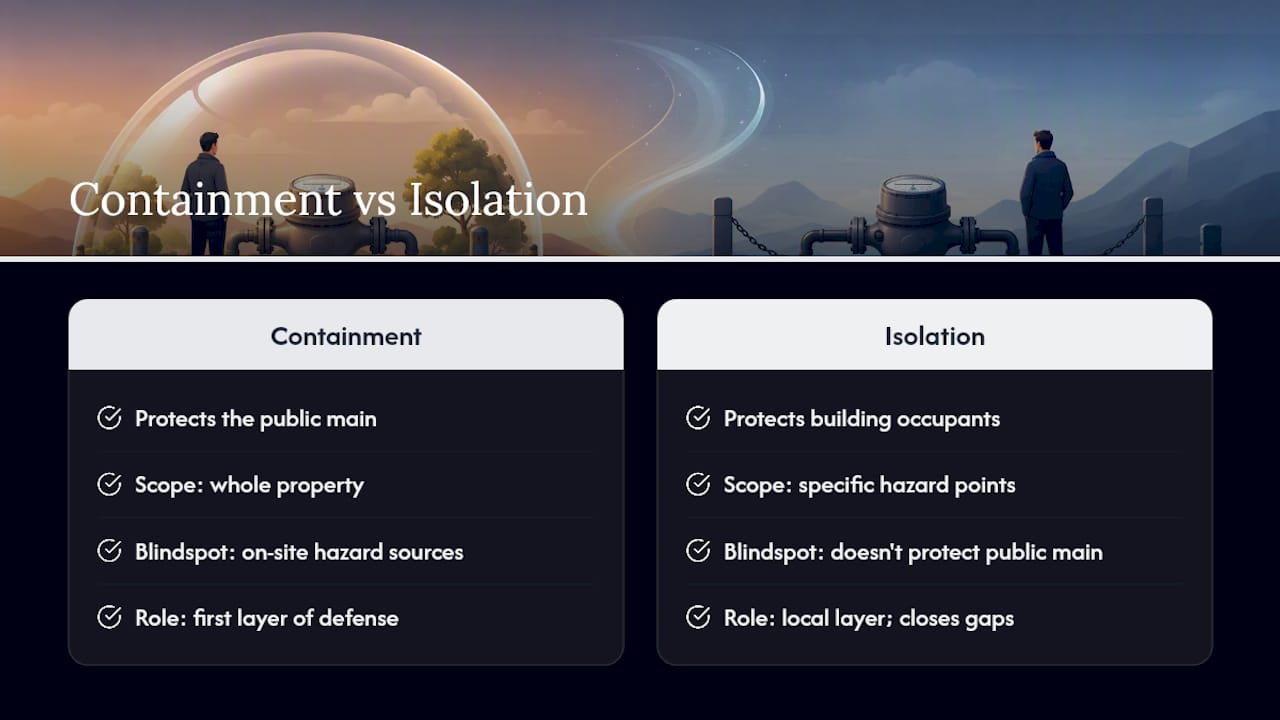
Containment protects the public water main by guarding the service connection with a backflow assembly installed right after the meter, while isolation protects the people inside a building by guarding specific fixtures and equipment where a hazard exists. Neither one replaces the other. A property with solid containment can still poison its own occupants if a boiler or chemical feed line inside the building has no isolation protection.
TL;DR:
- Containment devices are installed immediately after the water meter to protect the public water main from contamination at the property line.
- Isolation devices are placed at individual fixtures or equipment inside the building to prevent hazards from reaching the potable water supply.
- High-hazard sites require more robust containment, such as air gaps or reduced-pressure assemblies, while lower-hazard connections can use simpler devices like double check valves.
- Utility authorities primarily enforce containment by inspecting and regulating devices at the service connection, whereas building codes assign responsibility for internal isolation devices.
- Regular testing, usually annually, is mandatory for backflow preventers, and property owners must maintain records and update authorities after any plumbing modifications.
Table of Contents
- Containment vs Isolation Backflow: Where Containment Devices Go
- Isolation: Protecting What’s Inside the Building
- How Do You Choose the Right Backflow Device?
- Who Enforces Containment and Isolation Requirements?
- How Often Do Backflow Devices Need Testing?
- Why Containment and Isolation Work as a Team
- Southjerseybackflow: On-the-Ground Experience With Both Systems
- What Property Owners Consistently Get Wrong
- Get Your Backflow Systems Tested and Filed Correctly
- Where to Find the Official Guidance
- Sources
Containment vs Isolation Backflow: Where Containment Devices Go
Containment sits at a fixed, predictable spot: immediately downstream of the water meter, before the service line branches into any internal plumbing. That placement is deliberate. A single assembly at the property line stops contaminated water from traveling backward into the public distribution main, regardless of what happens to the plumbing further inside the building.
Utilities require containment most aggressively on properties with elevated risk of internal contamination, including commercial kitchens, medical facilities, manufacturing plants, and any site with auxiliary water sources like wells or fire pump systems. The SFPUC’s required levels of protection guidance shows utilities can mandate a reduced-pressure assembly at the service connection whenever onsite systems raise the stakes.
The device chosen for containment tracks the degree of hazard on the premises:
- Air gap: total physical separation, used where contamination risk is severe and space allows.
- Reduced-pressure principle assembly (RP): the standard for high-hazard commercial and industrial sites.
- Double check valve assembly (DC): acceptable where the hazard is lower, such as many residential and light commercial connections.
You can find a deeper breakdown of how these types of backflow prevention devices function in different settings.
Isolation: Protecting What’s Inside the Building
Isolation works at a different scale entirely. Instead of one assembly at the property line, isolation places smaller devices right at the equipment or fixture creating the hazard, so a problem in one branch of the plumbing never contaminates the rest of the building’s potable water.
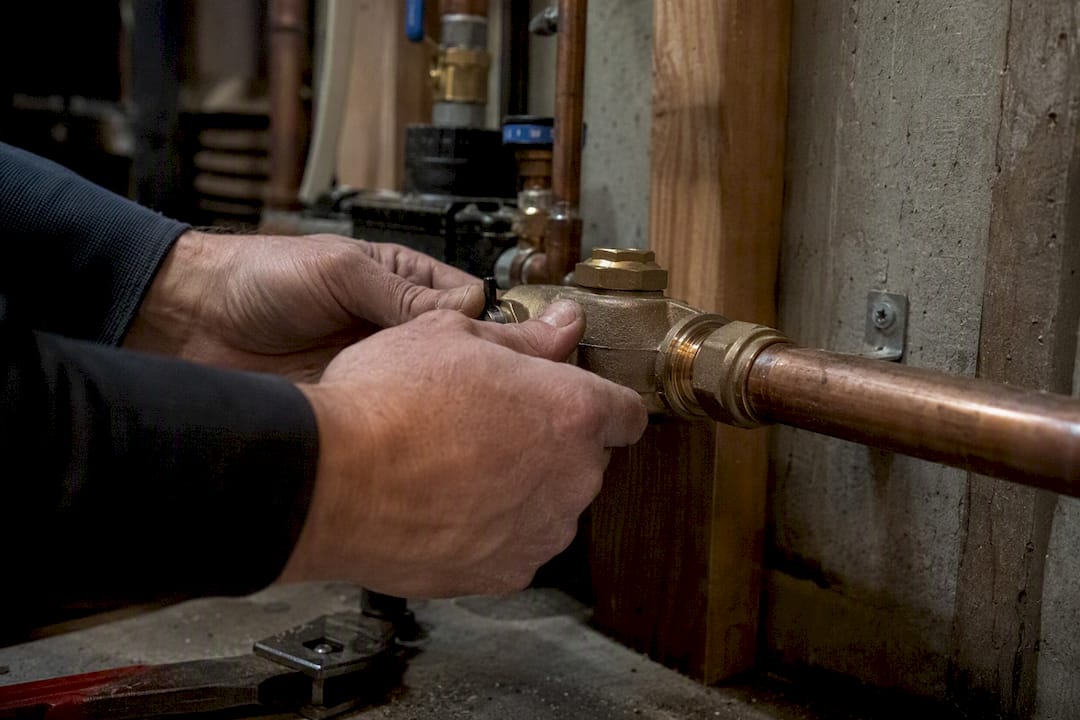
Boilers are a classic isolation point, since treated boiler water carries chemicals that must never reach a drinking tap. Irrigation systems need isolation at injection points where fertilizer or pesticide lines tie into the water supply. Cooling towers, chemical feed systems, and even a single mop sink with a hose bibb can all qualify as isolation points depending on what’s connected downstream.
Typical isolation devices include:
- Vacuum breakers: common on hose bibbs, irrigation zones, and other backsiphonage-prone fixtures.
- Double check valve assemblies: used for moderate internal hazards like some fire sprinkler branches.
- Reduced-pressure assemblies: required at higher-hazard internal points such as chemical injection systems.
A property might need a dozen isolation devices scattered through its plumbing while running just one containment assembly at the meter. Both jobs matter, but they’re not interchangeable.
How Do You Choose the Right Backflow Device?
Device selection isn’t a matter of preference. It follows a risk-based hierarchy that regulators and utilities apply consistently: the more severe the potential health hazard, the stronger the required protection.
- Air gap — reserved for the highest-hazard situations where physical separation is achievable, offering the most reliable protection because there’s no mechanical part that can fail.
- Reduced-pressure principle assembly (RP) — required wherever a high or severe health hazard exists but where a physical air gap isn’t practical, such as a chemical feed system that needs continuous flow.
- Double check valve assembly (DC) — permitted for lower-hazard applications where local code allows a simpler, lower-maintenance device.
Pressure conditions matter just as much as hazard severity. Backsiphonage, a drop in supply pressure that pulls contaminated water backward, calls for different protection than backpressure, where downstream pressure actually exceeds supply pressure and pushes water the wrong direction. Piping size and flow demand also narrow the field, since not every assembly is rated for high-volume commercial lines.
Air gaps are often the preferred solution on paper, but they typically require extra storage tanks or booster pumps to maintain flow, which is why mechanical assemblies dominate in real-world installations where continuous water delivery matters, according to EPA’s cross-connection guidance.
Installation access matters too. An RP assembly needs clearance for annual testing and periodic rebuilds, and a device crammed into a tight mechanical room creates a maintenance headache down the line. Both the EPA manual and state-level guidance like Ohio’s Backflow Prevention and Cross-Connection Control Manual tie specific hazard categories to specific minimum devices, giving inspectors and property owners a shared reference point instead of a judgment call made on the spot.
Who Enforces Containment and Isolation Requirements?
Two different authorities police these two systems, and property owners who assume one inspection covers everything are usually wrong.
Water utilities generally control containment. They require the assembly at the service connection, conduct or require the premise survey that decides the hazard level, and can shut off service if a required device is missing or fails testing. Isolation, by contrast, typically falls under building and plumbing codes enforced by local inspectors during construction, renovation, or complaint-driven review.
A functioning cross-connection control program usually includes:
- Premise surveys that classify hazard levels for each connection.
- Hazard tables specifying minimum device types by use category.
- Mandatory installation deadlines for identified hazards.
- Scheduled testing requirements tied to device type.
- Enforcement mechanisms, including service termination for unresolved violations, as documented in El Paso Water’s cross-connection control manual.
Owners are responsible for keeping test records on hand and notifying the utility whenever plumbing changes might affect the hazard classification, such as adding a new irrigation line or chemical process.
How Often Do Backflow Devices Need Testing?
Most jurisdictions require annual testing for backflow assemblies, though high-hazard installations sometimes face more frequent checks depending on local utility rules.
- A certified backflow tester checks check valve seating, confirms the relief valve on an RP opens correctly under test conditions, and verifies the assembly has adequate access for service.
- Test results get filed with the water utility, usually within a set window after the test date. Missing that deadline can trigger a compliance notice or worse.
- Property owners should keep copies of every test report and confirm with the utility that filings were received, not just submitted.
Reviewing common questions in this backflow preventer FAQ can help clarify what a specific notice actually requires.
Pro Tip: If you receive a compliance letter and aren’t sure whether it concerns your containment device or an internal isolation point, don’t guess. Pull your last test report first. It usually states the device location and type in plain language.
Why Containment and Isolation Work as a Team
A building with a perfectly maintained RP at the meter can still have a contamination event if a maintenance crew connects a garden hose to a chemical mixing tank with no isolation valve. Containment never sees that failure coming because the hazard never reaches the service connection.
That’s the layered-defense logic behind both containment and isolation: containment protects the public main from whatever happens on the property as a whole, and isolation protects the people inside the building from whatever happens at each specific hazard point. The Ohio EPA manual treats these as complementary layers precisely because gaps tend to appear where owners assume one covers the other. Periodic surveys, updated after any equipment change, catch the hazards a single device never will.
Southjerseybackflow: On-the-Ground Experience With Both Systems
Southjerseybackflow tests, certifies, repairs, and rebuilds backflow assemblies for residential, commercial, and multi-unit properties across New Jersey, filing test reports directly with the relevant water authorities. That work covers both sides of the equation: containment assemblies at the service connection and isolation devices protecting equipment inside the building.
Property owners who can’t locate a device’s last inspection record, or aren’t sure whether their current setup even satisfies their local plumbing codes, should treat that gap as a priority to close, not a detail to defer.
What Property Owners Consistently Get Wrong
If you only fix one thing after reading this, verify your containment assembly at the meter is present, functioning, and on file with your utility. Then check every piece of equipment inside the building that connects to a water line and creates a chemical, biological, or pressure hazard.
The nuance most owners miss: temporary fixes create permanent risk. A hose connected to a chemical tote “just for the afternoon,” or a retrofit irrigation line added without a permit, routinely becomes the hidden cross-connection nobody remembers five years later. When you’re unsure what’s protected and what isn’t, pull your records and schedule a certified tester before assuming everything’s fine.
— Jordan
Get Your Backflow Systems Tested and Filed Correctly
Southjerseybackflow is the direct alternative to guessing at your own compliance status. Instead of piecing together old test reports or hoping your last inspector caught every isolation point, you get a premise survey, testing on both containment and isolation devices, repair or rebuild service when a device fails, and direct filing of results with your water authority.

If you manage property in Ocean County, Mercer County, or anywhere else across South Jersey, scheduling a survey now closes the gap before it becomes a violation notice. Start with a look at backflow testing and certification in New Jersey to see exactly what’s involved, or check service availability on the Ocean County backflow page. For a step-by-step look at passing and filing correctly, the guide on staying compliant with New Jersey backflow testing walks through the whole process. For general facility maintenance planning, this commercial plumbing maintenance checklist is a useful companion resource.
Where to Find the Official Guidance
The EPA’s Cross-Connection Control Manual remains the foundational reference for containment and isolation definitions and program design. Ohio’s Backflow Prevention and Cross-Connection Control Manual offers detailed hazard-to-device mapping, and SFPUC’s required levels of protection tables show how a real utility applies those categories in practice. The EPA’s distribution system resources round out the broader program context.
Sources
- Cross-Connection Control Manual (EPA)
- Backflow Prevention and Cross-Connection Control Manual (Ohio / EPA assets)
- SFPUC required levels of protection guidance (Containment and Isolation tables)
- El Paso Water cross-connection control manual