TL;DR:
- Certified NJ backflow testers must appear on official approved lists to ensure compliance. Providers like South Jersey Backflow and Atlas Backflow offer full services, including testing, repairs, and documentation submission. Property owners should verify credentials, confirm service areas, and seek transparent pricing to easily meet state regulations.
What are the top certified alternatives to Leaquida.ca for backflow testing in New Jersey?
Leaquida.ca is a Toronto-based basement waterproofing company. If you landed here looking for backflow testing and prevention services in New Jersey, you need a different category of provider entirely: a NJDEP-certified backflow tester who appears on your local water authority’s approved list. The four providers below cover that need directly.
| Provider | Coverage Area | Certifications | Service Offerings | Pricing Transparency | Customer Service |
|---|---|---|---|---|---|
| South Jersey Backflow | Multiple NJ counties | NJDEP-approved | Testing, repair, certification filing | Transparent, published rates | Strong local reputation |
| atlasbackflow.com | Regional NJ/surrounding | NJDEP-recognized | Testing, documentation, calibrated equipment | Clear process documentation | Detailed communication |
| SmartWaterBackflow.com | NJ service area | Certified testers | Technology-enabled inspections, digital reports | Not publicly listed | Modern, tech-forward |
| abpa.org | Nationwide (standards body) | ABPA certification | Professional credentialing, standards guidance | N/A (not a testing service) | Industry association support |
One rule applies before you hire anyone: verify tester credentials against the NJDEP’s official list of approved certifying agencies, which includes ASSE, NEWWA, and select union programs. A tester not on your local water authority’s approved list will get your report rejected, regardless of how thorough the test was.
Table of Contents
- How do these backflow testing providers compare for NJ property owners?
- How to choose the right backflow testing provider in New Jersey
- How to verify a tester’s NJDEP credentials before hiring
- What does backflow testing typically cost in New Jersey?
- How long does backflow testing and certification take?
- What do customers say about these NJ backflow testing providers?
- Southjerseybackflow covers NJ compliance from test to certification filing
- Key Takeaways
How do these backflow testing providers compare for NJ property owners?
South Jersey Backflow
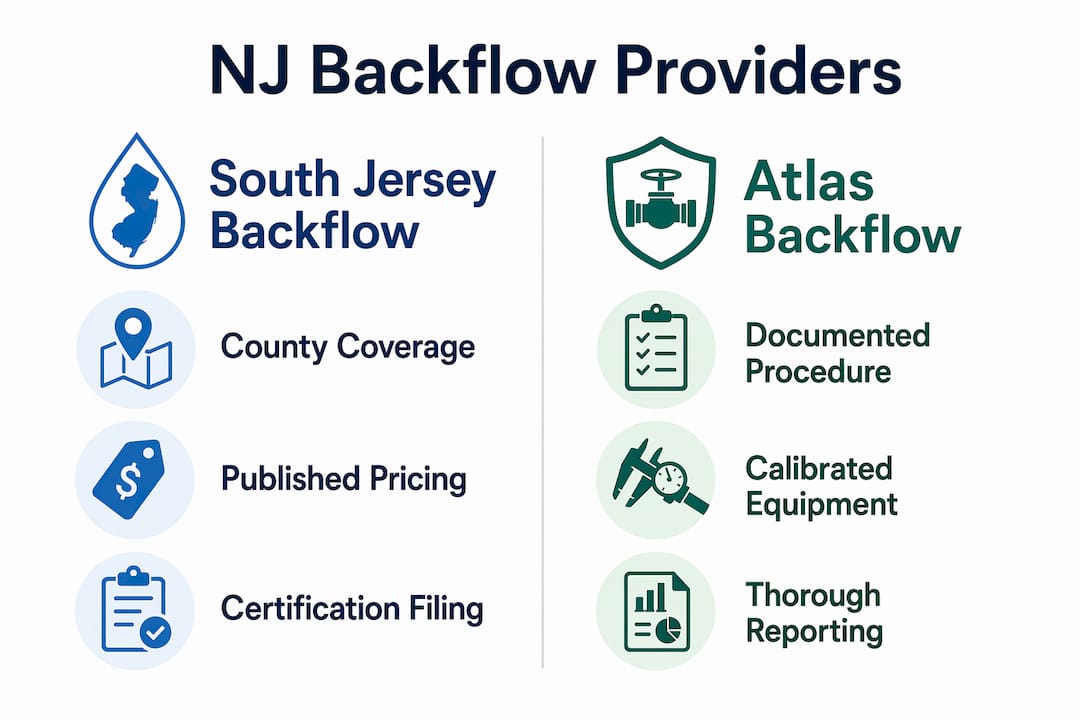
For most property owners and managers in South Jersey, this is the practical first call. Southjerseybackflow holds NJDEP-approved certification and covers a wide range of counties including Ocean, Mercer, Salem, Gloucester, Cumberland, Hunterdon, and Middlesex. The company handles the full compliance cycle: testing, any necessary repairs, and filing certification results with the appropriate authority. Pricing is published rather than quoted on request, which matters when you’re managing multiple properties on a budget. Their backflow preventer services page details the scope clearly.
atlasbackflow.com
Atlas Backflow stands out for its emphasis on documented procedure. Their technicians use calibrated equipment and detailed reporting, which is exactly what NJDEP compliance requires: the certification form must identify device type, location, tester name, and test results. Property managers overseeing commercial sites or high-hazard connections will find that level of documentation useful when audits happen.
SmartWaterBackflow.com
SmartWaterBackflow.com takes a technology-forward approach, using modern testing equipment and digital reporting tools. For clients who want electronic records and faster turnaround on paperwork, that’s a genuine advantage. Pricing is not publicly listed, so you’ll need to request a quote directly.
abpa.org
The American Backflow Prevention Association is not a testing service. It’s the national credentialing and standards body. If you’re vetting a tester and want to confirm they hold recognized credentials, ABPA certification is one of the NJDEP-accepted qualifications alongside ASSE International. Use abpa.org to verify a tester’s standing, not to book a test.
How to choose the right backflow testing provider in New Jersey
The certification question comes first. Under N.J.A.C. 7:10-10.6, backflow preventers designed for field testing must be tested prior to final inspection and annually thereafter. The tester must hold certification from a NJDEP-recognized agency, and the certification form must document device type, location, tester name, and results. A tester who skips any of those fields creates a compliance problem for you.
Beyond credentials, here’s what to evaluate before signing anything:
- Certification status: Confirm the tester appears on both the NJDEP list and your local water authority’s approved roster.
- County coverage: Not every certified tester operates in every county. Confirm your county is in their service area before scheduling.
- Service scope: Does the provider handle repairs if the device fails the test, or do you need a separate contractor?
- Documentation: Ask whether they submit results directly to the water authority or hand you paperwork to file yourself.
- Pricing clarity: Get a written quote that includes the test fee, any report filing fee, and what happens if a repair is needed.
- Turnaround time: For commercial properties with quarterly testing requirements, ask how quickly they can return.
- Warranty or guarantee: Some providers back their repair work with a service guarantee; others do not.
Pro Tip: Before scheduling, call your local water authority and ask for their current approved tester list. Cross-reference any provider’s name against that list. A tester who passed NJDEP certification two years ago but let it lapse will not appear on the current list, and their test results won’t be accepted.
One important exemption: one- and two-family homes in New Jersey are generally exempt from annual backflow testing requirements under the Plumbing Subcode. If you own a single-family rental, confirm with your municipality before assuming you owe an annual test.
How to verify a tester’s NJDEP credentials before hiring
The NJDEP maintains a current database of certified backflow prevention device testers, updated as certifying agencies submit their annual lists electronically. That electronic submission process is what keeps the database accurate, so it’s worth checking it directly rather than relying on a provider’s self-reported credentials.
Steps to confirm a tester is legitimate:
- Visit the NJDEP Division of Water Supply & Geoscience tester database and search by name or company.
- Check that the certifying agency (ASSE, NEWWA, ABPA, or a recognized union program) is on the NJDEP’s approved agency list.
- Contact your municipal water authority for their local approved tester roster, which may be more current than the state list.
- Ask the tester for their certification number and expiration date before scheduling.
- For physical connection permit holders, confirm the tester can submit results through the NJDEP online portal, since permittees must renew annually and submit certified results electronically.
Facilities with unapproved water supplies connected to public community supplies face quarterly device testing requirements and annual permit renewal. That’s a tighter schedule than most residential owners deal with, and it makes credential verification even more consequential.
What does backflow testing typically cost in New Jersey?
Pricing varies by device type, property complexity, and provider. A standard annual test for a single assembly at a residential or light commercial property is generally moderately priced. Properties with multiple assemblies or high-hazard connections, such as irrigation systems tied to a public supply, typically pay per device. Repair costs are separate and depend on the assembly type and what failed.
Transparent pricing from the start is a real differentiator. Some providers publish flat rates; others quote on request. When comparing options, ask specifically whether the quoted price includes result submission to the water authority, since that step is required for compliance and some providers charge it separately.
How long does backflow testing and certification take?
The physical test itself usually takes a short duration per assembly for a qualified technician. Digital reporting tools, like those used by SmartWaterBackflow.com, can shorten the paperwork side significantly. For most properties, same-day or next-day report submission is achievable.
Certification processing by the water authority varies by municipality. Some accept electronic submissions and update records within a few business days; others take longer. If you’re working against a compliance deadline, ask your provider how quickly they submit results and whether they confirm receipt with the authority.
What do customers say about these NJ backflow testing providers?
Southjerseybackflow draws consistent positive feedback for its county-wide availability and straightforward scheduling. Property managers in particular note the value of a provider who handles both testing and repairs without requiring a second contractor.
Atlas Backflow earns recognition for clear technician communication and thorough documentation, which property managers cite as useful when dealing with inspectors or insurance requirements.
SmartWaterBackflow.com is noted for its modern approach and digital records, appealing to clients who manage multiple properties and want centralized documentation.
Providers with transparent pricing and prompt service reduce compliance risk and make annual renewal smoother. That pattern holds across reviews for all three active testing providers in this comparison.
Southjerseybackflow covers NJ compliance from test to certification filing
When you need a certified backflow tester who knows New Jersey’s compliance requirements county by county, Southjerseybackflow is the direct answer. The company serves Ocean, Mercer, Salem, Gloucester, Cumberland, Hunterdon, Middlesex, and more, with NJDEP-approved certification and a full-service model: testing, repairs, and result submission handled in one visit when possible.
Pricing is published, not hidden behind a quote request. If a device fails, repairs happen without scheduling a second provider. For property managers juggling multiple sites, that single-vendor approach cuts the administrative load considerably. Read the full guide on passing and submitting backflow tests to understand exactly what the process requires, then schedule your test directly through southjerseybackflow.com.
Key Takeaways
For NJ property owners, the right leaquida.ca alternative is a NJDEP-certified local backflow tester who appears on your water authority’s approved list and handles documentation through to submission.
| Point | Details |
|---|---|
| Verify credentials first | Confirm any tester appears on the NJDEP database and your local water authority’s approved roster before booking. |
| One- and two-family exemption | Single- and two-family homes are generally exempt from annual testing under NJ’s Plumbing Subcode. |
| Full-service scope matters | Choose a provider who handles testing, repairs, and result submission to avoid coordinating multiple contractors. |
| Pricing transparency | A standard annual test for a single assembly at a residential or light commercial property is generally moderately priced. Confirm whether report filing is included in the quoted price. |
| Southjerseybackflow | Covers multiple NJ counties with NJDEP-approved certification, published pricing, and end-to-end compliance filing. |