TL;DR:
- A reduced pressure zone valve is a high-level backflow prevention device that protects potable water from contamination by maintaining a lower-pressure zone between check valves. It requires annual testing and proper installation in locations with adequate drainage, as mandated by New Jersey regulations. Proper maintenance and understanding of its function are essential to prevent water service shutoffs and ensure public health safety.
A reduced pressure zone valve, commonly called an RPZ valve or RPZ assembly, is a mechanical backflow prevention device that protects your potable water supply from contamination. It does this by maintaining a zone of lower pressure between two independent check valves, then physically discharging water if that pressure balance fails. For New Jersey property owners, understanding this device is not optional. Local water utilities require annual testing, and non-compliance can result in water service shutoffs. Backflow contamination occurs when distribution system pressure drops below downstream pressure, allowing irrigation chemicals or boiler treatments to flow backward into clean water lines.
What is a reduced pressure zone valve and how is it defined?
A reduced pressure zone valve is defined as a backflow prevention assembly with two independent check valves separated by a monitored pressure chamber. That chamber, called the reduced pressure zone, is maintained at least 2 psi lower than the incoming supply pressure by a differential pressure relief valve. The RPZ assembly design ensures continuous monitoring of that pressure differential, and the relief valve discharges water to atmosphere if the balance is ever disrupted. This is the standard industry term recognized by the American Backflow Prevention Association (ABPA) and the American Water Works Association (AWWA).
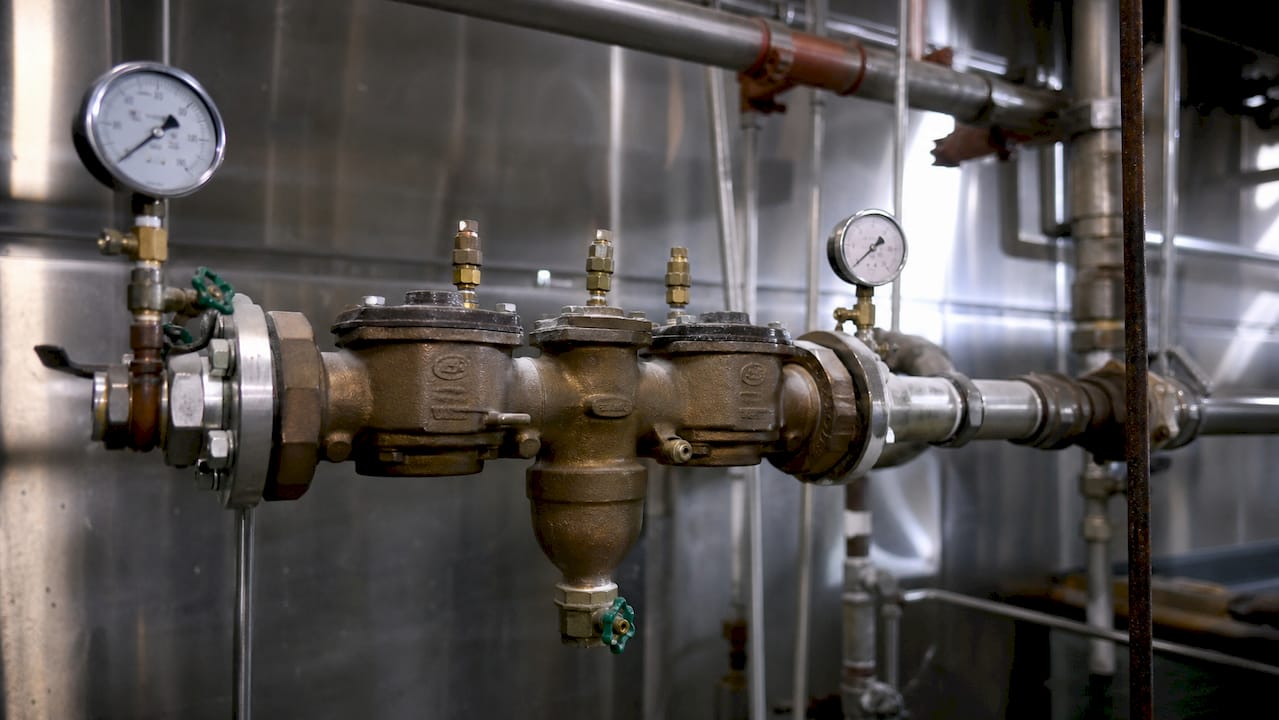
The device sits at the point where your property’s plumbing connects to the public water main. It acts as a physical barrier between your water-using equipment and the municipal supply. Property managers often encounter RPZ requirements when they install irrigation systems, commercial boilers, or fire suppression lines.
How does an RPZ valve work?
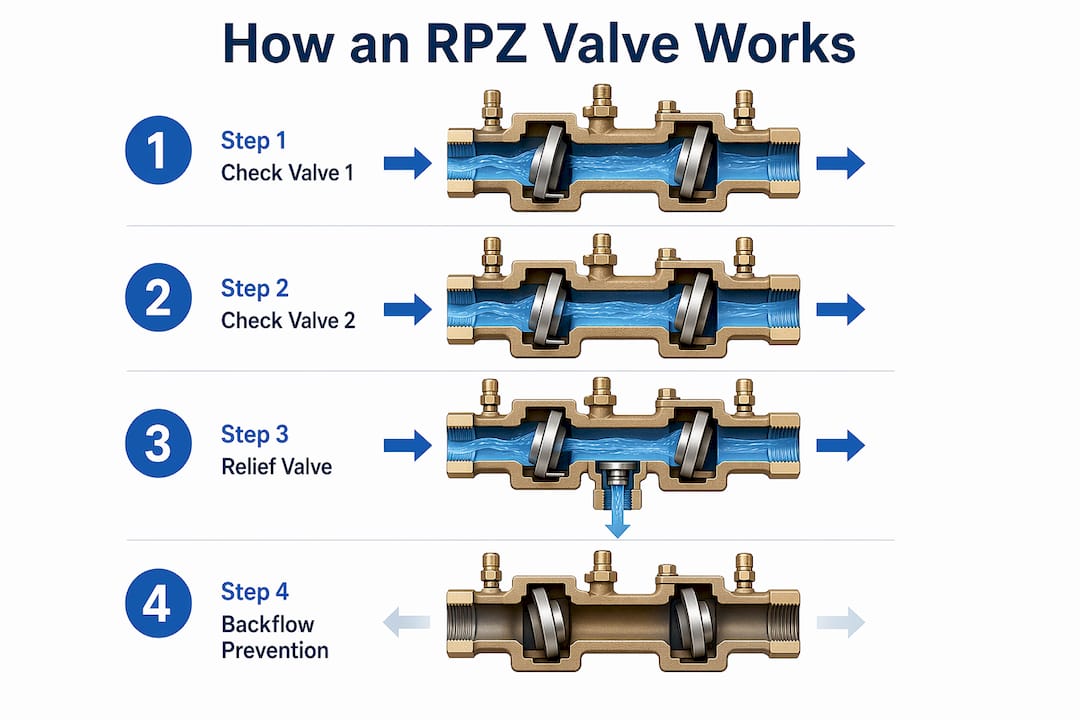
The RPZ valve operates through a sequence of pressure checks that run continuously during normal water use.
- Water enters the first check valve. Supply pressure pushes water through the first check valve into the reduced pressure zone chamber. The check valve only opens when supply pressure is high enough to overcome its spring tension.
- The reduced pressure zone is maintained. The differential pressure relief valve holds the chamber pressure at least 2 psi below supply pressure at all times. This pressure gap is the core protection mechanism.
- Water passes through the second check valve. From the chamber, water flows through a second independent check valve into your property’s plumbing. This second valve adds a redundant barrier.
- The relief valve monitors constantly. If either check valve leaks or supply pressure drops, the chamber pressure rises. When it rises to within 2 psi of supply pressure, the relief valve discharges water to atmosphere, breaking the hydraulic path entirely.
The fail-safe logic here is worth understanding clearly. Even if both check valves fail simultaneously, the relief valve opens and dumps water rather than allowing contaminated water to enter the supply. The device is designed to fail visibly, not silently. You will see water draining from the relief port. That is the system working correctly, not malfunctioning.
Pro Tip: If you see water draining from your RPZ valve’s relief port, do not immediately call it a failure. It may be responding to a pressure event. Call a certified tester to evaluate whether the device needs repair or simply responded to a transient pressure drop.
RPZ valves vs. other backflow prevention devices
RPZ valves provide the highest level of backflow protection available and are mandated for high-hazard cross-connections. That distinction matters when you are choosing or specifying a device for your property.
| Device | Protection Level | Typical Application | Testable |
|---|---|---|---|
| RPZ Assembly | Highest | Irrigation, boilers, chemical lines | Yes |
| Double Check Valve Assembly (DCVA) | Moderate | Low-hazard commercial connections | Yes |
| Atmospheric Vacuum Breaker (AVB) | Basic | Hose bibs, simple irrigation | No |
| Pressure Reducing Valve (PRV) | None (pressure only) | Pressure regulation | No |
The Double Check Valve Assembly uses two check valves but has no relief valve and no reduced pressure zone. It is acceptable for low-hazard applications but not for connections where contaminants could cause serious health consequences. The Atmospheric Vacuum Breaker is the simplest device and provides no protection against backpressure, only backsiphonage.
The most dangerous confusion in the field involves PRVs. Confusing PRVs with RPZ assemblies is a documented compliance risk. A PRV regulates water pressure to protect your pipes. It does not prevent backflow. Installing a PRV where an RPZ is required leaves your water supply unprotected and puts you in violation of New Jersey plumbing codes.
Pro Tip: Check your water utility’s cross-connection control survey or your original plumbing permit to confirm which device class your property requires. If your property has an irrigation system, a boiler, or a fire suppression line, you almost certainly need an RPZ, not a DCVA or PRV.
For more on protecting your property’s water system, the whole-house water safety perspective from SmartWaterBox covers complementary filtration approaches worth reviewing.
What are new jersey’s RPZ testing and compliance requirements?
New Jersey follows the standard cross-connection control framework used across most U.S. jurisdictions. The requirements are specific and carry real consequences for non-compliance.
- Annual testing is mandatory. Most jurisdictions including New Jersey require RPZ assemblies to be tested every year by a certified backflow prevention tester.
- Reports go to your local water utility. After each test, the certified tester submits a test report directly to your water utility. You do not submit it yourself. Confirm with your tester that submission is included in their service.
- Non-compliance triggers service shutoffs. Failure to test and report can lead to water service shutoffs or financial penalties. Utilities enforce this because the public water supply is at stake, not just your property.
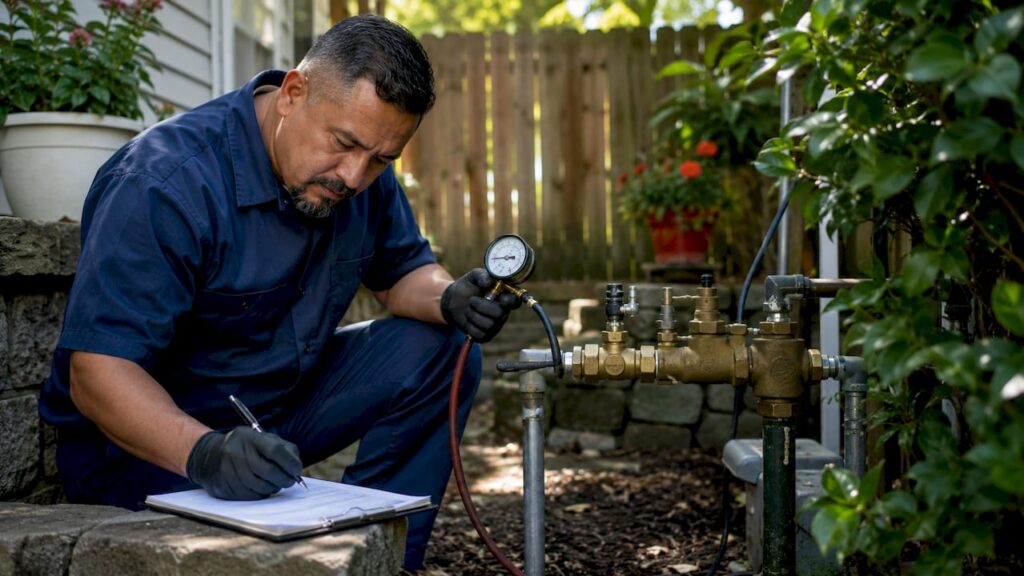
- Four test cocks verify device integrity. Certified testers use four test cocks on RPZ valves to verify spring performance and differential pressure using calibrated gauges. This confirms that both check valves and the relief valve are operating within design tolerances.
- Maintain your own records. Keep copies of every test report. If your utility claims a report was not received, your copy is your proof of compliance.
- Schedule before your deadline. Utilities often send compliance notices with a deadline. If you received a backflow letter from your New Jersey utility, act within the window stated. Waiting until the last week creates scheduling problems and risks a lapse.
Internal springs and diaphragms inside RPZ valves fatigue and scale over time. Annual testing catches these issues before they cause a device failure or a compliance violation. Skipping a year is not a minor oversight. It is a documented gap that utilities can act on.
How and where should RPZ valves be installed on NJ properties?
RPZ valve installation is not a DIY project. RPZ devices must be installed by licensed professionals in locations with proper drainage to handle relief valve discharges. Getting this wrong creates two problems: property damage from water discharge and a compliance failure that your utility will flag.
Choosing the right installation location
The relief valve on an RPZ assembly will discharge water during normal pressure events. That water needs somewhere to go. Install the device above a floor drain, a utility sink, or in an exterior location with adequate drainage. A device installed in a finished mechanical room with no drain will flood that room when the relief valve activates.
The device also needs to be accessible for annual testing. Testers need clear access to all four test cocks and both shutoff valves. Installing an RPZ behind drywall or in a cramped crawl space creates problems every year at inspection time.
Property types that commonly require RPZ valves in new jersey
- Residential properties with in-ground irrigation systems
- Commercial properties with cooling towers or boilers
- Properties with fire suppression systems connected to the potable supply
- Car washes, restaurants, and facilities using chemical injection
- Multi-family buildings with shared mechanical systems
- Properties in Haddonfield or Montclair with municipal irrigation requirements
A licensed New Jersey plumber must pull the permit and complete the installation. After installation, a certified tester performs the initial test before the device is placed in service. That first test report establishes the baseline for all future annual tests.
Pro Tip: Ask your installer to photograph the installation and document the device model, serial number, and installation date. This information speeds up every future annual test and is required if you ever need to file a warranty claim on the device.
Key takeaways
A reduced pressure zone valve is the highest-protection backflow prevention device available, and New Jersey property owners with irrigation systems, boilers, or fire suppression lines are required to install, test, and report on them annually.
| Point | Details |
|---|---|
| RPZ valve definition | A mechanical assembly with two check valves and a relief valve that maintains a lower-pressure zone to block backflow. |
| Highest protection level | RPZ assemblies outperform Double Check Valve Assemblies and Atmospheric Vacuum Breakers for high-hazard connections. |
| Annual testing required | New Jersey mandates yearly testing by a certified tester, with results submitted to your local water utility. |
| PRV is not a substitute | A pressure reducing valve regulates pressure only and does not prevent backflow or satisfy RPZ compliance requirements. |
| Installation needs drainage | The relief valve discharges water during normal operation, so proper floor or exterior drainage at the installation site is mandatory. |
Why most property owners get this wrong until it’s too late
I have seen the same pattern repeat across New Jersey properties. A property owner installs an irrigation system, the contractor mentions a backflow preventer, and the owner assumes the job is done. Two years later, a compliance notice arrives from the water utility, and the owner discovers the device was never tested after installation.
The RPZ valve is not a set-and-forget device. The internal springs and diaphragms that make it work degrade over time. A device that passed its first test can fail its third if it is not maintained. I have also seen properties where a PRV was installed instead of an RPZ because a non-specialist contractor made the substitution. The property owner had no idea, and the utility’s cross-connection inspector caught it during a survey. The fix required a full reinstallation.
The other thing most property owners do not expect is the relief valve discharge. When water starts draining from the side of the device, the instinct is to call it broken. Often it is not. It is responding to a pressure event, which is exactly what it is designed to do. Understanding that distinction saves unnecessary repair calls and prevents owners from bypassing the device to stop the draining, which is a serious safety violation.
My advice: work with a certified tester who submits reports directly to your utility, keep your own copy of every test, and schedule your annual test before your utility’s deadline, not after you receive a notice. Proactive management of your RPZ is far cheaper than a shutoff and emergency reinstallation.
— Jordan
Get your RPZ valve tested and stay compliant in new jersey
Annual RPZ testing is not just a regulatory checkbox. It is the only way to confirm your device is actually protecting your water supply. Southjerseybackflow provides certified backflow testing and repair services across New Jersey, handling the test, the report submission to your utility, and any repairs your device needs.
If you received a compliance notice or are due for your annual test, Southjerseybackflow makes the process straightforward. The team handles backflow testing compliance from the field test through report submission, so you stay on the right side of your water utility without the paperwork headache. Contact Southjerseybackflow to schedule your test before your deadline.
FAQ
What is the reduced pressure valve definition in simple terms?
An RPZ valve is a backflow prevention device with two check valves and a relief valve that keeps a lower-pressure zone between them, blocking contaminated water from flowing back into the public water supply.
How does an RPZ valve work when backflow occurs?
When backflow pressure threatens to push water backward, the differential pressure relief valve opens and discharges water to atmosphere, physically breaking the hydraulic connection before contamination can reach the potable supply.
What are the RPZ valve installation requirements in new jersey?
New Jersey requires RPZ valves to be installed by a licensed plumber in a location with proper drainage for relief valve discharge, followed by an initial test by a certified backflow tester before the device enters service.
How often do RPZ valves need to be tested in new jersey?
RPZ assemblies require annual testing by a certified tester, with the test report submitted to your local water utility. Failure to comply can result in water service shutoffs.
Can a pressure reducing valve replace an RPZ valve?
No. A PRV cannot replace an RPZ because it only regulates pressure and provides no backflow protection. Installing a PRV where an RPZ is required is a code violation and a public health risk.