FAQ
How Can I Tell If My Home or Business Has a Backflow Device? A Step-by-Step Identification Guide for New Jersey Properties
Many New Jersey homeowners and business owners are surprised to discover that their property may have a legal obligation to maintain a certified backflow prevention device — and many are equally surprised to find out they already have one installed but didn’t know it. Whether you’ve just received a compliance notice, recently purchased a property, or simply want to understand your plumbing system, this guide will walk you through exactly how to identify whether a backflow device exists on your property, where it’s likely located, what it looks like, and what to do next.
If you’re not sure what a backflow preventer actually is or why it matters, start with our foundational guide on what a backflow preventer is and how it works. Understanding the device will make it much easier to identify in the field.
Why This Matters: The Stakes of Not Knowing
New Jersey’s Uniform Plumbing Code requires that all testable backflow prevention devices be certified annually by a state-licensed professional. Properties that are required to have devices — and that don’t have them properly installed and certified — face fines, service shutoffs, and potential civil liability. But a significant number of New Jersey property owners don’t know whether their property has a device, where it’s located, or when it was last tested. That gap in knowledge is exactly what this guide is designed to close. Once you identify your device, our guide to how often backflow preventers need to be tested in New Jersey will tell you what’s required to stay compliant.
Step 1: Check Your Local Plumbing and Cross-Connection Control Requirements
The first place to look isn’t your property — it’s your local water utility or municipality. Most New Jersey water authorities and municipalities maintain records of which properties have registered backflow prevention devices and whether those devices are in compliance. If your property has a required device, it’s likely in their records.
You can check this by calling your local water utility (such as New Jersey American Water, a municipal water department, or your county utility authority) or by reviewing any compliance notices you may have received. If your municipality has sent you a backflow compliance notice, that’s confirmation that a device is required and may already exist on your property.
Additionally, if your community is served by a municipal water system that enforces cross-connection control (which is the vast majority of New Jersey municipalities), any property with an irrigation system, fire suppression system, pool, or commercial equipment connection is almost certainly required to have a device.
Step 2: Look for the Most Common Installation Locations
Backflow preventers are installed at the point where a cross-connection branches off from the main potable water supply. Depending on your property type and the nature of the cross-connection, you may find a backflow device in any of these locations:
Outside Your Home (Most Common for Residential Irrigation)
If you have an in-ground irrigation system, the most likely location for your backflow preventer is outdoors, at or near the point where the irrigation line branches off from the main water supply. This is often in a valve box in the ground near your water meter, along the exterior wall of your home, or in a mechanical enclosure. Pressure Vacuum Breakers (PVBs) in residential settings are often visible as a vertical standpipe with a mushroom-cap-shaped bonnet on top, standing 6 to 12 inches above the ground.
In Your Mechanical Room or Utility Area
For commercial and industrial properties, or for larger residential systems, backflow preventers are often located in mechanical rooms, utility closets, or basement equipment areas — near the main water entry point or next to the water meter. RPZ assemblies in commercial settings are typically larger bronze or brass assemblies with four test cocks, two shutoff handles, and a prominent relief valve port.
In an Underground Vault
Some larger commercial and industrial backflow preventer assemblies are installed in underground concrete or fiberglass vaults — essentially buried chambers beneath the ground surface, accessible via a removable cover or hatch. These are common for large-diameter RPZ assemblies on fire lines or main water service entries for commercial buildings.
Near the Water Meter
Many residential backflow devices are installed immediately downstream of the water meter. If you can locate your water meter, follow the main supply line from the meter into the house — a backflow device may be installed within the first few feet of that line.
Step 3: Know What to Look For — Identifying a Backflow Preventer by Sight
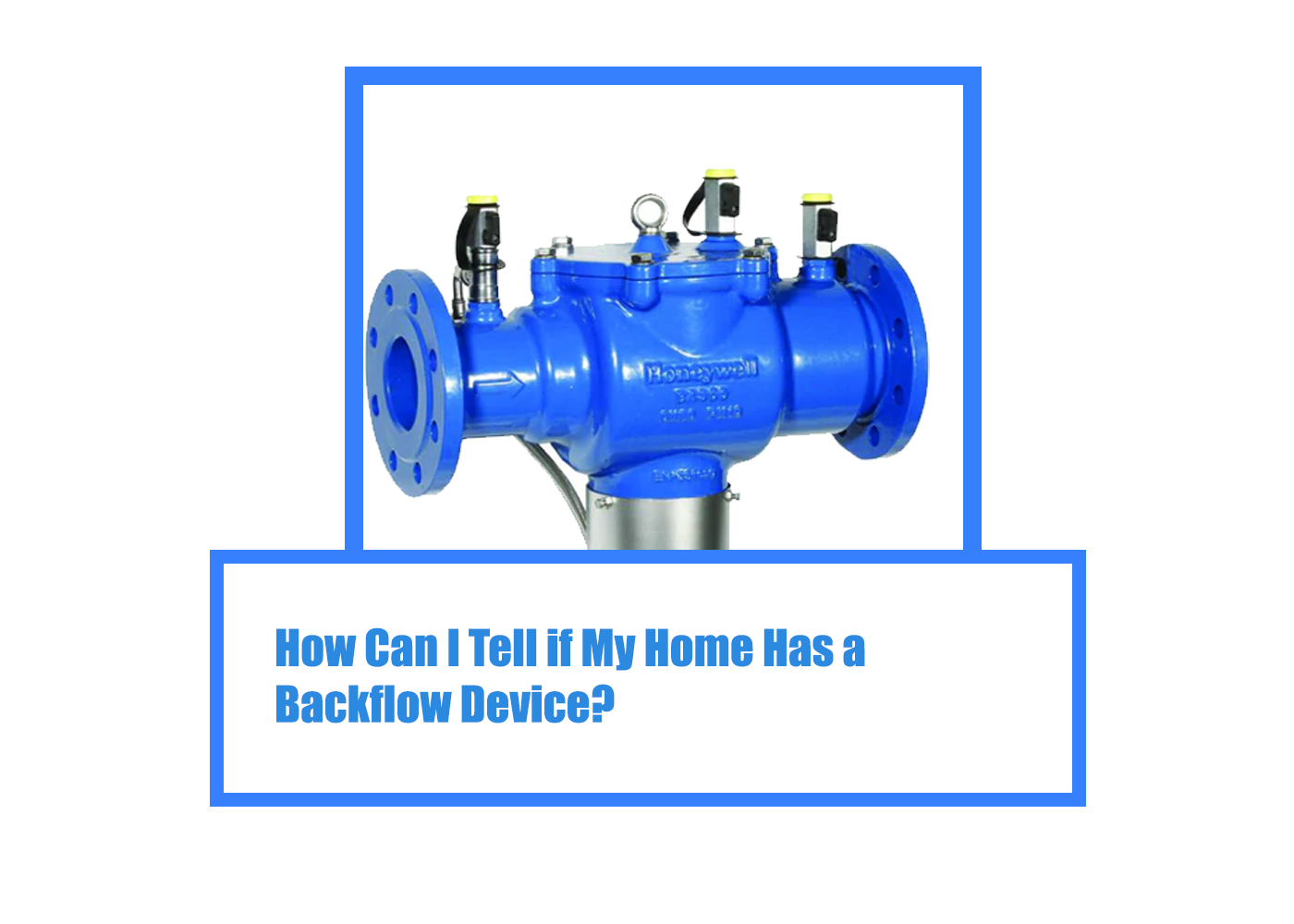
Backflow preventers have distinctive physical characteristics that distinguish them from ordinary pipe fittings and shutoff valves. Here are the key identifying features:
Test cocks (test ports): These are small threaded ports (typically four of them on an RPZ or DCVA) with screw caps, positioned at specific points on the assembly body. They allow a certified technician to connect test equipment for the annual certification test.
Relief valve discharge port: RPZ assemblies have a prominent port on the bottom or side of the body, often with a small screened drain or discharge tube. This is the relief valve, which opens to discharge water to atmosphere if the internal pressure differential indicates a check valve failure.
Two shutoff valves (gate valves or ball valves): Most testable backflow preventers have a shutoff valve on the inlet (upstream) and outlet (downstream) side of the assembly, allowing the device to be isolated for testing or servicing without shutting off the entire water supply to the building.
Manufacturer markings: Backflow preventers are typically marked with the manufacturer’s name and model number, the size (in inches), and may include a flow arrow indicating the correct installation orientation. Common brands you might see include Watts, Febco, Zurn Wilkins, Ames, Apollo, and Conbraco.
Body shape and material: Most backflow preventers are made of bronze, brass, or stainless steel. The body is typically cylindrical or roughly rectangular, and noticeably more complex than a simple pipe elbow or shutoff valve.
Step 4: Check Your Water Bill for Clues
If you’re having difficulty locating a physical device, your water bill may offer circumstantial evidence. An unusually high water usage figure — particularly if it seems inconsistent with your actual usage — can sometimes indicate that a backflow event has occurred and water has been lost through a relief valve discharge. While this isn’t definitive proof of a backflow device’s presence, it’s a signal worth investigating.
More directly, some water utilities include backflow compliance information on your water account or in your online utility portal. Check your account details or contact your water utility’s cross-connection control program to ask whether a device is registered to your service address.
Step 5: Inspect Your Sump Pump Area (for Older New Jersey Homes)
In some older New Jersey homes, particularly those with combined drainage systems or basement water management infrastructure, a backflow prevention valve may be installed on the sump pump discharge line or the foundation drain connection. These are often different from the standard irrigation-type backflow preventers and may not require annual certified testing — but they serve a similar purpose of preventing sewage or drainage water from flowing backward into the basement.
If you have a finished basement or a below-grade living space, having a licensed professional inspect your sump pump and foundation drain connections for backflow protection is a sound preventive measure, particularly in older homes built before modern cross-connection control codes were widely enforced.
Step 6: Check Your Service Connection Type
If your property is served by a separate service line (common in townhouse communities, older neighborhoods, or properties with shared water infrastructure), it’s important to understand how the main water line connects to your unit. Look at the service line connection at the street or at the property boundary.
If the service connection features an L-shaped fitting at the reservoir or main, with no inspection valve or check valve visible, there may be no backflow protection installed at the service level. This is particularly common in older communities developed before backflow protection was required by code. In this case, a property-level backflow preventer is even more critical.
If an inspection valve is present in the service line, that’s a positive sign, though it doesn’t substitute for a properly certified backflow prevention device.
Step 7: Schedule a Professional Assessment
If you’ve worked through these steps and still can’t determine with confidence whether your property has a backflow device, or if you’ve found one but aren’t sure whether it’s the right type or currently in compliance, the simplest and most reliable next step is to schedule a professional inspection with a certified backflow specialist. Our team at South Jersey Backflow serves properties throughout New Jersey and can quickly assess your cross-connection situation, identify any existing devices, and determine whether your property is in compliance with New Jersey’s backflow prevention requirements.
What If Your Property Doesn't Have a Required Backflow Device?
If your property requires a backflow preventer and doesn’t have one — or has one that’s non-functional, uncertified, or the wrong type — you’ll need to get into compliance promptly. The process involves selecting the appropriate device for your specific cross-connection hazard level (our guide to backflow preventer types can help), having it professionally installed and certified, and submitting the required test reports to your water authority.
The cost of backflow preventer installation and certification in New Jersey is reasonable and far less expensive than the fines and liabilities that come with non-compliance. Our team will handle the entire process from device selection through certification and paperwork filing.
What If You Have a Device That Hasn't Been Tested?
If you’ve found a device on your property but don’t have records of a recent annual test, you’re out of compliance. You need to schedule your annual backflow certification test immediately. The test itself is quick (typically 20 to 45 minutes), and if the device passes, you’ll receive a certification report that satisfies your water authority’s compliance requirement. If it fails, we’ll provide an immediate assessment of the repair or replacement options and can often complete the repair the same day.
Ready to Schedule Your Backflow Service in New Jersey?
South Jersey Backflow has served residential and commercial customers across New Jersey since 2004. Our certified technicians handle backflow preventer testing, repairs and rebuilds, and protective enclosures — all with transparent pricing and 24/7 emergency availability. Contact us today or call (856) 291-6809 to get started.