
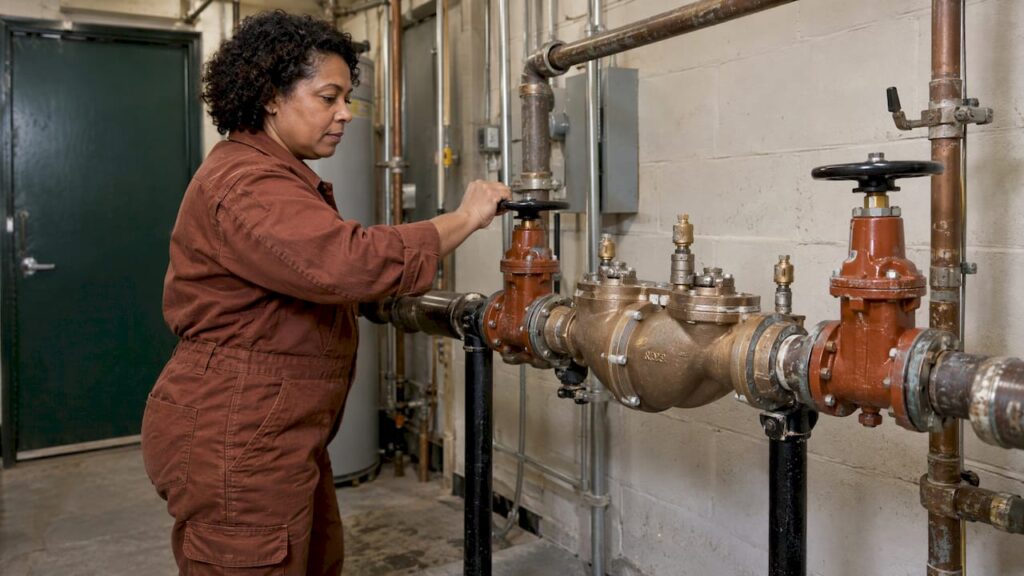
A backflow repair in New Jersey usually means a short, planned interruption of water at one property, not a long outage. A test is typically a matter of minutes and a repair or rebuild a bit longer. If your device is leaking right now, close the valve on the supply side of the device and call a licensed backflow professional. We test, repair and rebuild backflow preventers across New Jersey, so a call to South Jersey Backflow puts the whole job, including paperwork, in one place.
This guide is for New Jersey property owners and for property managers who handle buildings in the state. It covers what the shutdown involves, what to do in an emergency, what to plan for before a visit and what happens when the water comes back on.
TL;DR
- Annual testing causes only a brief interruption. One New Jersey-area utility, for example, describes about five minutes for annual testing and about 20 minutes for repairs at a home. Your device and plumbing layout set the real number.
- If a device is leaking, shut the valve before the device, protect it from freezing and call a licensed professional the same day.
- Never shut the main valve unless you must: it cuts water to the whole building.
- In New Jersey, testing must be done by a certified individual recognized by NJDEP, and repair work falls under plumbing licensing rules.
- Property managers should schedule shutdowns by building, notify tenants and make sure the test report is filed with the water authority.
Table of Contents
- Why water has to be shut off at all
- Which water goes off depends on where the device sits
- What to do when a device leaks or fails
- Does testing need the same shutdown as a repair?
- What New Jersey requires
- Planning the shutdown as a homeowner
- Planning for property managers
- What it costs
- Book the shutdown with the people who do the fix
- Our view on shutdowns
- FAQ
- Sources
Why water has to be shut off at all
A backflow preventer is a valve assembly that stops water from flowing backward from your irrigation, boiler, fire line or pool fill into the public supply. To test it, a technician has to stop the flow through the device and measure how its internal check valves and relief valve respond. To repair it, the assembly has to be opened. Neither can be done with water running through it.
That is why every test and repair involves a shutdown. The difference lies in how long and how far it reaches.
| Job | Typical water interruption | What it affects |
|---|---|---|
| Annual test | Short, often a few minutes | Only the line the device protects, or the building if the device sits on the main |
| Repair or rebuild | Longer, often around 20 minutes or more | Same line, until the device is reassembled and retested |
| New installation | Longest of the three | The line being modified |
The durations above follow the example of a utility that publishes its own figures: roughly five minutes for annual testing, and roughly 20 minutes for installation or further repairs and testing at a residence. Larger commercial assemblies take longer. Ask for the expected window when you book.
Which water goes off depends on where the device sits
Most homeowners search this keyword worried that the whole house will lose water. Often it will not.
Irrigation devices. A device on a lawn sprinkler line is usually downstream of the house supply. The shutoff valves on that device, or a dedicated irrigation shutoff, can isolate the sprinklers while the kitchen and bathrooms keep running.
Devices on the main or a domestic line. A device protecting a boiler, a pool fill or the whole building supply may sit on a line that feeds fixtures. The interruption then reaches those fixtures.
Fire sprinkler and commercial assemblies. Larger assemblies in commercial and multi-unit buildings can involve a fire protection system, which brings extra coordination. Warn the building and any monitoring company before the visit.
Tell us where your device is when you call. It shapes how we plan the visit and how long the shutdown lasts.

What to do when a device leaks or fails
A leaking backflow preventer is not always an emergency, but it should be handled quickly. Water spraying from the relief valve can mean the device is protecting your supply or that a part has worn out. Either way it needs service.
Official guidance from water departments elsewhere in the country is consistent on the first moves:
- Turn off the valve before the device. The City of Ocala, Florida advises closing the valve located ahead of a leaking device first. That stops the flow without touching the main.
- Protect the device from cold. The same notice says to wrap an exposed device against freezing and not to wrap a leaking one in wet materials, which raises the risk of freezing and damage.
- Call for service. Collier County, Florida’s water department tells residents that water leaking from the device pipe may mean backflow is occurring or the device needs service, and to call right away.
Those are Florida utilities, but the sequence applies the same way to a New Jersey property: isolate, protect, call. If you cannot find the valve ahead of the device, or the leak is heavy, shutting the main valve is the right call. A flooded basement costs far more than an hour without water.
How to tell which valve to close
Backflow assemblies have two shutoff valves, one on the inlet and one on the outlet side, plus small test cocks. Closing the inlet valve stops water entering the device. Leave the test cocks and the relief valve alone. They are part of how the device is tested, and opening them without knowing the device can make a leak worse.
If you are unsure which valve is which, do not guess on a pressurized line. Close the main and call us.
Does testing need the same shutdown as a repair?
No. Testing is the shorter job. The technician isolates the device, attaches a test kit and reads how the check valves and the relief valve perform. The utility cited above puts annual testing at about five minutes without water for residential customers and repairs or further testing at about 20 minutes.
If the test fails, the device needs repair or a rebuild. That is when the shutdown stretches. With the right parts on the truck, the repair can happen in the same visit, which keeps the outage to a single window instead of two. We stock OEM parts for same-visit repairs and rebuilds, so many jobs finish without a second shutdown.
Once the repair is done, the device has to be retested before it counts as compliant. Water is restored when the device is back in service and passing.
What New Jersey requires
Two rules shape how you schedule a shutdown.
Annual testing. Under the state plumbing subcode, backflow preventers designed for field testing that isolate a cross-connection between drinking water and a contaminant must be tested annually. The Department of Community Affairs bulletin notes that one- and two-family dwellings are exempt from that annual requirement under the subcode, though your local water supplier can set its own terms, so check your notice.
Who may do the work. The same bulletin says testing must be done by a qualified individual certified by an agency recognized by NJDEP’s Bureau of Safe Drinking Water. On the plumbing side, state rules say plumbing work must be done by a master plumber, an authorized plumbing contractor or a supervised employee, and note that backflow testing may also be done by individuals certified under N.J.A.C. 7:10-10.8.
There is also a rule for internal inspection of certain devices. For double check valve and reduced pressure zone assemblies on physical connections, the state code calls for an internal inspection within six months before a permit renewal application. Those assemblies are opened and the check parts examined, then the device is tested for tightness after reassembly. That is a planned shutdown you can schedule in advance.
Local rules differ. If you own in Jersey City, Newark or Trenton, we have written up the specifics: Jersey City backflow requirements, Newark testing requirements and Trenton testing requirements. If a repair means replacing or moving the device, see what to file in our guide to the backflow replacement permit in NJ.
Planning the shutdown as a homeowner
A planned visit is easy on your household. Before the technician arrives:
- Know where the device is. Typically it sits near the water meter, on the irrigation line or beside the boiler. Clear the area, including shrubs and stored items.
- Run what you need first. Fill a pitcher, finish laundry or the dishwasher, and avoid showers during the window.
- Tell everyone in the house. Someone flushing a toilet partway through is the most common surprise.
- Plan around a freeze. In winter, a device in an unheated space or outdoor enclosure is at risk. If yours is exposed, ask about a protective enclosure, since a frozen device is a common reason for a leak call.
After the visit, run a faucet briefly to clear air from the lines. Sputtering for a moment is normal. If water does not come back, or pressure is weak, call us the same day instead of adjusting valves yourself.
What to do if the device keeps discharging after repair
A relief valve that keeps dripping after water is restored means the device is not holding. Close the valve before the device, and call us so the device can be inspected again and retested. Banging pipes after the water returns are a separate issue; our page on water hammer after backflow explains the causes and fixes.
Planning for property managers
For a manager, the shutdown is a scheduling and communication task more than a plumbing one. A single missed notice can turn a ten-minute outage into a set of tenant complaints.
- List every device. Count them by building and by type: irrigation, domestic, fire line, boiler. Commercial devices are priced per device, so the count drives the budget. Our backflow testing budget guide for property managers walks through it.
- Group by building and day. Testing all devices in one building in one visit keeps the outage to one notice.
- Notify tenants in writing. Give the window, the affected fixtures and a contact number. Mention that the water will return on its own and that air may sputter from taps.
- Coordinate fire systems. If a fire line is involved, notify the monitoring company and the building’s responsible person before the shutdown.
- Confirm the filing. A passed test is only useful once the report reaches the water authority. Read our checklist on confirming backflow compliance filing for property managers.
- Check after a building shutdown. If a building has been vacant or closed, devices should be checked before water is restored to occupants; see backflow testing after a building shutdown.
A flood zone raises the stakes further. Where a property sits in one, protecting the device is part of the plan, and so is knowing how to keep sewage out.
What it costs
The shutdown itself carries no separate fee. You pay for the service performed. Our published ranges, listed on our FAQ page:
| Service | Published price |
|---|---|
| Annual residential certification test | $150 to $250 |
| Commercial device testing | $200 to $450 per device |
| Rebuild kit service (residential) | $125 to $250 |
| Protective enclosure installation | $200 to $500 |
| Residential installation | $300 to $800 |
Repairs and rebuilds beyond the rebuild kit service have no published price because the parts depend on the device. See our page on installing, testing and rebuilding costs for how it is laid out.
Book the shutdown with the people who do the fix
If your device has failed a test, is leaking or is due for its yearly certification, we can handle the whole thing: testing and certification, repair or rebuild, enclosure installation and the filing of your test report with the water authority. We offer emergency service and same-day service, we are family-owned, licensed and insured, and we cover New Jersey statewide. You can start with our testing and certification page or reach us through the contact page.

Managers with several properties can ask about consolidated billing across sites.
Our view on shutdowns
Most owners treat the shutdown as the scary part of backflow work. In our experience of how the job is built, the long outage comes from a second trip, not from the repair itself.
That is why we stock OEM parts and aim to repair or rebuild in the same visit. One window, one notice to tenants, one retest.
We also think the paperwork belongs in the same job. A repaired device that never reaches the water authority is still a compliance problem, so we file the test report directly for you.
If a device is leaking, close the valve ahead of it and call us. We would rather hear about a drip today than a failed device next month.
Jordan
FAQ
Does backflow testing require the water to be shut off?
Yes, briefly. The technician has to stop flow through the device to test it. One utility describes about five minutes for a residential annual test. Whether the whole building loses water depends on where the device is installed.
How do I shut off water to a leaking backflow preventer?
Close the valve located before the device, which stops flow into it, as one city water department advises. If you cannot find it or the leak is heavy, close the main valve and call a licensed backflow professional.
How long will water be off for a backflow repair?
Often around 20 minutes for a residential repair, per the same utility’s published figures, longer for larger commercial assemblies. A repair done in the same visit as the test avoids a second outage.
Can the water authority shut my water off for a missed test?
Local water suppliers enforce backflow rules and can set their own consequences. Check the notice from your utility for its deadline, and have the device tested and the report filed before it passes.
Sources
- Backflow | OUC
- Public Notice, City of Ocala
- Meters and Backflows, Collier County, FL
- Bulletin 99-2, New Jersey Department of Community Affairs
- N.J.A.C. 13:32-1.4, Scope of practice
- N.J.A.C. 7:10-10.6, Inspection and testing requirements