
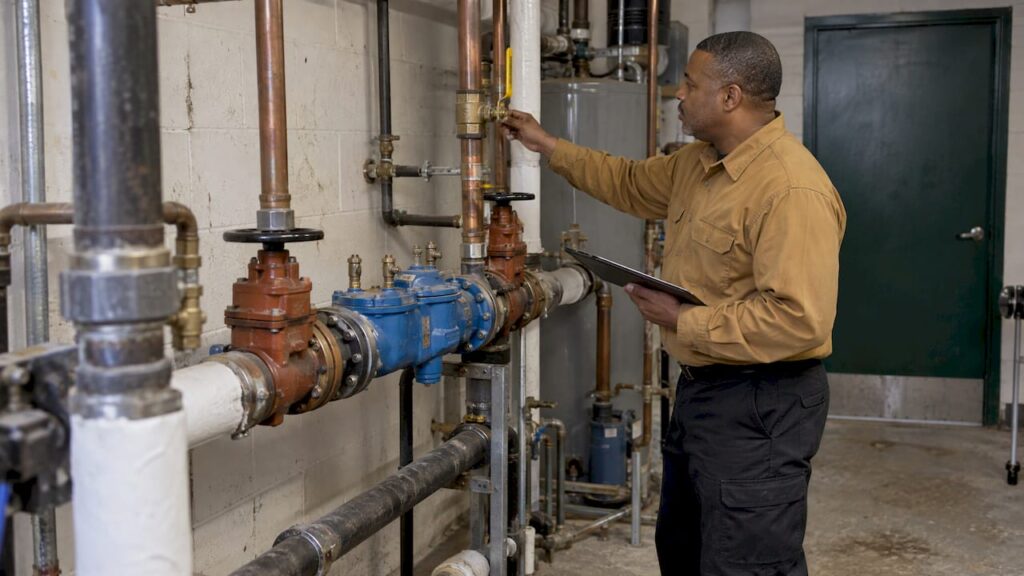
A cross-connection survey and a backflow test are two different jobs, and neither replaces the other. The survey looks over your whole plumbing system to find where contaminated water could reach the drinking supply and what protection each spot needs. The backflow test checks that a device already installed is working. In New Jersey, the survey decides which device you need and the test shows it still works.
TL;DR
- A survey finds hazards across the property and determines the type of backflow assembly required. A test checks one installed, testable assembly.
- A clean survey does not satisfy a test requirement, and a passed test does not tell you whether you are missing protection somewhere else.
- In New Jersey, a failed device must be repaired and retested within 30 days under N.J.A.C. 7:10-10.6. Replacing one takes a construction permit.
- Your water utility may ask for a survey, a test report, or both. Missed requests can end in disconnection.
- We test, certify, repair and rebuild devices across New Jersey and file the reports for you.
Table of Contents
- What a cross-connection is, and why both checks exist
- What a cross-connection survey does
- What a backflow test does
- Side by side
- Can one replace the other?
- Who does each job, and how often in New Jersey
- What to do after each result
- Property managers: building a simple compliance routine
- Local requirements differ by city and utility
- What the testing side costs with us
- Book the test, let us handle the filing
- FAQ
- Sources
What a cross-connection is, and why both checks exist
A cross-connection is an actual or potential link between the drinking water supply and plumbing that carries water that is not potable. EPA describes backflow through such a link as a potentially serious public-health hazard. Untreated water that gets in through an unprotected connection can cause serious chemical or microbiological contamination.
Backflow happens in two ways, according to EPA’s cross-connection issue paper:
- Backsiphonage: pressure in the distribution system drops and water is pulled backward.
- Backpressure: pressure in the connected non-potable system rises above the potable pressure and pushes water the wrong way.
Two questions follow from that. Where are the connections, and what protects each one? That is the survey. Is the protection working today? That is the test.
What a cross-connection survey does
A survey is an inspection and a risk assessment. A surveyor walks the property, or reviews a detailed questionnaire, to identify every point where the potable system touches something it should not, then records the level of hazard and the protection that fits.
New Jersey American Water gives a good picture of the scope. Its commercial water usage survey form asks about facility type, water use, auxiliary water systems, irrigation, fire systems and industrial processes. The answers help determine which backflow assembly a property needs.
Typical places a survey looks at:
- Lawn irrigation systems tied to the domestic supply
- Fire sprinkler and standpipe systems
- Boilers, chillers and cooling towers
- Auxiliary water sources such as wells or cisterns
- Commercial kitchens, car washes, laundries and process equipment
- Hose connections, fill lines and any bypass
The NJDEP definition of a physical connection is broad. Its guidance covers a cross-connection, bypass, valve, pipeline, auxiliary intake or device that permits, or may permit, water from an unapproved supply to enter an approved public potable supply. A survey is how you find those items before they cause trouble.
The output is a report: the hazards found, their ranking, and what to install or change. A survey may well conclude that a property needs no new device. It may also find a missing one, an incorrect type, or a connection to eliminate.
What a backflow test does
A backflow test is a hands-on check of one assembly that is already installed. It evaluates whether the assembly operates correctly under pressure conditions. New Jersey’s rule sets out procedures for reduced-pressure-zone and double-check assemblies, including check-valve tightness and differential pressure (N.J.A.C. 7:10-10.6).
In practice, the tester connects gauges to the assembly’s test cocks, runs the sequence for that device type and records the results. If the device passes, you get a certification with the device identified, its location, the test date, the result and the tester’s qualifications and signature. If it fails, it needs repair, usually new internal parts, or replacement.
The test says nothing about connections elsewhere on your property. A device can test perfectly and still be the wrong type for the hazard, or one hazard can have no device at all.
Side by side
| Cross-connection survey | Backflow test | |
|---|---|---|
| Question answered | Where are the hazards and what protection does each need? | Does this installed device work? |
| Scope | Whole property or building water system | One testable assembly at a time |
| Done by | A surveyor, or the owner filling out a utility questionnaire | A certified tester |
| Output | Hazard list and required assemblies | Pass or fail result and a test report |
| Timing | At setup, after changes, or when the utility requests it | Before final inspection and on a recurring schedule |
| If problems are found | Install, change or eliminate connections | Repair and retest, or replace |
Can one replace the other?
No. They sit at different points in the same process. The survey comes first because it decides what has to be protected and how. The test comes after installation and then repeats, because mechanical parts wear, debris lodges in check valves and pressures change.
Two examples show the gap:
- A restaurant passes its annual RPZ test. Months later it adds a chemical-fed dishwasher line and a new hose station. The old test report says nothing about either. A fresh survey would catch both.
- A property manager receives a utility survey form, returns it, and is told a double check assembly is required on the irrigation line. The survey did not protect anything. Until the device is installed, certified and tested, the hazard remains.
Who does each job, and how often in New Jersey
The rules for testing are clearer than the rules for surveys, which depend heavily on your water supplier.
Testing. N.J.A.C. 7:10-10.6 allows testing by a certified tester, or by an authorized owner representative in the presence of the administrative authority or water supplier. Permitted physical connections need tightness tests at least every three months. A failed installation must be repaired and retested within 30 days. If repair is not possible, the owner needs NJDEP approval for a new device.
Building code side. DCA Bulletin 99-2 says field-testable backflow preventers protecting connections between the potable supply and contaminants must be tested before final inspection and annually. Testable devices at one- and two-family dwellings are not required to be tested annually under that bulletin. Your local utility or municipality can still set its own expectations, so confirm with them.
The same bulletin explains that inspectors do not perform the test. They make sure the owner has a qualified person do it, either by witnessing it or by receiving a certification with the device, location, test date, result and the tester’s qualifications and signature. Keep that paperwork.
Surveys. New Jersey American Water, for example, runs a cross-connection program under which customers are responsible for installing and maintaining required equipment and keeping devices operable and tested. The utility can follow up repeatedly, and failure to comply may lead to water-service disconnection. If you get a survey form or letter from your supplier, answer it by the stated deadline. Our guide to water shutoff for a missed backflow test explains how that escalation goes.

What to do after each result
If the survey finds a hazard
The survey report tells you what assembly type each hazard calls for. Installing or replacing a backflow preventer needs a construction permit in New Jersey, as DCA’s model owner reminder states. Our page on the backflow replacement permit in NJ walks through what to file. Once the device is in, it needs its first certification test.
If a test fails
A failed device must be repaired or replaced, per the same DCA reminder, and in the regulation the clock is 30 days to repair and retest. Most failures come down to worn internal parts such as check valve seats, springs and seals, which a rebuild often resolves. Rebuild or replace, then retest, then file the new report.
If your device is outdoors
Exposed assemblies face freezing, vandalism and flooding. If your test history shows repeated freeze damage, look at a protective enclosure, and read the NJ backflow enclosure requirements first. If you are in a flood-prone area, see backflow in a New Jersey flood zone.
Property managers: building a simple compliance routine
If you run several properties, treat the two checks as separate lines in your calendar.
- Inventory. List every property, its water supplier and every device with location and type.
- Survey triggers. Re-check hazards when a tenant changes, when irrigation or fire systems are added or when equipment is installed. Answer any utility survey request promptly.
- Annual tests. Schedule tests for all testable devices on the supplier’s or municipality’s timeline.
- Filing. Confirm the report was actually filed with the water authority, not only handed to you.
- Failures. Track the 30-day repair and retest window.
- Shutdowns. After a building has been vacant or shut down, plan a test before reopening. See our guide to backflow testing after a building shutdown.
Our property manager compliance page explains how we confirm filing for multi-property portfolios, and consolidated billing is available.
Local requirements differ by city and utility
Who asks for what depends on where the property sits. If you are in a larger city, start with the local page: Newark, Jersey City, Camden or Trenton. Passaic County owners can start with our Passaic County service page.
What the testing side costs with us
The survey scope varies with the property, so we do not quote it here. For the device work we do, the published ranges on our FAQ are:
| Service | Published range |
|---|---|
| Annual residential certification test | $150–$250 |
| Commercial device testing | $200–$450 per device |
| Rebuild kit service (residential) | $125–$250 |
| Protective enclosure installation | $200–$500 |
| Residential installation | $300–$800 |
Rebuild and repair pricing for other cases is not published, so contact us for a quote. More on how these jobs are priced is on our installing, testing and rebuilding costs page.
Perspective
We see the same mix-up every season. An owner gets a letter from the water utility, assumes the annual test covers everything, and later learns a new irrigation line or a changed process was never reviewed. The survey and the test are partners. One tells you what must be protected, the other proves the protection is working.
Our approach is to keep the device side simple. We are family-owned, licensed and insured, and we stock OEM parts so that in many cases a failed device can be rebuilt on the same visit instead of waiting on a second trip. We file the test report directly with the water authority, so the paperwork is not left sitting in your glovebox or inbox. For a property manager with a dozen devices, that means one team, one schedule and one invoice.
If a survey tells you that you need a device, or a test tells you that you need a rebuild, that is the system doing its job. Fix it promptly, keep the certification and move on.
Jordan
Book the test, let us handle the filing
Whether your survey has just called for a new assembly or your annual test is due, we can test, certify, rebuild or install it and file the report for you. We offer same-day service and emergency calls across New Jersey for residential, commercial and multi-unit properties.
See our backflow preventer testing and certification page or contact us to schedule.
FAQ
Is a cross-connection survey the same as a backflow test?
No. A survey inspects the property to find hazards and decide what protection is needed. A backflow test checks that one installed assembly works properly. You may need both.
Do I need a survey if my backflow device passed its test?
A passed test only confirms that the device works. It does not review the rest of the property. If you have added irrigation, fire lines, equipment or a new use, or your utility sends a survey request, answer it separately from the test.
Who can perform a backflow test in New Jersey?
Under N.J.A.C. 7:10-10.6, a certified tester can, or an authorized owner representative can in the presence of the administrative authority or water supplier. Inspectors do not run the test themselves, according to DCA Bulletin 99-2.
What happens if my device fails?
It must be repaired or replaced, and the regulation gives owners 30 days to repair and retest. If repair is not possible, you need NJDEP approval for a new device, and replacement requires a construction permit.
What does a backflow test cost?
Our published range is $150–$250 for an annual residential certification test and $200–$450 per device for commercial testing. Final pricing depends on the device and site.
Sources
- EPA: Distribution System Water Quality, Cross-Connection Control fact sheet
- EPA: Potential Contamination Due to Cross-Connections and Backflow
- New Jersey American Water: Water Usage Survey Form
- N.J.A.C. 7:10-10.6, Inspection and testing
- NJDEP: Physical Connection Permit guidance
- NJ DCA Bulletin 99-2
- NJ DCA model owner reminder, backflow preventers
- New Jersey American Water: Cross Connection and Backflow Prevention